

Choosing the right farming equipment can easily make or break a harvest, and with over 10 to 15 percent of a farmer’s yearly budget often going straight to machinery and maintenance, every purchase feels high stakes. Most people fixate on the latest tractor models or fancy attachments. The truth is, the smartest investments start long before you even step foot on a sales lot.
Table of Contents
- Step 1: Evaluate Your Farming Needs And Budget
- Step 2: Research Types Of Farming Equipment Available
- Step 3: Compare Equipment Brands And Models
- Step 4: Inspect Equipment Quality And Specifications
- Step 5: Negotiate Prices And Financing Options
- Step 6: Finalize Purchase And Arrange For Delivery
Quick Summary
| Key Point | Explanation |
|---|---|
| 1. Assess Your Farming Needs | Understand your operational landscape, crop types, and terrain to determine appropriate equipment. |
| 2. Establish a Realistic Budget | Create a budget including purchase, maintenance, and operational fuel costs for effective financial planning. |
| 3. Research Equipment Thoroughly | Categorize equipment based on function and assess compatibility with specific farming tasks before purchasing. |
| 4. Compare Brands and Models | Analyze performance, reputation, warranties, and customer support to ensure reliable equipment acquisition. |
| 5. Finalize Documents and Delivery | Ensure all agreements and logistics are confirmed for a seamless transition after making a purchase. |
Step 1: Evaluate Your Farming Needs and Budget
Successful farming equipment purchasing starts with a strategic and comprehensive assessment of your specific agricultural requirements and financial limitations. Before investing thousands of dollars in machinery, farmers must develop a thorough understanding of their operational landscape, crop specifications, and economic constraints.
Begin by conducting a detailed inventory of your current farming operation. Examine your land size, primary crop types, terrain characteristics, and seasonal cultivation patterns. These factors will significantly influence the type and scale of equipment you require. For instance, a small vegetable farm will have drastically different machinery needs compared to a large grain production operation.
Financial planning represents another critical component of this initial evaluation. Create a comprehensive budget that includes not just the purchase price of equipment, but also ongoing maintenance costs, potential repair expenses, and operational fuel consumption. According to University of Wisconsin Extension, farmers should allocate approximately 10 to 15 percent of their annual operational budget for equipment investments and maintenance.
Consider these essential budgeting strategies for farming equipment acquisition:
- Determine your maximum equipment investment threshold
- Research financing options like agricultural equipment loans
- Factor in potential tax deductions for equipment purchases
- Calculate the expected return on investment for each piece of machinery
Additionally, explore alternative procurement methods that can help manage costs. Used equipment, equipment sharing cooperatives, or rental options might provide more financially flexible solutions for farmers with limited capital. By thoroughly assessing your specific needs and creating a realistic budget, you establish a solid foundation for making informed and strategic equipment purchasing decisions that will support your farm’s long term success.
The following table summarizes essential budgeting strategies mentioned throughout the guide, helping you efficiently plan your financial approach to farm equipment purchasing.
| Budgeting Strategy | Purpose/Consideration |
|---|---|
| Determine maximum equipment investment | Establish financial limits to avoid overspending |
| Research financing options | Explore agricultural loans, lease, and flexible payment alternatives |
| Factor in potential tax deductions | Leverage equipment purchases for possible tax savings |
| Calculate expected ROI | Assess investment value based on productivity and long-term benefits |
| Consider used, shared, or rental equipment | Reduce upfront costs with alternative procurement methods |
Step 2: Research Types of Farming Equipment Available
Diving into the world of farming equipment requires a systematic and comprehensive approach to understanding the diverse machinery options available for modern agricultural operations. Your research phase will help you identify the specific tools and machines that align perfectly with your farming needs and operational requirements.
Start by categorizing equipment based on fundamental agricultural functions. Tractors, the backbone of most farming operations, come in various sizes and configurations. Compact utility tractors work well for smaller farms, while larger row crop or utility tractors suit extensive agricultural enterprises. Pay close attention to horsepower ratings, transmission types, and hydraulic capabilities that match your specific field work demands.
Beyond tractors, explore specialized equipment categories that address specific agricultural tasks. Tillage equipment like plows, harrows, and cultivators prepare soil for planting. Seeding and planting machinery ranges from simple manual seeders to complex precision planters with GPS guidance systems. Harvesting equipment varies dramatically depending on your crops, from combine harvesters for grain production to specialized fruit and vegetable harvesting machines.
According to ATTRA Sustainable Agriculture, farmers should prioritize equipment that matches their scale of production and minimizes unnecessary complexity. Consider these key research strategies:
- Visit agricultural equipment trade shows
- Consult local agricultural extension offices
- Review equipment manufacturer catalogs and websites
- Talk with experienced farmers in your region
Remember that equipment research is not just about identifying machines but understanding their practical application. Attend demonstrations, request equipment trials when possible, and thoroughly evaluate how each piece of machinery integrates with your specific farming workflow. By methodically exploring available equipment options, you’ll develop a nuanced understanding that supports intelligent, strategic purchasing decisions for your agricultural operation.
Step 3: Compare Equipment Brands and Models
Comparing equipment brands and models represents a critical phase in your farming equipment purchasing journey, requiring meticulous research and strategic evaluation. This step goes beyond simple price comparisons, demanding a comprehensive analysis of performance, reliability, and long term operational value.
Manufacturer reputation plays a pivotal role in your comparison process. Established agricultural equipment manufacturers with proven track records provide more reliable machinery and typically offer superior customer support. Research each brand’s history of innovation, customer satisfaction ratings, and industry recognition. Some manufacturers have specialized expertise in specific types of agricultural equipment, making them more suitable for particular farming operations.
Performance specifications demand careful scrutiny. Examine technical details such as horsepower ratings, fuel efficiency, maintenance requirements, and compatibility with existing farm infrastructure. Warranty coverage becomes another crucial consideration, with comprehensive warranties indicating manufacturer confidence in their equipment’s durability. Pay close attention to warranty terms, including duration, what components are covered, and potential maintenance requirements to keep the warranty valid.
According to University of Wisconsin Extension, farmers should thoroughly investigate potential equipment purchases with these strategic approaches:
- Request detailed performance documentation
- Check parts availability and maintenance support
- Compare total cost of ownership, not just initial purchase price
- Verify dealer proximity and service capabilities
Additionally, leverage multiple information sources during your comparison. Agricultural equipment trade publications, online forums, local farming cooperative recommendations, and direct conversations with equipment dealers can provide nuanced insights that standard marketing materials might not reveal. By systematically comparing brands and models across multiple dimensions, you’ll develop a comprehensive understanding that supports an informed, strategic equipment purchasing decision tailored precisely to your farming operation’s unique requirements.
Step 4: Inspect Equipment Quality and Specifications
Inspecting equipment quality represents a critical checkpoint in your farming machinery purchasing process, demanding meticulous attention to detail and a systematic approach to evaluation. This step transforms your research into practical assessment, ensuring the equipment you are considering meets both your operational requirements and safety standards.
Begin with a comprehensive visual inspection that goes beyond surface appearances. Structural integrity matters immensely in farm equipment. Look for signs of excessive wear, structural damage, rust, or previous repairs that might compromise the machine’s reliability. Examine welds, frame conditions, and critical connection points carefully. Pay special attention to areas that experience significant stress during agricultural operations.
Mechanical functionality requires equally thorough examination. Start the equipment and observe its performance under various operational conditions. Listen for unusual sounds, check for smooth power transmission, and monitor how different systems interact. Fluid levels, including hydraulic fluid, engine oil, and coolant, provide critical insights into the equipment’s maintenance history. Dark, contaminated fluids might indicate neglect or potential internal mechanical issues.
According to University of Wisconsin Extension, farmers should verify these essential specifications during equipment inspection:
- Confirm precise horsepower and performance ratings
- Verify technology compatibility with existing farm systems
- Check maintenance records and service history
- Assess overall operational hours and previous usage patterns
Technology integration has become increasingly important in modern agricultural equipment. Evaluate electronic systems, GPS capabilities, and potential compatibility with precision farming technologies. Request comprehensive documentation, including original manufacturer specifications, maintenance logs, and any previous repair records. By conducting a thorough, methodical inspection, you transform your equipment purchasing from a potential risk into a strategic investment in your farming operation’s future success.
Below is a checklist table to guide you through key inspection points when evaluating farm equipment quality and specifications prior to purchase.
| Inspection Area | What to Check | Why It Matters |
|---|---|---|
| Structural Integrity | Look for wear, rust, damage, and repairs | Ensures reliability and longevity |
| Mechanical Function | Start and operate under varied conditions | Confirms smooth and safe operation |
| Fluid Condition | Check levels and look for contamination | Indicates maintenance history |
| Performance Ratings | Confirm horsepower and technology features | Matches equipment to your needs |
| Service Records | Verify maintenance logs and prior repairs | Reveals equipment care and history |
| Total Usage Hours | Assess hours used and earlier applications | Evaluates future lifespan |
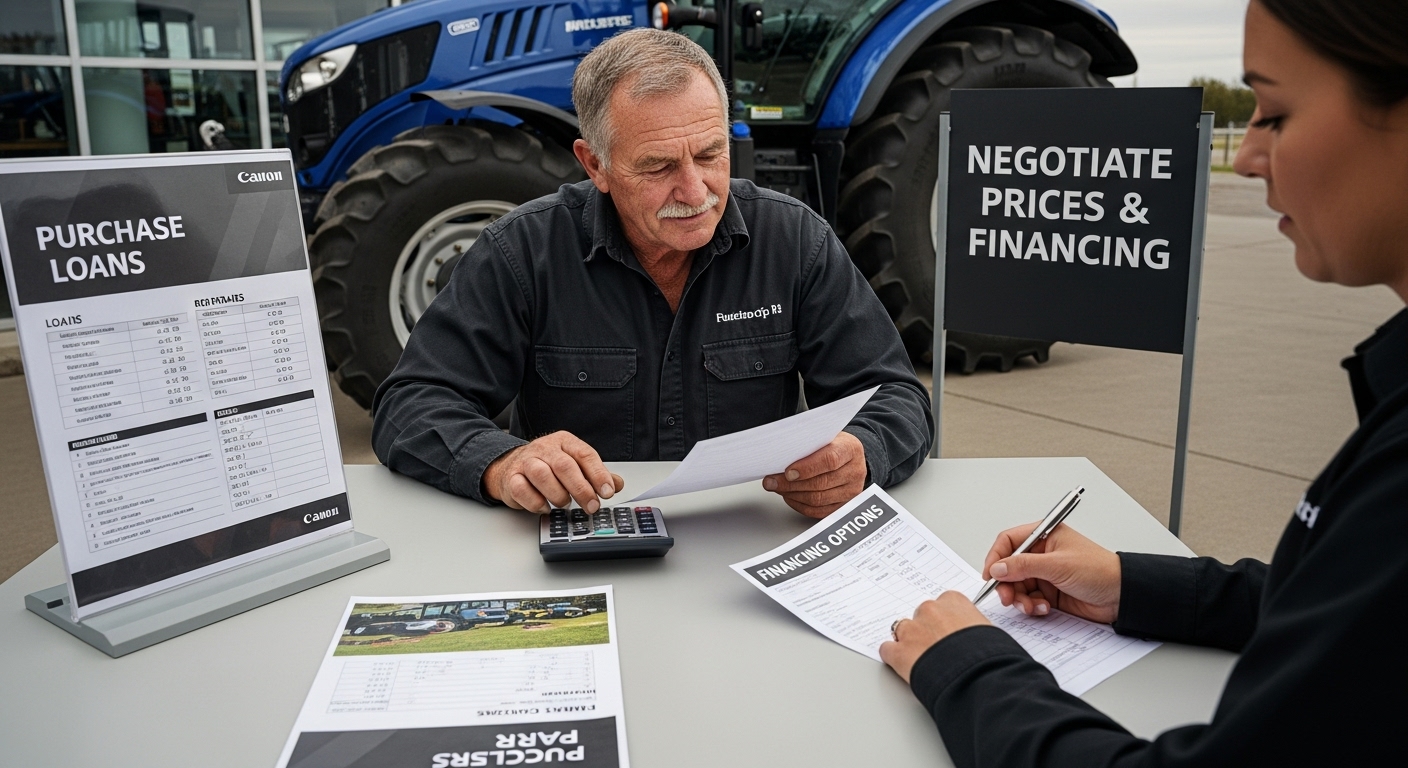
Step 5: Negotiate Prices and Financing Options
Negotiating prices and financing options represents a pivotal moment in your farming equipment acquisition strategy, where preparation meets financial acumen. This step requires a delicate balance of market knowledge, strategic communication, and financial planning to secure the most advantageous deal possible for your agricultural operation.
Price negotiation begins with comprehensive market research and a clear understanding of equipment valuation. Arrive at negotiations armed with detailed information about comparable equipment prices, current market rates, and the specific machine’s condition. Do not hesitate to discuss pricing transparently, highlighting your research and demonstrating your knowledge. Sellers are more likely to engage seriously with buyers who show genuine understanding of equipment value and market dynamics.
Financing options demand equally careful consideration. Explore multiple financial pathways, including dealer financing, agricultural equipment loans, and potential lease arrangements. Each financing method carries unique advantages and potential drawbacks. Some dealers offer attractive low interest rates, while agricultural banks might provide more flexible terms specifically tailored to farming operations. Consider your farm’s cash flow, long term financial strategy, and potential tax implications when selecting a financing approach.
According to Oklahoma State University Extension, farmers should strategically approach equipment financing with these key considerations:
- Compare total financing costs, not just monthly payments
- Evaluate potential tax deductions for equipment purchases
- Understand depreciation impacts on your farm’s financial statements
- Negotiate down payment and interest rate terms
Remember that successful negotiation is about creating a mutually beneficial agreement. Be prepared to walk away if the terms do not align with your financial goals. Maintain professional communication, demonstrate your serious intent, and show willingness to find creative solutions that satisfy both parties. By approaching price and financing negotiations with thorough preparation and strategic thinking, you position yourself to make a sound investment in your farming operation’s future.
Step 6: Finalize Purchase and Arrange for Delivery
Finalizing your farming equipment purchase represents the culmination of a strategic process, transforming careful research and negotiation into tangible agricultural capability. This critical step requires precise documentation, clear communication, and strategic planning to ensure a smooth transition of equipment ownership and delivery.
Legal documentation demands meticulous attention. Carefully review all purchase agreements, ensuring every detail matches your prior discussions and expectations. Verify the inclusion of warranties, service agreements, and any promised modifications or accessories. Request comprehensive documentation including original manufacturer certificates, maintenance records, and detailed equipment specifications. Retain multiple copies of all paperwork, creating a comprehensive record that protects your investment and provides critical reference information for future maintenance and potential resale.
Delivery logistics require equally strategic planning. Transportation arrangements should be confirmed well in advance of the equipment’s anticipated arrival. Depending on the machinery’s size and your farm’s location, you might need specialized transportation services equipped to handle heavy agricultural equipment. Confirm the delivery timeline, understand any potential additional transportation costs, and prepare your farm’s infrastructure to receive and safely store the new machinery.
According to University of Wisconsin Extension, farmers should prioritize these critical final steps:
- Confirm all financial transactions are complete
- Verify insurance coverage for new equipment
- Schedule initial equipment orientation and training
- Prepare appropriate storage and maintenance facilities
Before finalizing the purchase, request a comprehensive walkthrough of the equipment’s operational features. Understanding each function, safety mechanism, and maintenance requirement ensures you can immediately integrate the machinery into your farming operations. Take detailed notes, ask questions, and if possible, arrange for an on-site demonstration that allows you to operate the equipment under professional guidance. By approaching the final purchase and delivery with thoroughness and preparation, you transform your equipment acquisition from a transaction into a strategic investment in your agricultural success.

Unlock Smarter Farming Equipment Success With the Right Spare Parts Partner
After taking a careful look at your farming needs, comparing machinery brands, and negotiating prices as highlighted in this guide, there is one step many farmers overlook: ensuring reliable ongoing support for tractor accessories and spare parts. Even the best equipment can only perform at its peak with quick access to high-quality replacements and expert advice. Facing unexpected downtime or searching for hard-to-find parts can disrupt harvests, strain your budget, and slow your growth. You deserve a supply partner who matches your dedication to efficiency and success.
Experience the ease of shopping over 20,000 trusted agricultural products with free shipping in Greece for orders over €100. Whether you need tractor spares or want to secure the right parts before the next season, visit Pexlivanidis and explore our robust product listings. Join as a retail or wholesale B2B customer, submit a product inquiry, or register now to guarantee your peace of mind. Make your equipment investment last. Take control today with a partner who supports your farm every step of the way.
Frequently Asked Questions
What should I consider when evaluating my farming needs for equipment?
Before purchasing equipment, evaluate your land size, crop types, terrain characteristics, and seasonal cultivation patterns. Understanding these factors helps determine the type and scale of equipment required.
How can I create a budget for purchasing farming equipment?
Create a budget that includes purchase prices, ongoing maintenance costs, repair expenses, and operational fuel consumption. Allocate about 10 to 15 percent of your annual operational budget for these investments.
What different types of farming equipment should I research?
Research categories such as tractors, tillage equipment, seeding machinery, and harvesting tools. Each type serves different agricultural functions and should align with your operational needs.
What factors should I compare when evaluating different equipment brands and models?
Compare manufacturer reputation, performance specifications, warranty coverage, parts availability, and total cost of ownership. Look for reliable brands that offer adequate technical support and maintenance options.