

For agricultural machinery operators and repair service owners in Thessaloniki and Kavala, the difference between one-time transactions and long-term partnerships often comes down to the quality of customer service throughout the parts sales process. Every call, question, and technical hiccup is a chance to solve problems, build trust, and stand out from the competition. This guide explains how strategic service approaches not only help resolve everyday challenges but set the foundation for lasting client loyalty and sustained business growth.
Table of Contents
- Defining Customer Service In Parts Sales
- Types Of Customer Service In Parts Transactions
- Essential Skills For Effective Service Delivery
- Impact Of Service On Sales And Retention
- Common Service Pitfalls And How To Avoid Them
Key Takeaways
| Point | Details |
|---|---|
| Strategic Approach to Customer Service | Customer service in parts sales focuses on building lasting relationships by solving complex problems and creating trust rather than simply completing transactions. |
| Essential Skills Required | Successful service requires technical expertise, strong communication, emotional intelligence, and adaptability to effectively address customer needs. |
| Impact on Sales and Retention | High-quality customer service positively influences customer loyalty, trust building, and ultimately, financial performance in parts sales. |
| Common Service Pitfalls | Recognizing and addressing communication breakdowns, technical knowledge gaps, and operational shortcomings are vital to maintaining customer satisfaction and service quality. |
Defining Customer Service in Parts Sales
Customer service in parts sales represents more than simple transactional interactions – it’s a strategic approach to building lasting relationships with agricultural machinery operators and repair service professionals. The core purpose extends far beyond selling spare parts, focusing instead on solving complex problems and creating trust throughout the entire customer journey.
At its fundamental level, customer service encompasses multiple critical dimensions:
- Problem-solving capabilities for technical machinery issues
- Communication clarity about product availability and specifications
- Technical support that goes beyond basic product information
- Relationship management with agricultural industry professionals
Research indicates that customer service fundamentally focuses on solving problems across all stages of the consumer decision process. The key differentiators include speed of response, solution accuracy, and establishing genuine trust with clients. For agricultural machinery parts sales, this means providing expert guidance that helps operators minimize equipment downtime and maximize operational efficiency.
The human element remains paramount in this context. Personal interactions and emotional engagement distinguish top-performing parts sales organizations from average competitors. Understanding a client’s specific machinery challenges, anticipating potential technical requirements, and offering proactive solutions transform routine transactions into meaningful professional partnerships.
Customer service metrics in parts sales typically evaluate:
- Response time to technical inquiries
- Problem resolution rate
- Client satisfaction scores
- Repeat purchase percentage
- Technical support quality
Pro tip: Develop a comprehensive customer service strategy that prioritizes technical expertise, rapid communication, and personalized problem-solving to distinguish your parts sales approach from competitors.
Types of Customer Service in Parts Transactions
Customer service in parts transactions represents a complex ecosystem of interactions designed to support agricultural machinery operators through multiple engagement stages. These services go far beyond simple product exchanges, creating comprehensive support networks that address technical, logistical, and customer relationship challenges.
Research reveals several distinct customer service interaction stages critical to parts sales success:
- Pre-purchase inquiries: Technical product consultations
- Transactional support: Order processing and verification
- Technical assistance: Compatibility and installation guidance
- Post-purchase support: Warranty management and troubleshooting
- Follow-up care: Long-term equipment performance monitoring
After-sales services encompass multiple critical dimensions of customer engagement. These include field technical assistance, spare parts distribution, customer care, and accessory sales – each serving a unique purpose in maintaining client satisfaction and operational continuity.

The primary types of customer service in parts transactions can be strategically categorized:
Here’s a summary of how service types in parts transactions impact customer satisfaction:
| Service Type | Primary Function | Direct Customer Impact |
|---|---|---|
| Information Provision | Deliver technical and product details | Informed purchasing decisions |
| Technical Support | Guide troubleshooting and optimization | Reduced downtime and frustration |
| Logistical Support | Manage orders, shipping, and replacements | Reliable, timely order fulfillment |
| After-Sales Care | Warranty, follow-up, and ongoing assistance | Strengthens loyalty and retention |
- Information Provision Services
- Product specification details
- Compatibility verification
- Technical documentation support
- Technical Support Services
- Remote troubleshooting
- Installation guidance
- Performance optimization recommendations
- Logistical Support Services
- Order tracking
- Expedited shipping options
- Replacement part coordination
Customer service in parts sales is not just about solving immediate problems, but about creating lasting relationships built on trust, expertise, and reliable support.
Pro tip: Develop a comprehensive customer service protocol that seamlessly integrates technical knowledge, rapid response mechanisms, and proactive communication strategies to differentiate your parts sales approach.
Essential Skills for Effective Service Delivery
Effective customer service in parts sales demands a sophisticated blend of technical knowledge, interpersonal skills, and strategic communication. Agricultural machinery professionals require a comprehensive skill set that goes beyond mere transactional interactions, focusing instead on building trust and solving complex technical challenges.
Research highlights critical customer service competencies that distinguish exceptional service providers:
- Technical Proficiency: Deep understanding of machinery parts and systems
- Communication Skills: Clear, precise technical explanations
- Emotional Intelligence: Managing customer expectations and frustrations
- Problem-Solving Abilities: Rapid, accurate diagnostic capabilities
- Adaptability: Responding to diverse customer scenarios
The core skills necessary for effective service delivery can be categorized into several critical domains:
- Technical Competence
- Comprehensive product knowledge
- Diagnostic troubleshooting abilities
- Understanding complex machinery systems
- Interpersonal Communication
- Active listening techniques
- Empathetic customer interaction
- Clear, jargon-free explanations
- Operational Excellence
- Efficient problem resolution
- Accurate documentation
- Timely follow-up procedures
Exceptional service delivery transforms technical support from a necessary transaction into a strategic relationship-building opportunity.
Mastering these skills requires continuous learning and a commitment to understanding both the technical and human dimensions of customer service. Successful parts sales professionals recognize that technical expertise must be balanced with genuine customer care and communication skills.
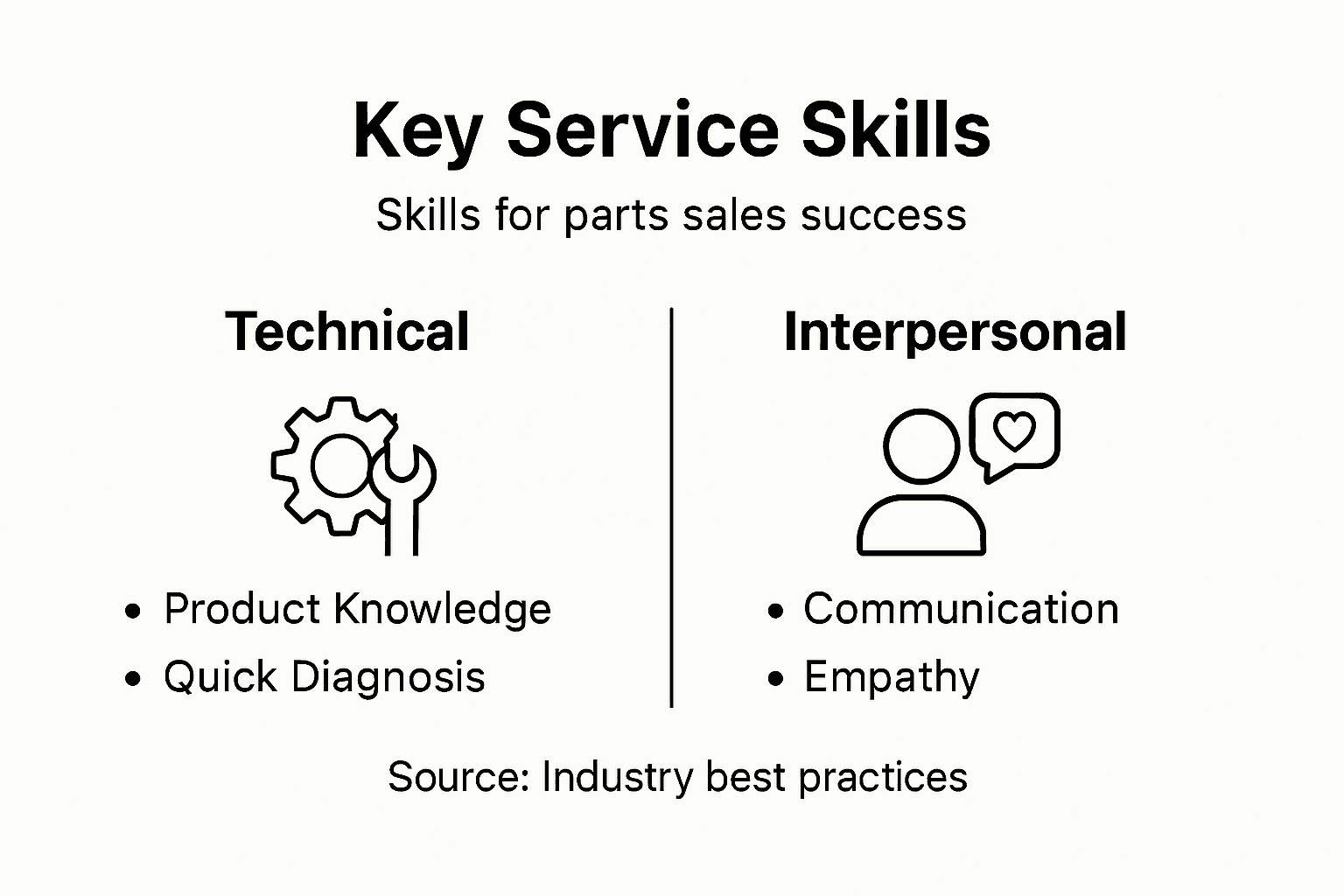
Compare core service skills and their value for parts sales success:
| Skill Domain | Key Attribute | Business Value |
|---|---|---|
| Technical Competence | Advanced machinery knowledge | Faster, accurate problem resolution |
| Interpersonal Communication | Empathetic and clear interaction | Builds trust, improves client rapport |
| Operational Excellence | Efficient processes and tracking | Consistently high quality service |
Pro tip: Develop a continuous professional development plan that focuses on both technical training and interpersonal skill enhancement to elevate your customer service performance.
Impact of Service on Sales and Retention
Customer service quality serves as a critical strategic lever that directly influences sales performance and customer retention in parts sales. Beyond mere transactional interactions, exceptional service transforms customer relationships into long-term partnerships that drive sustainable business growth and competitive advantage.
Research demonstrates significant service quality impacts on organizational success:
- Customer Loyalty: Increased repeat purchase probability
- Trust Building: Enhanced customer confidence
- Revenue Generation: Higher lifetime customer value
- Competitive Differentiation: Unique service experience
- Churn Reduction: Minimized customer attrition
The quantifiable dimensions of service impact can be strategically analyzed through multiple lenses:
- Financial Performance Metrics
- Sales conversion rates
- Average transaction value
- Customer acquisition cost
- Retention rate improvement
- Relationship Quality Indicators
- Customer satisfaction scores
- Net promoter ratings
- Referral frequency
- Engagement levels
- Long-Term Strategic Outcomes
- Market reputation
- Brand loyalty
- Competitive positioning
- Customer lifetime value
Exceptional service transforms transactional interactions into strategic relationship-building opportunities that extend far beyond immediate sales outcomes.
Successful parts sales organizations recognize that service quality is not a cost center but a strategic investment. By prioritizing customer success and proactive support, businesses can create sustainable competitive advantages that drive long-term growth and profitability.
Pro tip: Implement a comprehensive service performance tracking system that measures both quantitative metrics and qualitative customer feedback to continuously improve your service delivery strategy.
Common Service Pitfalls and How to Avoid Them
Customer service in parts sales is fraught with potential challenges that can undermine even the most well-intentioned support strategies. Recognizing and proactively addressing these common pitfalls is crucial for maintaining high-quality service and sustaining customer relationships in the competitive agricultural machinery parts market.
Research reveals critical service delivery challenges that can significantly impact customer satisfaction:
- Communication Breakdowns: Unclear or inconsistent messaging
- Technical Knowledge Gaps: Insufficient product understanding
- Slow Response Times: Delayed problem resolution
- Lack of Personalization: Generic customer interactions
- Inadequate Follow-up: Minimal post-transaction support
The most prevalent service pitfalls can be strategically categorized:
- Communication Failures
- Inconsistent information across channels
- Technical jargon misuse
- Poor listening skills
- Ineffective problem explanation
- Operational Shortcomings
- Inadequate inventory tracking
- Slow parts replacement processes
- Complex return procedures
- Limited technical support options
- Customer Relationship Mistakes
- Neglecting long-term customer needs
- Failing to build trust
- Minimal proactive communication
- Overlooking customer feedback
Exceptional service is not about avoiding mistakes entirely, but about how quickly and effectively you recover when challenges arise.
Successful parts sales organizations implement robust strategies to mitigate these risks. This involves continuous staff training, developing comprehensive communication protocols, and creating systems that prioritize customer experience at every interaction point.
Pro tip: Develop a comprehensive service recovery protocol that empowers front-line staff to resolve issues quickly and maintain customer confidence.
Elevate Your Parts Sales Success With Exceptional Customer Service
The article highlights key challenges in parts sales such as technical support delays, communication breakdowns, and the need for personalized problem-solving that builds trust and loyalty. If you are looking to overcome slow response times or insufficient technical guidance when purchasing agricultural machinery parts, you know how critical these service factors are to minimizing downtime and maximizing efficiency. At Pexlivanidis, we understand the importance of expert advice coupled with rapid support to help you make informed decisions and keep your equipment running smoothly.
Our extensive inventory of over 20,000 agricultural machinery parts comes with transparent product details and a dedicated customer service team ready to assist with availability inquiries and technical questions. Take advantage of benefits like free shipping within Greece for orders above 100€, wholesale membership options, and seamless order tracking designed to give you peace of mind. Explore our offerings today at Pexlivanidis Landing Page and experience firsthand how professional customer care transforms spare parts purchasing into a reliable, hassle-free partnership. Don’t wait until machine issues escalate take action now to secure the quality service and support your agricultural operations deserve.
Frequently Asked Questions
What are the key dimensions of customer service in parts sales?
Customer service in parts sales focuses on problem-solving capabilities, clear communication regarding product availability, technical support, and relationship management with agricultural industry professionals.
How can effective customer service impact sales and customer retention?
Excellent customer service can lead to increased customer loyalty, enhanced trust, higher revenue generation, and reduced churn rates, ultimately driving long-term business growth.
What essential skills are needed for effective customer service in parts sales?
Key skills include technical proficiency in machinery systems, strong communication abilities, emotional intelligence for managing customer expectations, and problem-solving skills for quick diagnostics.
What are common pitfalls in customer service for parts sales, and how can they be avoided?
Common pitfalls include communication breakdowns, technical knowledge gaps, slow response times, and lack of personalization. To avoid these, businesses can implement robust training, develop clear communication protocols, and prioritize customer feedback.