

Over 50 percent of American farmers report that unexpected equipment failures cost them valuable harvest time every year. As American agriculture becomes more technologically advanced, the need for reliable machinery and ongoing support grows more urgent. Understanding agricultural aftersales service reveals how maintenance, technical support, and customer guidance form a critical foundation for keeping farm operations on track and helping farmers get the most from their costly investments.
Table of Contents
- Defining Agricultural Aftersales Service
- Core Aftersales Service Components
- Variations In Aftersales Offerings
- How Aftersales Sustains Equipment
- Aftersales Service Obligations And Risks
Key Takeaways
| Point | Details |
|---|---|
| Comprehensive Aftersales Service | Agricultural aftersales service supports machinery performance through routine maintenance, technical support, and parts management. |
| Proactive Maintenance | Implementing maintenance plans every 250 hours can identify mechanical issues early, extending equipment lifespan. |
| Tailored Service Models | Aftersales offerings vary to fit specific operational needs, ranging from basic support to customized enterprise solutions. |
| Risk Management | Understanding legal and operational obligations is critical for effective service delivery and reducing financial exposure in aftersales. |
Defining Agricultural Aftersales Service
Agricultural aftersales service represents a comprehensive support system designed to maintain and optimize agricultural machinery performance after the initial purchase. Complex maintenance strategies from initial research studies reveal that this service goes far beyond simple repair work, encompassing a strategic approach to equipment longevity and operational efficiency.
At its core, agricultural aftersales service involves multiple critical components that ensure machinery continues functioning at peak performance. These typically include routine maintenance, technical support, parts replacement, diagnostic assessments, and ongoing customer guidance. Research examining machinery support frameworks highlights how comprehensive aftersales strategies directly correlate with increased equipment reliability and reduced operational downtime.
The primary objectives of agricultural aftersales service center around several key outcomes:
- Extending agricultural machinery lifecycle
- Minimizing unexpected equipment failures
- Providing rapid technical troubleshooting
- Ensuring optimal machinery performance
- Maintaining high customer satisfaction levels
Successful aftersales service requires a proactive approach that anticipates potential mechanical issues before they escalate into significant problems. Agricultural equipment represents substantial financial investments, making strategic maintenance and responsive support critical for farmers and agricultural businesses.
Pro Tip – Maintenance Planning: Schedule comprehensive equipment assessments every 250 operating hours or quarterly, whichever comes first, to preemptively identify and address potential mechanical vulnerabilities before they compromise your agricultural machinery’s performance.
Core Aftersales Service Components
The core components of agricultural aftersales service form a comprehensive ecosystem designed to support machinery performance and customer satisfaction. Detailed research on agricultural machinery service factors reveals several critical elements that constitute an effective support framework.
Technical Support Systems represent the foundational pillar of aftersales service. These systems encompass multiple interconnected functions:
- Rapid diagnostic capabilities
- Expert technician availability
- Remote troubleshooting mechanisms
- Comprehensive equipment problem resolution
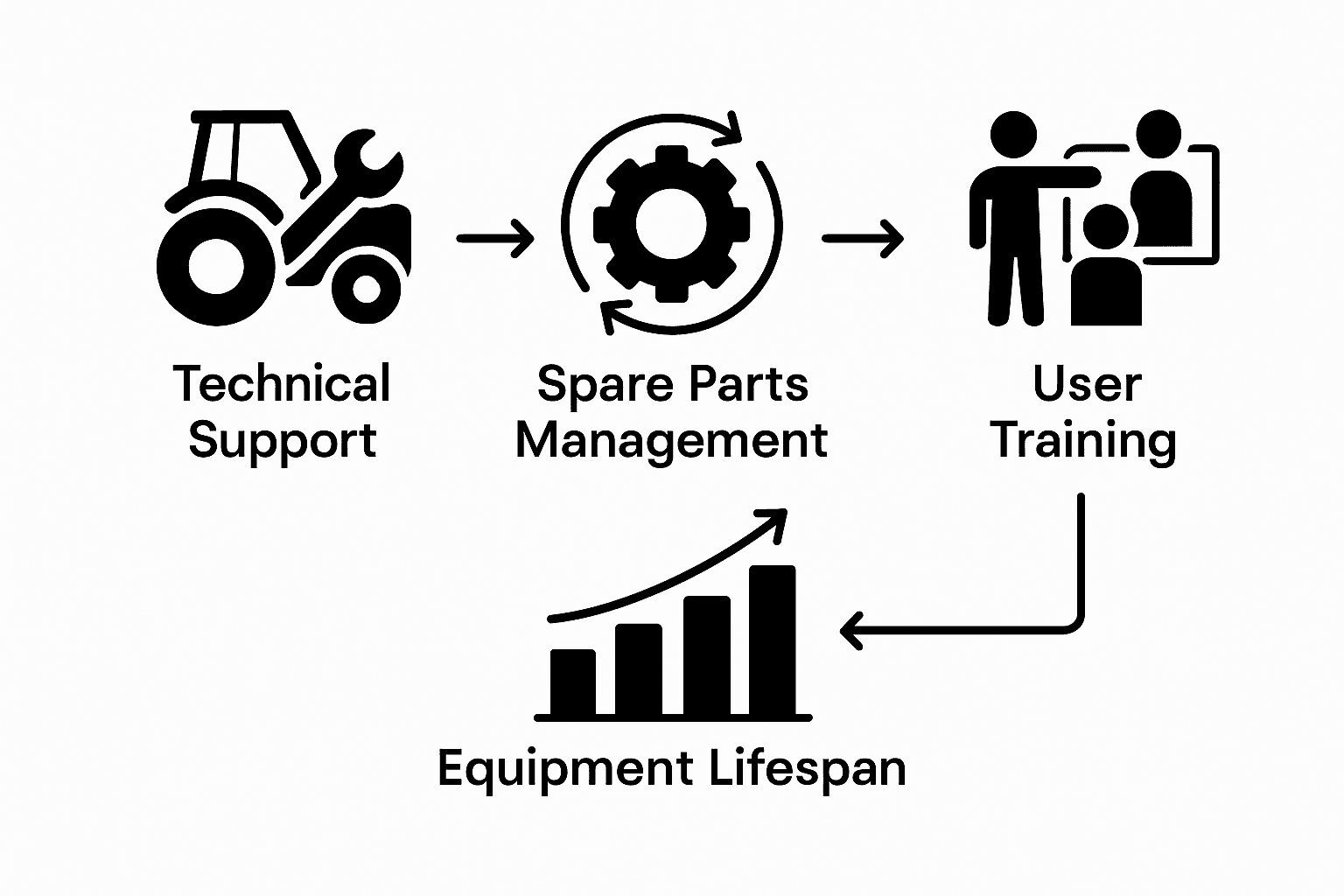
Spare parts management emerges as another crucial component in agricultural aftersales service. Efficient inventory systems ensure that replacement parts are readily available, minimizing equipment downtime and maintaining operational continuity. Farmers rely on quick access to specific components that match their machinery’s exact specifications.
Training and user management represent additional critical dimensions of aftersales service. Comprehensive training programs help operators understand complex machinery functionalities, implement proper maintenance protocols, and recognize early warning signs of potential mechanical issues. These educational initiatives extend beyond initial equipment purchase, providing ongoing support throughout the machinery’s operational lifecycle.
Additionally, service centers play a pivotal role in delivering comprehensive aftersales support. These centralized facilities provide physical locations where farmers can receive direct technical assistance, schedule maintenance appointments, and access specialized diagnostic equipment.
Here’s a summary of how each core aftersales service component contributes to business outcomes:
| Aftersales Component | Primary Function | Business Impact |
|---|---|---|
| Technical Support Systems | Rapid issue diagnosis and resolution | Reduces downtime and repair costs |
| Spare Parts Management | Ensures fast access to replacement parts | Maintains operational continuity |
| Training & User Management | Improves operator skills & safety | Decreases equipment misuse |
| Service Centers | Provides onsite specialized assistance | Increases customer satisfaction |
Pro Tip – Parts Tracking: Develop a digital inventory management system that tracks spare parts usage, predicts replacement needs, and alerts you about potential component shortages before they impact your agricultural operations.
Variations in Aftersales Offerings
Agricultural aftersales services are not one-size-fits-all solutions, but rather dynamic frameworks that adapt to specific operational requirements. Comprehensive research examining service strategy variations reveals multiple approaches that agricultural equipment providers implement to differentiate their support offerings.
The landscape of aftersales services can be categorized into several distinctive models:
- Standard Support Model: Basic maintenance and parts replacement
- Premium Service Package: Extended warranty, priority technical support
- Comprehensive Maintenance Plan: Regular diagnostics, proactive replacement
- Performance Optimization Service: Advanced monitoring and efficiency improvements
- Customized Enterprise Solutions: Tailored support for large-scale agricultural operations
Innovative approaches in agricultural service structures demonstrate how organizations strategically develop unique service frameworks. These variations emerge from understanding diverse customer needs, technological capabilities, and regional agricultural challenges. Some providers focus on rapid response times, while others prioritize predictive maintenance technologies or comprehensive training programs.
Regional and operational scale significantly influence aftersales service models. Small family farms might require different support structures compared to large commercial agricultural enterprises. Factors such as machinery complexity, technological sophistication, and financial constraints play critical roles in determining appropriate service offerings.
Technology integration has further transformed aftersales service variations. Advanced diagnostic tools, remote monitoring systems, and predictive maintenance algorithms enable more nuanced, data-driven support strategies. These technological innovations allow service providers to create increasingly personalized and efficient support frameworks.
Below is a comparison of common aftersales service models and their strategic focus:
| Service Model | Main Focus | Ideal For |
|---|---|---|
| Standard Support | Basic repair and replacement | Small, cost-conscious operations |
| Premium Service Package | Rapid response, extended support | Farms seeking minimal downtime |
| Comprehensive Maintenance Plan | Proactive, scheduled upkeep | Large, intensive users |
| Performance Optimization | Tech upgrades and monitoring | Tech-savvy, yield-driven farms |
| Customized Enterprise Solution | Tailored, scalable solutions | Multi-site or corporate farms |
Pro Tip – Service Matching: Conduct a comprehensive assessment of your specific agricultural equipment needs, operational scale, and budget to select an aftersales service model that provides the most appropriate balance of support and cost-effectiveness.
How Aftersales Sustains Equipment
Equipment sustainability represents a critical objective of comprehensive aftersales services, focusing on extending machinery operational life and maintaining peak performance. Advanced lifecycle management strategies for agricultural equipment demonstrate how systematic maintenance approaches can dramatically enhance machinery durability and functionality.
The sustainability process encompasses several interconnected strategies:
- Predictive diagnostic monitoring
- Systematic wear component replacement
- Performance optimization techniques
- Comprehensive equipment health tracking
- Technological adaptation and upgrade pathways
Robotic harvesting systems research underscores the importance of continuous technological intervention in maintaining equipment effectiveness. Modern aftersales services go beyond traditional repair models, implementing proactive monitoring systems that can predict potential mechanical failures before they occur.
Technological innovations have transformed equipment sustainability approaches. Advanced sensors, digital diagnostic tools, and real-time performance tracking enable unprecedented levels of machinery management. These systems collect granular data about equipment stress points, operational patterns, and potential degradation indicators, allowing for precise, targeted maintenance interventions.
The economic implications of effective equipment sustainability are substantial. By extending machinery operational lifespans, reducing unexpected breakdowns, and optimizing performance, aftersales services help agricultural operators minimize long-term capital expenditures. Effective maintenance strategies can potentially increase equipment utility by 30-50% compared to reactive repair approaches.
Pro Tip – Maintenance Tracking: Implement a digital maintenance log that records every service intervention, tracks component performance metrics, and generates predictive maintenance alerts based on historical equipment usage patterns.
Aftersales Service Obligations and Risks
Service obligations represent a complex legal and operational landscape that requires meticulous understanding and strategic management. Comprehensive research examining service risk mitigation strategies highlights the multifaceted challenges agricultural equipment providers face in maintaining robust aftersales support frameworks.
The primary obligations and associated risks include:
- Legal warranty compliance
- Performance guarantee fulfillment
- Timely repair and replacement protocols
- Technical support responsiveness
- Operational risk management
- Financial liability protection
Collaborative industry initiatives addressing service complexities demonstrate the evolving nature of technological and legal responsibilities in agricultural equipment support. Modern aftersales services must navigate intricate challenges involving technological sophistication, customer expectations, and regulatory compliance.
Technological advancements have significantly transformed risk management approaches. Autonomous systems and advanced diagnostic technologies enable more proactive risk mitigation strategies. Providers can now implement predictive monitoring systems that identify potential equipment failures before they escalate, thereby reducing legal and financial exposure.
Risk assessment in aftersales services involves multiple interconnected factors. These include equipment complexity, operational environment, maintenance history, and technological integration. Comprehensive risk management requires a holistic approach that combines legal expertise, technological understanding, and customer-centric service design.
Pro Tip – Risk Documentation: Develop a standardized digital risk assessment protocol that systematically documents equipment performance, maintenance interventions, and potential liability scenarios to create a comprehensive operational risk management framework.
Keep Your Agricultural Machinery Running Strong with Expert Aftersales Support
Maintaining high performance and extending the lifecycle of your agricultural equipment requires more than just buying the right machinery. This article highlights the importance of agricultural aftersales service including routine maintenance, rapid troubleshooting, and access to quality spare parts. At pexlivanidis.com, we understand that unexpected equipment downtime can severely impact your operations and profitability. That is why we offer a vast inventory of over 20,000 tractor accessories and spare parts designed to keep your machinery performing at its best.
Whether you need fast access to essential replacement parts or expert guidance to plan your maintenance schedule, our platform supports your aftersales needs with free shipping in Greece for orders over 100€ and exclusive wholesale options. Explore our full range of products and discover how the right spare parts can minimize downtime and increase equipment sustainability. Don’t wait for a breakdown to disrupt your work. Visit our online store today and secure the components that keep your agricultural business moving forward. Check out our product listings and reach out through our easy contact options to get personalized support now.
Frequently Asked Questions
What is agricultural aftersales service?
Agricultural aftersales service refers to a support system designed to maintain and optimize the performance of agricultural machinery after purchase. It includes routine maintenance, technical support, parts replacement, and customer guidance.
Why is aftersales service important for agricultural machinery?
Aftersales service is crucial as it extends the lifecycle of machinery, minimizes unexpected equipment failures, provides rapid technical troubleshooting, and ensures operational efficiency, ultimately maintaining high customer satisfaction levels.
How can farmers proactively manage their equipment maintenance?
Farmers can proactively manage maintenance by scheduling regular equipment assessments every 250 operating hours or quarterly, identifying potential mechanical issues before they escalate.
What are the core components of agricultural aftersales service?
The core components include technical support systems, spare parts management, training for users, and service centers that provide direct assistance, ensuring machinery operates effectively and efficiently.