

Tractors might look like the toughest machines on the farm, hauling heavy loads day after day and powering through the busiest seasons. But here is a wild fact. A single missed maintenance check can turn a reliable tractor into a breakdown that costs thousands and sidelines your operation at the worst moment. It surprises most people that the smallest investments in routine care often save more money and headaches than any fancy upgrade ever could.
Table of Contents
- The Importance Of Regular Maintenance For Tractor Parts
- Understanding The Impact Of Wear And Tear On Performance
- How Proper Maintenance Extends The Lifespan Of Equipment
- Economic Benefits Of Maintaining Tractor Parts
- Real-World Examples Of Consequences Of Neglect
Quick Summary
| Takeaway | Explanation |
|---|---|
| Regular maintenance prevents costly breakdowns | Systematic upkeep minimizes the risk of equipment failures, reducing repair costs during peak agricultural seasons. |
| Proactive care extends equipment lifespan | Routine inspections and part replacements ensure tractors operate efficiently over a long duration, protecting investment value. |
| Neglect leads to catastrophic failures | Ignoring maintenance can result in critical system breakdowns, disrupting productivity and leading to significant financial losses. |
| Understand wear indicators early | Recognizing signs of wear, such as increased fuel consumption and reduced power, allows for timely interventions that maintain performance. |
| View maintenance as a financial strategy | Treating upkeep as an investment helps optimize operational costs and enhances overall machinery value in the long run. |
The Importance of Regular Maintenance for Tractor Parts
Farmers and agricultural professionals understand that tractors represent significant financial investments that require strategic care. Regular maintenance of tractor parts is not merely a recommendation but a critical practice that directly impacts machine performance, operational efficiency, and long term economic sustainability.
Preserving Equipment Value and Performance
Maintaining tractor parts goes beyond simple repairs. It represents a proactive approach to equipment management that delivers substantial benefits. Agricultural machinery experts confirm that systematic maintenance can dramatically extend equipment lifespan and reduce unexpected breakdowns.
The core advantages of consistent maintenance include:
- Preventing premature wear on critical mechanical components
- Reducing the likelihood of catastrophic equipment failure
- Maintaining optimal fuel efficiency and operational performance
Financial Implications of Regular Part Maintenance
The economic rationale for maintaining tractor parts is compelling. Unexpected repairs can cost significantly more than routine maintenance. A small investment in regular part inspection and replacement can prevent major mechanical failures that might render equipment non-operational during critical agricultural seasons.
Key financial considerations involve understanding the lifecycle cost of tractor components. Replacing filters, checking hydraulic systems, and monitoring wear patterns are not expenses but strategic investments that protect your agricultural machinery’s overall value and functionality.
Below is a table comparing key maintenance strategies and their direct economic impacts, helping readers quickly see how specific maintenance actions provide financial and operational benefits.
| Maintenance Strategy | Economic Benefit | Operational Benefit |
|---|---|---|
| Regular part inspection & replacement | Prevents costly repairs and protects machinery value | Reduces risk of breakdowns, ensures reliability |
| Routine lubrication and calibration | Lowers need for expensive replacements | Maintains efficient operation |
| Early intervention for wear indicators | Saves money by fixing small problems before they escalate | Maintains consistent performance |
| Comprehensive maintenance approach | Preserves long-term resale value, minimizes overall costs | Increases uptime during busy seasons |
| Proactive system monitoring | Reduces emergency repair expenses | Identifies issues before they become critical |
Strategic Maintenance as Risk Management
Tractor maintenance should be viewed through a risk management lens. Each neglected component represents a potential point of systemic failure that could interrupt critical farming operations. By implementing a structured maintenance approach, farmers transform equipment care from a reactive task into a proactive strategy that safeguards both machinery and agricultural productivity.
Professional maintenance involves comprehensive assessment of all tractor parts, understanding their interconnected nature, and addressing potential issues before they escalate into significant mechanical problems.
Understanding the Impact of Wear and Tear on Performance
Wear and tear represents an inevitable process in agricultural machinery that systematically degrades tractor components through continuous operational stress. Recognizing how mechanical deterioration impacts overall equipment performance is crucial for farmers seeking to maximize their machinery’s operational lifespan and maintain peak productivity.
Mechanical Degradation Mechanisms
Understanding wear and tear requires examining how different mechanical forces progressively compromise tractor part integrity.
VIDEO:video_content] [Agricultural Engineering Research demonstrates that multiple complex factors contribute to mechanical component deterioration.
Key mechanical degradation mechanisms include:
- Friction between moving parts causing surface material erosion
- Thermal expansion and contraction creating microscopic structural changes
- Cumulative stress from repetitive mechanical loading
Performance Reduction Indicators
When tractor parts experience significant wear, performance indicators become increasingly evident. Reduced efficiency manifests through subtle changes that experienced operators can detect early. These signs include increased fuel consumption, reduced power output, unusual mechanical sounds, and decreased overall operational smoothness.
Critical performance reduction markers encompass:
This table summarizes the main indicators of wear and tear on tractor performance, providing a quick reference for operators to identify when maintenance is needed before severe issues develop.
| Wear Indicator | Impact on Performance | Action Recommended |
|---|---|---|
| Increased fuel consumption | Reduced efficiency, higher costs | Inspect for worn components |
| Reduced power output | Lowered operational capability | Check engine and powertrain |
| Unusual mechanical sounds | Possible part wear or damage | Conduct thorough inspection |
| Decreased hydraulic responsiveness | Slower equipment operation | Test and service hydraulics |
| Increased vibration during operation | Signs of imbalance or misalignment | Inspect moving/mechanical parts |
- Decreased hydraulic system responsiveness
- Increased vibration during equipment operation
- Noticeable reductions in power transmission efficiency
Long Term Mechanical Consequences
Neglecting early signs of wear and tear can precipitate catastrophic mechanical failures. Components subjected to prolonged stress without intervention experience accelerated degradation, transforming minor issues into substantial repair requirements. Professional maintenance strategies involve continuous monitoring and proactive replacement of components showing initial deterioration signs.
By understanding the nuanced progression of mechanical wear, farmers can develop sophisticated maintenance approaches that extend equipment functionality and protect their significant agricultural investments.
How Proper Maintenance Extends the Lifespan of Equipment
Tractor equipment represents a substantial investment for agricultural professionals, with proper maintenance serving as the most effective strategy for preserving machinery value and operational capabilities. Understanding the intricate relationship between systematic care and equipment longevity is essential for farmers seeking to maximize their machinery’s performance and economic utility.
Systematic Component Preservation
Proper maintenance transcends basic repair work, functioning as a comprehensive approach to equipment management. Agricultural Machinery Research confirms that strategic maintenance practices can dramatically extend equipment functionality by addressing potential issues before they escalate into significant mechanical failures.
Key systematic preservation strategies include:
- Regular lubrication of critical moving parts
- Comprehensive inspection of mechanical interfaces
- Precise calibration of mechanical systems
Economic Impact of Preventative Care
Long term economic benefits emerge from consistent maintenance practices. Each proactive intervention represents a strategic investment that prevents exponentially more expensive repair scenarios. By identifying and addressing minor wear patterns early, farmers can significantly reduce the total cost of equipment ownership.
Fundamental economic considerations encompass:
- Reducing unexpected equipment downtime
- Minimizing replacement part expenses
- Preserving equipment resale and operational value
Comprehensive Maintenance Philosophy
Maintenance should be viewed as a holistic approach to equipment management. Professional agricultural operators understand that each mechanical component contributes to overall system performance. Treating maintenance as a continuous, integrated process allows farmers to develop sophisticated strategies that protect their significant machinery investments.
By implementing a comprehensive maintenance philosophy, agricultural professionals transform equipment care from a reactive necessity into a proactive management strategy that ensures consistent, reliable performance across changing operational conditions.
Economic Benefits of Maintaining Tractor Parts
Maintaining tractor parts represents a strategic financial approach that goes far beyond simple equipment care. Agricultural professionals recognize that proactive maintenance directly influences operational costs, machinery performance, and long term economic sustainability for farming operations.
Cost Prevention and Value Preservation
Economic research on agricultural machinery demonstrates that systematic maintenance significantly reduces unexpected financial burdens. Preventative care transforms equipment management from a reactive expense into a calculated investment strategy that protects agricultural infrastructure.
Key cost prevention strategies include:
- Reducing probability of catastrophic mechanical failures
- Extending equipment operational lifespan
- Minimizing comprehensive repair expenses
Operational Efficiency and Financial Optimization
Proper maintenance directly correlates with improved operational efficiency. Well maintained tractor parts ensure consistent performance, reduced fuel consumption, and minimal productivity interruptions. The financial implications extend beyond immediate repair costs, encompassing broader economic considerations like fuel efficiency, labor optimization, and equipment reliability.
Critical operational efficiency benefits encompass:
- Enhanced fuel consumption performance
- Consistent mechanical output
- Reduced downtime during critical agricultural seasons
Long Term Economic Calculation
Economic analysis of tractor maintenance reveals that every dollar invested in systematic part care can potentially save multiple dollars in future repair and replacement expenses. Farmers who view maintenance as a strategic financial tool rather than an operational burden position themselves to maximize equipment value and agricultural productivity.
By understanding maintenance as a comprehensive economic strategy, agricultural professionals transform equipment care from a simple mechanical necessity into a sophisticated financial management approach that protects and enhances their most critical operational assets.
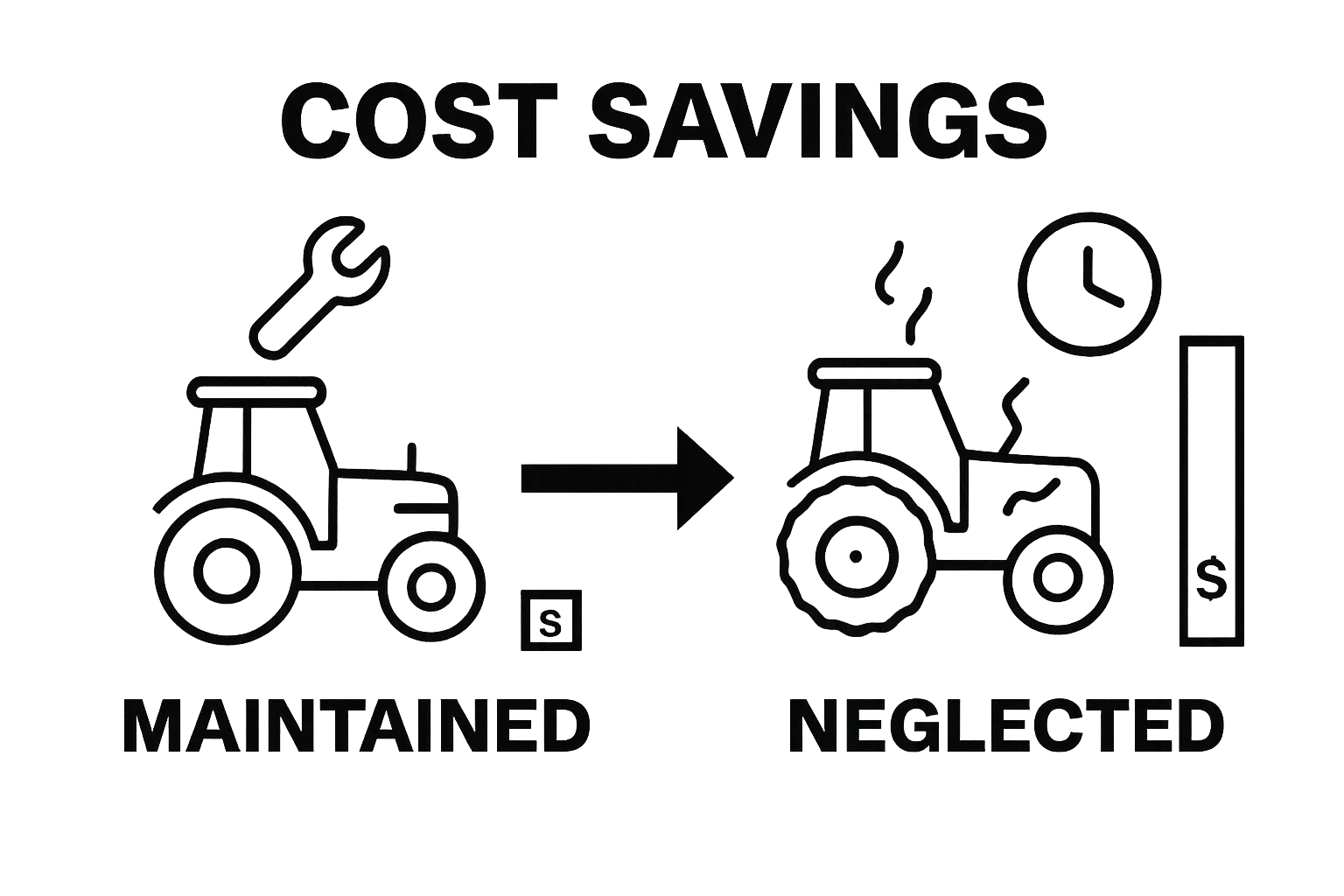
Real-World Examples of Consequences of Neglect
Neglecting tractor maintenance is not merely a theoretical risk but a tangible threat that can devastate agricultural operations. Agricultural professionals must understand how equipment deterioration translates into real economic and operational challenges that extend far beyond simple mechanical repairs.
Critical System Failures
USDA agricultural research demonstrates that systematic equipment neglect can precipitate catastrophic mechanical breakdowns. Preventable mechanical failures frequently result in substantial financial losses and critical disruptions during crucial farming seasons.
Typical neglect scenarios leading to critical system failures include:
- Complete engine shutdown during peak planting periods
- Irreparable transmission damage from overlooked lubrication
- Hydraulic system collapse due to contaminated fluid systems
Economic Impact of Delayed Maintenance
The financial consequences of equipment neglect extend well beyond immediate repair costs. Farmers experiencing unexpected machinery failures face compounded economic challenges including lost productivity, emergency repair expenses, and potential crop yield reductions. The cumulative economic impact can dramatically outweigh the modest investments required for routine maintenance.
Significant financial repercussions encompass:
- Emergency repair costs substantially higher than routine maintenance
- Lost agricultural productivity during equipment downtime
- Potential permanent reduction in machinery resale value
Operational Reliability Breakdown
Neglected equipment progressively loses operational reliability, transforming what might have been minor maintenance requirements into comprehensive system failures. Professional agricultural operators recognize that each postponed inspection and delayed part replacement incrementally increases the probability of catastrophic mechanical breakdown.
By understanding these real world consequences, farmers can develop proactive maintenance strategies that protect their critical agricultural infrastructure and ensure consistent, reliable equipment performance across changing operational conditions.
Keep Your Tractor Running Longer with the Right Parts and Expertise
Are you concerned about unexpected breakdowns, rising repair costs, or lost productivity due to neglected tractor parts? Maintaining your equipment is more than a routine task. As highlighted in the article, regular care guards against wear and tear, keeps your machinery running smoothly, and protects your farm’s financial health. When even a small component wears out, it can lead to system failures and halt your entire operation. You need fast access to dependable replacement parts so you never lose valuable time during crucial farming seasons.
At pexlivanidis.com, we offer more than 20000 carefully selected tractor accessories and spare parts to keep your machinery performing at its best. Enjoy benefits like free shipping in Greece for orders over 100€ and a simple search that helps you find exactly what you need. Explore our extensive inventory today and discover how easy it is to prevent costly downtime. Ready to secure your equipment’s future? Visit the main store page now, or contact us directly through our contact form for personalized support and quick answers. Do not wait until you face an emergency. Take action now to keep your tractors reliable season after season.
Frequently Asked Questions
Why is regular maintenance important for tractor parts?
Regular maintenance is crucial for extending the lifespan of tractor parts, preventing unexpected breakdowns, and maintaining optimal performance. Systematic care can save significant costs over time by avoiding major repairs and preserving the equipment’s value.
What are common indicators that tractor parts need maintenance?
Common indicators include increased fuel consumption, unusual mechanical sounds, reduced power output, decreased hydraulic responsiveness, and vibrations during operation. Recognizing these signs early can help prevent more substantial mechanical issues.
How does wear and tear affect tractor performance?
Wear and tear progressively degrades tractor components, leading to decreased efficiency and increased operational risks. Neglected parts can result in catastrophic failures, ultimately affecting productivity and increasing repair costs.
What strategies can farmers implement for effective tractor maintenance?
Farmers should adopt a comprehensive maintenance philosophy that includes regular lubrication of moving parts, thorough inspections, and timely replacement of worn components. Proactive strategies can enhance operational reliability and reduce overall ownership costs.