

Every American agricultural operation depends on reliable equipment, yet even a single missing part can bring entire farms to a standstill. With machinery growing increasingly complex, accurate parts catalogs have become essential for keeping tractors and harvesters running smoothly. Understanding how these catalogs work can save hours of frustration, prevent costly mistakes, and help you take control of your equipment maintenance decisions with confidence.
Table of Contents
- Defining A Parts Catalog For Machinery
- Types Of Parts Catalogs Used In Agriculture
- Key Features And Structure Explained
- How Parts Catalogs Benefit Buyers And Businesses
- Common Mistakes When Using Parts Catalogs
Key Takeaways
| Point | Details |
|---|---|
| Importance of Parts Catalogs | Parts catalogs are essential tools for documenting components, facilitating quick identification and procurement of machinery parts. |
| Types of Catalogs | Agricultural parts catalogs are available in printed, digital, and advanced formats, each tailored to specific operational needs. |
| Benefits to Buyers | Effective parts catalogs enhance procurement accuracy, reduce operational errors, and improve cost management for buyers and businesses. |
| Common Mistakes | Users often make critical errors by neglecting important details, emphasizing the need for meticulous verification when using parts catalogs. |
Defining a Parts Catalog for Machinery
A parts catalog is a comprehensive organizational tool that meticulously documents and categorizes components essential for machinery maintenance and repair. Imagine it as a detailed reference guide that provides critical information about specific equipment parts. These catalogs are far more than simple lists – they are strategic resources designed to help technicians, mechanics, and equipment operators quickly identify, locate, and order precise replacement components.
At its core, a parts catalog serves multiple crucial functions. It compiles detailed information about various components including precise part numbers, technical specifications, and comprehensive descriptions. Think of it like a detailed map that guides professionals through the intricate landscape of machinery components. For agricultural machinery like tractors, this means having instant access to specifics about engine parts, hydraulic systems, transmission components, and other critical equipment elements.
The strategic value of a parts catalog extends far beyond simple identification. These resources streamline supply chain management, reduce equipment downtime, and minimize potential errors in parts procurement. By providing standardized, accurate information, parts catalogs help organizations maintain equipment efficiency, control maintenance costs, and ensure smooth operational continuity. Agricultural professionals rely on these catalogs to make informed decisions about equipment maintenance, replacement parts, and long-term machinery management strategies.
Key features of an effective parts catalog typically include:
- Precise part numbers and identifiers
- Detailed component specifications
- Technical illustrations or diagrams
- Compatibility information for different machinery models
- Pricing and availability details
- Cross-referencing capabilities for alternative parts
Types of Parts Catalogs Used in Agriculture
In the agricultural machinery sector, parts catalogs come in diverse formats designed to meet specific operational needs. Agricultural parts catalogs encompass multiple resource types that help farmers and technicians manage complex equipment maintenance requirements. These specialized resources range from comprehensive printed manuals to sophisticated digital databases, each serving unique purposes in equipment management and repair.
Traditionally, agricultural parts catalogs are categorized into several primary types. Printed catalogs remain popular among older farming operations, offering detailed physical illustrations and part specifications. Digital catalogs, including downloadable PDFs and interactive online platforms, have become increasingly prevalent, providing instant access to part information. Some advanced catalogs now integrate augmented reality features, allowing users to scan equipment and immediately identify specific component details.
The most sophisticated parts catalogs in modern agriculture offer advanced functionalities beyond simple part identification. These comprehensive resources typically include detailed information about machinery components across various agricultural equipment types, such as tractors, harvesters, plows, and specialized farming machinery. They often incorporate additional features like:
- Interactive search capabilities
- Compatibility cross-referencing
- Real-time inventory tracking
- Historical maintenance records
- Detailed technical specifications
- Price and availability information
Modern agricultural professionals increasingly rely on these sophisticated digital parts catalogs to streamline maintenance processes, reduce equipment downtime, and make informed procurement decisions. The evolution of these resources reflects the growing complexity and technological advancement in agricultural machinery management.
Key Features and Structure Explained
Parts catalogs represent intricate systems of information management, designed to provide comprehensive insights into machinery components. Traditional parts catalogs serve as foundational reference guides that document spare parts through detailed illustrations, precise descriptions, and systematic part numbering. These resources are meticulously structured to help technicians and parts managers navigate complex equipment landscapes efficiently.

The core architecture of modern parts catalogs typically follows a hierarchical organizational approach. Components are categorized by major systems, such as engine, transmission, hydraulic systems, and electrical components. Electronic Parts Catalogs (EPCs) have revolutionized this structure by offering dynamic, interactive information platforms that integrate live inventory tracking and real-time updates. This digital transformation enables instant component identification, compatibility verification, and procurement processes.
A comprehensive parts catalog’s structure generally includes several critical elements:
- Systematic part numbering scheme
- Detailed technical specifications
- Exploded view diagrams
- Cross-referencing capabilities
- Pricing information
- Compatibility matrices
- Historical maintenance records
- Replacement part recommendations
Professional agricultural equipment managers recognize that an effective parts catalog is more than a simple inventory list. It represents a strategic tool for equipment maintenance, cost management, and operational efficiency. By providing precise, accessible information, these catalogs help organizations minimize equipment downtime, optimize repair processes, and make informed procurement decisions that directly impact agricultural productivity.
How Parts Catalogs Benefit Buyers and Businesses
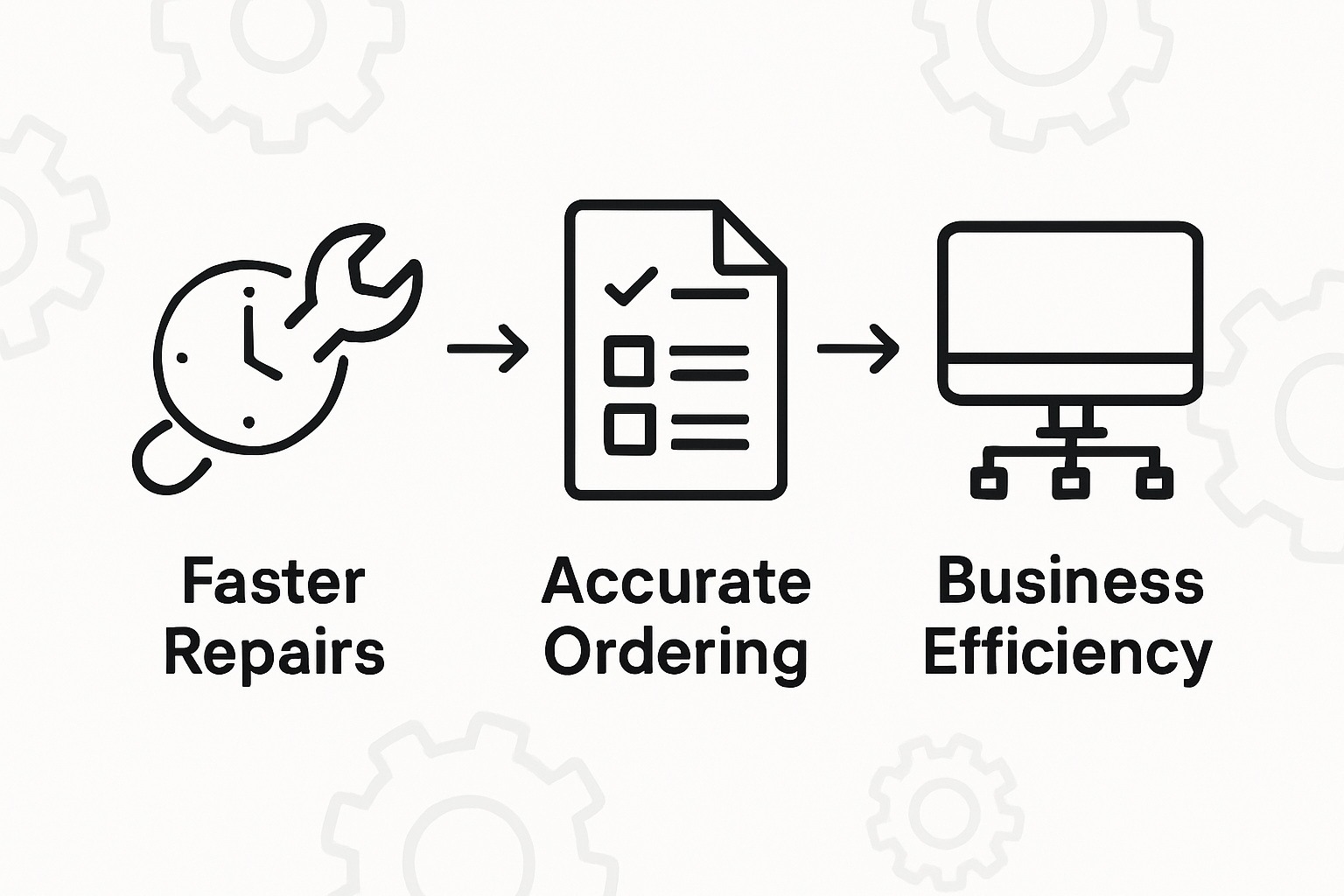
Parts catalogs represent far more than simple reference documents – they are strategic business tools that transform operational efficiency across agricultural equipment sectors. Electronic Parts Catalogs (EPCs) enhance accuracy and streamline procurement processes, enabling businesses to reduce errors, optimize inventory management, and build stronger customer relationships through precise, reliable information delivery.
For buyers, parts catalogs provide critical advantages that directly impact equipment maintenance and operational costs. These comprehensive resources allow agricultural professionals to quickly identify exact component specifications, verify compatibility, and make informed purchasing decisions. The ability to access detailed technical information reduces potential mistakes in parts selection, ultimately preventing costly equipment downtime and supporting long-term machinery performance.
Businesses benefit from parts catalogs through multiple strategic dimensions:
- Reduced operational errors
- Enhanced inventory tracking
- Improved customer service capabilities
- Faster quote generation
- Simplified procurement processes
- Accurate cost management
- Streamlined maintenance documentation
Modern electronic parts catalogs revolutionize traditional information management by integrating real-time updates, interactive features, and comprehensive data repositories. This technological evolution transforms parts catalogs from static reference documents into dynamic business intelligence tools that support strategic decision-making, optimize supply chain efficiency, and create competitive advantages for agricultural equipment providers and operators.
Common Mistakes When Using Parts Catalogs
Parts catalogs can be complex resources that require careful navigation and precise interpretation. Common errors often stem from misidentifying parts through incorrect diagram or part number interpretation, which can lead to costly procurement mistakes and significant operational disruptions in agricultural equipment management.
Professionals frequently encounter several critical mistakes when working with parts catalogs. Overlooking essential equipment identification details like model numbers or serial numbers can result in ordering incompatible components. These seemingly minor oversights can trigger substantial financial and operational consequences, potentially causing equipment malfunction or extended downtime.
Key mistakes to avoid when using parts catalogs include:
- Neglecting to verify exact model specifications
- Misreading technical diagrams
- Failing to cross-reference part numbers
- Ignoring equipment serial number information
- Relying on outdated or incomplete catalog versions
- Skipping compatibility checks
- Assuming universal part interchangeability
Successful parts catalog usage requires meticulous attention to detail, systematic verification processes, and a comprehensive understanding of equipment-specific nuances. Agricultural professionals must develop robust practices that minimize human error and maximize the accuracy of parts identification and procurement strategies.
Discover Precision and Reliability with Our Extensive Parts Catalog
Maintaining your agricultural machinery demands accurate parts identification and seamless access to detailed component information. As the article highlights, common challenges like misreading technical diagrams or ordering incompatible parts can lead to costly downtime and operational setbacks. At pexlivanidis.com, we understand the critical role a well-organized parts catalog plays in ensuring efficient repairs and smooth farming operations. With over 20,000 tractor accessories and spare parts, our online platform offers detailed product descriptions, compatibility information, and a user-friendly search function designed to eliminate mistakes and simplify your procurement process.
Don’t let equipment downtime hold back your productivity. Explore our expansive inventory at pexlivanidis.com today to find precise replacement parts that match your exact machinery needs. Take advantage of free shipping within Greece for orders over 100€ and streamline your maintenance workflow. Visit our storefront now and experience how a comprehensive digital parts catalog paired with reliable service can elevate your agricultural machinery maintenance to the next level.
Frequently Asked Questions
What is a parts catalog?
A parts catalog is a detailed organizational tool that documents and categorizes components essential for machinery maintenance and repair, providing information such as part numbers, specifications, and descriptions.
Why are parts catalogs important for agricultural machinery?
Parts catalogs are crucial because they help technicians quickly identify and order the correct replacement components, streamline supply chain management, reduce equipment downtime, and minimize errors in parts procurement.
What types of parts catalogs are used in agriculture?
Parts catalogs in agriculture include printed manuals, digital databases, and advanced catalogs with features like interactive search capabilities and real-time inventory tracking, catering to various operational needs.
What common mistakes should be avoided when using parts catalogs?
Common mistakes include neglecting to verify model specifications, misreading diagrams, failing to cross-reference part numbers, and relying on outdated catalog versions, which can lead to procurement errors and operational disruptions.