

Locating the exact part number for a tractor can quickly turn from routine task to major headache, especially when facing a tight repair schedule in Thessaloniki or Kavala. For mechanics working on a mix of old and new machinery, these unique codes are more than labels—they are the backbone of fast and error-free maintenance. Mastering the use of unique part number identification systems puts you in control, helping you avoid mismatched components and costly delays throughout the repair and ordering process.
Table of Contents
- Agricultural Part Numbers: Core Concepts
- Decoding Numbering Systems And Formats
- Major Brands And Their Unique Schemes
- Real-World Use Cases For Mechanics
- Common Mistakes When Ordering Parts
Key Takeaways
| Point | Details |
|---|---|
| Importance of Part Numbers | Part numbers are essential for effective communication, precise tracking, and efficient inventory management in agricultural machinery maintenance. |
| Standardization Benefits | Standardized part numbering reduces errors and enhances collaboration between mechanics, suppliers, and various technical systems. |
| Ordering Accuracy | Accurate part number identification is crucial to prevent costly mistakes and ensure compatibility during the procurement process. |
| Modern Practices | Emphasizing intelligent numbering systems streamlines operations, enabling mechanics to manage complex inventories effectively and adapt to technological advancements. |
Agricultural Part Numbers: Core Concepts
In the complex world of agricultural machinery maintenance, part numbers serve as critical communication tools that transcend simple identification. These unique alphanumeric codes are the universal language mechanics use to precisely track, order, and replace components across different agricultural equipment systems. Unique part number identification systems streamline procurement and inventory management by reducing reliance on lengthy descriptive explanations.
Agricultural part numbers function as more than just labels – they represent comprehensive tracking mechanisms for machinery components. These codes typically encode critical information about the part, such as:
- Manufacturing origin
- Product category
- Specific design specifications
- Material composition
- Equipment compatibility
- Production date and revision history
Mechanics and parts managers rely on these structured codes to prevent errors, ensure accurate replacements, and maintain efficient inventory management. Part numbering best practices help reduce duplication and facilitate seamless integration across various technical systems like CAD, ERP, and vendor databases.
The standardization of part numbers allows agricultural equipment technicians to communicate precisely about specific components, regardless of manufacturer or equipment type. By understanding the intricate coding systems behind these numbers, mechanics can quickly identify, source, and replace parts with minimal confusion or potential error.
The following table summarizes how part numbers impact essential agricultural maintenance processes:
| Maintenance Area | Role of Part Numbers | Business Outcome |
|---|---|---|
| Inventory Management | Streamline tracking and reordering | Reduces stockouts and surplus |
| Equipment Repair | Ensure correct component selection | Minimizes downtime |
| Warranty & Documentation | Track revisions and replacements | Simplifies warranty claims |
| Procurement | Standardize supplier communication | Prevents costly ordering errors |
Pro tip: Always photograph or document the original part number before removal to ensure accurate replacement during machinery repairs.
Decoding Numbering Systems And Formats
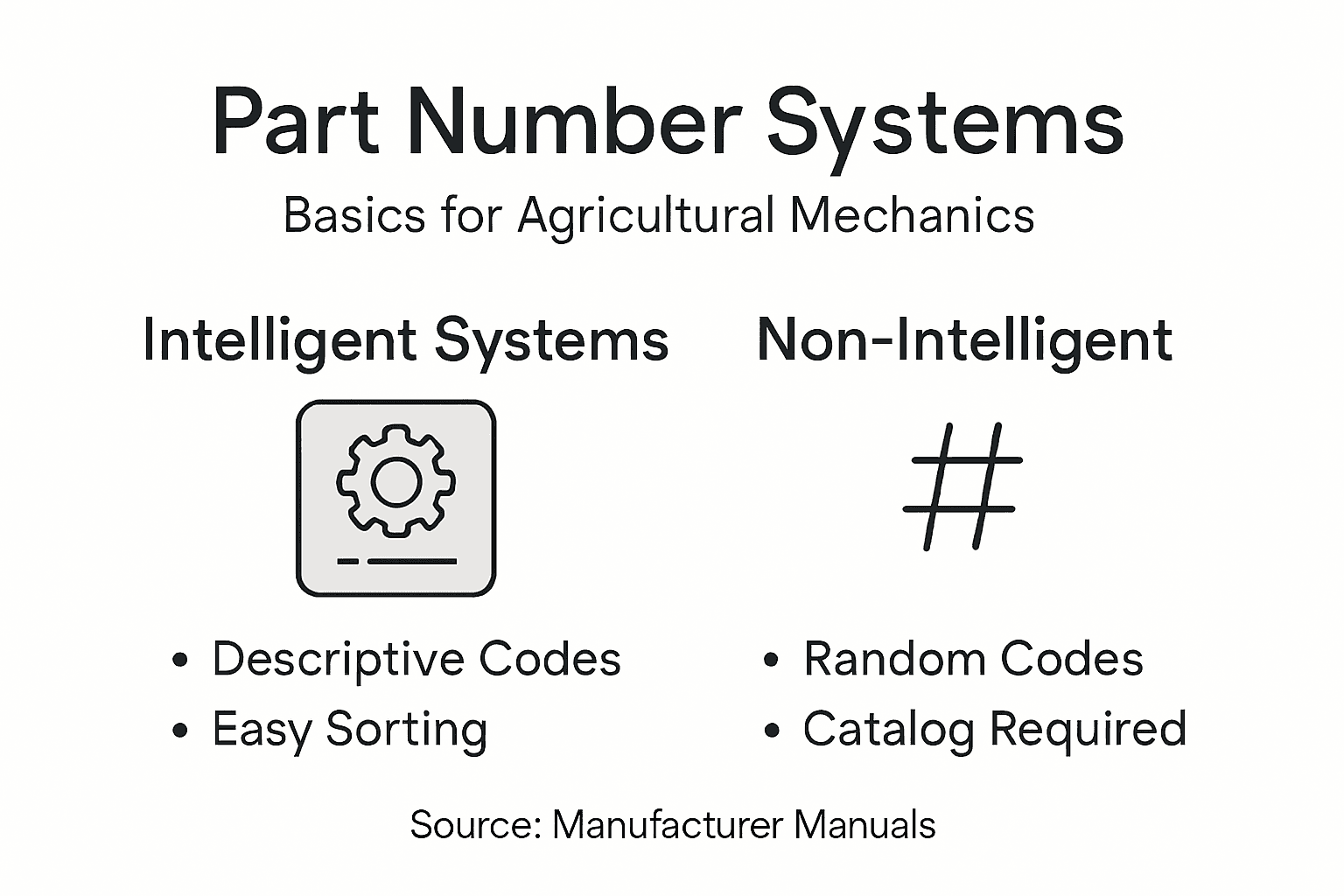
In agricultural machinery maintenance, understanding part numbering systems is crucial for effective component management. These systems are fundamentally categorized into two primary approaches: intelligent and non-intelligent numbering schemes. Each method offers unique advantages and challenges for mechanics seeking precise equipment identification.
The two primary part numbering approaches include:
- Non-Intelligent (Non-Significant) Systems:
- Use sequential or arbitrary codes
- Do not embed descriptive information
- Simpler and faster to implement
- Easier to generate and manage
- Intelligent (Significant) Systems:
- Encode descriptive details within the number
- Include information about part type, size, or function
- Provide more context about the component
- More complex but potentially more informative
Modern part numbering best practices emphasize creating systems with consistent characteristics. Effective numbering schemes should possess clear attributes like simple character sets, unambiguous identifiers, and a standardized approach that supports clarity across procurement, production, and maintenance processes.

While older systems prioritized detailed, descriptive numbering, contemporary agricultural equipment management favors shorter, more streamlined numeric identifiers. These modern approaches focus on uniquely identifying parts while minimizing potential errors and maximizing system flexibility. The goal is to create a part numbering method that balances information density with ease of use and scalability.
Here’s a comparison of intelligent vs. non-intelligent numbering in agricultural parts management:
| Attribute | Intelligent System | Non-Intelligent System |
|---|---|---|
| Encoded Info | Part type and specs | No descriptive meaning |
| Implementation | Requires structured setup | Simple to deploy |
| Scalability | Supports large portfolios | May become confusing |
| Error Risk | Lower with proper use | Higher in complex fleets |
Pro tip: Always cross-reference part numbers with manufacturer catalogs to verify precise component compatibility and avoid potential mismatches.
Major Brands And Their Unique Schemes
Agricultural equipment manufacturers develop sophisticated part numbering strategies that reflect their specific operational requirements and technological approaches. Intelligent and non-intelligent numbering schemes represent critical decision points for brands seeking to optimize their component identification systems.
Key characteristics of major brand part numbering approaches include:
- Sequential Numbering Strategies:
- Simple and straightforward identification
- Minimizes complexity in tracking
- Easily scalable across product lines
- Reduces potential human error
- Hierarchical Numbering Systems:
- Embed multiple layers of product information
- Include category, subcategory, and specific component details
- Provide comprehensive tracking capabilities
- Support complex product portfolios
Leading manufacturers’ part numbering practices demonstrate a critical focus on adaptability and traceability. Modern agricultural equipment brands increasingly invest in sophisticated software tools that automate part number assignment, validation, and management, ensuring consistency and reducing potential documentation errors.
The evolution of part numbering reflects broader technological trends in agricultural manufacturing. Contemporary brands prioritize flexible systems that can quickly adapt to changing product designs, supply chain dynamics, and technological innovations. These sophisticated numbering schemes serve as more than simple identifiers – they represent complex information management tools that support efficient maintenance, procurement, and inventory control processes.
Pro tip: Develop a personal reference guide mapping specific manufacturer part number conventions to streamline your identification process.
Real-World Use Cases For Mechanics
Mechanics working with agricultural equipment face complex challenges that demand precise part identification skills. Agricultural mechanics rely on accurate part numbers to navigate intricate machinery maintenance and repair scenarios across diverse agricultural systems.
Typical real-world applications for part number expertise include:
- Preventive Maintenance Scenarios:
- Identifying exact replacement components
- Tracking equipment wear and degradation
- Scheduling timely interventions
- Predicting potential system failures
- Troubleshooting Critical Breakdowns:
- Rapid component identification
- Minimizing equipment downtime
- Ensuring precise parts ordering
- Supporting complex repair diagnostics
Mechanics must navigate multiple complex scenarios where part numbers serve as critical communication tools. These alphanumeric codes enable professionals to communicate precisely about specific components, bridging gaps between manufacturers, suppliers, and service teams. Accurate part number interpretation becomes especially crucial when dealing with advanced precision agriculture technologies that demand exact specifications.
The practical implications of part number mastery extend far beyond simple identification. Skilled mechanics transform these codes into strategic assets, using them to optimize inventory management, streamline repair processes, and maintain comprehensive equipment performance records. Understanding the nuanced language of part numbers allows technicians to anticipate maintenance needs, reduce operational disruptions, and deliver more efficient agricultural machinery support.
Pro tip: Create a personalized digital or physical reference system cataloging unique part number patterns for frequently serviced equipment models.
Common Mistakes When Ordering Parts
Agricultural mechanics frequently encounter ordering challenges that can significantly impact equipment maintenance and repair efficiency. Complete guide to ordering tractor parts highlights the critical importance of precision when selecting replacement components for agricultural machinery.
Most common part ordering mistakes include:
- Identification Errors:
- Misreading part number digits
- Confusing similar-looking codes
- Overlooking model-specific variations
- Failing to verify exact equipment compatibility
- Documentation Mistakes:
- Incomplete part specifications
- Incorrect measurement references
- Neglecting serial number cross-referencing
- Misinterpreting manufacturer revision codes
Technical precision becomes paramount when ordering agricultural machinery parts. Mechanics must meticulously verify every detail, understanding that a single digit or character misinterpretation can lead to expensive purchasing mistakes, extended equipment downtime, and potential system incompatibility. The financial and operational risks of incorrect part orders extend far beyond the immediate cost of the component.
Successful parts procurement requires a systematic approach that combines technical knowledge, careful documentation, and thorough verification. Experienced mechanics develop robust strategies to minimize ordering errors, including maintaining detailed equipment records, utilizing manufacturer catalogs, and cross-referencing multiple information sources before finalizing any purchase.
Pro tip: Always take a clear, high-resolution photograph of the original part alongside its part number before placing an order to ensure maximum accuracy.
Simplify Agricultural Part Number Challenges with Reliable Access to Spare Parts
Understanding agricultural part numbers is essential for mechanics aiming to reduce equipment downtime and avoid costly ordering mistakes. This article highlights common pain points such as identification errors, complex numbering systems, and the importance of precise compatibility verification. If you have ever struggled to decode part numbers or faced delays due to incorrect parts, you know how critical it is to have a trusted parts supplier that supports your maintenance workflow.
At pexlivanidis.com, we offer a comprehensive inventory of over 20,000 agricultural components including tractor accessories and spare parts designed to match exact manufacturer specifications. Our platform helps you confidently navigate part numbering complexities by providing clear product information and availability. Whether you are performing preventive maintenance or urgent repairs, our free shipping within Greece on orders over 100€ and wholesale options empower you to act swiftly and keep your equipment running efficiently.
Explore our extensive catalog today by visiting our main page, or reach out through our contact tools to get expert assistance. Take control of your parts ordering process and reduce downtime by sourcing the right components now.
Frequently Asked Questions
What are agricultural part numbers?
Agricultural part numbers are unique alphanumeric codes used to identify and track components of agricultural machinery. They streamline procurement and inventory management by ensuring accurate replacements and communication among mechanics.
How do intelligent and non-intelligent part numbering systems differ?
Intelligent systems encode descriptive details within the part number, providing context about the part’s type, size, or function. In contrast, non-intelligent systems use arbitrary or sequential codes without embedded information, making them simpler to implement but less informative.
Why is it important to verify part numbers before ordering?
Verifying part numbers is crucial because a single digit or character misinterpretation can lead to incorrect parts being ordered. This can result in expensive purchasing mistakes, extended equipment downtime, and system incompatibility, affecting overall operational efficiency.
What common mistakes do mechanics make when ordering parts?
Common mistakes include misreading part numbers, overlooking model-specific variations, and failing to cross-reference serial numbers. Such errors can lead to incorrect parts being ordered and significant operational delays.