

TL;DR:
- Farm tools include hand-held, mechanical, or motorized implements used for soil preparation, planting, and harvesting. The Iseki TLE series compact tractor offers versatile, efficient support for small to medium farms through its powerful engine, ergonomic design, and wide range of attachments. Proper maintenance and targeted technology integration maximize productivity, efficiency, and equipment lifespan.
Farm tools are defined as any hand-held, mechanical, or motorized implements used to prepare soil, plant crops, manage vegetation, and harvest produce. The Iseki TLE series compact tractors represent one of the most versatile farm tools available for small to medium-scale operations, combining a 54.4 PS turbo-diesel engine with ergonomic controls and a broad range of compatible attachments. Choosing the right tools from a complete agricultural tools list directly determines how much labor you spend per acre and how consistent your yields are. This guide covers farming tool types, the Iseki TLE’s key features, maintenance practices, and how modern technology is reshaping what farm equipment can do.
What are the main types of farm tools and their practical uses?
Farm tools are classified into tillage implements, planting tools, and harvesting machinery, each serving a distinct stage of the crop production cycle. Understanding this classification is the first step toward building a practical agricultural tools list that matches your farm size and crop type.
Hand tools: the foundation of daily farm work
Hand tools like spades, hoes, bolos, and cultivating forks handle tasks that machinery cannot reach: weeding between rows, transplanting seedlings, and breaking up compacted surface soil. A spade cuts cleanly through root systems during bed preparation, while a bolo clears brush and cuts stalks at harvest. These tools are irreplaceable on small plots, raised beds, and orchard floors where tractor access is limited.
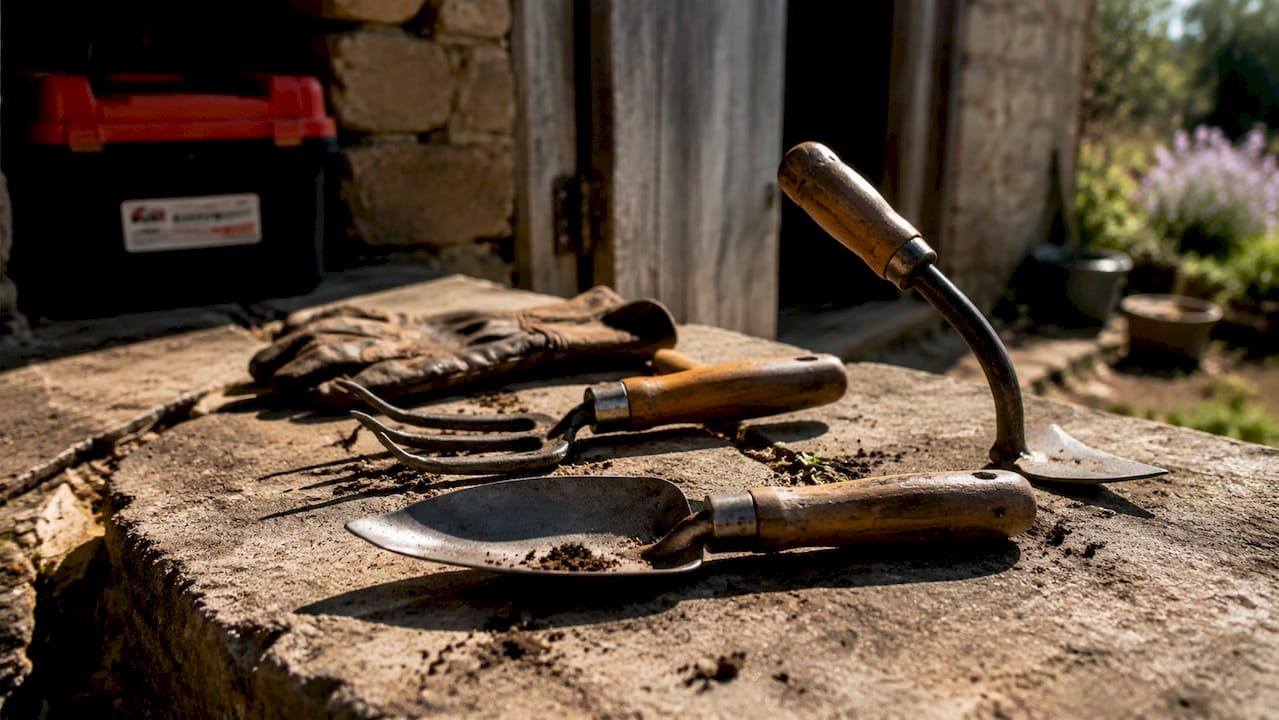
The key to getting value from hand tools is matching the tool to the task. A flat hoe works for surface weeding, but a ridging hoe is the right choice for forming planting furrows. Using the wrong tool wastes time and damages soil structure.
Tillage implements and planting equipment
Tillage implements include moldboard plows, disc harrows, chisel plows, and rotary tillers. A moldboard plow inverts the soil layer completely, burying crop residue and exposing fresh soil for planting. A disc harrow follows primary tillage to break up clods and create a finer seedbed. Rotary tillers, often mounted on compact tractors like the Iseki TLE, combine both functions in a single pass.
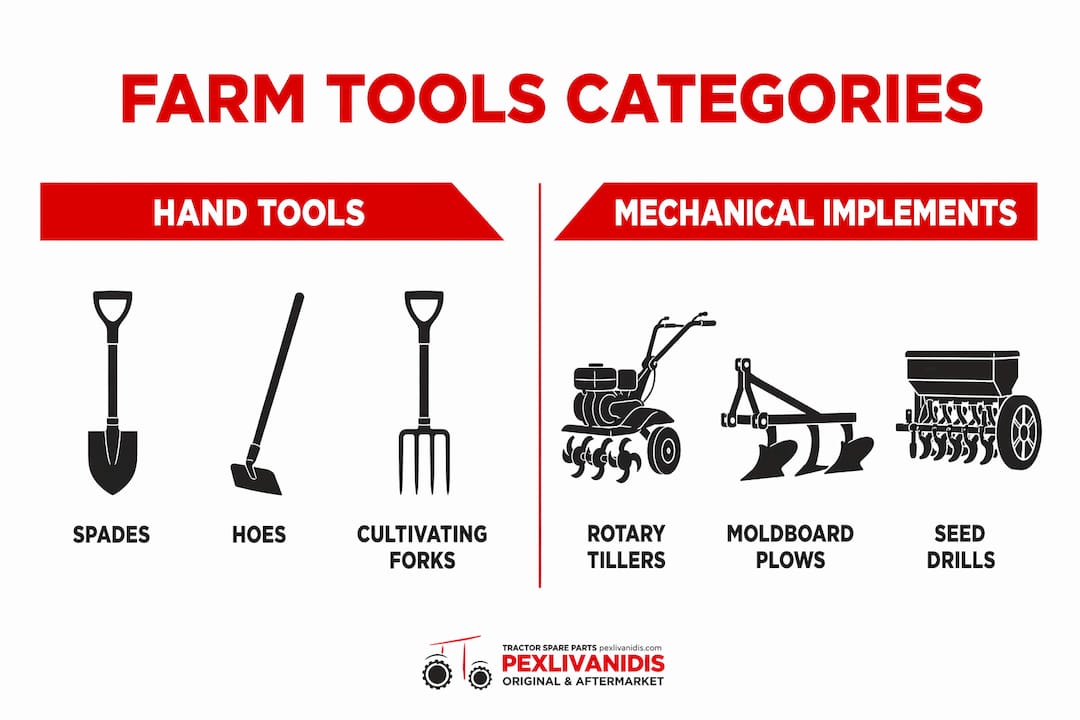
Planting tools range from simple hand dibbers to GPS-enabled seed drills. Precision planters with 65-88% improved seed placement accuracy reduce seed waste and produce more uniform plant populations. More uniform populations mean easier mechanical harvesting and more predictable yields.
Harvesting machinery and how to choose
Combine harvesters, forage choppers, and grain carts handle the final stage of production. For smaller operations, walk-behind reapers and hand-operated grain threshers are cost-effective alternatives. The decision between machinery and hand tools should be based on acreage, crop type, and available labor.
| Tool Category | Best For | Key Examples |
|---|---|---|
| Hand tools | Small plots, transplanting, weeding | Spade, hoe, bolo, fork |
| Tillage implements | Soil preparation, seedbed creation | Moldboard plow, disc harrow, rotary tiller |
| Planting equipment | Seed placement, row establishment | Seed drill, precision planter, transplanter |
| Harvesting machinery | Large-scale grain and forage harvest | Combine harvester, forage chopper, reaper |
Pro Tip: Match your implement selection to your smallest field, not your largest. Oversized equipment on tight plots compacts headlands and wastes fuel on every turn.
How does the Iseki TLE compact tractor support diverse farm activities?
The Iseki TLE 4 series delivers 54.4 PS of turbo-diesel power through a 2-pedal hydrostatic transmission, giving operators smooth, stepless speed control without clutching. The rear lift capacity reaches 1,200 kg, which is sufficient for most three-point-hitch implements used on small to medium farms. Its compact dimensions allow it to work in orchards, polytunnels, and tight field corners where larger tractors cannot operate.
Ergonomic design and operator comfort
Japanese compact tractors like the Iseki TLE prioritize ergonomics and operator comfort through low-noise engine enclosures, a simplified control layout, and a flat platform that reduces fatigue during long work sessions. This matters more than most buyers realize. Operator fatigue is a leading cause of implement damage and field errors, particularly during planting and spraying operations where precision is critical.
The 2-pedal hydrostatic system removes the learning curve associated with manual gear tractors. New operators reach full productivity faster, and experienced operators can focus attention on the implement rather than the drivetrain.
Compatible attachments and use cases
The Iseki TLE’s three-point hitch and power take-off (PTO) system support a wide range of attachments. You can learn more about PTO system basics to understand how each attachment draws power from the tractor. Compatible implements include:
- Front loaders for material handling and manure management
- Rotary mowers and flail mowers for orchard floor and roadside maintenance
- Rear tillers for seedbed preparation in market gardens
- Trailers for produce and supply transport across the farm
- Snow blowers and front blades for winter maintenance on farm roads
This range of attachments makes the Iseki TLE one of the best farm equipment choices for operators who need one machine to handle multiple seasonal tasks. Exploring essential tractor accessories gives you a clear picture of which add-ons deliver the most return per investment.
Pro Tip: When switching between a front loader and a rear tiller on the same day, check your ballast weight distribution. Front loader work shifts weight forward; rear tiller work shifts it back. Incorrect ballast reduces steering control and tire wear.
What are the key maintenance practices for farm tools and the Iseki TLE?
Maintenance is the single largest factor separating equipment that lasts 20 years from equipment that fails at 5. Both hand tools and compact tractors require consistent attention, but the failure modes are very different.
Hand tool care: cleaning, sharpening, and storage
Clean hand tools after every use. Soil left on metal surfaces accelerates rust, particularly on cutting edges. A wire brush removes dried soil, and a light coat of linseed oil on wooden handles prevents cracking. Sharpen hoe blades and spade edges with a flat file at a 45-degree angle. A sharp hoe cuts weeds cleanly; a dull one pushes them aside and leaves roots intact.
Store hand tools off the ground, hanging on wall-mounted racks in a dry shed. Tools stored on concrete floors absorb moisture from below and rust from the inside of wooden handles outward. This is a common oversight that destroys otherwise serviceable equipment within a single wet season.
Iseki TLE hydraulic and mechanical maintenance
Hydraulic system integrity is the most critical maintenance area on the Iseki TLE. Neglecting hydraulic seals on compact tractors often leads to leaks that require full hydraulic block replacement after 60 to 70 hours of operation if seals fail early. Early detection is the only cost-effective solution. Check hydraulic connections and seals at every 50-hour service interval, and replace seals at the first sign of weeping fluid rather than waiting for a full leak.
Follow this maintenance sequence for the Iseki TLE:
- Check engine oil level and condition before every operating session.
- Inspect hydraulic fluid level and all visible hydraulic lines for seeping at 50-hour intervals.
- Clean the air filter every 100 hours, or more frequently in dusty conditions.
- Grease all PTO shaft and three-point hitch pivot points every 50 hours.
- Inspect tire pressure and wheel bolt torque at the start of each season.
- Calibrate all mounted implements, particularly planters and sprayers, before each use season.
Proper calibration of farm implements is critical to avoid under-application of seeds and fertilizers, which directly reduces yield without any visible warning until harvest.
Pro Tip: If the Iseki TLE engine cuts off unexpectedly during operation, check the operator presence sensor under the seat before calling a technician. Sensor glitches are commonly resolved by simply reseating yourself firmly on the operator platform, which resets the safety circuit.
How do advanced technologies in farm tools improve productivity?
Modern farm equipment has moved well beyond mechanical function. The best farm equipment today operates as a data platform, collecting field information and adjusting performance in real time.
Combine harvesters using AI-driven automation achieve 78 to 90% operational automation, handling threshing, winnowing, and grain separation with minimal operator input. This level of automation reduces operator fatigue on large operations and allows a single operator to manage harvest windows that previously required a full crew.
GPS-enabled precision planters represent the most accessible technology upgrade for mid-scale farms. These systems use field maps and real-time GPS data to vary seeding rates across a field based on soil type and historical yield data. The result is fewer seeds wasted on low-productivity zones and higher populations in high-yield areas.
| Technology | Efficiency Gain | Primary Benefit |
|---|---|---|
| AI-driven combine automation | 78-90% automation rate | Reduced operator fatigue, consistent threshing |
| GPS precision planters | 65-88% better seed placement | Lower seed cost, more uniform crop stands |
| Intelligent Power Management (IPM) | 40% ground prep efficiency | Faster field cycles, lower fuel consumption |
| Remote diagnostics | Continuous monitoring | Fewer unplanned breakdowns, longer equipment life |
High-horsepower tractors like the John Deere 8R series use Intelligent Power Management to improve ground preparation by 40% and reduce application time by 30%. These tractors function as technology platforms where features like AutoTrac autonomous guidance and remote diagnostics extend equipment lifespan without requiring replacement.
Integrating multiple operations into fewer field passes by combining tilling, planting, and fertilizing reduces soil compaction and improves profitability per acre. Fewer passes mean less fuel, less tire wear, and less structural damage to soil aggregates. For farms managing GPS-based crop management, this integration can translate to yield increases of up to 20%.
“The farms that get the most from technology are not the ones with the most equipment. They are the ones that use fewer, better-matched tools with consistent maintenance and calibration.”
What I’ve learned from years of working with farm tools and compact tractors
The most common mistake I see operators make is treating a compact tractor like a scaled-down version of a large row crop machine. It is not. The Iseki TLE and similar compact tractors are purpose-built for versatility in confined spaces, and that design philosophy requires a different operating mindset. You get the most from these machines by using the right attachment for each task rather than forcing one implement to do everything.
Hydraulic maintenance is where I see the most avoidable costs. Operators run the machine until a leak appears, then discover the repair bill is three times what a scheduled seal replacement would have cost. The hydraulic system on a compact tractor operates under high pressure in a small block. Small leaks escalate fast. Checking seals at 50-hour intervals is not overcautious. It is the minimum standard for protecting a significant investment.
On the technology side, I think the industry sometimes oversells automation as a replacement for operator skill. GPS planters and AI-driven harvesters are genuinely useful, but they perform best when the operator understands what the machine is doing and why. A precision planter calibrated incorrectly still plants at the wrong rate, regardless of how sophisticated the control system is. Technology amplifies good practice. It does not substitute for it.
My advice for operators choosing between traditional and modern tools: start with the tasks that consume the most labor hours and look for targeted solutions there. You do not need a fully automated operation to improve efficiency. One well-chosen implement, properly maintained and correctly calibrated, delivers more value than five underused attachments gathering dust in a shed.
— George
Upgrade your farm equipment knowledge with Pexlivanidis
Pexlivanidis stocks over 20,000 agricultural machinery parts and accessories, covering everything from Iseki TLE hydraulic seals to precision planter components. Whether you are sourcing spare parts for a compact tractor or planning an implement upgrade, the resources at Pexlivanidis give you the technical depth to make the right call. Start with the guide to essential machinery parts to identify which components your equipment needs most. For operators focused on keeping their machines running at peak performance, the machinery maintenance guide covers service intervals, hydraulic care, and implement calibration in practical detail. Pexlivanidis serves farmers and equipment operators across Thessaloniki, Kavala, and the wider region, with free shipping within Greece on orders over 100€.
FAQ
What does “farm tools TLE” refer to in agriculture?
“Farm tools TLE” refers to the combination of standard agricultural implements and the Iseki TLE compact tractor series, which is widely used in small to medium farm operations for soil preparation, planting, and transport tasks.
What are the most essential farm implements for a small farm?
The most practical implements for a small farm are a rotary tiller, a rear mower, a front loader, and a set of hand tools including spades, hoes, and forks. These cover soil preparation, vegetation management, and material handling across all seasons.
How often should you service an Iseki TLE compact tractor?
The Iseki TLE requires an engine oil check before every session, hydraulic seal inspection every 50 hours, and air filter cleaning every 100 hours. Neglecting hydraulic maintenance is the most common cause of costly block replacements on this model.
How do GPS precision planters improve crop yields?
GPS precision planters improve seed placement accuracy by 65 to 88%, reducing seed waste and producing more uniform plant populations. More uniform stands are easier to manage mechanically and produce more consistent yields at harvest.
What is the rear lift capacity of the Iseki TLE 4 series?
The Iseki TLE 4 series has a rear lift capacity of 1,200 kg, which is sufficient for most three-point-hitch implements used in market gardening, orchard management, and small-scale grain production.
Key takeaways
Matching the right farm tools to your operation, maintaining them consistently, and integrating targeted technology delivers more productivity than any single equipment upgrade alone.
| Point | Details |
|---|---|
| Classify tools by function | Build your agricultural tools list around tillage, planting, and harvesting stages to avoid gaps and redundancy. |
| Iseki TLE versatility | The 54.4 PS engine and 1,200 kg lift capacity support front loaders, tillers, mowers, and snow equipment across all seasons. |
| Hydraulic maintenance is critical | Inspect Iseki TLE seals every 50 hours to prevent leaks that escalate into full hydraulic block replacements. |
| Technology amplifies good practice | AI-driven combines and GPS planters improve efficiency only when correctly calibrated and operated by skilled users. |
| Fewer passes, better outcomes | Combining tilling, planting, and fertilizing in fewer field passes reduces soil compaction and lowers operating costs. |