

Modern farms depend on more than just seeds and weather—the right tillage equipment can boost crop yields by up to 30 percent according to leading agricultural studies. With growing pressure to feed a rising population, preparing soil efficiently has never been more important. Understanding how different tillage machines transform raw ground into fertile fields helps both seasoned farmers and newcomers make choices that improve productivity and protect land for future harvests.
Table of Contents
- What Is Tillage Equipment and Its Role
- Types of Tillage Equipment Explained
- Key Features and How Each Type Works
- Safe Operation and Maintenance Essentials
- Cost, Efficiency, and Buying Considerations
Key Takeaways
| Point | Details |
|---|---|
| Role of Tillage Equipment | Tillage equipment mechanically manipulates soil to optimize conditions for crop production, including seed germination and weed control. |
| Types of Tillage Equipment | Equipment is categorized into primary and secondary types, each serving distinct purposes in soil management and crop preparation. |
| Operational Safety and Maintenance | Implementing proper safety checks and routine maintenance are crucial for efficient tillage operations and to prolong equipment lifespan. |
| Cost and Efficiency Considerations | Farmers should evaluate the total cost of ownership—including purchase, maintenance, and operational efficiency—when selecting tillage equipment for their farms. |
What Is Tillage Equipment and Its Role
Farmers have used mechanical soil manipulation techniques for centuries, but modern tillage equipment represents a sophisticated approach to preparing agricultural land for optimal crop production. According to Britannica, tillage involves the mechanical manipulation of soil to prepare it for planting, control weeds, and manage crop residues – a critical process in sustainable agriculture.
The primary purpose of tillage equipment is transforming raw land into a productive growing environment. Wikipedia explains that tillage refers to agricultural soil preparation through mechanical agitation, which includes digging, stirring, and overturning the ground. These mechanical interventions create a favorable soil environment that supports:
- Seed germination
- Root development
- Organic matter incorporation
- Weed control
- Soil structure improvement
Modern tillage equipment ranges from traditional plows to advanced multi-functional implements designed to minimize soil disruption while maximizing agricultural productivity. By carefully breaking up and aerating soil, these machines help farmers create optimal conditions for crop growth. The equipment works by loosening soil layers, creating fine seedbeds, and preparing ground for planting – essentially serving as a critical bridge between raw land and productive agricultural space.
Understanding the nuanced role of tillage equipment means recognizing it as more than just machinery. These tools represent a sophisticated agricultural technology that balances mechanical intervention with ecological sensitivity, helping farmers transform potential farmland into thriving, productive growing environments.
Types of Tillage Equipment Explained
Tillage equipment can be strategically classified into distinct categories that serve different agricultural preparation purposes. Britannica provides a foundational breakdown, distinguishing between primary tillage and secondary tillage implements – each playing a unique role in soil management and crop preparation.
Primary Tillage Equipment
Primary tillage tools are designed for deep soil penetration and initial ground preparation. These heavy-duty implements perform critical functions like:
- Breaking up compacted soil layers
- Turning over soil completely
- Integrating crop residues
- Creating initial ground disruption
Common primary tillage equipment includes:
- Moldboard plows
- Chisel plows
- Deep rippers
- Subsoilers
Secondary Tillage Equipment
Wikipedia highlights disc harrows as a prime example of secondary tillage tools. These implements focus on refining the soil surface after primary tillage. Secondary equipment typically aims to:
- Break up soil clods
- Create smooth planting surfaces
- Control emerging weeds
- Incorporate additional organic matter
Typical secondary tillage tools include:
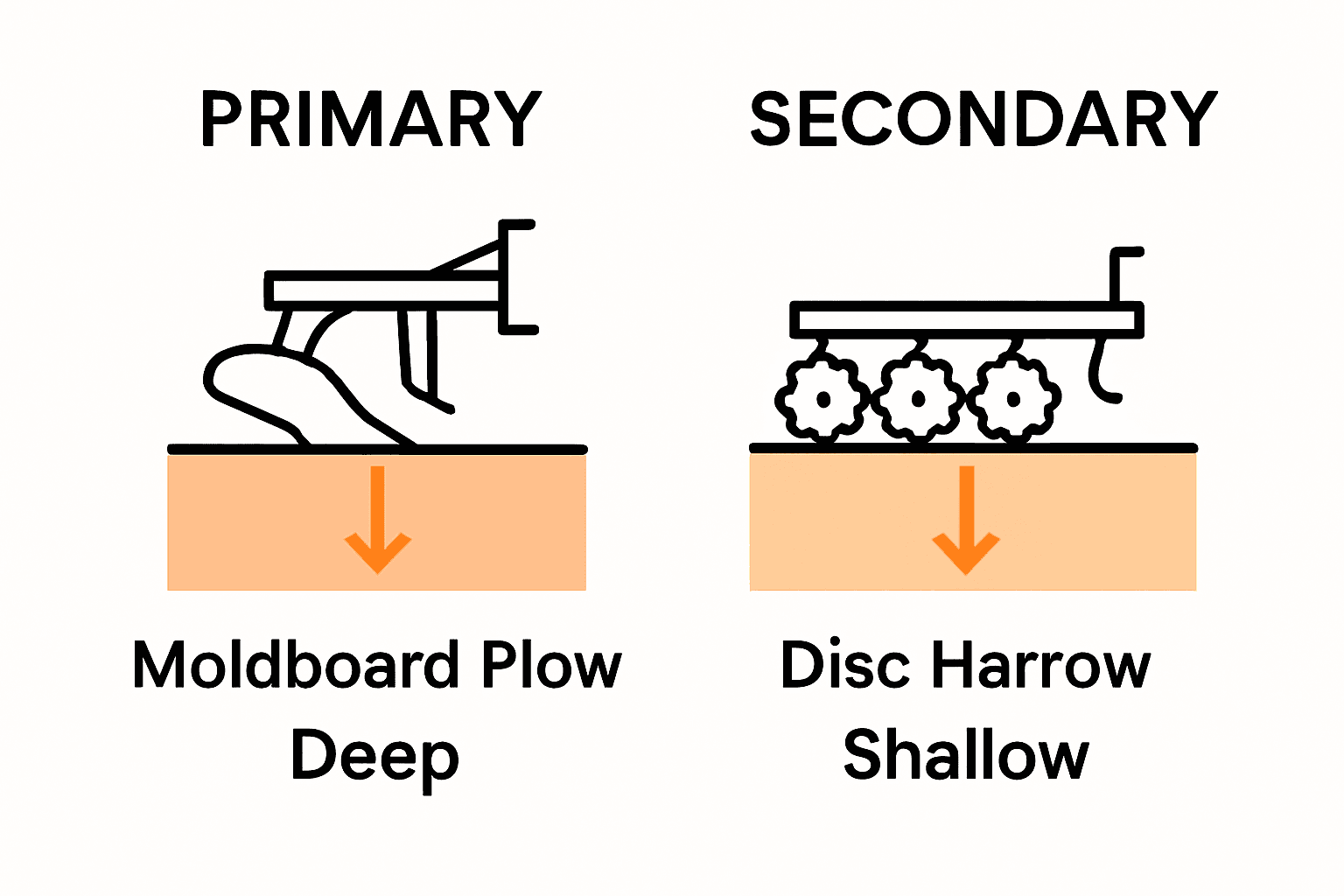
- Disc harrows
- Rotary hoes
- Field cultivators
- Spike-tooth harrows
The progression from primary to secondary tillage represents a sophisticated approach to soil preparation. While primary tools create major structural changes, secondary implements fine-tune the ground, ensuring an optimal environment for seed germination and crop growth. Farmers select and combine these tools based on specific soil conditions, crop types, and local agricultural practices.
Key Features and How Each Type Works
Understanding the intricate mechanisms of tillage equipment reveals the sophisticated engineering behind agricultural soil preparation. Different implements are designed with specific features to address unique soil management challenges and optimize crop production conditions.
Moldboard Plow Mechanics
According to Wikipedia, the moldboard plow represents a classic tillage tool with a unique design featuring a curved blade that fundamentally transforms soil structure. Its primary function involves cutting through soil and completely inverting it, which accomplishes several critical agricultural objectives:
- Burying crop residues and weeds
- Improving soil aeration
- Creating a clean seedbed
- Disrupting potential pest habitats
Subsoiler Deep Penetration
Wikipedia explains that subsoilers are specialized implements engineered for deep soil intervention. These tools feature long, powerful shanks that penetrate beneath the traditional plow layer, addressing soil compaction issues that standard tillage equipment cannot resolve.
Subsoilers work by:
- Breaking up hardpan layers
- Enhancing root growth potential
- Improving water infiltration
- Minimizing topsoil disturbance
The strategic design of subsoilers allows farmers to address deep soil structural problems without completely turning over the entire soil profile. By creating vertical fractures in compacted layers, these implements promote better drainage, root exploration, and overall soil health.
Effective tillage equipment selection requires understanding these nuanced mechanical approaches.
Farmers must consider soil type, crop requirements, and environmental conditions when choosing between different tillage implements, ensuring optimal ground preparation for maximum agricultural productivity.
Safe Operation and Maintenance Essentials
Operating tillage equipment involves more than just understanding its mechanical functions – it requires a comprehensive approach to safety, maintenance, and professional care. Britannica emphasizes that proper maintenance is crucial to ensuring efficient operation and preventing potential soil and equipment damage.
Pre-Operation Safety Checklist
Before engaging any tillage implement, farmers must conduct a thorough equipment inspection:
- Check all bolts and connections for tightness
- Inspect hydraulic lines for wear or leaks
- Verify proper tire inflation
- Examine cutting edges and wear points
- Ensure all safety shields are in place
- Test all mechanical and hydraulic functions
Maintenance Best Practices
Wikipedia highlights the importance of component-specific maintenance, particularly for implements like disc harrows. Critical maintenance steps include:
- Lubricating moving parts regularly
- Checking disc integrity and alignment
- Replacing worn components promptly
- Cleaning equipment after each use
- Storing implements in protected areas
Safe operation also demands understanding equipment limitations and matching implements to specific soil conditions. Farmers must adjust equipment settings according to ground type, moisture levels, and topographical variations. Personal protective equipment like sturdy boots, close-fitting clothing, and protective eyewear are essential during tillage operations.
Ultimately, equipment maintenance is an investment in both agricultural productivity and personal safety. Regular inspections, timely repairs, and adherence to manufacturer guidelines transform tillage equipment from mere tools into reliable, long-lasting agricultural assets.
Cost, Efficiency, and Buying Considerations
Selecting the right tillage equipment represents a significant investment that extends far beyond initial purchase price. Britannica emphasizes that farmers must consider multiple factors when evaluating equipment, including initial cost, operational efficiency, and compatibility with existing machinery.
Financial Considerations
Investing in tillage equipment involves analyzing several critical financial dimensions:
- Upfront equipment cost
- Maintenance and repair expenses
- Fuel consumption rates
- Potential productivity improvements
- Long-term soil health benefits
- Depreciation and resale value
Efficiency Evaluation
Wikipedia highlights that equipment efficiency depends on complex interactions between:
- Specific soil types
- Crop requirements
- Field topographical conditions
- Climate and seasonal variations
Smart purchasing decisions require farmers to look beyond the price tag and assess the total cost of ownership. This means calculating potential yield increases, fuel savings, and reduced soil compaction that high-quality implements can deliver. Modern tillage equipment represents an investment in agricultural productivity, with advanced designs offering improved efficiency, reduced environmental impact, and enhanced crop performance.
Ultimately, the most expensive equipment isn’t always the best choice. Farmers must balance technological features, performance capabilities, and budget constraints. Consulting with local agricultural experts, comparing multiple options, and understanding your specific farm’s unique requirements will guide you toward the most appropriate tillage equipment investment.
Optimize Your Tillage Equipment Performance with Reliable Spare Parts
Preparing your fields for planting requires the right tillage equipment working at its best. Whether you use a moldboard plow to invert soil, a subsoiler to break compacted layers, or disc harrows for refining seedbeds, maintaining these tools directly impacts your crop success. The challenges of wear and tear, timely maintenance, and the need for compatible, durable spare parts can slow down your farming operations and affect soil health.
At pexlivanidis.com, we understand the importance of keeping your tillage implements in top condition. With over 20,000 agricultural machinery parts available, including tractor accessories and specialized components for primary and secondary tillage equipment, we make it easy to find exactly what your farm needs. Enjoy free shipping across Greece on orders over 100€ and access wholesale options if you run a larger operation. Do not let worn-out parts or delayed maintenance hold back your productivity.
Explore our extensive inventory today at pexlivanidis.com and discover how quality parts can extend the life of your tillage equipment. Need help selecting the right components for your specific soil and crop needs? Contact our expert team through the website to get personalized advice and keep your soil preparation efficient and safe. Upgrade your tillage tools now and take the first step toward a more productive season.
Frequently Asked Questions
What is the primary purpose of tillage equipment?
The primary purpose of tillage equipment is to transform raw land into a productive growing environment by mechanically manipulating the soil to prepare it for planting, control weeds, and manage crop residues.
What are the main types of tillage equipment?
Tillage equipment is primarily classified into primary tillage tools, which break up compacted soil and prepare the ground, and secondary tillage tools, which refine the soil surface and control weeds after primary tillage.
How does a moldboard plow work?
A moldboard plow uses a curved blade to cut through and invert soil, burying crop residues and weeds while improving soil aeration and creating a clean seedbed for planting.
What maintenance practices are essential for tillage equipment?
Essential maintenance practices include conducting pre-operation inspections, lubricating moving parts, replacing worn components promptly, and cleaning equipment after use to ensure efficient operation and longevity.