

TL;DR:
- A tractor PTO shaft transfers engine power to attached implements, requiring correct matching of speed, spline, torque rating, and engagement type. Using incompatible shafts or improper adapters increases equipment failure, safety hazards, and maintenance costs. Proper measurement, maintenance, and understanding of shaft specifications ensure reliable operation and prevent avoidable failures.
A tractor PTO shaft is a rotating mechanical component that transfers engine power from the tractor to an attached implement. Understanding tractor PTO shaft types means knowing four classification factors: rotational speed, spline configuration, series torque rating, and engagement mechanism. Manufacturers like Walterscheid and Bondioli & Pavesi build shafts to strict industry standards, and choosing the wrong type causes equipment failure, safety hazards, and costly downtime. This guide breaks down every classification so you can match the right shaft to your tractor and implement every time.
What are the main tractor PTO shaft types by speed and spline?
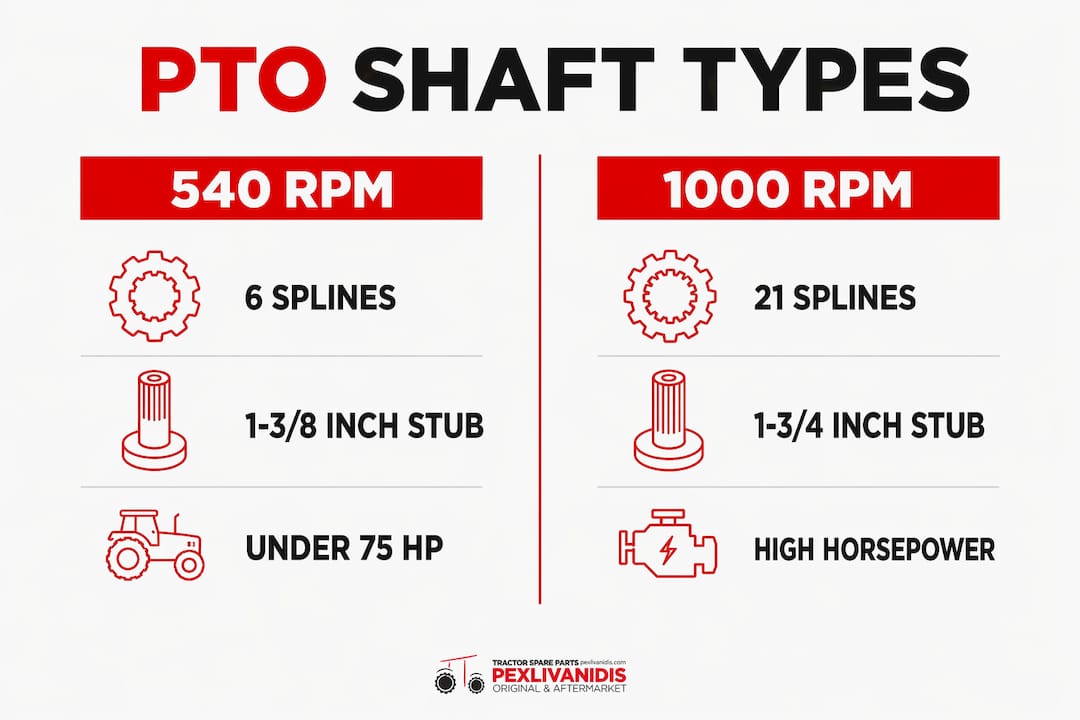
The two primary tractor PTO shaft types are the 540 RPM shaft and the 1000 RPM shaft. Each runs at a different speed and uses a different spline count, which means they are physically incompatible with each other without an adapter.
540 RPM PTO shafts use 6 splines on a 1-3/8 inch stub and are suited for implements under 75 HP. This covers the majority of mid-sized farm equipment: finish mowers, small balers, tillers, and augers. The 540 RPM standard is the most common configuration you will find on compact and utility tractors.
1000 RPM shafts carry 21 splines on a 1-3/4 inch stub and are built for high-capacity, high-horsepower implements. Large round balers, heavy rotary cutters, and grain augers running on 100+ HP tractors all require 1000 RPM connections. A 20-spline variant also exists on some older European equipment, so always verify the spline count before ordering a replacement shaft.
| Specification | 540 RPM Shaft | 1000 RPM Shaft |
|---|---|---|
| Spline Count | 6 splines | 21 splines |
| Stub Diameter | 1-3/8 inch | 1-3/4 inch |
| Typical HP Range | Up to 75 HP | 75 HP and above |
| Common Implements | Tillers, small balers, mowers | Large balers, heavy cutters, grain augers |
| Shaft Speed | 540 RPM | 1000 RPM |
Mismatching speed and spline configurations does not just reduce performance. It causes immediate mechanical failure and creates serious safety risks for the operator. Adapters that convert between 6-spline and 21-spline shafts increase leverage and stress on seals and bearings, accelerating premature failure. Use adapters only as a short-term fix, never as a permanent solution.
Pro Tip: Before you buy any PTO shaft, count the splines on your tractor’s PTO stub and check the implement’s input shaft. A five-second check prevents an expensive mistake.
How do PTO shaft series ratings affect your shaft choice?
Series ratings classify PTO shafts by their torque capacity and universal joint size. Series classifications run from Series 1 through Series 6, with Series 1 covering 20–35 HP applications and Series 6 rated for 60–100+ HP heavy-duty work. Torque capacity ranges from roughly 2,000 lb-in in light-series shafts to over 5,500 lb-in in the heaviest configurations.
Choosing the correct series is not just about matching your tractor’s rated HP. Shock-loading applications like rotary cutters hitting rocks, or stump grinders encountering hard ground, generate torque spikes well above steady-state operating loads. High shock and torque spike applications require a shaft series rated above nominal PTO horsepower to prevent constant shear pin or slip clutch activation. Always build in a safety margin of at least one series above your calculated requirement when running aggressive implements.
| Series | Typical HP Range | Approx. Torque Capacity | Common Applications |
|---|---|---|---|
| Series 1 | 20–35 HP | Up to 2,000 lb-in | Small tillers, seeders |
| Series 2 | 35–50 HP | Up to 2,800 lb-in | Mid-size mowers, spreaders |
| Series 3 | 50–65 HP | Up to 3,500 lb-in | Hay rakes, medium balers |
| Series 4 | 65–80 HP | Up to 4,200 lb-in | Large mowers, heavy tillers |
| Series 5 | 80–100 HP | Up to 4,900 lb-in | Round balers, large augers |
| Series 6 | 100+ HP | 5,500+ lb-in | Heavy rotary cutters, industrial implements |
Cross-checking your implement’s torque requirement against the shaft’s rated capacity is the single most important step in shaft selection. Your implement’s manual will list the required input torque. If it does not, contact the manufacturer directly before purchasing a shaft.
Pro Tip: When running a rotary cutter or wood chipper, go one series higher than the math suggests. The cost difference between Series 3 and Series 4 is minor. The cost of a failed universal joint mid-season is not.
What are the common PTO engagement mechanisms?
PTO engagement type determines how and when power flows from the tractor to the implement. There are four main systems, and each suits different farming operations.
Transmission PTO, Live PTO, and Independent PTO each deliver power differently, and the distinction matters for both productivity and safety. Here is how each system works:
- Transmission PTO: Power stops the moment you press the clutch. This is the oldest and simplest design, found on older tractors. It works for stationary applications like running a grain auger, but it is a poor choice for any implement that needs to keep spinning while you reposition the tractor.
- Live PTO: Uses a two-stage clutch. The first stage disengages the transmission while the PTO keeps running. The second stage stops both. This lets you slow or stop the tractor without killing the implement, which is useful for baling and mowing.
- Independent PTO (IPTO): Uses a dedicated hydraulic or mechanical clutch that operates completely separately from the tractor’s drivetrain. IPTO allows engagement at any time regardless of tractor speed and is the standard on modern tractors. It gives you the most precise control and is the preferred system for tasks like running a front-mount loader attachment or a precision seeder.
- Economy PTO (540E): Delivers 540 RPM PTO speed at a lower engine RPM than standard. Economy PTO reduces fuel consumption and noise during light-duty operations like running sprayers or small threshers. Most farmers underuse this setting despite its real fuel savings on long days.
Independent PTO systems significantly reduce drivetrain shock and improve implement control. That is a key reason why IPTO has become standard on virtually every new utility and row-crop tractor sold today.
For a deeper look at how these systems interact with your tractor’s drivetrain, the tractor PTO basics guide at Pexlivanidis covers the full picture clearly.
What practical tips should farmers know about PTO shaft safety?
Selecting the right shaft type is only half the job. Proper measurement, installation, and maintenance determine whether that shaft lasts one season or ten.
Incorrect PTO shaft length causes catastrophic mechanical failure in two ways. A shaft that is too short pulls apart during operation. A shaft that is too long bottoms out and destroys the gearbox. Measure both the minimum collapsed distance and the maximum extended distance between your tractor’s PTO stub and the implement’s input shaft before ordering.
Matching spline size is necessary but not sufficient. You must also verify collapsed and extended shaft lengths to avoid driveline damage during operation. This is the step most operators skip, and it is the most common cause of mid-season shaft failures.
Here are the top maintenance and safety practices every operator should follow:
- Lubricate regularly. Grease all universal joints and slip clutch components according to the manufacturer’s schedule. Dry joints fail fast under load.
- Inspect the PTO shield. A damaged or missing shield is a serious safety hazard. Replace it before operating.
- Check for wear at the splines. Worn splines on either the tractor stub or the implement input shaft cause slippage and heat buildup.
- Store shafts properly. Hang shafts vertically or store them flat. Storing them bent or under weight warps the telescoping tubes.
- Never exceed rated torque. If your slip clutch is activating frequently, the shaft series is too light for the application.
Proper lubrication, shield integrity, and regular inspection are the three factors that most directly extend PTO shaft service life and prevent accidents.
Pro Tip: Measure your shaft length with the implement in the position it will be in during the tightest turn you make in the field, not just in a straight line. Shafts that fit straight often pull apart in a sharp turn.
Key takeaways
Selecting the right PTO shaft requires matching rotational speed, spline count, series torque rating, and engagement type to both your tractor and your implement’s specific demands.
| Point | Details |
|---|---|
| Speed and spline must match | 540 RPM uses 6 splines; 1000 RPM uses 21 splines. Never mix without understanding the risks. |
| Series rating determines torque safety | Choose a series rated above your nominal HP when running shock-load implements like rotary cutters. |
| Engagement type affects control | Independent PTO gives the most operator control and is standard on modern tractors. |
| Shaft length is critical | Measure minimum and maximum distances to prevent bottoming out or pulling apart during operation. |
| Maintenance extends service life | Regular lubrication, shield checks, and spline inspections prevent the most common shaft failures. |
Why i think most PTO shaft failures are completely avoidable
The most common mistake I see is operators confusing engine horsepower with PTO horsepower. PTO horsepower is always lower than gross engine horsepower, and sizing a shaft to the engine spec rather than the actual PTO output leads to either an undersized shaft or a false sense of safety margin. Get the PTO HP number from your tractor’s spec sheet, not the marketing brochure.
The second mistake is treating adapters as a permanent solution. Operators consistently underestimate the mechanical risks of adapters converting between different spline types, especially under heavy or variable loads. I have seen shafts with adapters fail within a single season on work that a correctly matched shaft would handle for years.
Investing in a quality shaft from a manufacturer like Walterscheid or Bondioli & Pavesi, sized correctly for the series and engagement type, costs less than one repair call. The complete PTO shaft guide at Pexlivanidis is a resource I recommend to anyone who wants to go deeper on specifications before buying.
— George
Find the right PTO shaft parts at Pexlivanidis
Pexlivanidis stocks over 20,000 agricultural machinery parts, including PTO shafts, universal joints, and driveline components suited for every series rating and spline configuration. Whether you are replacing a worn Series 3 shaft on a mid-size baler or sourcing a 1000 RPM input shaft for a heavy rotary cutter, the catalog covers both retail and wholesale needs. Explore the full breakdown of agricultural machinery parts to find compatible components for your tractor and implement combination. For ongoing upkeep, the machinery maintenance guide at Pexlivanidis walks through service intervals and inspection checklists that keep your driveline running season after season.
FAQ
What is the difference between 540 and 1000 RPM PTO shafts?
540 RPM shafts use 6 splines and suit implements under 75 HP, while 1000 RPM shafts use 21 splines and are built for high-capacity, high-horsepower equipment. The two types are physically incompatible without an adapter.
How do i know which PTO shaft series i need?
Match the series to your implement’s torque requirement, then go one series higher for shock-load applications like rotary cutters or wood chippers. Series ratings run from Series 1 at 20–35 HP up to Series 6 at 100+ HP.
What is an independent PTO and why does it matter?
Independent PTO uses a dedicated clutch that operates separately from the tractor’s transmission, allowing you to engage or disengage the implement at any tractor speed. It gives the most precise control and is standard on modern utility and row-crop tractors.
Can i use an adapter to connect a 540 RPM shaft to a 1000 RPM implement?
Adapters exist for this conversion, but they increase mechanical stress on seals and bearings and risk premature failure, especially under heavy loads. Use a correctly matched shaft whenever possible.
How do i measure the correct PTO shaft length?
Measure the distance between the tractor PTO stub and the implement input shaft at both the minimum collapsed position and the maximum extended position during operation, including during tight turns. A shaft that fits straight can pull apart in the field if the range is not verified.