

TL;DR:
- A CAT 1 tractor is defined by its three-point hitch standards, using specific pin sizes and spacing, not by horsepower or brand. It typically handles 20 to 45 HP engines and supports various small-scale farming implements with compatible dimensions and weight ratings. Proper measurement and verification of hitch specifications are essential to ensure safe and effective implement attachment and operation.
If you’ve spent any time shopping for farm equipment, you’ve run into the term “CAT 1 tractor” and probably wondered whether it refers to a brand, a horsepower range, or something else entirely. The answer surprises most people. A CAT 1 tractor is defined not by its engine size or manufacturer but by the ISO 730 linkage standard governing its three-point hitch system. Get this wrong, and you’ll be standing in a field with an implement that physically won’t attach to your tractor. Get it right, and you’ll match equipment with confidence every single time.
Table of Contents
- Key takeaways
- What is a CAT 1 tractor: the spec that actually defines it
- What a CAT 1 tractor does and who uses it
- Category 0, 1, and 2: understanding the differences
- Selecting implements safely for a CAT 1 tractor
- My honest take on the CAT 1 category confusion
- Find the right parts and implements at Pexlivanidis
- FAQ
Key takeaways
| Point | Details |
|---|---|
| CAT 1 is a hitch standard | Category 1 refers to the ISO 730 linkage spec, not a horsepower class or brand name. |
| Pin sizes define the category | Top link pin is 19mm and lower hitch pins are 22mm, with 28-inch lower hitch spacing. |
| Typical power range is 20 to 45 HP | Horsepower correlates to Category 1, but pin dimensions are the actual standard. |
| Ideal for small to medium farms | CAT 1 tractors handle mowing, tilling, scraping, and post-hole digging on moderate acreage. |
| Adapters exist but have limits | Cat 0 implements can adapt to Cat 1 hitches, but going the other direction is rarely practical. |
What is a CAT 1 tractor: the spec that actually defines it
The most important thing to understand about a CAT 1 tractor is that “Category 1” is a hitch specification, not a brand designation. You’re not looking at a Caterpillar machine. You’re looking at a tractor whose rear three-point hitch conforms to the Category 1 standard under ISO 730.
Here are the exact numbers that define a Category 1 three-point hitch:
| Hitch Component | Category 1 Specification |
|---|---|
| Top link pin diameter | 19mm (0.75 inch) |
| Lower hitch pin diameter | 22mm (0.875 inch) |
| Lower hitch point spacing | 710mm (28 inches) |
| Typical power range | 20 to 45 HP |
| Typical lift capacity | Up to 2,500 lbs |
The Category 1 hitch specs listed above are the literal definition of what makes a tractor fall into this category. A tractor making 38 HP with the correct pin sizes and spacing is a CAT 1 machine. A tractor making the same 38 HP with different pin dimensions is not.
Lift capacity is another number worth knowing. CAT 1 tractors typically lift up to 2,500 pounds, though the actual figure varies based on hydraulic geometry and tractor model. Physical size also plays a role in where you can use them. These machines typically measure 40 to 60 inches wide, which means they can operate in areas where a larger tractor simply won’t fit.
Pro Tip: Before you buy any implement for a CAT 1 tractor, measure the lower hitch pin spacing on your tractor rather than relying on the spec sheet. Older or non-standard machines can vary slightly, and 5 minutes with a tape measure prevents a frustrating trip back to the dealer.
What a CAT 1 tractor does and who uses it
Small farms and property owners represent the core audience for CAT 1 tractors, and for good reason. The size and power balance these machines offer makes them incredibly practical for anyone managing 5 to 100 acres without needing heavy industrial equipment.
The typical task list for a CAT 1 tractor reads like a checklist for small-scale land management:
- Rotary cutting and finish mowing for pasture maintenance and roadside cleanup
- Box scraping and grading to level driveways, manage runoff, and maintain dirt roads
- Tilling and soil prep before planting gardens, food plots, or pasture seeding
- Post-hole digging with a three-point auger for fence installation
- Front loader work on models equipped with a compatible loader package
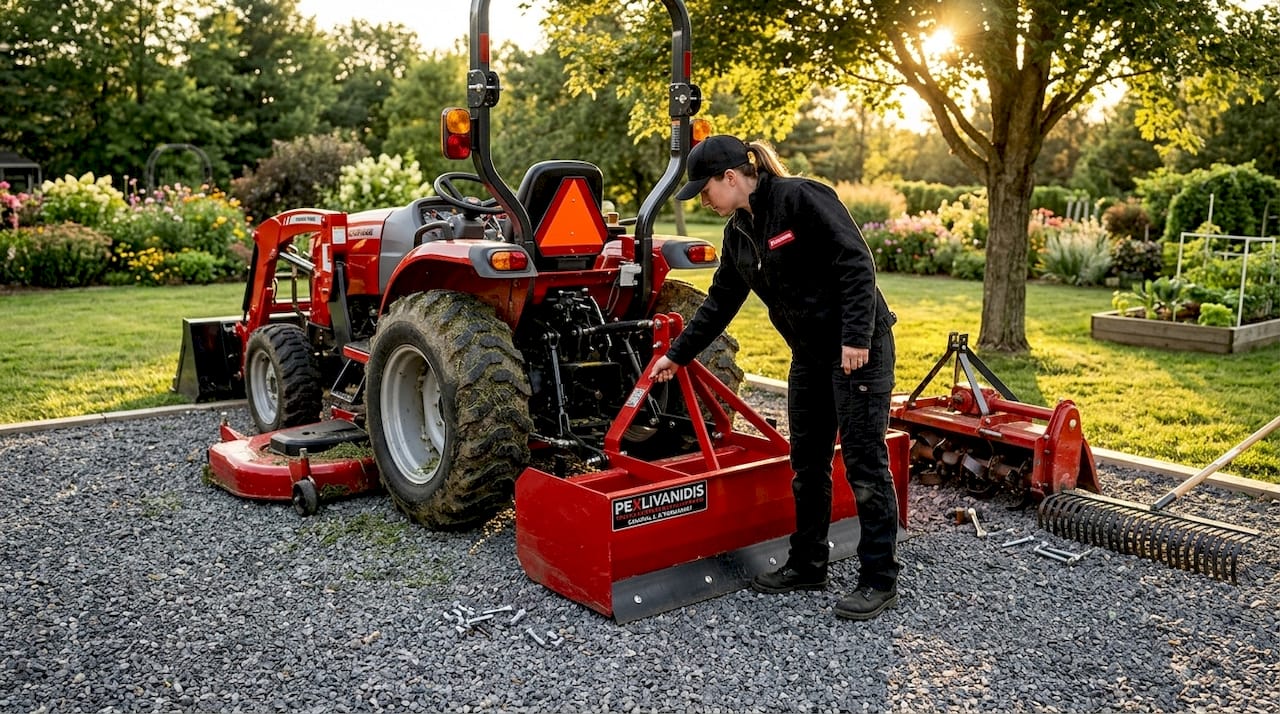
The agricultural implements you can run on a CAT 1 machine cover nearly every task a small to mid-sized operation needs. Rotary cutters, box blades, tillers, post-hole augers, rear blades, and landscape rakes all mount to a Category 1 hitch without modification.
Pro Tip: If you plan to run a rear tiller regularly, pay close attention to your tractor’s PTO horsepower rating, not just its engine HP. Tillers are PTO-driven and place heavy continuous demand on the drivetrain. A 30 HP tractor with a strong PTO rating will outperform a higher-HP machine with a weaker PTO output every time.
What makes these tractors so popular among property owners is versatility. A single machine can mow in the morning, grade a driveway in the afternoon, and dig post holes by the end of the day. That’s a lot of productivity from one piece of equipment sitting in a relatively compact footprint.
Category 0, 1, and 2: understanding the differences
This is where confusion tends to multiply. The three-point hitch system comes in multiple categories, and the differences between them are not cosmetic. They affect what implements physically fit your machine and how safely you can operate them.
Here’s a clear side-by-side comparison:
| Feature | Category 0 | Category 1 | Category 2 |
|---|---|---|---|
| Top link pin | 12.7mm | 19mm | 25.4mm |
| Lower hitch pins | 15.9mm | 22mm | 28.6mm |
| Lower hitch spacing | 478mm | 710mm | 870mm |
| Typical HP range | Under 20 HP | 20 to 45 HP | 40 to 100+ HP |
| Typical implement weight | Up to ~200 lbs | 300 lbs and up | 600 lbs and up |
The weight difference matters more than most buyers expect. Cat 0 implements weigh roughly 200 lbs or less, while Category 1 implements typically start at 300 lbs and climb considerably from there. Trying to run a full-sized Cat 1 implement on a Cat 0 hitch isn’t just a poor fit physically. It’s a structural mismatch that can damage the hitch arms or create unsafe lifting conditions.
Going the other direction is more manageable. Adapters allow Cat 0 implements to mount on Cat 1 hitches, which makes sense when you’re stepping up to a larger tractor but still own lighter implements. The reverse almost never works cleanly, so plan your purchases accordingly.
There’s one more variation worth knowing:
- Standard Category 1 is the full-spec hitch found on most 20 to 45 HP tractors.
- Limited Category 1 is a reduced version found on subcompact tractors. The limited Cat 1 hitch has a lower maximum lift height and reduced capacity, even though it uses the same pin sizes. You’ll see this on some subcompact models in the 15 to 25 HP range.
- Category 2 scales everything up for mid-range utility tractors and is not cross-compatible without adapters.
If you’re buying a subcompact tractor and the dealer says it has a “Cat 1 hitch,” ask specifically whether it’s a standard or limited Cat 1. The answer changes which implements will work safely.
Selecting implements safely for a CAT 1 tractor
Knowing the specs is one thing. Applying them correctly when you’re standing in front of a used implement or browsing an online listing is another. Here’s how to stay out of trouble.
The most common mistake buyers make is using horsepower as a proxy for hitch category. Relying on horsepower alone to match implements can cause connection failures or create unsafe conditions, especially when equipment crosses category lines. A 35 HP tractor might have a limited Cat 1 or a full Category 1 depending on the manufacturer and model year. Horsepower gives you a ballpark. Pin diameter gives you the answer.
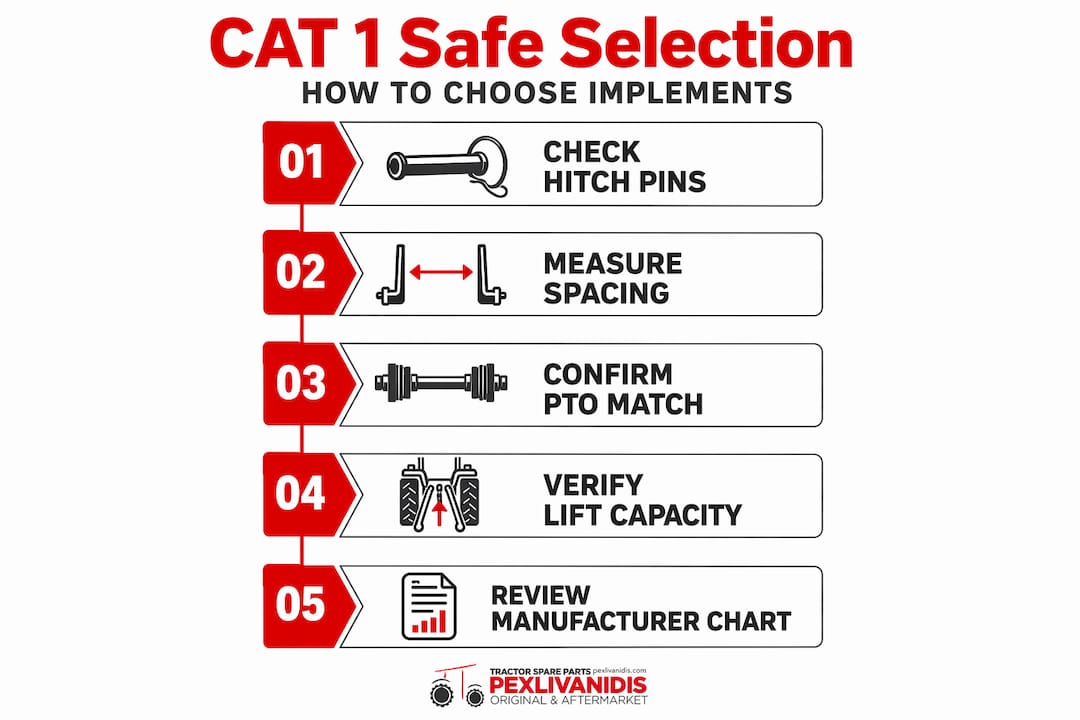
Follow this process when evaluating any implement:
- Measure or confirm the lower hitch pin spacing on your tractor (should be 710mm or 28 inches for standard Cat 1)
- Verify the implement’s pin hole sizes match your tractor’s lower link pins (22mm for Cat 1)
- Check the implement’s listed weight against your tractor’s rated lift capacity
- Review your tractor’s hydraulic capacity if running a loader simultaneously with a rear implement
Tractor compatibility is more nuanced than most people expect when they first start out. Even within Category 1, differences in top link geometry, PTO shaft height, and lift arm sway can affect how well a specific implement performs on a specific tractor.
Adapters can solve certain problems. Cat 0-to-Cat 1 adapters are widely available and let you run lighter legacy implements on a larger machine. Use them for occasional light-duty tasks, not for regular heavy work where the size mismatch puts continuous stress on the connection points.
Pro Tip: Always pull up the manufacturer’s implement compatibility chart, not just the category listing. Some implements are labeled “Cat 1 compatible” but have weight ratings that exceed what a lower-end Cat 1 tractor can safely lift. The chart tells the whole story.
My honest take on the CAT 1 category confusion
I’ve talked with dozens of small farm operators who bought their first tractor based on horsepower and figured they’d sort out the implement situation later. That approach works out fine sometimes. Other times, it means a box blade that won’t hook up or a tiller that sits 3 inches too low for the PTO shaft to reach.
What I’ve learned from watching these situations play out is that pin diameter is the definitive measure for hitch category, full stop. Horsepower is a useful correlation, but it’s not a standard. Two tractors with identical HP ratings can have entirely different hitch categories depending on who built them and when.
The other thing I’d push back on is the assumption that a limited Cat 1 hitch is “close enough” to a standard Cat 1 for all practical purposes. It isn’t. The reduced lift height on a limited Cat 1 machine becomes a real operational constraint the first time you try to use a rear box blade on uneven terrain. You find out quickly that “close enough” in specification terms does not mean “identical in the field.”
My advice: spend 20 minutes with the types of tractors guide before you buy, confirm every pin size and spacing number against the actual machine, and never trust a category label alone. The numbers don’t lie.
— George
Find the right parts and implements at Pexlivanidis
Once you understand your tractor’s hitch category, the next step is making sure every part attached to it is the right fit. Pexlivanidis carries an inventory of over 20,000 agricultural machinery parts and accessories, from hitch components to PTO parts and everything in between. Whether you’re sourcing a replacement lower link pin, looking for compatible tractor accessories, or checking up on what your Category 1 setup can realistically handle, the resources here cut through the guesswork.
Start with the agricultural machinery parts guide to understand what components keep your three-point hitch system performing reliably. If you’re thinking about upgrading your setup or adding a new implement this season, the agricultural machinery buying tips give you a practical framework for making smart decisions without overspending. Pexlivanidis supports both retail and wholesale customers across Greece, with free shipping on orders over 100€.
FAQ
What defines a CAT 1 tractor?
A CAT 1 tractor is defined by its three-point hitch conforming to the ISO 730 Category 1 standard, which specifies a top link pin of 19mm, lower hitch pins of 22mm, and lower hitch point spacing of 710mm (28 inches). It is not defined by brand or horsepower alone.
What horsepower range is considered CAT 1?
Category 1 tractors typically fall in the 20 to 45 HP range, though horsepower is a manufacturer correlation rather than the defining criterion. Pin size and hitch spacing are the actual standards.
Can I use Cat 0 implements on a CAT 1 tractor?
Yes, with adapters. Cat 0-to-Cat 1 adapters are widely available and allow lighter Cat 0 implements to mount on a Cat 1 hitch. The reverse, using Cat 1 implements on a Cat 0 hitch, is generally not advisable due to weight and structural mismatches.
What is the difference between a standard and limited CAT 1 hitch?
A limited Category 1 hitch uses the same pin dimensions as a standard Cat 1 but has a lower maximum lift height and reduced lift capacity. It is commonly found on subcompact tractors in the 15 to 25 HP range.
What implements work on a CAT 1 tractor?
Common Category 1 implements include rotary cutters, box blades, rear tillers, post-hole augers, landscape rakes, and rear blades. The key is confirming the implement’s pin sizes and weight fall within your specific tractor’s hitch and hydraulic ratings.