

Every American farmer knows that efficiency is the backbone of modern agriculture. With over 95 percent of American farms relying on tractors equipped with power take-off systems, understanding how these mechanical lifelines operate is more important than ever. Whether running a hay baler or a sprayer, the right PTO setup turns a single engine into the heart of every tool on the field. Explore how PTO technology saves time, cuts costs, and keeps American agriculture at the forefront of global farming.
Table of Contents
- Defining Power Take-Off in Tractors
- Key PTO Types and Their Differences
- How PTO Systems Operate Safely
- Common PTO Applications on Farms
- Risks, Maintenance, and Safety Measures
Key Takeaways
| Point | Details |
|---|---|
| Power Take-Off Mechanism | The PTO efficiently converts engine power to operate various agricultural equipment, enhancing productivity without the need for separate engines. |
| Types of PTO Systems | Various PTO types, particularly speed-based classifications, cater to specific farming tasks, enabling farms to select the right system for their needs. |
| Safety Precautions | Implementing strict safety measures, including protective shields and maintenance checks, is essential to prevent accidents related to PTO operations. |
| Versatile Applications | PTO systems support a wide range of agricultural implements, significantly improving operational efficiency and reducing equipment costs. |
Defining Power Take-Off in Tractors
A power take-off (PTO) represents a crucial mechanical interface that transforms a tractor’s engine power into functional energy for auxiliary agricultural equipment. Tractor PTO fundamentals enable farmers to power complex machinery without requiring separate independent engines, dramatically enhancing operational efficiency across diverse farming tasks.
At its core, a power take-off is a specialized mechanical system that transmits rotational power from a tractor’s engine to external implements through a standardized drive shaft. This innovative mechanism allows farmers to operate a wide range of attachments like hay balers, mowers, grain augers, and agricultural pumps using the tractor’s primary engine as the power source. The standard PTO design typically features a splined shaft that connects directly to the tractor’s transmission, enabling seamless power transfer.
The PTO system’s versatility makes it a fundamental component in modern agricultural machinery. By providing a universal power transmission method, PTOs dramatically reduce equipment complexity and cost. Farmers can quickly switch between different implements without investing in multiple specialized engines, saving significant time and financial resources. The standardized design means that most agricultural implements are engineered to connect directly to a tractor’s power take-off, creating a modular and adaptable farming equipment ecosystem.
Key PTO Types and Their Differences
Power take-off systems are not a one-size-fits-all solution. Agricultural equipment manufacturers have developed multiple PTO types to accommodate diverse farming needs, each with unique characteristics and performance specifications. Understanding these variations helps farmers select the most appropriate power transmission method for their specific operational requirements.
Speed-Based PTO Classifications emerge as a primary method of differentiation. PTO types are standardized according to rotational speeds and shaft dimensions, with each type serving distinct agricultural applications. For instance:
- Type 1 PTO: Operates at 540 rpm with a 1+3/8 inch, 6-spline shaft
- Type 2 PTO: Runs at 1,000 rpm with a 1+3/8 inch, 21-spline shaft
- Type 3 PTO: Operates at 1,000 rpm with a 1+3/4 inch, 20-spline shaft
- Type 4 PTO: Functions at 1,300 rpm with a 57.5 mm, 22-spline shaft
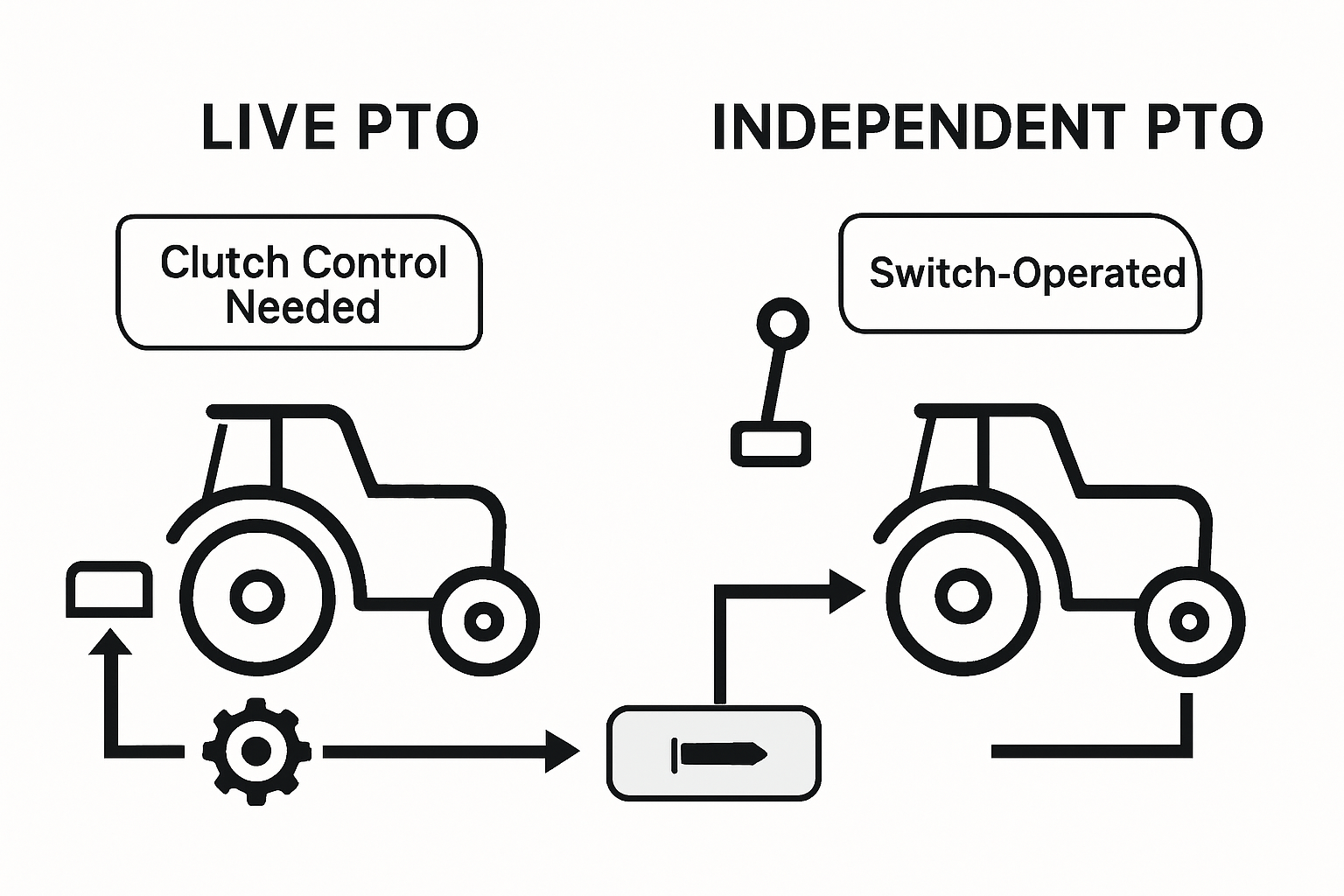
Beyond speed classifications, PTO systems are also categorized by operational control mechanisms. Live PTOs provide independent control of the PTO and tractor motion, allowing operators to engage or disengage power transmission without stopping the tractor. Conversely, non-live PTOs link PTO operation directly to the tractor’s movement, requiring the vehicle to be in motion for the attachment to function. This distinction significantly impacts farming efficiency, with live PTOs offering greater flexibility and precision in complex agricultural tasks.
How PTO Systems Operate Safely
Safety is paramount when working with power take-off systems. Tractor PTO fundamentals emphasize the critical importance of understanding and implementing comprehensive safety protocols to prevent potentially fatal accidents involving rotating machinery.
Farm safety experts recommend several key protective measures to minimize risks associated with PTO operations. These critical safety guidelines include:
- Always use appropriate shields to cover the PTO stub shaft when not in use
- Maintain a safe distance from the PTO during operation
- Shut down the PTO and engine completely before performing any maintenance
- Wear fitted clothing that cannot become entangled in moving parts
- Never step over or work near an exposed rotating shaft
PTO shaft guards must meet rigorous safety standards, ensuring maximum operator protection. These guards should be non-rotating, properly sized, and equipped with restraining devices. Proper maintenance of these protective mechanisms is crucial, as damaged or improperly installed guards can create false security and actually increase the risk of serious injury. Farmers and equipment operators must regularly inspect PTO shields for integrity, replacing any damaged or worn components immediately to maintain optimal safety standards.
Common PTO Applications on Farms
Power take-off systems transform tractors into versatile workhorses, enabling farmers to power a wide range of critical agricultural implements. Tractor PTO technologies have revolutionized farm operations by creating a universal power transmission method that supports multiple complex tasks simultaneously.
Farm implements rely extensively on PTO power transmission across diverse agricultural applications. The most common PTO-powered equipment includes:
- Mowing Equipment: Brush hogs and rotary mowers that cut through dense vegetation and maintain field boundaries
- Hay Production Tools: Balers that compress and package harvested hay
- Material Handling: Grain augers for moving and transferring agricultural products
- Irrigation Systems: Powerful water pumps for crop irrigation
- Crop Preparation: Sprayers for distributing fertilizers and pesticides
- Ground Preparation: Tillers and cultivators for soil management
The remarkable versatility of PTO systems allows farmers to quickly switch between different implements without investing in multiple specialized engines. This modular approach significantly reduces equipment costs and increases operational flexibility, enabling a single tractor to perform numerous critical farm tasks efficiently. By standardizing power transmission across different agricultural tools, PTO technology has become an indispensable innovation in modern farming practices.
Risks, Maintenance, and Safety Measures
Power take-off systems represent powerful yet potentially dangerous agricultural technologies that demand rigorous safety protocols. Tractor PTO safety fundamentals emphasize the critical importance of understanding and mitigating inherent mechanical risks associated with rotating machinery.
PTOs pose significant entanglement risks that can lead to serious injury or death, making comprehensive safety awareness essential for all farm operators. The most critical safety guidelines include:
- Maintain a constant safe distance from rotating PTO shafts
- Wear fitted clothing that cannot become entangled
- Never attempt to step over or reach around an exposed rotating shaft
- Stop the engine completely before performing any maintenance
- Ensure all protective shields are in place and undamaged
Regular inspection and maintenance of PTO shaft guards are crucial for preventing potential accidents. Operators must consistently verify that protective mechanisms meet recognized safety standards, including proper sizing, non-rotating design, and functional restraining devices. Damaged or improperly maintained guards can create false security and dramatically increase the risk of catastrophic injuries. Comprehensive safety training, coupled with meticulous equipment maintenance, represents the most effective strategy for minimizing risks associated with power take-off systems.
Enhance Your Tractor PTO Performance with Trusted Parts and Accessories
Maximizing your tractor’s power take-off efficiency means relying on durable components and proper accessories that guarantee safety and versatility on the farm. The article highlights challenges like ensuring PTO safety, maintaining protective shields, and selecting the right PTO type to match your equipment needs. If you want to avoid costly downtime, reduce risks linked to rotating shafts, and achieve seamless power transmission across various agricultural implements you need dependable parts designed for these exact purposes.
Discover a vast selection of tractor accessories and spare parts at Pexlivanidis that cater specifically to PTO systems and broader agricultural machinery requirements. With over 20,000 products in stock, free shipping on orders over 100€, and special offers for wholesale customers, this is your opportunity to boost farm productivity and safety today. Don’t wait until maintenance issues slow you down. Explore our inventory and get the right solutions now by visiting Pexlivanidis main site and experience hassle-free ordering and expert support.
Frequently Asked Questions
What is a Power Take-Off (PTO) in tractors?
A Power Take-Off (PTO) is a mechanical system that transfers the engine power of a tractor to various agricultural implements, allowing them to operate without needing separate engines.
What are the different types of PTOs available for tractors?
PTOs are categorized based on speed and operational control. Common types include Type 1 (540 rpm), Type 2 (1,000 rpm), Type 3 (1,000 rpm, larger shaft), and Type 4 (1,300 rpm), each suited for specific agricultural applications.
How can I ensure safe operation of PTO systems on my farm?
To operate PTO systems safely, always use appropriate shields, maintain a safe distance from the PTO during operation, turn off the PTO and engine before maintenance, wear fitted clothing, and regularly inspect protective covers for integrity.
What are some common applications of power take-off systems in agriculture?
Common applications of PTO systems include driving mowing equipment, hay balers, grain augers, irrigation pumps, sprayers, and ground preparation tools, making tractors versatile workhorses on farms.