

Finding dependable replacement parts for your tractor in Greece can be challenging, especially for operators in Thessaloniki and Kavala who rely on their equipment every day. Some believe any component will do the job, yet certified parts are tested and approved according to strict European and international safety standards, offering protection that generic alternatives often lack. This article uncovers vital truths and clears up common myths, showing you how the right choice keeps your machinery running safely and efficiently for seasons to come.
Table of Contents
- Certified Parts Explained And Common Myths
- Types Of Parts: Certified Vs. Aftermarket
- Quality Standards And Manufacturer Approval
- Impact On Safety, Performance, And Warranties
- Cost Analysis: Certified Versus Non-Certified
- Pitfalls Of Using Uncertified Tractor Parts
Key Takeaways
| Point | Details |
|---|---|
| Importance of Certified Parts | Certified parts ensure safety, performance, and compliance with regulations, distinguishing them from generic alternatives. |
| Myths About Certified Parts | Common misconceptions include beliefs that they are overly expensive or perform identically to generic parts, which can lead to unsafe choices. |
| Long-Term Financial Benefits | Investing in certified parts may involve higher upfront costs but results in lower maintenance and operational delays over time. |
| Risks of Non-Certified Parts | Using uncertified components can lead to safety hazards, performance failures, and voided warranties, compromising overall equipment effectiveness. |
Certified Parts Explained and Common Myths
Navigating the world of agricultural machinery parts can feel like threading a needle in a haystack. Many farmers mistakenly believe that all replacement components are created equal, but certified parts represent a critical distinction in equipment maintenance and safety. EU Machinery Directives establish clear guidelines that separate standard components from those meeting rigorous safety and performance standards.
Certified parts undergo extensive testing and evaluation to ensure they meet specific manufacturing requirements. These components are not just random replacements, but precision-engineered solutions designed to integrate seamlessly with your agricultural equipment. The certification process involves multiple critical assessments:
- Dimensional accuracy and tolerancing
- Material composition verification
- Structural integrity testing
- Performance under standard operational conditions
- Compliance with safety regulations
Unfortunately, several myths persist about certified parts that can mislead agricultural machinery operators. Let’s debunk some of the most common misconceptions:
- Myth: Certified parts are unnecessarily expensive
- Myth: Generic parts perform identically to certified components
- Myth: Certification is just a marketing strategy
- Myth: All parts meeting basic specifications are equally reliable
These myths can lead farmers to make risky decisions that compromise equipment performance and safety. Certified parts represent a critical investment in machinery longevity, operational efficiency, and worker protection. Unlike generic alternatives, these components undergo rigorous quality control processes that minimize potential equipment failure risks.
Certification is not an optional luxury—it’s a fundamental requirement for responsible agricultural machinery management.
Pro tip: Always request documentation proving the certification status of replacement parts before installation, and maintain a record of component traceability for future reference and potential warranty claims.
Types of Parts: Certified vs. Aftermarket
When maintaining agricultural machinery, farmers face a critical decision between certified parts and aftermarket components. While both options might seem similar at first glance, they represent dramatically different approaches to equipment maintenance and reliability. Understanding the fundamental differences can save significant time, money, and potential equipment damage.
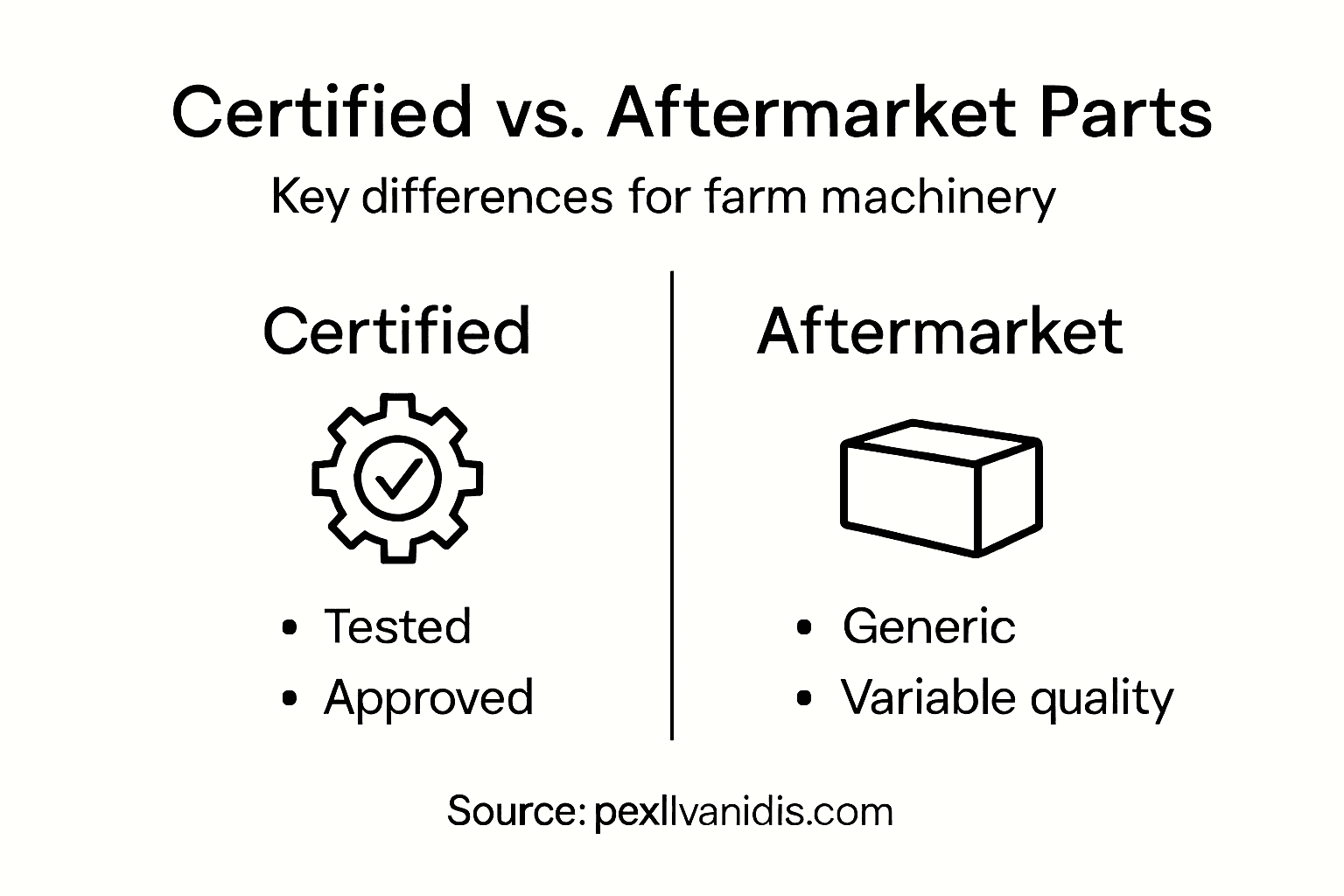
Certified parts and aftermarket components differ across several key dimensions:
- Origin:
- Certified Parts: Manufactured by original equipment manufacturer (OEM)
- Aftermarket Parts: Produced by third-party manufacturers
- Quality Control:
- Certified Parts: Rigorous testing and precise engineering standards
- Aftermarket Parts: Variable quality and inconsistent manufacturing processes
- Performance Guarantees:
- Certified Parts: Comprehensive warranty and guaranteed compatibility
- Aftermarket Parts: Limited or no manufacturer warranty coverage
The primary distinctions extend beyond simple manufacturing processes. Certified parts undergo meticulous engineering assessments that ensure precise dimensional tolerances, material specifications, and functional integrity. Aftermarket components, while often less expensive, introduce potential risks of equipment malfunction, reduced performance, and accelerated wear.
Here’s a concise comparison of certified versus aftermarket parts across crucial considerations:
| Key Aspect | Certified Parts | Aftermarket Parts |
|---|---|---|
| Manufacturing | Made by original manufacturer | Made by third-party company |
| Testing Process | Strict, documented assessments | Varies, less oversight |
| Warranty Impact | Maintains manufacturer warranty | Can void existing warranty |
| Long-Term Value | Greater reliability, fewer issues | May lead to higher repair costs |
Choosing between certified and aftermarket parts is not just a financial decision—it’s a critical assessment of equipment reliability and operational safety.
Many agricultural machinery operators mistakenly believe aftermarket parts offer equivalent performance. However, subtle variations in manufacturing can lead to significant compatibility issues. Precision matters—especially in high-stress agricultural environments where equipment reliability directly impacts productivity.
- Risk Assessment: Evaluate potential performance compromises
- Compatibility Check: Confirm exact specifications match original equipment
- Cost-Benefit Analysis: Consider long-term maintenance and replacement expenses
- Warranty Implications: Understand potential impact on existing equipment warranties
Pro tip: Always consult your equipment manufacturer’s recommended parts list and maintain detailed records of component replacements to preserve machinery performance and warranty coverage.
Quality Standards and Manufacturer Approval
Understanding the intricate landscape of quality standards for agricultural machinery parts requires navigating complex technical requirements and stringent manufacturer specifications. ASABE standards represent a critical benchmark for ensuring component reliability and performance across agricultural equipment systems.
Manufacturer approval processes involve multiple layers of rigorous evaluation:
- Technical Specifications:
- Dimensional accuracy verification
- Material composition analysis
- Stress tolerance testing
- Safety Compliance:
- Comprehensive risk assessment
- Functional performance validation
- Durability under extreme conditions
- Documentation Requirements:
- Detailed engineering specifications
- Traceability documentation
- Quality control certification
The international safety protocols established by ISO 18497:2018 provide a comprehensive framework for systematic component evaluation. These standards go beyond simple mechanical compatibility, encompassing sophisticated assessment methodologies that examine every aspect of part performance, safety, and long-term reliability.
Manufacturer approval is not a checkbox—it’s a comprehensive validation of engineering excellence and operational integrity.
Agricultural machinery manufacturers invest substantial resources in developing precise approval processes. These protocols protect equipment operators by ensuring that only components meeting the most stringent quality benchmarks receive official certification. The approval process typically involves:
- Initial design review and technical documentation assessment
- Prototype testing under simulated operational conditions
- Comprehensive performance and durability evaluations
- Ongoing quality monitoring and periodic re-certification
Pro tip: Request complete certification documentation for any replacement parts, and verify the manufacturer’s approval status through official channels before installation.
Impact on Safety, Performance, and Warranties
Certified parts represent far more than simple replacements—they are critical safeguards for agricultural machinery performance, safety, and long-term operational integrity. Machinery Directive guidelines underscore the profound implications of using certified components, highlighting their role in protecting both equipment and operator.
The multifaceted impact of certified parts spans several critical domains:
- Safety Dimensions:
- Reduced risk of catastrophic equipment failure
- Compliance with industry safety standards
- Minimized potential for operator injury
- Performance Considerations:
- Optimal machinery functionality
- Precise engineering tolerances
- Consistent operational reliability
- Warranty Protection:
- Preservation of manufacturer coverage
- Documented component traceability
- Reduced liability exposure
Agricultural machinery research consistently demonstrates that certified parts are not optional luxuries but essential investments in equipment longevity. Non-certified components can introduce unpredictable variables that compromise entire machinery systems, potentially leading to expensive repairs and dangerous operational scenarios.
Choosing certified parts is not just about immediate performance—it’s about long-term reliability and safety.
The warranty implications of using certified parts extend far beyond simple component replacement. Manufacturers design their warranty structures to incentivize responsible maintenance practices, which means:
- Using non-certified parts can immediately void existing warranties
- Certified components provide documented performance guarantees
- Proper documentation becomes crucial for warranty claim processes
- Systematic part tracking protects both operators and manufacturers
Pro tip: Maintain a comprehensive maintenance log documenting all part replacements, including certification details, to protect your warranty coverage and equipment investment.
Cost Analysis: Certified Versus Non-Certified
Deciphering the true economic impact of certified parts requires looking beyond initial price tags and understanding the comprehensive financial landscape of agricultural machinery maintenance. Agricultural maintenance research reveals a nuanced perspective on the long-term cost implications of component selection.
The cost comparison between certified and non-certified parts extends across multiple financial dimensions:
- Upfront Expenses:
- Certified parts: Higher initial investment
- Non-certified parts: Lower immediate purchase cost
- Maintenance Costs:
- Certified parts: Reduced repair frequency
- Non-certified parts: Higher likelihood of unexpected failures
- Operational Downtime:
- Certified parts: Minimized equipment interruption
- Non-certified parts: Potential extended repair times
Mechanical Power analysis emphasizes that true cost-effectiveness transcends the initial purchase price. Non-certified components might seem economically attractive in the short term, but they frequently generate hidden expenses through accelerated wear, increased repair frequency, and potential catastrophic system failures.
This summary highlights the financial and operational impacts of choosing certified or non-certified parts:
| Factor | Certified Parts Benefit | Non-Certified Parts Risk |
|---|---|---|
| Durability | Lower replacement frequency | More frequent part failures |
| Downtime | Shorter repair interruptions | Increased risk of extended stoppages |
| True Cost Over Time | Less cumulative maintenance | Higher hidden operating expenses |
| Equipment Lifespan | Maximized with proper parts | Shortened by subpar replacements |
The cheapest part is rarely the most economical solution in agricultural machinery maintenance.
Comprehensive cost analysis reveals several critical financial considerations:
- Calculate total lifecycle expenses, not just initial part cost
- Factor in potential equipment downtime and productivity losses
- Consider warranty implications and potential future repair needs
- Evaluate long-term reliability and performance metrics
Pro tip: Develop a spreadsheet tracking part replacement costs, downtime expenses, and repair frequencies to objectively compare the true economic impact of certified versus non-certified components.
Pitfalls of Using Uncertified Tractor Parts
Navigating the complex landscape of agricultural machinery maintenance requires understanding the profound risks associated with uncertified tractor parts. Machinery Directive guidelines highlight critical safety and operational challenges that emerge when farmers compromise on component quality.
Uncertified parts present multiple significant risks across different operational dimensions:
- Safety Hazards:
- Increased potential for unexpected mechanical failures
- Higher likelihood of operator injury
- Compromised equipment structural integrity
- Performance Limitations:
- Reduced machinery efficiency
- Inconsistent operational reliability
- Accelerated component degradation
- Financial Implications:
- Potential voiding of manufacturer warranties
- Higher long-term maintenance expenses
- Increased equipment downtime
Agricultural maintenance research demonstrates that uncertified parts are not merely a cost-saving alternative, but a potential pathway to significant operational and financial risks. These components often lack the rigorous quality control and engineering precision that certified parts inherently provide.
Cutting corners with uncertified parts is gambling with your equipment’s performance and your farm’s productivity.
The cascading consequences of using uncertified components can be devastating:
- Immediate performance degradation
- Accelerated wear on interconnected machinery systems
- Potential catastrophic equipment failure
- Compromised operator safety
- Potential invalidation of equipment warranties
Pro tip: Always request comprehensive documentation and certification details before installing any replacement parts, and cross-reference these with your original equipment manufacturer’s specifications.
Secure Your Agricultural Machinery with Certified Parts from Pexlivanidis
The challenges of maintaining agricultural machinery with uncertified or low-quality parts are real and costly. This article highlights crucial risks such as compromised safety, reduced performance, voided warranties, and increased downtime. Many farmers struggle with identifying reliable replacement components that meet strict quality and safety standards established by EU Machinery Directives and manufacturers. When it comes to preserving your equipment’s longevity and ensuring smooth operations, precision matters.
At pexlivanidis.com, we understand these pain points. Offering a vast inventory of over 20,000 certified tractor spare parts and accessories, we guarantee products that comply with manufacturer approval and rigorous quality benchmarks. Benefit from free shipping in Greece on orders above 100€ and access wholesale options designed to support both regional farmers and businesses. Don’t compromise your machinery’s safety and efficiency. Explore our comprehensive selection and experience peace of mind knowing you are investing in parts that protect your equipment and your livelihood.
Start safeguarding your agricultural equipment today by visiting our main site at pexlivanidis.com. Check product availability, make inquiries, and secure genuine certified parts that keep your farm running reliably without interruption.
Frequently Asked Questions
What are certified parts in agricultural machinery?
Certified parts are components that meet stringent safety and performance standards set by regulatory bodies, ensuring they are reliable and suitable for use in agricultural machinery.
Why are certified parts more expensive than aftermarket parts?
Certified parts undergo rigorous testing and quality control, ensuring high standards of safety and performance, which contributes to their higher upfront cost compared to aftermarket parts that may vary in quality.
How do certified parts impact the warranty of agricultural machinery?
Using certified parts typically preserves the manufacturer’s warranty on agricultural equipment, while using non-certified components may void existing warranties.
What are the benefits of using certified parts instead of generic alternatives?
Certified parts offer enhanced reliability, lower risk of equipment failures, and optimal performance. They are designed with precise engineering specifications to ensure compatibility with your machinery.