

Over 80 percent of American farmers experience unexpected tractor breakdowns during peak seasons, impacting both productivity and profit. Thorough preparation and regular checks are crucial for anyone relying on agricultural machinery. With the right approach, you can extend your equipment’s life and avoid costly downtime by focusing on critical tractor maintenance steps proven to make a real difference in the field.
Table of Contents
- Step 1: Prepare And Inspect Essential Tractor Components
- Step 2: Upgrade And Adjust Key Engine And Transmission Systems
- Step 3: Maintain Optimal Lubrication And Fluid Levels
- Step 4: Replace Worn-Out Parts With High-Quality Spares
- Step 5: Test And Verify Improved Tractor Performance
Quick Summary
| Key Point | Explanation |
|---|---|
| 1. Conduct Regular Inspections | Thoroughly inspect tractor components to prevent breakdowns and extend equipment life before major operations. |
| 2. Maintain Fluid Levels Systematically | Regularly check and manage lubrication and fluid levels to avoid mechanical failures and ensure optimal performance. |
| 3. Replace Worn Parts Promptly | Identify and replace worn-out components with high-quality spares to enhance efficiency and safety during operations. |
| 4. Document Maintenance Activities | Keep a detailed log of inspections, adjustments, and replacements to track the health of your tractor over time. |
| 5. Test Performance After Upgrades | Implement controlled tests after maintenance to verify improvements in fuel efficiency, power output, and overall operational stability. |
Step 1: Prepare and inspect essential tractor components
Preparing your tractor for optimal performance begins with a comprehensive inspection of its core components. Regular checks will prevent unexpected breakdowns and extend the life of your agricultural equipment. Tractor maintenance experts recommend a systematic approach to evaluating your machine’s critical systems before each major operation.
Start by conducting a thorough visual and functional assessment of key tractor elements. Check the engine oil levels first, ensuring they are at the correct mark and free from contamination. Inspect hydraulic fluid reservoirs for proper volume and clarity. Detailed inspection protocols suggest examining tire pressure, looking for uneven wear or potential damage that could compromise stability and performance. Pay close attention to battery connections, ensuring they are clean, tight, and corrosion-free.

A critical tip for farmers is to create a consistent pre-operation checklist. Documenting each inspection helps track your tractor’s maintenance history and can reveal emerging issues before they become expensive repairs. Tractor parts replacement strategies become more predictable when you maintain a rigorous inspection routine. By investing 15-20 minutes in thorough preparation, you significantly reduce the risk of unexpected downtime during critical agricultural seasons.
Step 2: Upgrade and adjust key engine and transmission systems
Upgrading and fine-tuning your tractor’s engine and transmission systems is crucial for maintaining peak performance and preventing premature wear. Comprehensive tractor operator guidelines emphasize the importance of systematic maintenance and precise adjustments to ensure optimal machinery function.
Begin by thoroughly examining your transmission system. Check transmission fluid levels and quality, looking for signs of contamination or degradation. Inspect gear mechanisms for smooth operation and listen for any unusual sounds during shifting. Pay special attention to the clutch and linkage systems, ensuring they engage and disengage smoothly without excessive resistance. Lubricate moving parts according to manufacturer specifications to reduce friction and minimize potential mechanical stress.
A critical maintenance strategy involves creating a detailed log of all system adjustments and upgrades. Tractor spare parts replacement becomes more predictable when you track performance changes and component wear patterns. By investing time in meticulous system evaluation and proactive upgrades, you can significantly extend your tractor’s operational lifespan and maintain consistent agricultural productivity.
Step 3: Maintain optimal lubrication and fluid levels
Spring tractor maintenance protocols underscore the critical importance of comprehensive fluid management for peak agricultural equipment performance. Maintaining proper lubrication and fluid levels is not just a routine task but a fundamental strategy to prevent mechanical failures and extend your tractor’s operational life.
Begin with a systematic approach to fluid inspection. Check engine oil levels first, ensuring the quantity and quality meet manufacturer specifications. Pre-use agricultural tractor inspection guidelines recommend examining coolant reservoirs, hydraulic systems, and transmission fluid with equal diligence. Look for signs of contamination such as discoloration, particles, or unusual consistency that might indicate underlying mechanical issues. Use clean dipsticks and proper measurement techniques to assess fluid levels accurately, wiping and reinserting to get precise readings.
A critical maintenance tip is to establish a consistent lubrication schedule. Tractor spare parts replacement becomes more predictable when you track fluid conditions and address potential wear patterns proactively. By dedicating time to meticulous fluid management, you can prevent costly breakdowns and ensure your tractor operates at maximum efficiency throughout demanding agricultural seasons.
Step 4: Replace worn-out parts with high-quality spares
Tractor safety protocols emphasize the critical importance of proactively identifying and replacing components that show signs of excessive wear. Replacing worn-out parts is not merely a maintenance task but a fundamental strategy to ensure both operational efficiency and operator safety.
Agricultural equipment maintenance guidelines recommend a systematic approach to parts replacement. Start by thoroughly inspecting critical components such as belts, filters, brake systems, and hydraulic lines. Look for visible signs of deterioration including cracks, unusual wear patterns, rust, or material fatigue. Pay special attention to components that experience high stress during agricultural operations. When selecting replacement parts, prioritize quality over cost by choosing manufacturer-recommended or equivalent high-grade alternatives that match your specific tractor model and operational requirements.
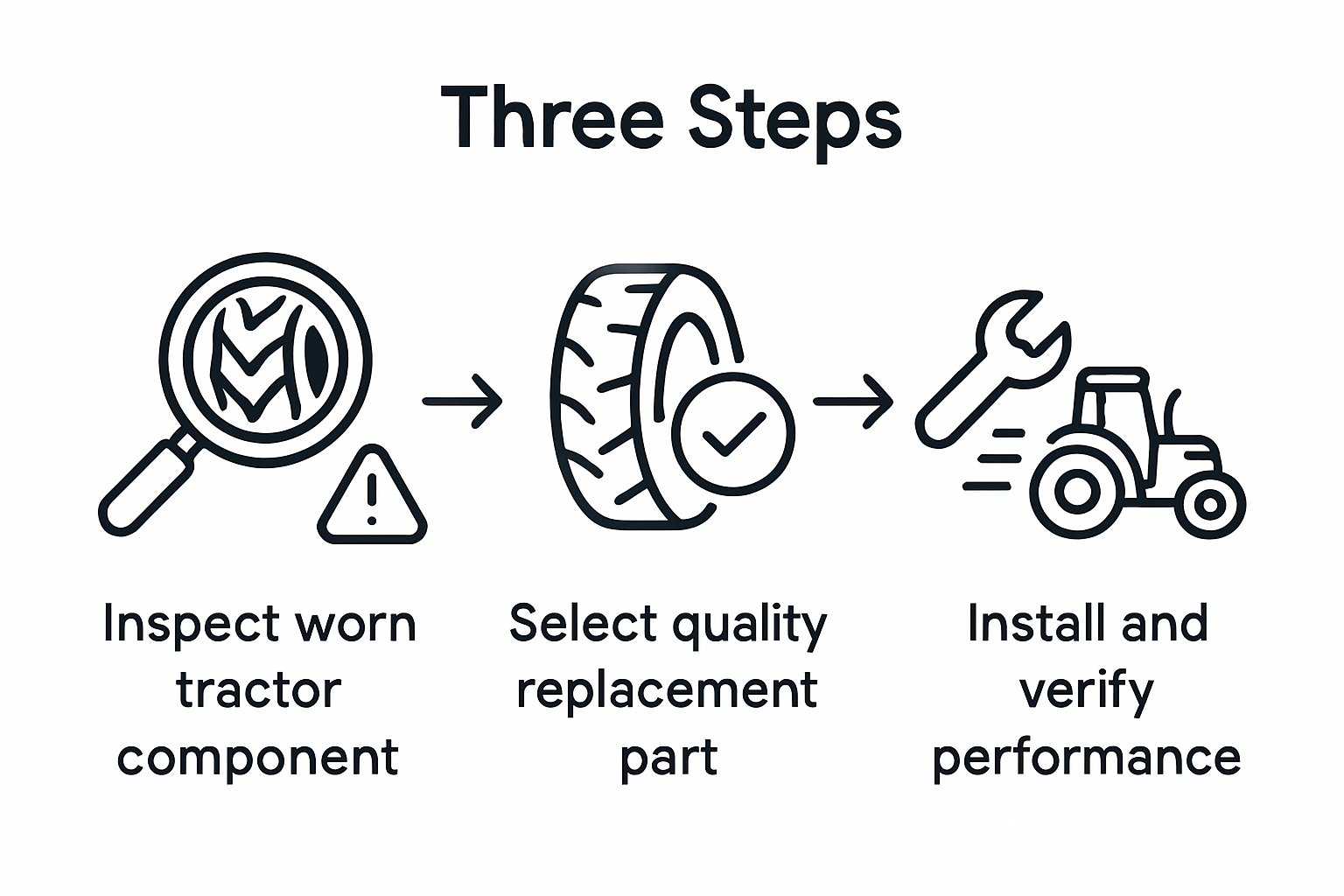
A critical maintenance strategy involves maintaining a comprehensive inventory of essential spare parts. Tractor spare parts replacement becomes more predictable when you establish a proactive tracking system for component wear and potential failures. By investing time in strategic parts management and timely replacements, you can significantly reduce unexpected downtime and maintain your tractor’s peak performance throughout demanding agricultural seasons.
Step 5: Test and verify improved tractor performance
Preventive maintenance protocols underscore the importance of comprehensive performance verification after implementing mechanical improvements. Testing your tractor systematically ensures that all recent upgrades and repairs translate into tangible operational enhancements.
Begin with a methodical performance assessment. Conduct a series of controlled tests across different operational scenarios that simulate your typical agricultural workload. Monitor key performance indicators such as fuel efficiency, power output, hydraulic system responsiveness, and overall mechanical stability. Pay special attention to engine temperature, noise levels, vibration patterns, and acceleration characteristics. Use precision measuring tools and document your observations carefully to establish a clear baseline for comparison with previous performance metrics.
A critical verification strategy involves understanding common tractor performance issues and tracking incremental improvements. By creating a detailed performance log that captures both quantitative measurements and qualitative observations, you can develop a comprehensive understanding of your tractor’s mechanical health. This proactive approach not only validates your maintenance efforts but also helps predict potential future maintenance requirements before they escalate into significant mechanical challenges.
Ensure Maximum Tractor Efficiency With Quality Spare Parts
Optimizing tractor performance involves meticulous maintenance from inspecting key components to upgrading engine systems and replacing worn parts. If you face challenges like unexpected breakdowns, inefficient machinery, or the need for dependable replacement parts following the detailed strategies in the article, you are not alone. These pain points require reliable solutions that keep your tractor running smoothly through every agricultural season.
At pexlivanidis.com, you gain access to a vast inventory of over 20,000 premium tractor accessories and spare parts designed to meet your exact needs. Whether you need high-quality belts, filters, hydraulic components, or engine parts, our platform makes it simple to find and order what you need quickly. Don’t let worn-out parts or poor lubrication affect your tractor’s productivity. Take action now to secure the parts that help you maintain optimal lubrication, perform critical upgrades, and replace components promptly. Explore our selection at pexlivanidis.com and experience the difference of timely, quality repairs and upgrades.
Ready to enhance your tractor’s efficiency and reduce downtime? Visit pexlivanidis.com today and browse our comprehensive range of agricultural machinery parts. Your tractor’s peak performance is just a few clicks away.
Frequently Asked Questions
How do I inspect my tractor to improve its performance?
To inspect your tractor for improved performance, focus on key components such as engine oil levels, hydraulic fluids, tire pressure, and battery connections. Begin by checking these elements before each major operation and document your findings to track any emerging issues.
What adjustments should I make to my tractor’s engine and transmission for optimal efficiency?
Adjust your tractor’s engine and transmission by checking fluid levels and ensuring that gear mechanisms operate smoothly. Regularly lubricate moving parts and log your adjustments to monitor performance changes over time.
How can I maintain proper lubrication and fluid levels in my tractor?
Maintain optimal lubrication and fluid levels by systematically inspecting engine oil, coolant, hydraulic fluids, and transmission levels. Establish a consistent maintenance schedule to prevent breakdowns and ensure that your tractor runs efficiently throughout the season.
What should I do when I notice worn-out parts?
When you notice worn-out parts, promptly replace them with high-quality, manufacturer-recommended components to ensure safety and efficiency. Regularly inspect critical components like belts and brakes, and keep a comprehensive inventory of essential spare parts to reduce downtime.
How can I test my tractor’s performance after making maintenance upgrades?
Test your tractor’s performance by conducting controlled assessments across various operational scenarios to monitor fuel efficiency, power output, and mechanical stability. Keep a detailed performance log to compare results with past metrics and identify improvements or further maintenance needs.