

TL;DR:
- Returning agricultural parts in Greece requires timely notification within 14 days, proper documentation, and unused, original packaging to qualify. The process involves contacting the seller, obtaining an RMA, repackaging carefully, and tracking shipment while ensuring all conditions are met for a refund. Accurate inspection and thorough documentation are essential to avoid disputes, and building good supplier relationships can improve outcomes.
Returning agricultural machinery parts in Greece sounds straightforward until you are standing with a wrong-spec tractor component, a ticking 14-day clock, and no clear picture of what comes next. A mishandled return can mean lost money, delayed planting seasons, and strained supplier relationships. Whether you are a farmer in Kavala buying a single spare, or a dealer in Thessaloniki managing dozens of orders, having a solid parts return process guide in hand changes everything. This article walks you through exactly what to prepare, how to execute the return, what happens during inspection, and how to avoid the mistakes that get claims rejected.
Table of Contents
- Key Takeaways
- Parts return process guide: what to prepare first
- Step-by-step return process for agricultural parts
- What happens after the return shipment arrives
- Common mistakes that derail agricultural parts returns
- My take on returns in Greece’s agricultural machinery sector
- Get quality parts with clear return support from Pexlivanidis
- FAQ
Key Takeaways
| Point | Details |
|---|---|
| Know the 14-day window | Greek and EU law gives you 14 days to notify the seller and return unused parts without stating a reason. |
| Documentation protects you | Photos, invoices, and part numbers create an evidence trail that resolves disputes faster. |
| Packaging determines eligibility | Original boxes, manuals, and seals must be intact; missing components often trigger partial refunds or outright refusals. |
| Withdrawal vs. warranty are different | Confusing a change-of-mind return with a defect warranty claim leads to wrong timelines and denied requests. |
| Inspection drives the refund decision | Refunds are processed only after a technician approves condition, typically 7 to 10 days after receipt. |
Parts return process guide: what to prepare first
Before you contact anyone, get your paperwork and the physical part in order. Sellers in Greece will check everything, and gaps in your documentation are the number one reason returns stall.
Eligibility requirements
Returns are accepted only if parts are unused, in original resale condition, with complete original packaging and proof of purchase. That means shrink wrap, foam inserts, instruction sheets, and any accessories that shipped with the part. If you opened the box to test fit a component on the tractor, that part may no longer qualify, even if it never turned a single bolt.
The following conditions determine whether your part is eligible for return:
- Unused and uninstalled. The part must show no signs of mounting, oil contact, or mechanical wear.
- Original packaging intact. Original packaging and manuals are essential to prove parts are resellable; missing components often lead to reduced refunds or outright refusals.
- Proof of purchase. Your invoice or receipt must match the part number, date, and seller. Keep digital copies.
- Within the legal return window. The standard return window in Greece is 14 days from delivery, aligned with EU consumer law. Some agricultural parts retailers shorten this to 7 days, so check your specific seller’s policy when you order.
What cannot be returned
Used or installed parts, custom orders, consumables, or parts damaged due to mishandling are generally excluded from returns. That includes hydraulic seals that were unwrapped, filters that were opened, and any part ordered to specific dimensions for your machine. If you are unsure whether your item falls into one of these categories, contact the seller before attempting a return. A quick email saves you the cost of shipping a rejected item back to yourself.
Pro Tip: Photograph the part, the packaging, and the shipping label the moment your order arrives. If something is wrong, you have time-stamped evidence before you even open the box. This single habit resolves more disputes than any other step in the guide to part returns.
Documentation checklist before you start
| Document | Why you need it |
|---|---|
| Original invoice or receipt | Links your purchase to the part number and sale date |
| Photos of part and packaging | Proves condition at time of return initiation |
| Serial number or part code | Confirms identity of the item being returned |
| Seller’s return policy copy | Establishes agreed terms and timelines |
Step-by-step return process for agricultural parts
Once you have confirmed eligibility and gathered your documents, the actual return process steps are straightforward. Follow them in order and you will not leave money on the table.
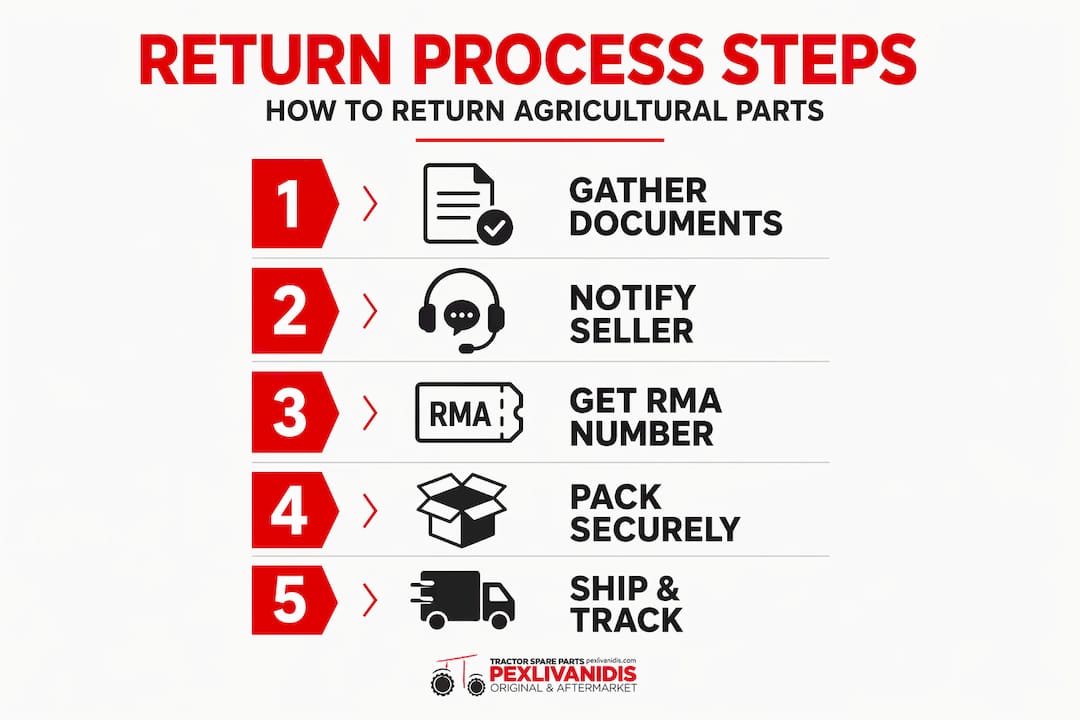
- Contact the seller directly. Reach the supplier by email or phone and state your intent to return. Include your order number, part number, reason for return, and condition of the item. Written contact is preferable because it creates a record. Many Greek agricultural retailers require email notification as the first official step.
- Get a return authorization number. Most sellers issue an RMA (Return Merchandise Authorization) number. Do not ship anything without it. Packages arriving without authorization are routinely refused or left in limbo at the warehouse.
- Repackage the part carefully. Place the part back in its original box with all inserts, manuals, and seals. If the original outer box is damaged, use a clean secondary box that fits snugly. Write the RMA number clearly on the outside of the package. Do not write directly on the product box.
- Choose a tracked shipping method. Ship with a carrier that provides a tracking number and, for parts valued over 50€, add insurance. Photographing parts and packaging before sending helps prevent disputes about condition or mismatches during transit. Keep the tracking receipt until your refund is confirmed.
- Confirm shipping cost responsibility. For standard withdrawal returns, the customer typically covers shipping costs. If the part is defective, the seller usually pays. Verify this in writing before you ship, because warranty returns may shift shipping cost responsibility compared to standard withdrawal returns.
- Send the seller your tracking number. Email the tracking details immediately after dispatch. This keeps your timeline documented and signals that you met the return window.
- Follow up if you have not heard back within five business days of delivery. Sellers receive high volumes, and a polite follow-up with your tracking confirmation is not only acceptable but advisable.
Pro Tip: When following the return process steps, print a copy of your email notification, RMA confirmation, and tracking receipt and keep them together in one folder, digital or physical. If a dispute arises weeks later, that folder is your entire case.
What happens after the return shipment arrives
The parts refund process does not end when you drop the package at the courier. What happens next at the seller’s end determines your outcome.
The inspection stage
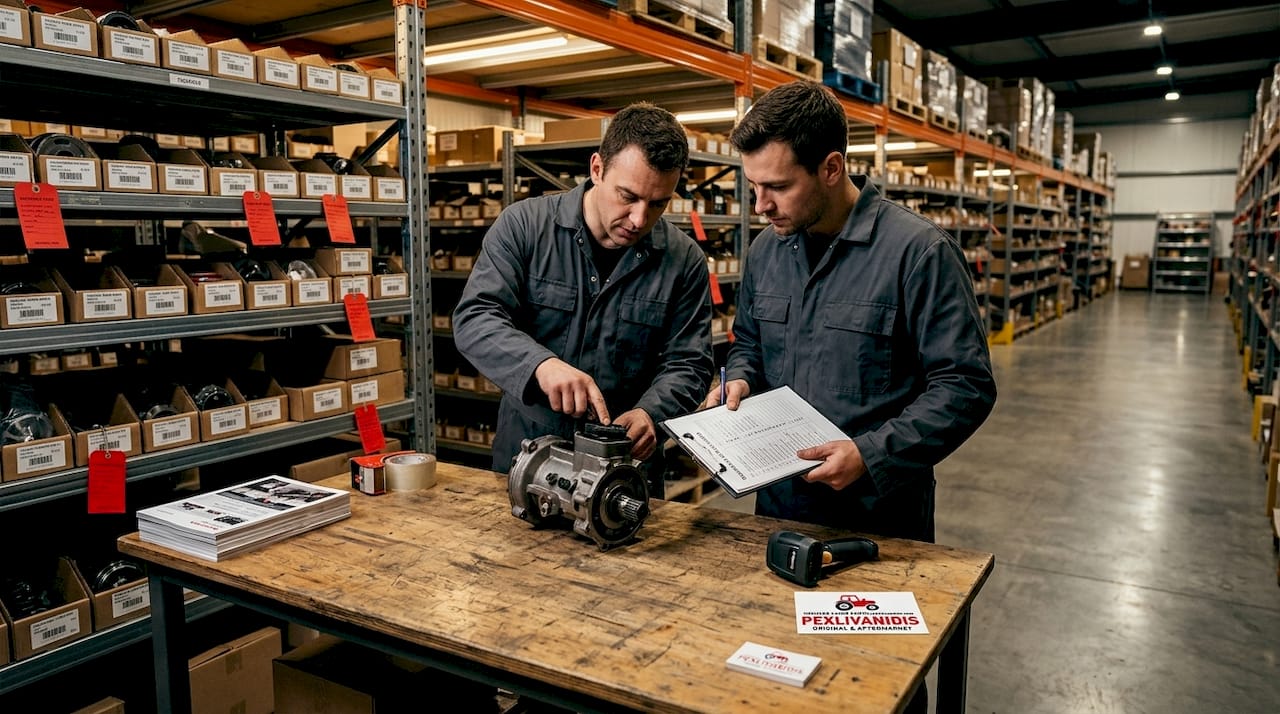
The return process generally involves three key checkpoints: return authorization, inspection at intake, and disposition decision. A technician will physically examine the returned part against the following criteria:
- Physical condition: scratches, corrosion, signs of installation, or missing parts
- Packaging completeness: all original materials, inserts, and documentation present
- Part identity: serial number or code matches the authorized return
- Documentation match: invoice and RMA number align with what was shipped
Refund outcomes compared
| Outcome | Likely cause | What to do |
|---|---|---|
| Full refund approved | Part unused, packaging intact, docs complete | Refund processed in 7 to 10 days |
| Partial refund issued | Minor packaging damage or missing accessory | Accept or dispute with photos |
| Return refused | Part shows use, installation, or damage | Request written explanation, escalate if needed |
| Restocking fee applied | Policy allows deduction for handling | Check policy terms before returning |
Refunds are typically processed within 7 to 10 days after inspection if the return is approved. If you receive a partial refund or denial, request the seller’s written inspection findings immediately. Return inspections verify item condition against what was sold, and discrepancies trigger partial or denied refunds. Strong photographic evidence is your most effective tool to contest decisions you believe are wrong.
Common mistakes that derail agricultural parts returns
Even experienced farm supply managers run into problems with the process for returning items. Most of these issues are preventable.
- Missing the notification deadline. Many customers discover they passed the 14-day window simply because they waited to see if the part would work. Set a calendar reminder the day you receive any agricultural parts order.
- Confusing withdrawal with warranty. Distinguishing withdrawal rights from warranty defect claims is essential because each path changes approval criteria, timelines, and shipping cost responsibility. Warranty claims require proof of defect. Withdrawal returns do not require a reason but require unused, intact condition.
- Poor repackaging. Sending a part in a torn original box, or worse, a plastic bag, signals mishandling and gives sellers grounds for a reduced refund. Repackage as if the part is being sold new.
- No photos before shipping. Without evidence of the part’s condition at the time you sent it, you cannot effectively dispute a seller’s claim that the item arrived damaged.
- Missing documentation or incomplete packaging are the leading causes of return failures. Standardizing an internal checklist that includes invoice retention, part number capture, and packaging preservation prevents most of these failures for businesses.
- Assuming all sellers follow the same timeline. Mistakenly assuming a single uniform return window risks rejecting valid returns or accepting unsuitable items. Policies vary, and some agricultural parts suppliers operate on a 7-day window, not 14.
Pro Tip: Before placing any order for tractor components, review the seller’s equipment return policy and screenshot it. Policies can change, and having the version active at the time of purchase protects you if there is a disagreement later. This is especially relevant for businesses placing bulk parts orders online.
My take on returns in Greece’s agricultural machinery sector
I have watched countless returns go sideways not because the customer was wrong but because they treated the process casually. A part costing 300€ does not get the same paper trail as a car purchase, even though the stakes are just as real for a small farm operation.
The uncomfortable truth I have found is that most return rejections are self-inflicted. Customers unbox parts without photographing them, store them in a work shed for three weeks while deciding, then expect a smooth refund. Treating agricultural machinery part returns like a legal evidence trail and documenting condition and communications meticulously reduces loss and accelerates resolution. That framing changes behavior instantly.
What I have also seen is that the customers who maintain a consistent relationship with their parts supplier, regular orders, clear communication, professional tone in disputes, get better outcomes. Return management is an opportunity to build trust through transparency and responsiveness, and that works both ways. A supplier who knows you as a reliable customer will often go further than their written policy when something goes wrong.
The advice I would give any farm business in northern Greece right now is this: treat your parts returns as a process, not a reaction. Build the checklist, take the photos, read the policy before you order. The farmers and dealers I have seen recover refunds fastest are the ones who prepared before the problem happened.
— George
Get quality parts with clear return support from Pexlivanidis
Pexlivanidis carries over 20,000 agricultural machinery parts for tractors and farm equipment, serving customers across Thessaloniki, Kavala, and the wider Greek region. Every product comes with transparent policies so you know your rights before you order. For customers looking to reduce return hassles at the source, choosing the right part the first time matters most. Pexlivanidis provides detailed product specifications, expert guidance, and resources like the machinery maintenance guide to help you order with confidence and keep your equipment running without interruption. Explore the full catalog at pexlivanidis.com and ask the team directly if you have questions about compatibility before placing your order.
FAQ
What is the return window for agricultural parts in Greece?
The standard return window is 14 days from delivery under Greek and EU consumer law, though some agricultural retailers apply a shorter 7-day window. Always confirm the seller’s specific policy at the time of purchase.
What documents do I need to return a tractor part?
You need your original invoice or receipt, the complete original packaging with all accessories and manuals, and the RMA number issued by the seller before you ship.
Can I return a part I already tested on my tractor?
No. Parts that show any signs of installation, oil contact, or mechanical use are generally excluded from standard withdrawal returns. Defective parts may qualify under warranty claims, which require proof of the defect.
How long does a parts refund take after the return is received?
Refunds are typically processed 7 to 10 days after the seller receives and inspects the returned item, provided the part meets all condition and documentation requirements.
What is the difference between a withdrawal return and a warranty claim?
A withdrawal return is a change-of-mind return within the legal window and requires the part to be unused and intact. A warranty claim applies when a part is defective and may allow returns outside the standard window, but requires documented proof of the fault and may shift shipping cost responsibility to the seller.