

When a tractor breaks down during harvest, every minute waiting for spare parts can set back operations across Thessaloniki and Kavala. In a market filled with choices, dependable customer service for sourcing and supporting tractor parts becomes a true differentiator. Leading global standards now highlight that exceptional customer service in machinery supply must be woven into every aspect of support, not just answers to urgent calls. Discover new ways to secure rapid, expert assistance that keeps your equipment reliable and your business moving forward.
Table of Contents
- Defining Customer Service In Machinery Supply
- Types Of Customer Support For Machinery Clients
- Key Functions: Communication, Sourcing, And Support
- Customer Service Responsibilities And Best Practices
- Common Service Challenges And How To Overcome Them
Key Takeaways
| Point | Details |
|---|---|
| Comprehensive Support Approach | Customer service in machinery supply involves technical support, parts availability, training, and proactive communication to enhance client relationships. |
| Types of Customer Support | Various support channels, including technical phone support, on-site assistance, and digital resources, cater to the complex needs of agricultural clients. |
| Key Functions for Satisfaction | Effective communication, strategic sourcing, and robust support are essential for maintaining client satisfaction and operational excellence. |
| Best Practices for Service Professionals | Holistic training in technical skills and emotional intelligence is vital for building long-term client relationships and sustaining high-quality service. |
Defining Customer Service in Machinery Supply
Customer service in machinery supply represents a comprehensive approach to supporting agricultural equipment operators throughout their machinery lifecycle. International service standards emphasize that exceptional customer service extends far beyond simple transactional interactions, integrating seamlessly into every aspect of an organization’s operational culture.
At its core, customer service in machinery supply involves providing strategic assistance that addresses the complex needs of agricultural professionals. This includes multiple critical dimensions:
- Technical troubleshooting and maintenance support
- Rapid spare parts availability and logistics
- Expert consultation for equipment selection
- Comprehensive product training and guidance
- Responsive communication channels
The primary goal of machinery supply customer service is not merely solving immediate problems but creating long-term customer relationships that deliver tangible value. Customer service quality represents an intangible asset that can significantly differentiate companies in the competitive agricultural machinery market.
Effective customer service requires deep understanding of agricultural machinery complexities, technological nuances, and the specific operational challenges faced by farmers and agricultural professionals. Successful providers develop comprehensive support ecosystems that anticipate customer needs, provide proactive solutions, and demonstrate genuine commitment to client success.
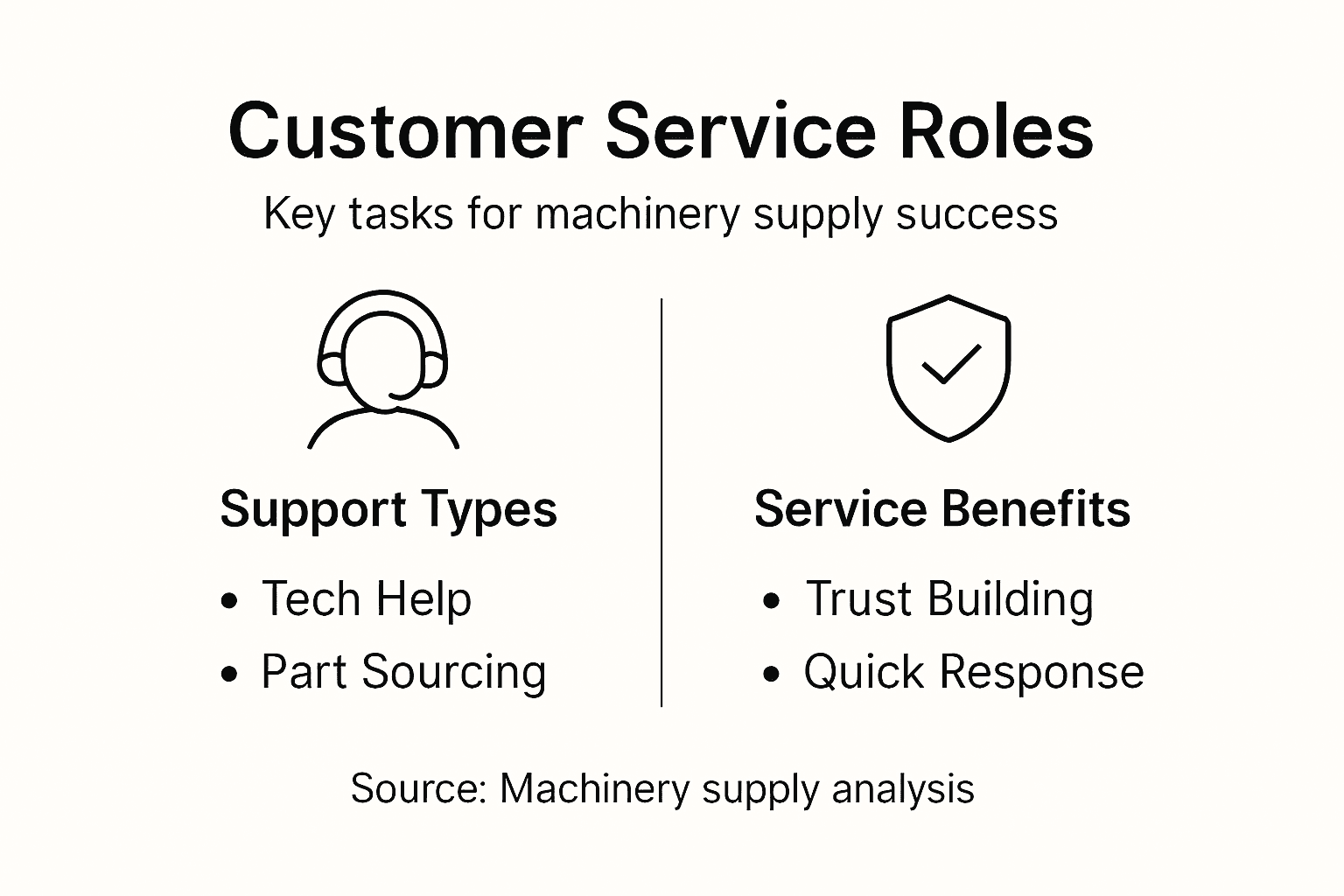
Pro tip: Develop a comprehensive customer service strategy that views each interaction as an opportunity to build trust and demonstrate expertise in agricultural machinery solutions.
Types of Customer Support for Machinery Clients
Customer support channels in machinery supply encompass a comprehensive range of specialized services designed to address the complex needs of agricultural equipment operators. These support mechanisms are critical for ensuring optimal machinery performance, client satisfaction, and long-term operational success.
The primary types of customer support for machinery clients include:
- Technical Phone Support
- Direct troubleshooting assistance
- Equipment diagnostics
- Immediate problem resolution
- On-Site Field Support
- Direct machinery inspection
- Complex repair services
- Hands-on equipment training
- Digital Support Channels
- Email technical consultations
- Online maintenance guides
- Video troubleshooting resources
- Spare Parts Management
- Rapid parts identification
- Quick replacement logistics
- Inventory availability checks
Effective customer support transcends mere problem-solving. Strategic support services integrate deep technical knowledge with proactive client engagement, anticipating potential equipment challenges before they significantly impact agricultural operations.
Comprehensive support strategies require multifaceted customer interaction approaches that blend technological expertise with responsive, personalized communication. Successful machinery suppliers develop robust support ecosystems that combine technical proficiency, rapid response times, and genuine commitment to client success.
Pro tip: Develop a tiered customer support system that matches specific client complexity levels, ensuring tailored technical assistance for different agricultural machinery needs.
Here’s a quick comparison of customer support types and their ideal use cases in machinery supply:
| Support Type | Best For | Typical Response Time |
|---|---|---|
| Technical Phone | Immediate troubleshooting | Within 1 hour |
| On-Site Field | Complex repairs & training | 24-48 hours |
| Digital Channels | Documentation & remote guidance | Same-day to 48 hours |
| Spare Parts Mgmt | Replacement logistics | Depends on inventory (1-5 days) |
Key Functions: Communication, Sourcing, and Support
Customer service functions in machinery supply represent a sophisticated ecosystem of interconnected strategic activities designed to deliver comprehensive client support. These functions are critically important for maintaining operational excellence and ensuring customer satisfaction throughout the machinery lifecycle.
The key functions in machinery customer service include:
- Communication Functions
- Clear product information sharing
- Responsive inquiry management
- Technical problem explanation
- Transparent status updates
- Sourcing Functions
- Strategic supplier selection
- Quality parts procurement
- Cost-effective equipment identification
- Reliable inventory management
- Support Functions
- Technical troubleshooting
- Maintenance guidance
- Performance optimization advice
- After-sales service coordination
Successful machinery supply customer service demands more than transactional interactions. Strategic communication approaches integrate deep technical understanding with proactive client engagement, anticipating potential challenges before they disrupt agricultural operations.

Strategic sourcing practices play a pivotal role in developing robust customer service frameworks. These practices ensure not just immediate client needs are met, but long-term operational reliability is maintained through intelligent supplier relationships and comprehensive support mechanisms.
Pro tip: Develop a comprehensive customer service matrix that maps communication, sourcing, and support functions to specific client machinery complexity levels.
The following table summarizes key functions in machinery customer service and their impact on client satisfaction:
| Function Group | Example Impact | Operational Benefit |
|---|---|---|
| Communication | Faster issue resolution | Reduces downtime |
| Sourcing | Reliable parts procurement | Minimizes supply interruptions |
| Support | Optimized equipment performance | Improves client productivity |
Customer Service Responsibilities and Best Practices
Customer service professionals in machinery supply must navigate a complex landscape of technical expertise, communication skills, and strategic problem-solving. These responsibilities extend far beyond simple transactional interactions, requiring a nuanced approach to client support that integrates technical knowledge with exceptional interpersonal capabilities.
Key responsibilities in machinery customer service include:
- Communication Responsibilities
- Active and empathetic listening
- Clear technical explanation
- Conflict resolution skills
- Transparent information sharing
- Technical Responsibilities
- Accurate machinery diagnostics
- Precise problem identification
- Efficient solution implementation
- Comprehensive performance analysis
- Client Engagement Responsibilities
- Proactive issue anticipation
- Personalized support strategies
- Continuous learning and adaptation
- Building long-term client relationships
Best practices in machinery customer service demand a holistic approach that balances technical proficiency with emotional intelligence. Successful professionals understand that each interaction represents an opportunity to demonstrate expertise, build trust, and reinforce the organization’s commitment to client success.
International service standards provide a structured framework for delivering consistent, high-quality customer experiences. These standards emphasize the importance of developing comprehensive service protocols that address operational, financial, and learning perspectives, ensuring a systematic approach to customer satisfaction in machinery supply.
Pro tip: Develop a continuous training program that combines technical skill enhancement with advanced communication and emotional intelligence workshops.
Common Service Challenges and How to Overcome Them
Supply chain disruptions represent a critical challenge in machinery customer service, demanding sophisticated strategies for maintaining operational continuity and client satisfaction. These challenges require proactive management approaches that anticipate potential systemic risks and develop robust mitigation mechanisms.
Common challenges in machinery customer service include:
- Supply Chain Challenges
- Extended procurement lead times
- Component price volatility
- Inventory management complexity
- Global logistics disruptions
- Technical Support Challenges
- Complex equipment diagnostics
- Rapid technological changes
- Skill gap in technical support
- Diverse machinery specifications
- Communication Challenges
- Managing client expectations
- Translating technical information
- Resolving complex technical issues
- Maintaining consistent service quality
Successful organizations develop strategic resilience frameworks that transform potential challenges into opportunities for demonstrating client commitment and technical expertise. These approaches involve continuous learning, adaptive strategies, and comprehensive risk management protocols.
Global supply pressures necessitate innovative solutions that go beyond traditional problem-solving. This includes investing in workforce skills, diversifying supplier networks, and implementing advanced planning technologies to maintain service reliability.
Pro tip: Develop a dynamic risk management system that combines predictive analytics, cross-functional training, and flexible supply chain strategies.
Strengthen Your Machinery Success with Expert Customer Support and Quality Parts
Navigating the complexities of agricultural machinery supply requires more than just quality equipment. The article highlights critical challenges like supply chain disruptions, rapid technological changes, and effective communication. These issues can hinder your operations and reduce productivity if not managed with expert customer service and reliable sourcing. At pexlivanidis.com, we understand that strategic sourcing, transparent communication, and prompt technical support form the backbone of machinery supply success.
Discover how our extensive inventory of over 20,000 tractor accessories and spare parts can help you overcome supply delays and maintenance hurdles. With free shipping for orders over 100€ within Greece and tailored B2B membership options, we offer solutions perfectly aligned with your operational needs. Explore our website https://pexlivanidis.com to access detailed product information and responsive customer service that works with you to reduce downtime and optimize equipment performance.
Ready to transform challenges into opportunities for growth Engage with our expert support team today by visiting pexlivanidis.com and take the first step toward dependable machinery supply. Your seamless agricultural operations start with trusted parts and a partner who understands your business needs.
Frequently Asked Questions
What is the main goal of customer service in machinery supply?
The main goal of customer service in machinery supply is to build long-term relationships with clients by providing strategic assistance that addresses their complex needs, ultimately delivering tangible value beyond solving immediate problems.
What are the different types of customer support available for machinery clients?
Customer support in machinery supply includes various types such as technical phone support for immediate troubleshooting, on-site field support for complex repairs and training, digital support channels for remote guidance, and spare parts management for efficient logistics.
How can effective communication enhance customer service in machinery supply?
Effective communication in machinery supply enhances customer service by facilitating clear product information sharing, responsive inquiry management, and transparent updates on technical issues, leading to faster issue resolution and increased customer satisfaction.
What common challenges do customer service representatives face in the machinery supply sector?
Common challenges include supply chain disruptions leading to extended procurement times, complex technical support needs due to rapidly changing technology, and communication difficulties in managing client expectations and translating technical information.