

TL;DR:
- John Deere offers four main tractor transmission types, including hydrostatic, PowerShift variants, full PowerShift, and IVT. Choosing the correct system impacts operational efficiency, maintenance costs, and task suitability. Proper maintenance and matching the transmission type to your workload ensure long-term performance and cost savings.
John Deere tractor transmission types are specialized systems that transfer engine power to the drivetrain, controlling speed, direction, and torque delivery across every farming task. John Deere offers four primary categories: Hydrostatic (eHydro™), PowrReverser™/PowrQuad™, Full PowerShift/E-series, and the Intelligent Variable Transmission (IVT™/AutoPowr™). Each type suits different workloads, operator preferences, and maintenance demands. Choosing the wrong one for your operation costs you time, fuel, and money. This guide breaks down how each gearbox works, where it excels, and what it takes to keep it running.
What are the main John Deere tractor transmission types?
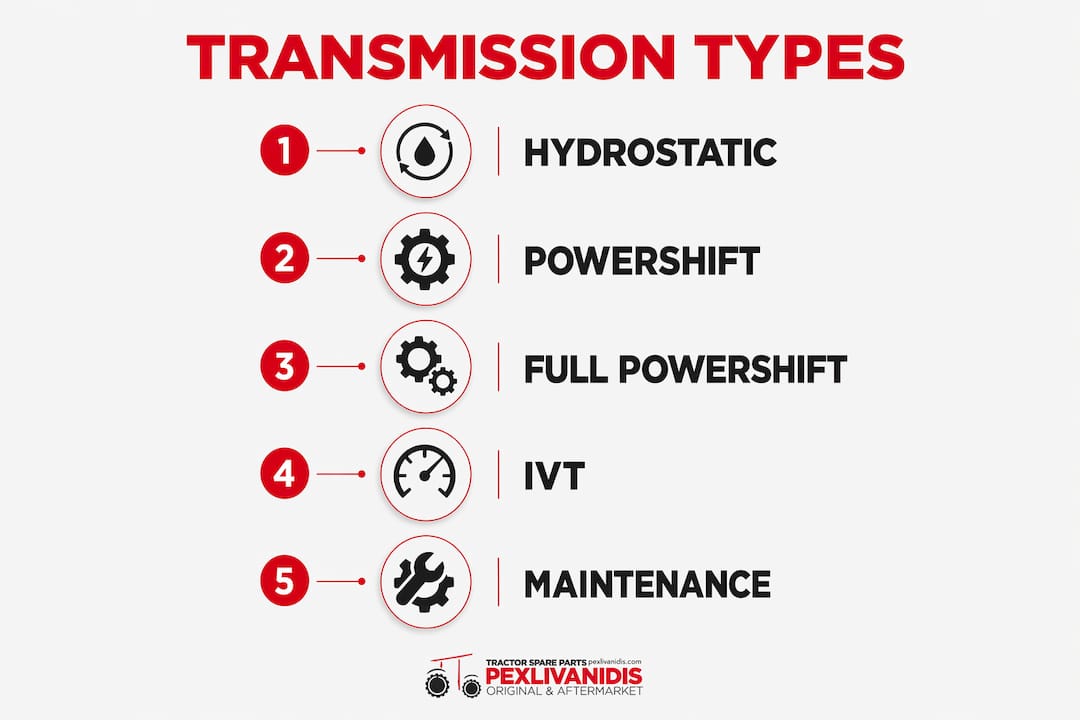
John Deere offers four primary transmission categories as of 2026: Hydrostatic (eHydro™), PowerShift variants, Full PowerShift/E-series, and IVT™/AutoPowr™. Understanding how each one works is the foundation for making a smart purchase or maintenance decision.
- Hydrostatic (eHydro™): Power transfers through hydraulic fluid rather than mechanical gears. The operator controls speed with a foot pedal, making direction changes smooth and immediate. This system suits compact and utility tractors used for loader work, mowing, and precision tasks. The trade-off is moderate power loss at the PTO compared to mechanical systems.
- PowrReverser™ / PowrQuad™ / Powr8™: These are PowerShift variants with varied clutch usage. PowrReverser™ allows clutchless forward-to-reverse changes, ideal for loader cycles. PowrQuad™ adds push-button gear shifting within ranges. Powr8™ improves shift speed and load capacity. The 5120M utility tractor is a strong example, offering 32 forward and 16 reverse speeds.
- Full PowerShift and E-series (e18™, e19™, e23™): These transmissions deliver zero power interruption during gear changes. The operator never loses momentum mid-shift. The 6R 180 row-crop tractor offers the e19 PowerShift as a standard option, with transport speeds reaching 50 km/h.
- IVT™ / AutoPowr™: The Intelligent Variable Transmission provides infinite speed control between zero and maximum. It adjusts gear ratios continuously without steps or interruptions. John Deere fits IVT across the 6M to 7R Series, making it the top choice for high-load precision farming.
Each type represents a different philosophy: simplicity, versatility, power continuity, or full automation. Knowing which philosophy matches your farm is the first step.
How do John Deere transmissions affect efficiency and task suitability?
The right tractor gearbox does more than move the machine. It determines how much fuel you burn, how tired you get at the end of the day, and how well the tractor handles each specific task.
- Hydrostatic transmissions excel at loader work and mowing. Hydrostatic systems use hydraulic fluid for power transfer, enabling precise control and easy direction changes. The downside is measurable PTO power loss, which makes them less suited for heavy tillage or large baler work.
- PowrReverser™ systems allow direction changes on the fly without clutch use. This is a direct productivity gain for operators doing repetitive loader cycles or snow removal. Fewer clutch actions mean less operator fatigue over a full shift.
- Full PowerShift and E-series transmissions suit high-horsepower, heavy-duty tasks. Zero power interruption means the tractor maintains ground speed through gear changes during plowing or heavy cultivation. This matters most when soil resistance is high and momentum loss costs real time.
- IVT™ / AutoPowr™ delivers the best fuel efficiency under variable load conditions. IVT provides precise speed control with strong efficiency, making it ideal for precision work and high-load farming. The system automatically adjusts to load changes, so the engine always runs near its most efficient point.
Pro Tip: For mixed-use operations that split time between loader work and field cultivation, a PowrQuad™ or Powr8™ transmission often delivers the best balance of ease and mechanical simplicity without the cost of a full IVT system.
The key trade-off across all types is complexity versus control. More automation means more precision and comfort, but also more electronic components that require specialist diagnostics when something goes wrong.
What are the maintenance requirements for John Deere transmission types?
Transmission maintenance is where most repair bills originate. A disciplined service schedule protects your investment regardless of which type you run.
- Follow fluid and filter change intervals strictly. Fluid and filter changes every 500 hours under normal operation, reduced to 250 hours in severe environments, is the standard interval. Severe conditions include dusty fields, extreme temperatures, and heavy continuous loads.
- Use only John Deere-approved transmission fluids. Non-approved oils risk hydraulic and electronic system damage across the full John Deere transmission range. Wet clutch components are especially sensitive to fluid chemistry. Using the wrong oil voids warranty coverage and can destroy clutch packs within a single season.
- Adjust your service frequency to transmission complexity. A PowrReverser™ or PowrQuad™ system has fewer electronic sensors than an IVT™. Simpler systems are easier to inspect visually and diagnose mechanically. IVT™ and E-series transmissions require electronic diagnostic tools, such as John Deere’s Service ADVISOR, to read fault codes accurately.
- Check for early warning signs. Slipping during gear changes, delayed engagement, or unusual noise during direction reversals all signal fluid degradation or clutch wear. Catching these early prevents a minor service job from becoming a full rebuild.
- Inspect breathers and seals at every service. Contaminated fluid from a failed seal is one of the most common causes of premature transmission failure. A five-minute visual check at each service interval saves thousands in repair costs.
Pro Tip: Keep a tractor maintenance log that records fluid type, change date, and hours at each service. This single habit makes it far easier to spot patterns before they become failures.
Maintenance differences between transmission types are real. Mechanical PowerShift systems tolerate minor service delays better than electronically managed IVT units. That does not mean you should delay service on either, but it does mean IVT owners need to be more disciplined.
How do PowerShift variants differ and why does it matter?
PowerShift terminology varies significantly, and confusing the subtypes leads to wrong expectations and poor workflow decisions. The three main categories are Semi-PowerShift, Full PowerShift, and the newer E-series.
| Transmission type | Clutch required for gear change | Power interruption | Example |
|---|---|---|---|
| Semi-PowerShift (PowrReverser™) | Yes, for range shifts | Brief interruption | 5E Series utility tractors |
| Semi-PowerShift (PowrQuad™) | Yes, for range shifts | Brief interruption | 5120M utility tractor |
| Full PowerShift (Powr8™) | No | Zero interruption | 6M Series tractors |
| E-series (e19™, e23™) | No | Zero interruption | 6R 180 row-crop tractor |
Understanding Semi-PowerShift versus Full PowerShift is crucial for managing tractor operation cycle times and workload efficiency. A Semi-PowerShift operator still uses the clutch when changing between gear ranges, which adds a brief pause in power delivery. In a loader cycle repeated 200 times a day, those pauses add up.
Full PowerShift and E-series transmissions eliminate that pause entirely. Clutchless gear changes dramatically improve operator productivity, but understanding when clutch use is still necessary during range shifts avoids costly mechanical stress. Forcing a range change without the clutch on a Semi-PowerShift system damages synchronizers over time.
The practical takeaway: if your primary work involves repetitive directional changes or frequent speed adjustments under load, step up to Full PowerShift or E-series. For lighter mixed-use work, a PowrQuad™ or PowrReverser™ delivers solid performance at a lower purchase and repair cost.
What should farmers consider when choosing a John Deere tractor transmission?
Selecting the right transmission comes down to matching the gearbox to your actual workload, not the most advanced option available.
- Primary task determines the type. Loader work and mowing favor hydrostatic or PowrReverser™ systems for their ease of direction control. Heavy tillage, plowing, and high-speed transport favor Full PowerShift or IVT™ for their power continuity and efficiency.
- Ease of use versus mechanical simplicity is a real trade-off. Farmers often underestimate the benefit of mechanical PowerShift simplicity for reducing diagnostic costs despite advanced automation trends favoring IVTs. An IVT™ is more comfortable to operate, but a PowrQuad™ is faster and cheaper to repair in the field.
- Long-term maintenance costs matter more than purchase price. An IVT™-equipped tractor costs more upfront and more to repair when electronics fail. A mechanical PowerShift system can often be serviced by a competent local mechanic without specialist software.
- Operator familiarity affects daily productivity. A farmer switching from a manual transmission tractor to an IVT™ needs time to adapt. Choosing a transmission that matches your team’s current skill level avoids a productivity dip during the transition period.
- Consider the full tractor lifespan. A transmission that suits your operation today should still suit it in 10 years. If you plan to expand into precision agriculture or GPS-guided field work, an IVT™ or E-series transmission integrates better with those systems. You can also review transmission types and their agricultural uses for a broader technical overview before committing.
Key Takeaways
John Deere tractor transmission types range from simple hydrostatic systems to fully automated IVT units, and matching the right type to your workload is the single most important factor in long-term performance and cost control.
| Point | Details |
|---|---|
| Four primary categories | John Deere offers eHydro™, PowerShift variants, Full PowerShift/E-series, and IVT™/AutoPowr™. |
| Task matching is critical | Hydrostatic suits loader work; IVT™ suits precision and high-load field tasks. |
| Fluid intervals protect the system | Change transmission fluid every 500 hours normal, 250 hours in severe conditions, using only JD-approved oils. |
| PowerShift subtypes differ significantly | Semi-PowerShift requires clutch for range shifts; Full PowerShift and E-series deliver zero power interruption. |
| Simplicity has real value | Mechanical PowerShift systems cost less to diagnose and repair than electronically managed IVT units. |
What I’ve learned from years around John Deere gearboxes
The most common mistake I see farmers make is buying the most advanced transmission available and then struggling with repair bills two years later. IVT™ and E-series systems are genuinely impressive. They make long days easier and fuel bills lower. But they demand a level of maintenance discipline and diagnostic capability that not every operation has in place.
My honest recommendation: if you have reliable access to a John Deere dealer with Service ADVISOR capability and you run the tractor hard every day, the IVT™ pays for itself. If you are running a mid-size mixed operation and your nearest dealer is an hour away, a PowrQuad™ or Powr8™ gives you 90% of the performance with far less risk when something goes wrong at harvest time.
The other thing worth saying plainly: electronic versus mechanical transmission choices affect more than just comfort. They affect who can fix your tractor, how fast, and at what cost. That is a farm management decision, not just a spec sheet comparison. Operator familiarity matters too. A driver who knows a PowrQuad™ inside out will outperform a driver still learning an IVT™ every single time.
— George
Pexlivanidis: your source for tractor transmission parts and guidance
Keeping a John Deere transmission in top condition requires the right parts, the right fluids, and reliable technical guidance. Pexlivanidis stocks over 20,000 agricultural machinery parts, including transmission components and approved consumables for the full range of John Deere gearbox types. Whether you run a 5120M with a PowrQuad™ or a 6R 180 with an e19 PowerShift, you will find what you need. For farmers who want to go deeper on service schedules and component selection, the agricultural machinery maintenance guide at Pexlivanidis covers transmission upkeep alongside every other critical system on your tractor. Free shipping within Greece applies to orders over 100€.
FAQ
What are the four main John Deere tractor transmission types?
John Deere offers Hydrostatic (eHydro™), PowerShift variants (PowrReverser™, PowrQuad™, Powr8™), Full PowerShift/E-series (e18™, e19™, e23™), and the Intelligent Variable Transmission (IVT™/AutoPowr™). Each type suits different tasks and operator preferences.
How often should I change John Deere transmission fluid?
Fluid and filter changes are recommended every 500 hours under normal conditions and every 250 hours in severe environments. Always use John Deere-approved transmission oils to protect wet clutch components and electronics.
What is the difference between Semi-PowerShift and Full PowerShift?
Semi-PowerShift systems like PowrReverser™ and PowrQuad™ require clutch use when changing gear ranges, causing a brief power interruption. Full PowerShift and E-series transmissions shift without any clutch input and deliver zero power interruption.
Is an IVT transmission worth the extra cost?
An IVT™ delivers the best fuel efficiency and operator comfort for high-load, precision farming tasks. The higher upfront cost and more complex repair requirements make it most worthwhile for operations with regular dealer access and heavy daily use.
Which John Deere transmission is best for loader work?
Hydrostatic (eHydro™) and PowrReverser™ transmissions are best suited for loader work. Both allow smooth, fast direction changes with minimal operator effort, reducing fatigue during repetitive loading cycles.