

Reducing downtime is a top priority for Greek farmers, and American agricultural machinery often leads the way with high parts interchangeability standards. Relying on one specialized part can turn a minor breakdown into a costly halt, especially during harvest. Understanding how interchangeable parts work helps farm operators and maintenance managers keep equipment running smoothly, cut repair times, and manage costs without sacrificing productivity. Learn how smart choices in parts compatibility can keep machinery reliable all season long.
Table of Contents
- What Parts Interchangeability Means in Farming
- Main Types and Standards for Interchangeability
- How Interchangeable Parts Boost Efficiency
- Risks and Challenges When Swapping Parts
- Legal, Safety, and Warranty Considerations
Key Takeaways
| Point | Details |
|---|---|
| Interchangeable Parts Enhance Efficiency | Greek farmers can quickly replace components, minimizing downtime and boosting productivity. |
| Types of Interchangeability | Complete interchangeability allows for direct replacement, while limited interchangeability requires careful adjustments. |
| Economic Benefits | Farmers save on repair times and inventory costs, allowing for flexible maintenance strategies. |
| Legal and Safety Compliance | Farmers must ensure parts meet manufacturer standards to maintain warranty coverage and safety regulations. |
What Parts Interchangeability Means in Farming
Parts interchangeability represents a critical operational strategy for Greek farmers seeking to maximize agricultural machinery efficiency. At its core, interchangeable parts enable seamless component replacement without requiring custom modifications or extensive technical expertise. This standardization allows farmers to quickly swap out damaged or worn components, minimizing equipment downtime and maintaining continuous agricultural productivity.
In practical farming contexts, interchangeability means that specific machinery components are manufactured to precise specifications that guarantee near-identical dimensions and performance characteristics. These meticulously engineered parts can fit multiple equipment models within the same machinery category, dramatically simplifying maintenance processes. Standardized component design ensures reliable operation by creating predictable replacement options that reduce repair complexity and technical skill requirements.
The benefits of parts interchangeability extend beyond immediate repair convenience. Farmers gain significant economic advantages through reduced repair times, lower inventory storage costs, and increased equipment reliability. By selecting machinery with high interchangeability potential, agricultural operators can create more flexible maintenance strategies, strategically stock fewer specialized components, and respond more rapidly to unexpected equipment failures.
Pro tip: When purchasing new agricultural equipment, prioritize machinery brands and models that demonstrate high parts interchangeability across their product lines to maximize long-term maintenance flexibility and cost-effectiveness.
Main Types and Standards for Interchangeability
In agricultural machinery, interchangeability standards are classified into distinct categories that define how components can be replaced across different equipment models. Comprehensive interchangeability frameworks typically encompass two primary types: complete and limited interchangeability, each with specific implications for farm equipment maintenance and repair strategies.
Complete Interchangeability represents the ideal scenario where any manufactured part can be directly substituted without additional modifications. In this system, components are engineered to such precise tolerances that they can be swapped seamlessly across multiple machinery units. Farmers benefit from reduced downtime and simplified inventory management, as standardized dimensional systems enable straightforward part replacement.

Conversely, Limited Interchangeability requires more nuanced approaches. These systems may necessitate selective assembly, pre-grouping of components, or minor adjustments to ensure proper fitting. Agricultural equipment manufacturers often employ this approach when achieving absolute dimensional uniformity becomes cost-prohibitive. International standards like ISO play a crucial role in defining acceptable tolerance ranges, ensuring that even with limited interchangeability, farmers can still efficiently maintain and repair their machinery.
Pro tip: When evaluating agricultural equipment, request detailed interchangeability specifications from manufacturers to understand the exact compatibility and replacement potential of machine components.
Here is a comparison of complete versus limited parts interchangeability in agricultural machinery:
| Aspect | Complete Interchangeability | Limited Interchangeability |
|---|---|---|
| Replacement Speed | Instant, no modifications needed | May require adjustment or grouping |
| Inventory Management | Simplified, minimal specialized stock | Requires broader stock or pairing |
| Upfront Manufacturing Cost | Higher due to tight tolerances | Lower, with more flexible standards |
| Downtime Risk | Very low, quick repairs | Moderate, fitting may take time |
How Interchangeable Parts Boost Efficiency
Interchangeable parts are a game-changing strategy for agricultural operations seeking to maximize machinery performance and minimize operational disruptions. Quick component replacement techniques enable farmers to rapidly address equipment failures, ensuring continuous productivity and reducing expensive downtime that can critically impact seasonal agricultural activities.
The economic advantages of interchangeable parts extend far beyond immediate repair capabilities. By standardizing component designs, farmers can maintain a more streamlined inventory of replacement parts, reducing storage costs and complexity. This approach allows for greater flexibility in equipment maintenance, as standard parts can often be used across multiple machinery models and brands, creating a more adaptable and cost-effective maintenance strategy.
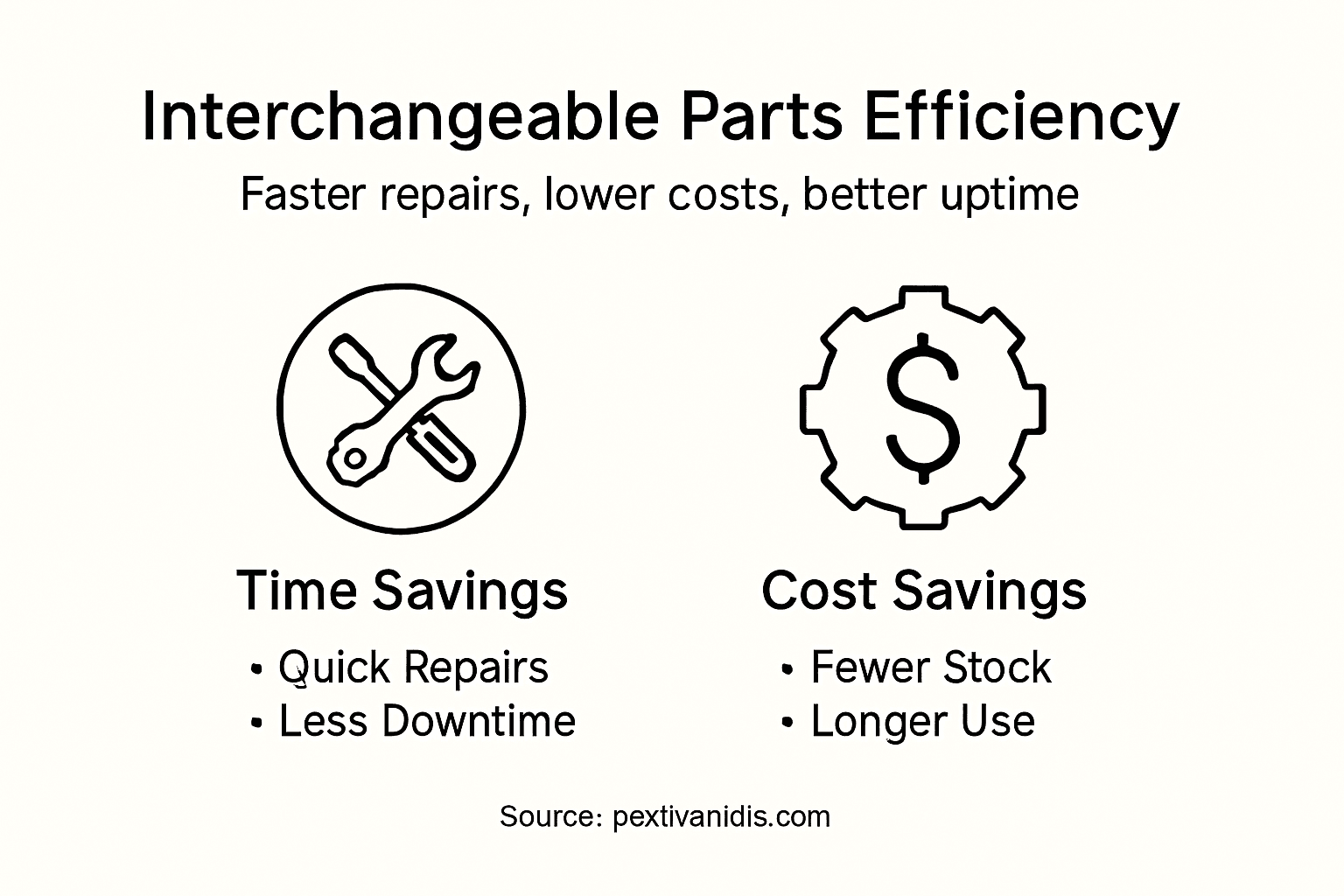
Moreover, interchangeability directly supports operational efficiency by minimizing equipment downtime and production interruptions. When a critical component fails, farmers can quickly source and install a standard replacement part without extensive custom fabrication or waiting for specialized components. This rapid response capability is particularly crucial during time-sensitive agricultural periods like planting and harvesting, where every hour of machinery operation can significantly impact crop yields and overall farm productivity.
Pro tip: Develop a comprehensive parts inventory system that catalogs interchangeable components across your machinery fleet, enabling faster and more efficient equipment maintenance and repairs.
Risks and Challenges When Swapping Parts
While interchangeable parts offer significant advantages, farmers must navigate several critical risks associated with component replacement. Variations in part quality and manufacturer standards can introduce unexpected complications that potentially compromise machinery performance and operational reliability. Understanding these potential pitfalls is essential for making informed decisions about parts replacement strategies.
One of the most significant challenges involves ensuring precise compatibility beyond basic dimensional measurements. Seemingly interchangeable components might differ in material quality, manufacturing tolerances, or internal specifications that are not immediately apparent. These subtle differences can lead to reduced equipment efficiency, increased wear on connected systems, or even catastrophic machinery failures during high-stress agricultural operations.
Spare parts inventory management presents another complex challenge for farmers seeking to optimize their equipment maintenance approach. The unpredictable nature of machinery breakdowns requires a delicate balance between maintaining sufficient spare parts and avoiding excessive inventory costs. Miscalculations can result in unexpected downtime, with critical components either unavailable when needed or consuming valuable storage resources without guaranteeing immediate usability.
Pro tip: Develop a rigorous testing protocol for newly acquired replacement parts, including dimensional verification, material stress tests, and compatibility assessments before full deployment in critical farming equipment.
This table summarizes key risks farmers should assess when swapping out interchangeable parts:
| Risk Category | Potential Issues | Mitigation Strategy |
|---|---|---|
| Quality Variation | Lower performance or faster wear | Source from trusted suppliers |
| Compatibility | Misfit due to hidden differences | Conduct detailed inspections |
| Inventory Balance | Excess stock or shortages | Monitor usage and forecast |
| Legal/Safety | Warranty loss or liability | Document replacements, stay compliant |
Legal, Safety, and Warranty Considerations
Warranty protection represents a critical consideration when implementing parts interchangeability in agricultural machinery. Navigating legal and safety standards requires farmers to meticulously understand manufacturer specifications and potential implications of using alternative components. The wrong replacement part can not only compromise equipment performance but also potentially invalidate existing warranty coverage.
Safety standards demand rigorous compliance with regulatory requirements that protect both equipment integrity and operator well-being. Farmers must verify that any interchangeable parts meet precise manufacturing specifications, design tolerances, and industry safety regulations. Manufacturer-approved parts maintain equipment warranties and ensure that machinery continues to operate within intended performance parameters, minimizing potential legal and operational risks.
Legal considerations extend beyond immediate warranty concerns. Using non-approved parts can expose farmers to significant liability if equipment malfunctions lead to workplace accidents or property damage. This risk underscores the importance of maintaining comprehensive documentation, conducting thorough parts compatibility assessments, and working closely with equipment manufacturers and authorized parts suppliers to ensure full compliance with safety and legal standards.
Pro tip: Maintain a detailed record of all parts replacements, including manufacturer specifications, purchase documentation, and compatibility assessments to protect your equipment warranty and legal standing.
Maximize Farming Efficiency with Reliable Interchangeable Parts
Downtime in farming can be costly and frustrating. As highlighted in the article “Parts Interchangeability – Reducing Downtime in Farming,” quick and precise replacement of standardized components is essential to keep machinery running smoothly and maintain productivity. If you struggle with parts compatibility, inventory management, or the risk of unreliable replacements, you are not alone. Ensuring access to high-quality interchangeable parts that fit your agricultural equipment perfectly is key to reducing repair time and safeguarding your operations.
At pexlivanidis.com, we understand the importance of seamless parts interchangeability for Greek farmers. Our extensive inventory of over 20,000 tractor accessories and spare parts is designed to meet strict quality standards and compatibility requirements. Whether you need immediate replacements to prevent costly downtime or are looking to streamline your maintenance supplies, our platform offers fast shipping within Greece and personalized support. Explore our selection and experience how the right parts can transform your farming efficiency. Visit pexlivanidis.com today and take the first step toward hassle-free equipment maintenance that keeps your farm moving forward without interruption.
Frequently Asked Questions
What is parts interchangeability in farming?
Parts interchangeability refers to the ability to replace components of agricultural machinery without needing custom modifications, allowing for quick repairs and maintaining equipment efficiency.
How does complete interchangeability differ from limited interchangeability?
Complete interchangeability allows any part to be swapped without modifications, while limited interchangeability may require adjustments or selective assembly for proper fitting of components.
What are the economic benefits of using interchangeable parts in farming?
Using interchangeable parts can reduce repair times, lower inventory storage costs, and increase equipment reliability, leading to overall cost savings and improved operational efficiency.
What are the risks associated with swapping parts?
Risks include variations in part quality, hidden compatibility issues, challenges in inventory management, and potential legal or warranty complications if non-approved parts are used.