

Ordering tractor parts online can feel overwhelming when you need the right fit for your John Deere or Massey Ferguson in Thessaloniki or Kavala. For small-scale farmers and repair technicians in Northern Greece, one mismatched part could mean days lost in the field or costly breakdowns. With so many suppliers and products to review, knowing how to identify your exact needs, compare reputable vendors, and confirm genuine quality can safeguard your equipment and save money. Start with precision and compatibility to keep your tractors running smoothly all season.
Table of Contents
- Step 1: Identify Your Tractor’s Exact Needs
- Step 2: Compare Reputable Online Parts Suppliers
- Step 3: Verify Compatibility And Product Details
- Step 4: Evaluate Shipping, Payment, And Return Policies
- Step 5: Confirm Quality Upon Delivery
Quick Summary
| Key Point | Explanation |
|---|---|
| 1. Identify Tractor Needs Precisely | Check your tractor’s manual, locate the serial number, and document part specifications to ensure compatibility during online purchases. |
| 2. Compare Reputable Suppliers | Assess manufacturer certifications, customer reviews, and warranty coverage to select high-quality, compatible parts for your tractor. |
| 3. Verify Compatibility Thoroughly | Collect your tractor’s serial number and measure parts to confirm that replacements meet exact specifications before ordering. |
| 4. Understand Shipping and Return Policies | Review payment methods, shipping costs, and return policies to avoid unexpected issues and expenses when ordering online. |
| 5. Conduct Quality Checks Upon Delivery | Thoroughly inspect received parts against your order to identify any discrepancies or damage, ensuring they meet your tractor’s needs. |
Step 1: Identify Your Tractor’s Exact Needs
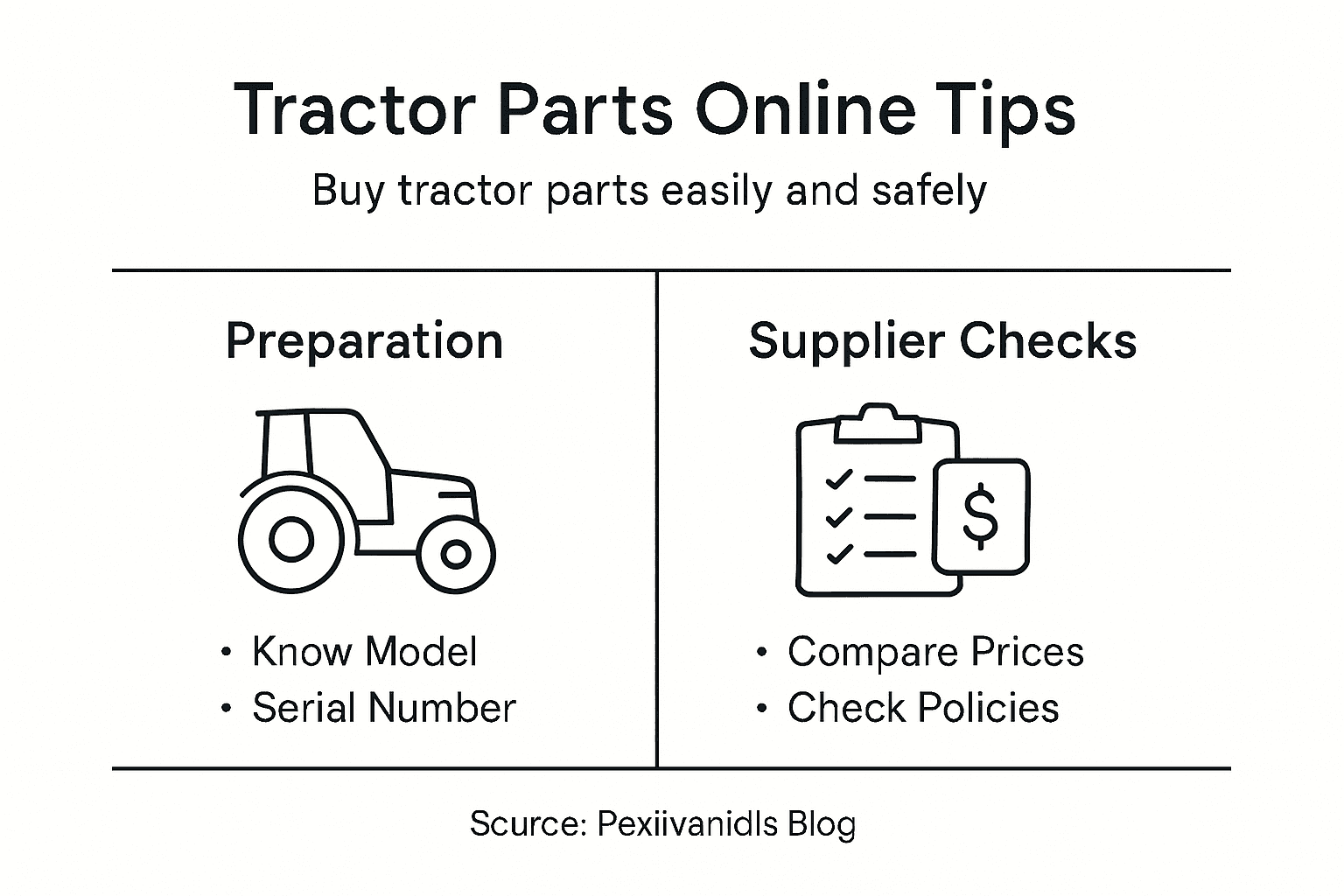
Identifying your tractor’s precise parts requirements is crucial for effective online purchasing. Understanding your specific model and components will save time, money, and prevent potential compatibility issues when shopping for replacement parts.
To accurately identify your tractor’s needs, follow these strategic steps:
- Check the tractor’s manual for exact model specifications
- Locate the serial number typically found on the frame or engine block
- Measure existing parts carefully before searching online
- Document specific wear patterns or damage
Your serial number acts as a critical identifier. Manufacturers like Massey Ferguson, John Deere, and Kubota use unique codes that precisely map to specific part configurations. When searching online, types of essential tractor parts become significantly easier to match.
Photographing the damaged or needed component provides additional clarity for online parts specialists. Detailed images help match exact specifications, reducing the risk of incorrect purchases.
Precision matters: A single mismatched part can cause cascading mechanical failures.
Pro tip: Keep a dedicated folder with your tractor’s documentation, serial number photographs, and parts history to streamline future maintenance and replacement efforts.
Step 2: Compare Reputable Online Parts Suppliers
Comparing online tractor parts suppliers requires a strategic approach to ensure you receive high-quality, compatible components for your specific agricultural machinery. Understanding how to evaluate different vendors can save you significant time and prevent costly purchasing mistakes.
When comparing online parts suppliers, focus on several critical assessment criteria:
- Check manufacturer certifications for quality assurance
- Review customer feedback and ratings thoroughly
- Examine warranty coverage for each potential supplier
- Compare shipping options and delivery timeframes
- Verify parts compatibility with your specific tractor model
OEM-quality component standards demonstrate a supplier’s commitment to precision and reliability. Reputable vendors typically provide comprehensive technical support, ensuring you can confidently select the right parts for your equipment.
Prioritize suppliers who offer detailed product specifications, clear return policies, and responsive customer service. Some online platforms provide comparison tools that can help you quickly assess different vendor offerings, making your selection process more efficient.
Not all online suppliers are created equal: Your diligence determines your purchasing success.
Pro tip: Create a spreadsheet to track different supplier details, including pricing, shipping costs, warranty terms, and return policies to make a comprehensive side-by-side comparison.
Step 3: Verify Compatibility and Product Details
Ensuring absolute compatibility between your tractor and replacement parts requires meticulous attention to detail and a systematic verification approach. A single mismatched component can lead to significant mechanical complications and potential equipment damage.
To thoroughly verify product compatibility, follow these critical steps:
- Collect your tractor’s exact serial number
- Measure existing part dimensions precisely
- Compare OEM part numbers exactly
- Review detailed product specifications
- Check mounting hardware requirements
Tractor part compatibility strategies demand careful documentation of your specific equipment model. Understanding the nuanced differences between original equipment manufacturer (OEM) and aftermarket components helps prevent potential installation challenges.

Careful examination of product descriptions, technical specifications, and compatibility charts becomes crucial. Most reputable online suppliers provide detailed measurement guides and compatibility matrices that can help you confirm whether a specific part will work seamlessly with your agricultural machinery.
Here’s a comparison of OEM versus aftermarket tractor parts to guide your purchasing decisions:
| Characteristic | OEM Parts | Aftermarket Parts |
|---|---|---|
| Fit Precision | Exact match for model | May require adjustments |
| Warranty Coverage | Manufacturer-backed warranty | Varies by supplier |
| Price Range | Usually higher | Often more affordable |
| Support Options | Full technical support | May be limited |
Precision matters: One millimeter can mean the difference between a perfect fit and a complete replacement.
Pro tip: Take clear, high-resolution photographs of the part you need to replace and keep your tractor’s manual nearby during your online search to cross-reference specifications quickly.
Step 4: Evaluate Shipping, Payment, and Return Policies
Navigating the complexities of online purchasing requires a thorough understanding of a supplier’s shipping, payment, and return policies. These critical details can significantly impact your overall buying experience and potential financial protection.
When evaluating an online tractor parts supplier, carefully examine the following key aspects:
- Verify available payment methods
- Check shipping cost structures
- Review complete return policy details
- Understand potential restocking fees
- Confirm warranty coverage terms
Freight and return policy considerations reveal important nuances in online parts purchasing. Different suppliers have unique approaches to shipping charges, with some offering prepaid shipping and others adding freight costs directly to your invoice.
Paying close attention to the fine print can prevent unexpected expenses and complications. Some suppliers impose restocking fees for returned items, and special order parts are frequently non-returnable. Credit card, PayPal, and bank transfer options provide flexibility, but each comes with its own set of transaction considerations.
Key shipping and return policy features to check before purchasing tractor parts online:
| Policy Feature | Why It Matters | What to Look For |
|---|---|---|
| Shipping Cost | Affects overall purchase price | Clear pricing structure |
| Return Window | Ensures flexibility | Minimum 14–30 days |
| Restocking Fees | Impacts refund amount | Transparent fee details |
| Payment Methods | Determines transaction ease | Multiple secure options |
Not all policies are created equal: Read the details before clicking ‘purchase’.
Pro tip: Screenshot and save the supplier’s complete shipping and return policy before finalizing your purchase, ensuring you have documentation of the terms at the time of transaction.
Step 5: Confirm Quality Upon Delivery
Receiving your tractor parts marks the final critical stage of your online purchasing journey, where careful inspection can prevent potential mechanical issues and ensure you’ve received exactly what you ordered. Thorough quality verification protects your investment and agricultural equipment’s performance.
When your parts arrive, conduct a comprehensive inspection following these essential steps:
- Verify package contents against original order
- Inspect packaging for shipping damage
- Check part dimensions and specifications
- Test mechanical fitment and connections
- Document any discrepancies immediately
Quality control strategies demonstrate the importance of methodical product assessment. Comprehensive inspection helps identify potential manufacturing defects or shipping-related damages that might compromise your tractor’s functionality.
Professional farmers understand that a meticulous unboxing process can save significant time and expense. Compare received parts against original specifications, checking for correct measurements, surface integrity, and precise manufacturing standards. If any issues are detected, photograph and document them thoroughly before contacting the supplier.
Precision matters: Your first inspection is your best defense against substandard parts.
Pro tip: Create a standardized inspection checklist and keep it near your delivery area to ensure consistent and comprehensive quality verification for every parts shipment.
Streamline Your Tractor Parts Purchase with Trusted Solutions
Buying tractor parts online effectively means overcoming challenges like identifying the exact model, verifying compatibility, and navigating shipping and return policies. With so many details to consider, the risk of ordering the wrong part or dealing with unreliable suppliers can create frustration and delay critical repairs.
At Pexlivanidis, we understand these pain points. Our extensive inventory of over 20,000 agricultural machinery parts ensures you find the perfect fit for your tractor without compromise. Whether you need to confirm compatibility or want clear product details, our dedicated platform supports your search every step of the way. Explore our broad selection of tractor parts backed by transparent shipping and return policies that protect your investment.
Don’t let uncertainty slow your operations—take control of your tractor maintenance today. Visit Pexlivanidis homepage now to find reliable parts with confidence and experience hassle-free agricultural machinery support that keeps your work moving forward.
Frequently Asked Questions
How can I accurately identify my tractor’s parts needs before buying online?
To accurately identify your tractor’s parts needs, check the tractor’s manual for specifications, locate the serial number on the frame or engine block, measure existing parts, and document any wear patterns or damage. Take high-resolution photographs of the parts to aid in online searches.
What should I look for when comparing online tractor parts suppliers?
When comparing online tractor parts suppliers, check for manufacturer certifications, read customer feedback and ratings, examine warranty coverage, and verify that parts are compatible with your specific tractor model. Create a spreadsheet to track supplier details for easy comparison.
How do I ensure compatibility between my tractor and the replacement parts?
To ensure compatibility, collect your tractor’s exact serial number, measure existing parts precisely, compare OEM part numbers, and review detailed product specifications. Document all measurements and specifications, as even minor discrepancies can lead to installation issues.
What key shipping and return policy details should I consider before purchasing?
You should consider available payment methods, shipping costs, the supplier’s return policy, and any potential restocking fees. Always read the full terms before purchasing to avoid unexpected expenses.
How can I confirm the quality of tractor parts upon delivery?
To confirm quality upon delivery, verify that package contents match your order, inspect for any shipping damage, and check the dimensions and specifications of the received parts. Document any discrepancies immediately and address issues with the supplier to protect your investment.
What steps can I take to streamline the online purchasing process for tractor parts?
Streamline your online purchasing by keeping a dedicated folder with your tractor’s documentation, serial number photographs, and parts history. This organized information allows for quick reference and makes future maintenance and replacement efforts more efficient.