

TL;DR:
- Farmers often confuse tractor cultivator types, risking soil damage or ineffective weed control. Selecting the proper cultivator depends on soil conditions, crop stage, and tractor compatibility, emphasizing timing and maintenance. Mechanical cultivation increasingly aids weed management and soil health, making correct equipment choice vital for modern farming success.
Most farmers have stood in front of a row of implements at a dealer and walked away more confused than when they arrived. Tractor cultivator types are one of the most misunderstood categories in agricultural equipment, often lumped together with tillers or treated as interchangeable. They are not. Picking the wrong type does not just waste money. It can damage soil structure, miss your weed control window, and put strain on a tractor that was never built for that load. This guide cuts through the noise and gives you a clear, practical breakdown of each type, how they differ, and how to choose the right one for your operation.
Table of Contents
- Key takeaways
- Major tractor cultivator types and how they work
- Cultivator vs tiller: knowing the real difference
- Matching cultivators to your tractor’s hitch and lift capacity
- Practical applications of cultivators in modern farming
- How to choose and maintain the right cultivator
- My take on cultivators after years in agricultural equipment
- Find the right parts and support at Pexlivanidis
- FAQ
Key takeaways
| Point | Details |
|---|---|
| Know your cultivator category | Shovel-type, rotary, and spring-tine cultivators each serve distinct soil conditions and crop stages. |
| Cultivators are not tillers | Cultivators work at 1 to 4 inches depth for post-planting weed control; tillers turn soil deep before planting. |
| Match hitch category first | Category 0 and Category 1 hitch pins are not interchangeable; mismatches cause failures in the field. |
| Timing beats horsepower | A smaller cultivator used at the right crop stage outperforms a heavy unit used too late. |
| Invest in wear parts | Carbide-tipped coulters last significantly longer in abrasive soils, cutting long-term replacement costs. |
Major tractor cultivator types and how they work
Tractor-mounted cultivators fall into four primary categories based on their mechanism: shovel-type, rotary, spring-tine, and specialized paddy field cultivators. Each operates on a different principle and delivers different results depending on your soil and crop situation. Understanding these differences is the starting point for every good purchasing decision.
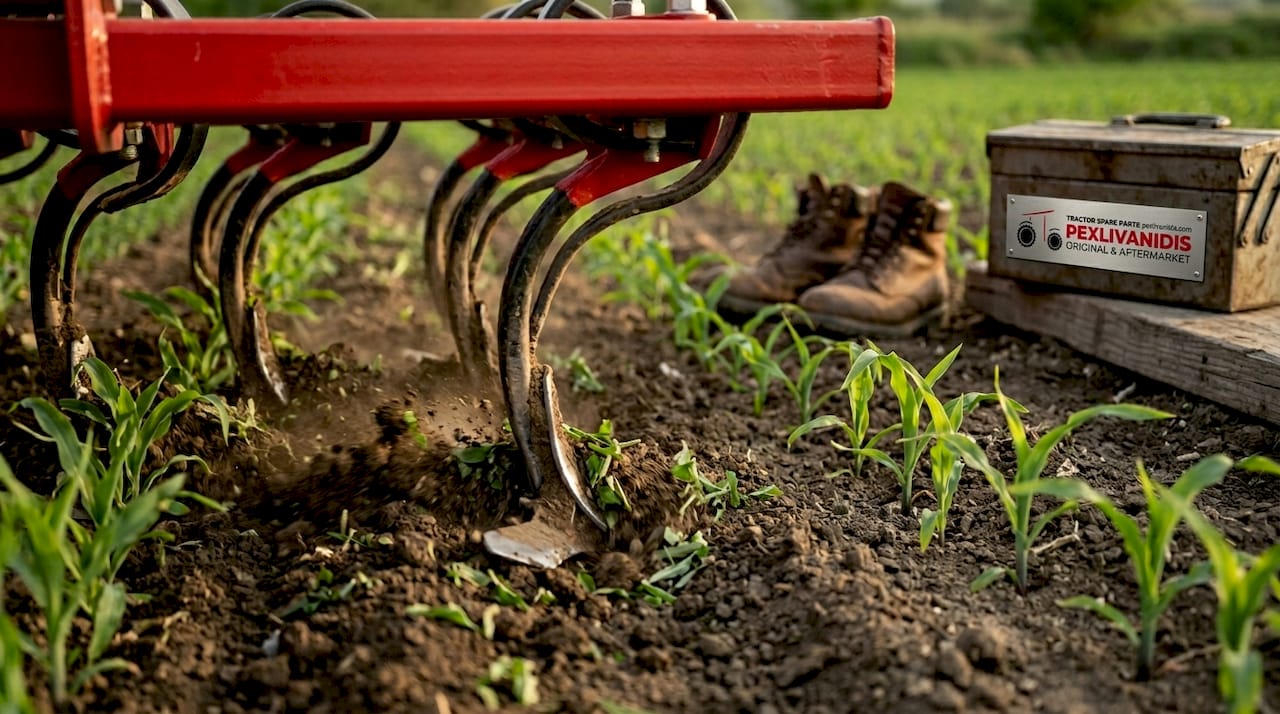
Shovel-type (field) cultivators are the workhorses of row crop farming. They use rigid or semi-rigid shanks fitted with shovels, sweeps, or chisels to break up compacted surface soil between crop rows. You will see these in corn, soybean, and cotton fields where the priority is loosening the top few inches without disturbing roots. Shank configuration matters a lot here. Wider sweeps cover more ground but require more draft. Narrower points penetrate compacted soil more effectively.
Rotary cultivators use high-speed rotating blades or tines driven by the tractor’s PTO. They cut, mix, and incorporate surface material in a single pass. These are popular in market gardens and vegetable operations where seedbed refinement and fast residue incorporation are priorities. The tradeoff is that rotary cultivators consume more power and can over-work fragile soils if the operator is not careful with speed settings.
Spring-tine cultivators use flexible C-shaped or S-shaped tines that vibrate as they move through the soil. This vibration does two things well: it dislodges small weed seedlings and aerates the top layer without the aggressive soil displacement of a rigid shank. You will find spring-tine units popular in small grain crops shortly after emergence, where gentle action is critical to avoid disturbing the crop’s shallow roots.
Paddy field cultivators are a specialized category designed for wet, flooded conditions in rice cultivation. They churn the standing water and soil together, controlling weeds and incorporating organic matter before transplanting. Outside of rice farming, you will rarely encounter these.
Pro Tip: For vegetable growers working in raised beds, a PTO-driven rotary cultivator set to a shallow depth pass gives you the weed control of hand-hoeing at a fraction of the time.
Cultivator vs tiller: knowing the real difference
This is where most purchasing mistakes happen. The confusion between a cultivator and a tiller is understandable because both touch soil and both attach to a tractor. But their jobs are completely different, and confusing tillers with cultivators leads to poor soil health and failed weed control.
Here is the clearest way to understand the split:
| Feature | Cultivator | Tiller |
|---|---|---|
| Operating depth | 1 to 4 inches | 6 to 12 inches or more |
| Primary purpose | Weed control, aeration, post-planting | Seedbed preparation, pre-planting |
| Timing of use | After crop emergence, between rows | Before planting season |
| Effect on soil | Shallow disturbance, structure preserved | Deep turning, structure disrupted |
| Crop roots | Safe for established plants | Not suitable near active crops |
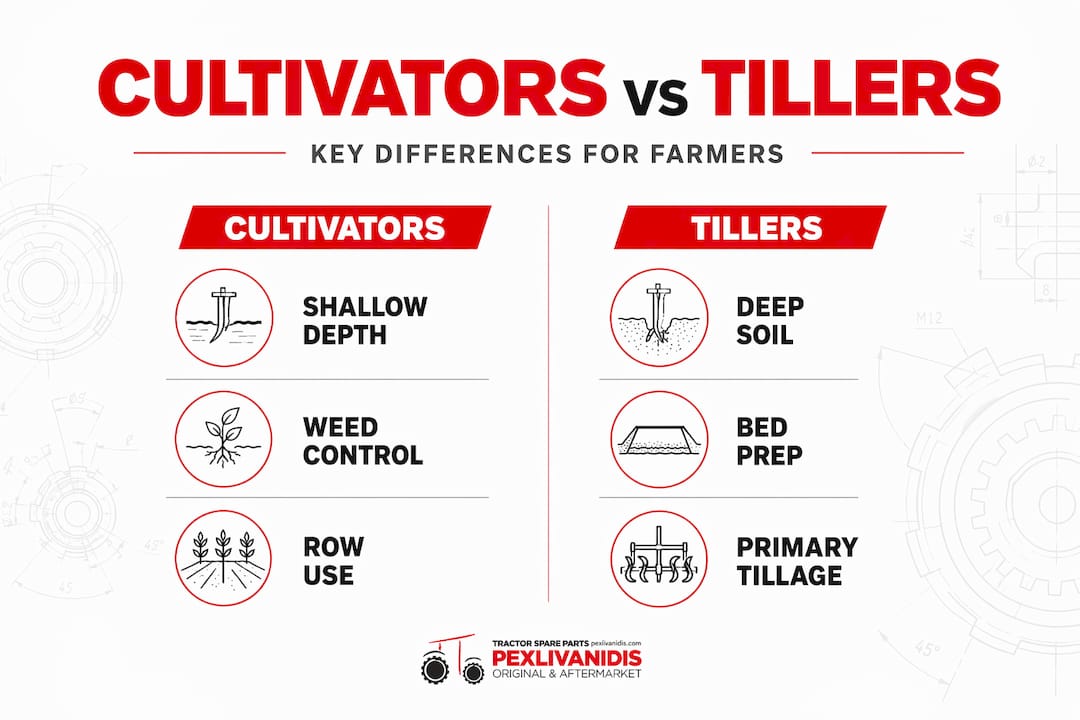
Cultivators operate at shallow depth to manage weeds and soil aeration between rows after the crop is already in the ground. Tillers perform deep soil turning and are used for seedbed preparation before anything is planted. Running a tiller through an established crop row will tear out roots. Running a cultivator through virgin or heavily compacted soil will either skip across the surface or break the machine.
Using cultivators for aggressive deep tillage is one of the most common and costly mistakes in field equipment management. The tines and shanks on a cultivator are simply not engineered for the resistance that deep soil breaking demands.
Pro Tip: If you are buying your first tractor implement and you are not sure whether you need a cultivator or a tiller, ask yourself one question: Do you need to work the soil before planting or after? Before means tiller. After means cultivator.
Matching cultivators to your tractor’s hitch and lift capacity
Getting the right cultivator type is only half the job. The other half is making sure it physically connects to your tractor and that your tractor can actually handle the load.
Category 0 uses 5/8-inch hitch pins and is designed for compact and sub-compact tractors, typically under 40 horsepower. Category 1 uses 7/8-inch pins and fits tractors in the 40 to 100 horsepower range. Category 2 steps up to 1 1/8-inch pins for larger utility and row crop tractors. Adapters exist, but hitch mismatch adapters fail under real field conditions. Do not rely on them for a cultivator you plan to use every season.
Beyond pin size, you need to check your tractor’s rated lift capacity against the cultivator’s working weight. This matters most with wider, multi-row cultivators. Key factors to verify before purchase include:
- Three-point hitch category: Confirm pin diameter matches your tractor exactly. Do not assume.
- Rated lift capacity: Weigh the cultivator fully assembled with all shanks and guards attached, not just the frame.
- PTO shaft speed: Rotary cultivators require the correct PTO speed, either 540 or 1000 RPM. Mixing these up can destroy a gearbox within minutes.
- Working width vs. tractor wheelbase: A cultivator wider than your tractor’s rear wheelbase becomes difficult to control on slopes and headlands.
- Hydraulic requirements: Some cultivators use hydraulic fold systems. Verify your tractor has the remote hydraulic couplers to support this.
For a detailed breakdown of how tractor specs match to implement requirements, the tractor compatibility guide from Pexlivanidis walks through the specifics with real examples.
Practical applications of cultivators in modern farming
Cultivators are showing up in more places than ever before because the problems they solve are growing. Mechanical cultivation is a primary tool for managing herbicide-resistant weeds in both organic and conventional systems. As certain weed species develop resistance to common chemistries, mechanical weed control with a tractor cultivator gives growers a chemical-free alternative that still delivers results.
The benefits extend well beyond weed pressure:
- Soil aeration between rows reduces compaction from wheel traffic and keeps root zones open for moisture and gas exchange.
- Incorporation of cover crop residue in the top few inches speeds decomposition without full tillage passes.
- Ridge-till systems rely on cultivators to maintain bed shape and manage in-row weeds in crops like corn without destroying the ridge structure.
- No-till systems use specialized no-till cultivators with coulters that slice through residue cleanly, maintaining surface cover while still addressing weed emergence.
Precision, timing, and controlled soil management define what separates an effective cultivator pass from a wasted one. Row crop cultivators need accurate row spacing guidance to work between plants without clipping leaves. Running the cultivator when weeds are in the white thread to small cotyledon stage, before they have established root systems, multiplies the effectiveness of every pass.
Crops that respond best to regular cultivation include corn, soybeans, dry beans, vegetables, and cotton. Small grains during the tillering phase also benefit from spring-tine passes that break up surface crusting. For more on how these farm tools support weed control across different systems, Pexlivanidis covers the topic in depth.
How to choose and maintain the right cultivator
Start with your soil type and work outward from there. Heavy clay soils need more robust shanks with better penetration. Sandy, loose soils benefit from spring-tine or sweep configurations that cover ground without over-disturbing structure. Here is a practical sequence for making your selection:
- Define your primary use. Post-planting weed control in row crops points to shovel-type or sweep cultivators. Seedbed refinement in market gardens points to rotary units.
- Know your tractor’s specs. Hitch category, lift capacity, and PTO speed are non-negotiable starting points, not afterthoughts.
- Match row spacing. The cultivator’s gang spacing must match or adjust to the crop’s row spacing. A cultivator set for 30-inch corn rows will not work correctly in 15-inch small grain rows without reconfiguration.
- Calculate your working width. Bigger is not always better. A narrower cultivator you can handle precisely is more effective than a wide one you cannot control.
- Evaluate wear part quality. Carbide-tipped coulters last 400 to 500 hectares in abrasive soils compared to far shorter service life from standard hardened steel. On large farms, the premium pays for itself quickly.
- Plan your maintenance schedule. Inspect shank bolts and tine fasteners after every 20 to 30 hours of use. Replace worn sweeps or shovels before they lose their cutting edge, not after.
Pro Tip: Cultivators are precision tools, not primary tillage equipment. If your field has heavy compaction or unbroken sod, run a subsoiler or disc first. Asking a cultivator to break virgin soil will bend shanks, strip bolts, and leave the field half-worked.
A common mistake worth calling out separately: buying based on width alone. Many growers size up to a wider cultivator to reduce passes, then discover their tractor does not have the hydraulic or lift capacity to handle headland turns cleanly. The result is damaged equipment and incomplete coverage on row ends. Read your tractor’s operator manual for rated lift numbers before you finalize any purchase.
For guidance on selecting the right tractor accessories and matching them to your machine, the Pexlivanidis resource library covers compatibility considerations across tractor brands and implement categories.
My take on cultivators after years in agricultural equipment
I have watched farmers spend serious money on the wrong cultivator more times than I can count. And in almost every case, the mistake was not about budget. It was about sequence. They picked the implement first and tried to make the tractor fit it afterward.
What I have learned is that timing matters more than size. A 4-row cultivator used at exactly the right weed stage will outperform an 8-row unit used three days too late every single time. Weeds that have rooted past the cotyledon stage resist mechanical control. Once you miss that window, you are looking at a second pass or a rescue herbicide application. Neither is where you want to be.
I also think the hitch compatibility issue is massively underestimated. Most farmers who come in with bent shanks and stripped bolts were running a Category 1 cultivator on a Category 0 tractor with an adapter. The adapter holds at first. Then you hit a wet clay patch at speed and everything lets go at once.
The growing role of mechanical weed control in managing herbicide-resistant populations is something I feel strongly about. Chemical programs alone are losing the battle in some weed species. Cultivators give you a reliable, repeatable intervention that does not depend on any chemistry. Integrated correctly into a rotation, they reduce your input costs and protect soil structure at the same time.
Invest in the right type, match it to your tractor honestly, and maintain the wear parts on schedule. That sequence will serve you better than any single piece of equipment ever could.
— George
Find the right parts and support at Pexlivanidis
When you know what type of cultivator you need and how it fits your tractor, the next step is sourcing quality parts and implements you can rely on season after season. Pexlivanidis carries an inventory of over 20,000 agricultural machinery parts, including cultivator wear parts, shanks, coulters, and tractor accessories suited to a wide range of farm operations. Browse the agricultural machinery parts overview to identify what your cultivator setup needs, or explore the machinery maintenance guide to build a service schedule that keeps your equipment performing across the full working season. Free shipping within Greece applies to orders over 100€, with B2B wholesale options available for dealers and large operations.
FAQ
What is a cultivator in agriculture?
A cultivator is a tractor-mounted implement used for shallow soil disturbance between crop rows after planting. Its primary functions are mechanical weed control and surface aeration, typically at depths of 1 to 4 inches.
What are the main tractor cultivator types?
The four main categories are shovel-type (field) cultivators, rotary cultivators, spring-tine cultivators, and paddy field cultivators. Each suits different soil conditions, crop types, and weed management strategies.
What is the difference between a cultivator and a tiller?
Cultivators work at 1 to 4 inches depth for post-planting weed control, while tillers work at 6 to 12 inches or more for pre-planting seedbed preparation. Using one in place of the other leads to equipment damage or poor results.
How do I match a cultivator to my tractor?
Start with your tractor’s three-point hitch category and rated lift capacity. Category 0 tractors use 5/8-inch pins, Category 1 tractors use 7/8-inch pins. Never rely on adapters for regular field use, as they fail under real working loads.
When is the best time to run a cultivator?
The most effective window is when weeds are at the white thread to small cotyledon stage, before they establish root systems. Cultivation at this stage gives maximum weed kill with minimum soil disturbance.