

TL;DR:
- A tractor is a versatile, year-round farm vehicle used for towing and implementing tasks. A harvester is a specialized machine designed solely for cutting, threshing, and cleaning crops during harvest season. Farm size and intended tasks determine whether a tractor with attachments or a dedicated harvester offers the best efficiency and cost-effectiveness.
A tractor is a multipurpose power vehicle designed for towing implements and performing year-round farm tasks, while a harvester is a specialized machine built exclusively for cutting, threshing, and cleaning crops at harvest time. These two machines are not interchangeable. Understanding the core differences between them is the single most important step in making a sound equipment investment. Whether you farm 10 acres of wheat or 500 acres of corn, the tractor vs harvester decision shapes your operating costs, labor needs, and seasonal efficiency for years to come.
What are the key differences between a tractor and a harvester?
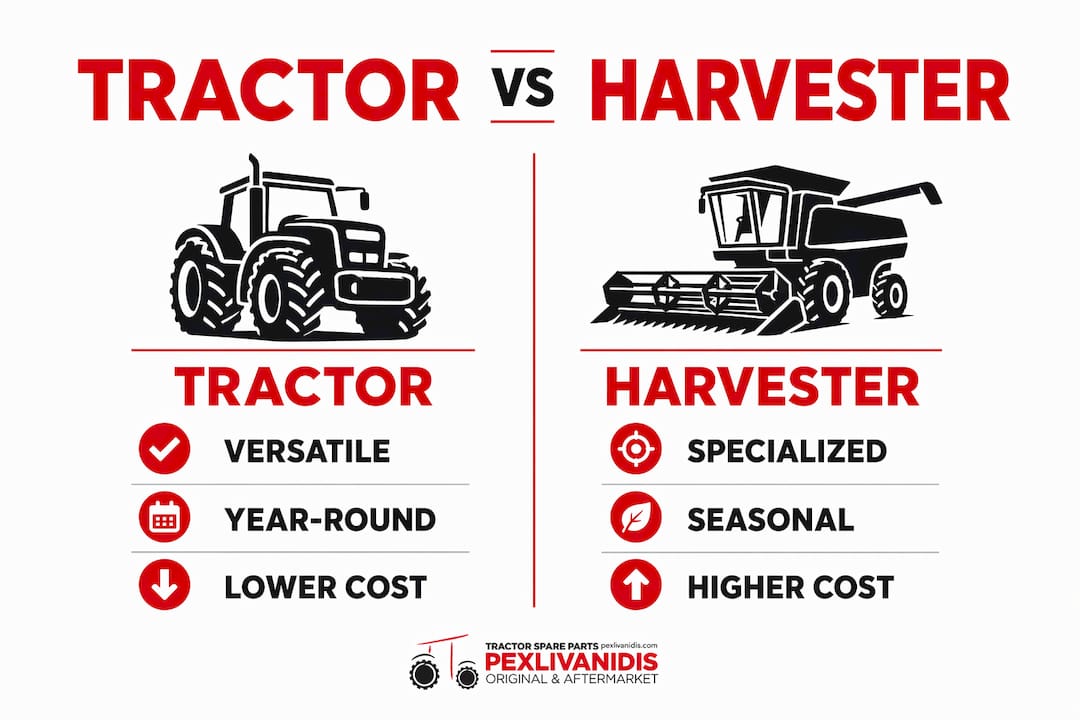
A tractor and a harvester serve fundamentally different roles, and tractors vs harvesters are best understood as complementary tools rather than competing options. Tractors are year-round workhorses. Harvesters are seasonal specialists.
The mechanical distinction starts with power transmission. Tractors have PTO shafts optimized for pulling heavy loads and running diverse implements. Combine harvesters lack a PTO entirely. That single design difference explains why a combine cannot replace a tractor for plowing, spraying, or baling.
Here is how the two machines differ across the most critical operational categories:
- Purpose: Tractors power and tow implements for plowing, sowing, spraying, and hauling. Harvesters cut, thresh, separate, and clean grain in a single continuous pass.
- Design: Tractors are modular. You attach and detach implements based on the task. Harvesters are all-in-one machines with fixed internal systems for reaping and processing.
- Mobility: Tractors are compact and highly maneuverable across varied terrain. Self-propelled combines are large, wide, and built for open field efficiency, not tight rows or small plots.
- Seasonal use: Tractors work every month of the year. Harvesters operate during a narrow harvest window, typically a few weeks per crop cycle.
- Speed profile: Tractors are engineered for low-speed, high-torque output through PTO shafts. Combine harvesters optimize continuous high-speed harvesting with complex threshing and cleaning mechanisms.
Pro Tip: If you only own one machine and farm under 50 acres, a tractor with attachments covers more operational ground across the full year than a dedicated combine ever could.
The size gap between the two machines also matters in practice. A standard utility tractor fits through most farm gates and orchard rows. A full-size combine harvester like the CLAAS X9 1100 requires wide field access and significant storage space during the off-season. That physical reality alone rules out self-propelled combines for many small and medium operations.
How do costs and farm size affect the tractor vs harvester decision?
Farm size is the single biggest factor in this agricultural machinery comparison. The wrong machine for your acreage does not just underperform. It actively costs you money every season.
Self-propelled harvesters cost between ₹17 lakh and over ₹40 lakh, while tractor-mounted harvesters range from ₹12 lakh to ₹26 lakh. Farmers who already own a tractor gain a major cost advantage by choosing a mounted unit, since it uses the existing engine and drivetrain. The CLAAS X9 1100, one of the most capable combines on the market, covers up to 40 acres per hour and features automated threshing. That capacity only makes financial sense above 100 hectares of cultivated land.
| Factor | Tractor-Mounted Harvester | Self-Propelled Combine |
|---|---|---|
| Upfront cost | Lower (uses existing tractor) | Significantly higher |
| Fuel cost | Shared with tractor | Dedicated, higher consumption |
| Operator skill | Standard tractor license | Specialized training required |
| Acres per hour | 2–3 acres | Up to 40 acres (large models) |
| Best farm size | Under 50 acres | 100+ acres |
| Maintenance complexity | Moderate | High |
ROI timing for self-propelled combines typically spans 4–6 seasons for farms larger than 50 acres. Smaller farms rarely achieve payback because fuel and maintenance costs eat into any efficiency gains. Buying a large self-propelled harvester for farms under 25 acres often leads to excessive overhead and negative ROI. That is not a hypothetical risk. It is a documented pattern across small farm operations.
Pro Tip: Before purchasing any harvester, calculate your total harvestable acres per season and divide your expected machine cost by that number. If the per-acre cost exceeds local custom harvesting rates, hiring a contractor is the smarter financial move.
Tractor-mounted hydraulic reapers offer a middle path. The HR6 model, suited for tractors with 25–50 HP, costs between Rs. 95,000 and Rs. 1,25,000. Hydraulic reapers cover 2–3 acres per hour and reduce manual labor costs by up to 70%. For a mid-size grain farm, that combination of low capital cost and meaningful labor savings is hard to beat.
Which tasks and crops are best suited for tractors versus harvesters?
Tractors handle the full calendar of farm work. Harvesters handle one job exceptionally well. Knowing which crops and tasks belong to each machine prevents costly mismatches.
Best uses for tractors:
- Tillage: plowing, discing, and subsoiling before planting
- Planting: pulling seed drills and planters across prepared soil
- Crop protection: towing sprayers for herbicide and pesticide application
- Hauling: moving grain carts, trailers, and livestock equipment
- Hay and forage: running balers, mowers, and tedders via PTO
- General utility: loader work, grading, and post-hole drilling
Best uses for harvesters (combine and mounted types):
- Grain crops: wheat, barley, corn, soybeans, and canola
- Specialty crops: cotton pickers and sugar cane harvesters are crop-specific machines
- High-volume reaping: cutting and threshing in a single field pass
- Large-scale grain cleaning: separating grain from chaff at speed
One crop consideration that often gets overlooked is straw quality. Tractor-mounted harvesters maintain straw in longer pieces, preserving quality for fodder. Combines chop straw finely, which complicates collection and reduces its value for dairy farmers and fodder producers. If your operation sells or uses straw as feed, a tractor-mounted reaper protects that revenue stream in a way a combine cannot.
Farmers prioritizing straw quality often prefer tractor-mounted reapers precisely because long straw is useful for fodder and storage. This is a real competitive advantage for mixed livestock and grain operations. A combine optimized for grain throughput simply was not designed with straw preservation in mind.
What should farmers know about maintaining tractors and harvesters?
Maintenance requirements differ sharply between these two machine types, and that gap affects your total cost of ownership more than most buyers expect.
- Daily tractor checks: Inspect engine oil, coolant, hydraulic fluid, tire pressure, and air filter before each shift. These checks take under 15 minutes and prevent the majority of field breakdowns. Pexlivanidis covers daily tractor upkeep in detail for farmers who want a structured routine.
- Seasonal harvester preparation: Combines require thorough pre-season servicing. This includes inspecting the header, cleaning the threshing drum, checking belts and chains, and calibrating grain sensors. Skipping pre-season prep on a combine is the fastest way to lose days during a narrow harvest window.
- Operator licensing and skill: Tractor operation requires a standard agricultural vehicle license in most regions. Self-propelled combines require skilled operators with specialized training. That training cost and the difficulty of finding qualified operators adds real friction for smaller farms.
- Repair complexity: Tractor repairs are generally straightforward. Common issues include hydraulic leaks, PTO seal failures, and electrical faults. Combine repairs involve complex internal mechanisms, including threshing concaves, sieves, and grain elevators. Downtime during harvest is far more costly than downtime during tillage season.
- Parts availability: Tractor spare parts are widely stocked and competitively priced. Combine parts, especially for high-end models, can have longer lead times and higher costs. Keeping a stock of critical wear parts before harvest season starts is standard practice on large grain farms.
Preventative maintenance is the most cost-effective strategy for both machine types. A structured preventative maintenance program for tractors extends service life significantly and reduces unplanned repair costs. The same principle applies to harvesters, where pre-season and post-season servicing protects a much larger capital investment.
Key Takeaways
Tractors provide year-round versatility for diverse farm tasks, while harvesters deliver specialized efficiency during harvest season, and matching machine type to farm size is the defining factor in achieving positive ROI.
| Point | Details |
|---|---|
| Tractors are year-round machines | Tractors handle tillage, planting, spraying, and hauling across every season. |
| Harvesters are seasonal specialists | Combines and mounted reapers operate during a narrow harvest window each year. |
| Farm size drives the decision | Self-propelled combines only justify their cost on farms exceeding 100 hectares. |
| Mounted reapers suit smaller farms | Tractor-mounted units cut upfront cost and integrate with existing equipment. |
| Straw quality favors mounted reapers | Mounted reapers preserve long straw for fodder; combines chop it, reducing value. |
What I have learned from watching farmers get this decision wrong
The most common mistake I see is farmers buying equipment for the farm they want, not the farm they have. A 30-acre grain grower does not need a CLAAS X9 1100. That machine is built for commercial operations covering hundreds of acres per day. Putting it on a small farm is like buying a semi-truck to deliver groceries across town. The capacity is there. The economics are not.
What actually works for small and medium operations is a well-maintained tractor paired with the right mounted implements. Many small and medium-scale farmers benefit more from tractor-mounted harvesters because of simplicity, lower upfront cost, and better integration with existing operations. That is not a compromise. It is the correct tool for the job.
The other mistake I see regularly is underestimating maintenance complexity on self-propelled combines. These machines have sophisticated internal systems that demand skilled technicians. When a combine breaks down on day three of a 10-day harvest window, the financial damage goes far beyond the repair bill. Lost yield, spoiled grain, and rushed decisions compound quickly.
My honest recommendation: if you are under 50 acres, invest in a quality tractor and a mounted reaper. If you are scaling past 100 acres of grain, a self-propelled combine starts to make sense, but only if you have the operator skill and service infrastructure to support it. Match the machine to the mission. The numbers will follow.
— George
How Pexlivanidis can help you maintain and upgrade your equipment
Keeping your tractor or harvester running at full capacity depends on having the right parts when you need them. Pexlivanidis stocks over 20,000 agricultural machinery parts, covering everything from tractor hydraulic components to wear parts for harvesting attachments. Whether you are sourcing replacement belts before harvest season or upgrading your tractor’s PTO system, the catalog at Pexlivanidis covers the full range of needs for both retail and wholesale buyers. Start with the guide to essential machinery parts to identify exactly what your equipment requires. For farmers in Thessaloniki, Kavala, and surrounding regions, free shipping applies on orders over 100€, making it practical to stock critical spares before the season starts.
FAQ
What is the main difference between a tractor and a harvester?
A tractor is a multipurpose power vehicle used year-round for towing and operating implements. A harvester is a specialized machine used seasonally to cut, thresh, and clean crops.
Can a tractor replace a combine harvester?
A tractor cannot replace a combine harvester for large-scale grain harvesting, but a tractor paired with a mounted reaper performs well on farms under 50 acres. The two machines serve different purposes and work best together.
Which is more cost-effective for small farms: a tractor-mounted harvester or a self-propelled combine?
Tractor-mounted harvesters are more cost-effective for small farms because they use the existing tractor’s engine and cost significantly less upfront. Self-propelled combines only justify their investment on farms exceeding 100 hectares.
Do combine harvesters have a PTO shaft like tractors?
Combine harvesters do not have a PTO shaft. Tractors are specifically engineered with PTO output for running diverse implements, while combines use internal drive systems dedicated to threshing and cleaning functions.
Why do some farmers prefer tractor-mounted reapers over combines for grain harvesting?
Tractor-mounted reapers preserve straw in longer pieces, which maintains its value for fodder and dairy operations. Combines chop straw finely, reducing its usefulness for farmers who sell or use straw as animal feed.