

TL;DR:
- A Cat 1 tractor refers to a standardized three-point hitch system suited for 20 to 50 HP small and medium-sized farms. It features 7/8-inch lift arm pins, 3/4-inch top link pins, and supports up to approximately 2,500 pounds; variations like limited Cat 1 have lower lift capacities. Understanding hitch categories and verifying specifications prevent costly implement mismatches and ensure optimal equipment performance.
If you’ve been shopping for farm equipment or researching implements, you’ve almost certainly seen the term “Cat 1 tractor” and wondered exactly what it means. The CAT 1 tractor definition has nothing to do with Caterpillar the construction company. It refers to a standardized hitch category system that determines which implements attach to which tractors. Getting this wrong costs you money. You buy a tiller that won’t connect to your machine, or you overload a hitch that wasn’t built for the job. This guide gives you the full picture.
Table of Contents
- Key Takeaways
- What is a Cat 1 tractor, exactly?
- Cat 1 vs. other hitch categories
- Best uses for Cat 1 tractors
- Selecting and maintaining a Cat 1 tractor
- My honest take on Cat 1 tractors
- Get more from your Cat 1 tractor with Pexlivanidis
- FAQ
Key Takeaways
| Point | Details |
|---|---|
| Horsepower range | Cat 1 tractors typically run between 20 and 50 HP, making them ideal for small to mid-sized farms. |
| Hitch pin sizes | Lift arm pins measure 7/8 inch and the top link pin is 3/4 inch, with arms spaced roughly 26 inches apart. |
| Lift capacity | A standard Cat 1 hitch supports up to around 2,500 pounds, with some subcompact models rating lower. |
| PTO standard | Cat 1 tractors use a 540 RPM power take-off, which is the standard for most small farm implements. |
| Limited Cat 1 exists | Some tractors carry a limited Cat 1 hitch with identical dimensions but reduced lift height. Know which one you have. |
What is a Cat 1 tractor, exactly?
The term “Category 1” refers to a standardized three-point hitch classification, not to a brand or engine type. The three-point hitch is the triangular mounting system at the rear of your tractor that connects implements. It uses two lower lift arms and one top link to form a triangle, giving the operator three degrees of mechanical motion for raising, lowering, and leveling a tool. That standardized hitch system is an industry-wide benchmark that allows quick attachment across a wide range of agricultural tools.
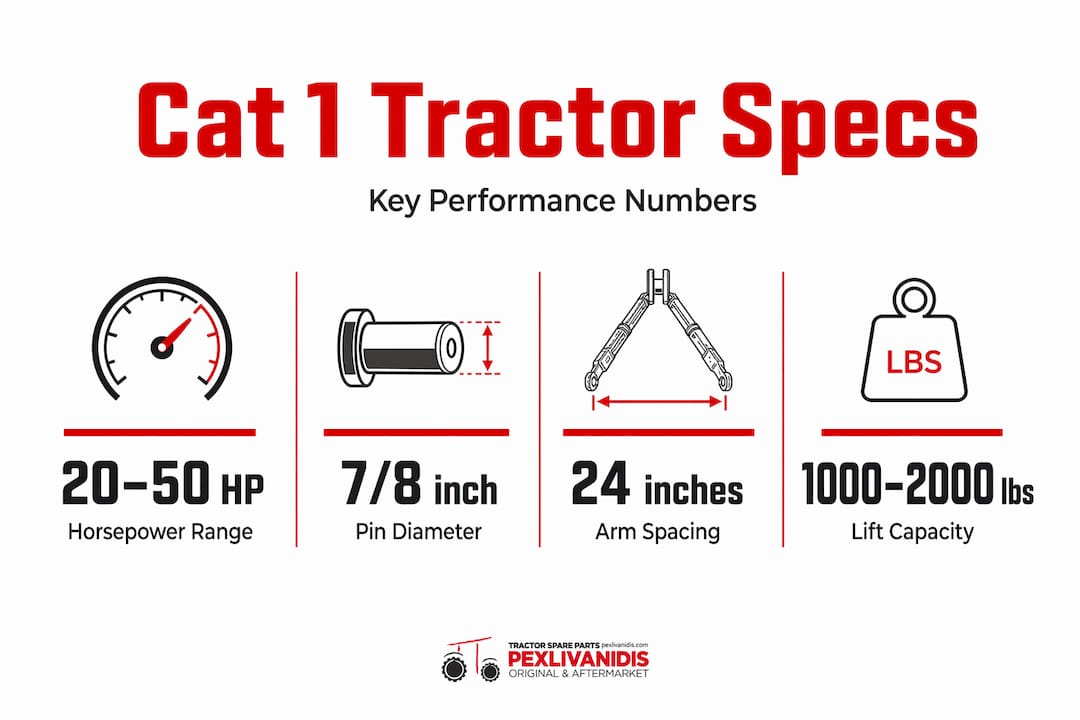
Cat 1 tractors operate in the 20 to 50 horsepower range, which covers most compact and utility tractors you’ll find on small farms, hobby operations, and residential properties. The specific pin dimensions define the category. Lift arm pins are 7/8 inch in diameter. The top link pin is 3/4 inch. The distance between the lift arm pins sits at approximately 26 inches.
One detail that trips up a lot of buyers: there is a variation called the limited Category 1 hitch. A limited Cat 1 hitch shares all the same pin dimensions as the standard version, but it cannot lift implements as high and has a lower overall lift capacity. If you have a subcompact tractor, you may be working with this reduced version without realizing it.
| Spec | Category 1 Value |
|---|---|
| Horsepower range | 20 to 50 HP |
| Lift arm pin diameter | 7/8 inch |
| Top link pin diameter | 3/4 inch |
| Lift arm spacing | ~26 inches |
| Lift capacity (standard) | Up to ~2,500 lbs |
| PTO speed | 540 RPM |
Pro Tip: Before buying any implement, pull out your tractor’s manual and confirm whether you have a standard Cat 1 hitch or a limited Cat 1. The pin sizes look identical, but the lift height difference can make certain tools functionally unusable on your machine.
Cat 1 vs. other hitch categories
The hitch category system runs from Category 0 at the smallest end to Category 4 at the heaviest end. Understanding where Cat 1 sits helps you avoid costly compatibility mistakes.
Category 0 covers the smallest garden tractors, typically under 20 HP. Pin sizes are smaller across the board. You rarely see Cat 0 implements sold new today, but older equipment still uses them.
Category 1 covers the 20 to 50 HP range as described above. It’s the most commonly owned hitch category in North America, particularly among hobby farmers and small commercial growers.
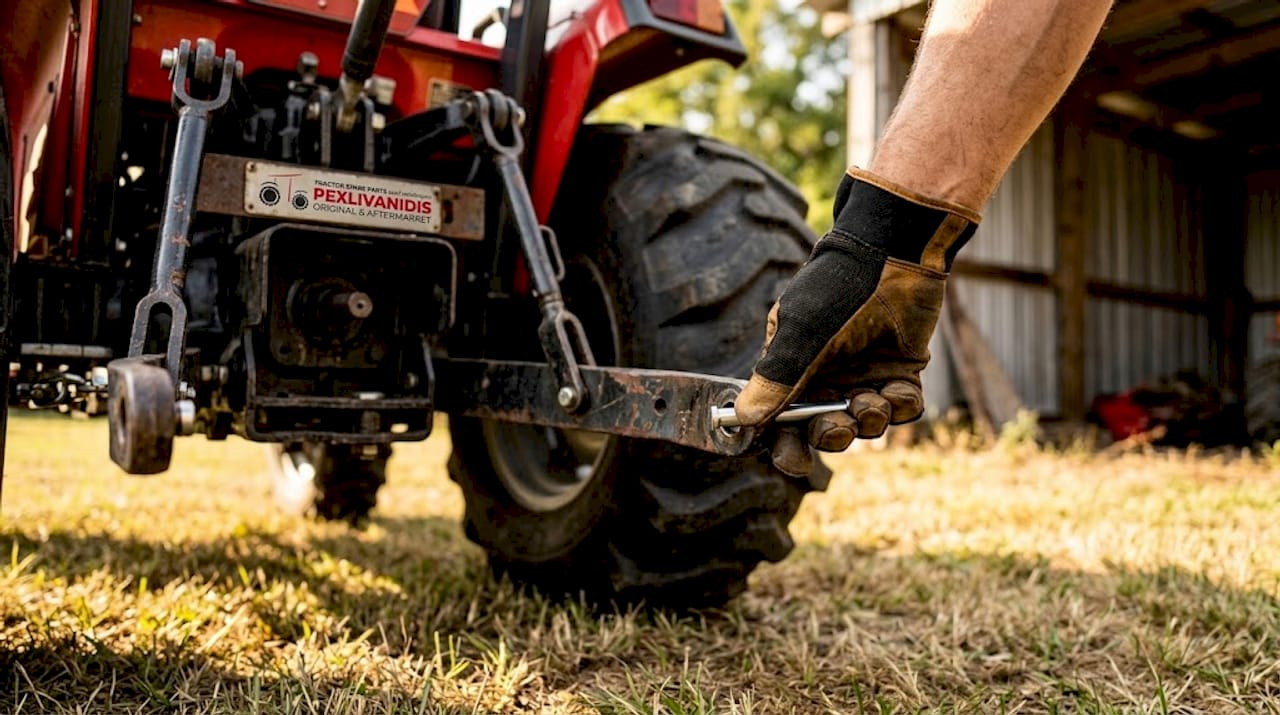
Category 2 steps up significantly. Cat 2 pins are larger and the spacing between arms is wider, designed for tractors running roughly 40 to 100 HP. The overlap between 40 and 50 HP is where confusion happens. A 45 HP tractor might technically support either category depending on the manufacturer’s design.
Categories 3 and 4 are reserved for large agricultural equipment, row-crop tractors, and heavy commercial machines. If you’re reading this article, you’re almost certainly not in that range.
The most common and costly mistake people make with 3 point hitch types is trying to force a Cat 2 implement onto a Cat 1 tractor using adapter bushings. Bushings can reduce the pin hole diameter to fit, but they don’t upgrade the lift capacity or arm strength. You’re still running Cat 1 loads, and overloading those arms damages the linkage over time.
A few practical things to watch for when comparing categories:
- Implement labels are not always accurate. Verify pin sizes with a caliper before purchasing used equipment.
- A Cat 1 tractor with a front loader attachment has different weight distribution rules than a tractor without one. Match the rear implement weight accordingly.
- PTO speed matters too. Cat 1 tractors run at 540 RPM. Cat 2 machines may offer both 540 and 1000 RPM outputs. Using a 1000 RPM implement on a 540 RPM shaft destroys both.
Best uses for Cat 1 tractors
Cat 1 tractors punch well above their weight class in terms of practical utility. Category 1 tractors are favored for small to medium farms because they deliver adequate power for most everyday tasks while staying narrow enough to maneuver through tight spaces, typically 40 to 60 inches wide.
The balance between size and capability is the real strength here. You can till a vegetable garden, mow a pasture, move soil with a bucket loader, and drill fence post holes all with one machine and a few implement swaps. That versatility is exactly why Cat 1 remains the most popular category for farms under 100 acres.
Common implements that work well with Cat 1 tractors include:
- Box blades and graders for driveway and land shaping work
- Rotary tillers for seedbed preparation and garden cultivation
- Finish mowers and bush hogs for pasture and field maintenance
- 3-point seeders and spreaders for small-scale planting
- Rear blades for snow removal and light grading
- Post hole diggers (PTO-driven) for fence installation
- Small disc harrows for breaking up compacted soil
A real-world example worth knowing: Kioti’s CS2530, a subcompact with 24.5 HP and a Cat 1 hitch, has a lift capacity of 700 pounds. That’s a limited Cat 1 in practice. It can handle a finish mower or a small tiller without any problem. A heavy three-point backhoe attachment would overload it.
Pro Tip: When calculating what implements you can run, subtract the weight of your front loader bucket (if equipped) from your rear lift capacity. Front-mounted weight shifts the center of gravity forward and reduces the effective load your rear hitch can safely handle.
Selecting and maintaining a Cat 1 tractor
Choosing the right Cat 1 tractor comes down to matching horsepower and hitch specs to your actual workload, not to the maximum you might theoretically need someday.
- List your implements first. Write down every tool you plan to attach now and within the next five years. Check each one’s required horsepower and hitch category. Work backward from that list to identify the minimum HP you actually need.
- Check brand-specific hitch specs. John Deere, Kubota, and Mahindra all build Cat 1 tractors with standardized pin sizes, but lift arm geometry and hydraulic flow rates vary by model. A tiller that works perfectly on a Kubota BX series may sit at a slightly different angle on a Mahindra eMax. Test fit critical implements before finalizing a purchase.
- Understand your lift capacity in real terms. The standard Cat 1 lift capacity of around 2,500 pounds is a maximum rating at the hitch points. The closer an implement is mounted to the tractor, the more effective that capacity is. Extended attachments with long reach arms reduce usable lift.
- Keep up with hitch maintenance. The three-point hitch pins and bushings wear over time. Worn pins cause sloppy implement control and can damage both the tractor and the tool. Inspect and grease hitch pins at every service interval. For detailed guidance on keeping your machine healthy, the preventative maintenance guide at Pexlivanidis covers inspection schedules and service points specific to compact tractors.
- Watch your PTO shaft angles. When a Cat 1 implement is lowered for transport or raised to maximum height, the PTO shaft angle increases sharply. Exceeding the manufacturer’s maximum shaft angle causes vibration, premature wear, and eventually shaft failure. Adjust implement height to keep the shaft within spec.
- Choose the right oil. Hydraulic performance in your three-point hitch system depends directly on fluid quality and change intervals. Using the wrong viscosity leads to sluggish lift response, especially in cold weather. The Pexlivanidis guide on choosing tractor oil walks you through exactly what your Cat 1 hydraulic system needs.
My honest take on Cat 1 tractors
I’ve worked around Cat 1 machines for years, and my strongest opinion is this: most small farmers underestimate how capable these tractors really are, and a smaller group overloads them trying to avoid upgrading to Cat 2. Both groups end up frustrated.
The farmers who get the most out of Cat 1 tractors are the ones who build their implement list around realistic tasks rather than aspirational ones. You don’t need 60 HP to till a two-acre garden or mow 40 acres of pasture. A well-maintained 35 HP Cat 1 machine with quality implements will outperform a neglected 50 HP tractor every single time.
What I’ve found is that the hitch maintenance question separates experienced operators from beginners faster than anything else. The three-point linkage gets ignored until something breaks. By then, you’re replacing pins, lift arms, or in bad cases, the top link casting itself. Fifteen minutes of greasing and inspection every 50 hours prevents nearly all of those failures.
One thing worth saying plainly: don’t let brand loyalty drive the purchase over specifications. I’ve seen farmers insist on a particular brand’s tractor, then discover the hitch geometry doesn’t match the implements they already own. Measure the pins, check the lift capacity, and then decide on the brand.
— George
Get more from your Cat 1 tractor with Pexlivanidis
Owning a Cat 1 tractor is only half the equation. Keeping it running at full capacity requires the right parts, the right fluids, and the right maintenance schedule. Pexlivanidis stocks over 20,000 agricultural machinery parts, including hitch components, PTO shafts, hydraulic fittings, and tractor accessories that fit the most common Cat 1 models on the market today.
Whether you’re replacing worn hitch pins or outfitting a tractor with new implements, the essential machinery parts guide at Pexlivanidis gives you a clear breakdown of what your machine actually needs. For farmers looking to upgrade their setup rather than just maintain it, the machinery upgrade tips resource covers practical improvements that add real utility to compact tractors without unnecessary expense. Free shipping within Greece on orders over 100€.
FAQ
What horsepower is a Cat 1 tractor?
Cat 1 tractors operate in the 20 to 50 horsepower range. This covers most compact and subcompact tractors used on small farms, hobby properties, and landscaping operations.
What is a category 1 three-point hitch?
A category 1 three-point hitch is a standardized rear attachment system with lift arm pin diameters of 7/8 inch, a top link pin of 3/4 inch, and approximately 26 inches of spacing between the lower lift arms.
Can I use Cat 2 implements on a Cat 1 tractor?
You can use bushing adapters to reduce Cat 2 pin holes to Cat 1 size, but the tractor’s lift capacity and arm strength remain at Cat 1 levels. This works for lighter implements but can damage the hitch if you exceed the rated load.
What is the difference between a Cat 1 and limited Cat 1 hitch?
A limited Cat 1 hitch shares the same pin dimensions as a standard Cat 1 but has reduced lift height and lower lift capacity. It’s common on subcompact tractors and affects which implements you can run effectively.
What PTO speed do Cat 1 tractors use?
Cat 1 tractors use a standard 540 RPM PTO output. Always confirm your implements are rated for 540 RPM before connecting them, since running a 1000 RPM implement on a 540 shaft causes serious mechanical damage.