

TL;DR:
- A tractor drawbar is a heavy steel bar mounted at the rear of the tractor, serving as a fixed hitch point for pulling implements and trailers that support their own weight. It transfers the tractor’s pulling force directly to towing attachments, making it essential for heavy-duty towing tasks where hydraulic systems are unnecessary. Proper hitch height is critical for safety and traction, with the ideal just below the rear axle centerline to prevent overturns and maintain optimal ground contact.
A drawbar on a tractor is defined as a heavy steel bar mounted at the rear of the tractor that provides a fixed hitch point for pulling trailing implements and trailers. Known in industry terminology as the tractor drawbar or tow bar hitch, it transfers the tractor’s pulling force directly to attachments that rely on their own wheels, skids, or runners for ground contact. Unlike hydraulic systems, the drawbar is purely mechanical. It is one of the oldest and most dependable connection points on any farm tractor, from a compact utility model to a large John Deere or Massey Ferguson row-crop machine.
What is a drawbar used for on a tractor?
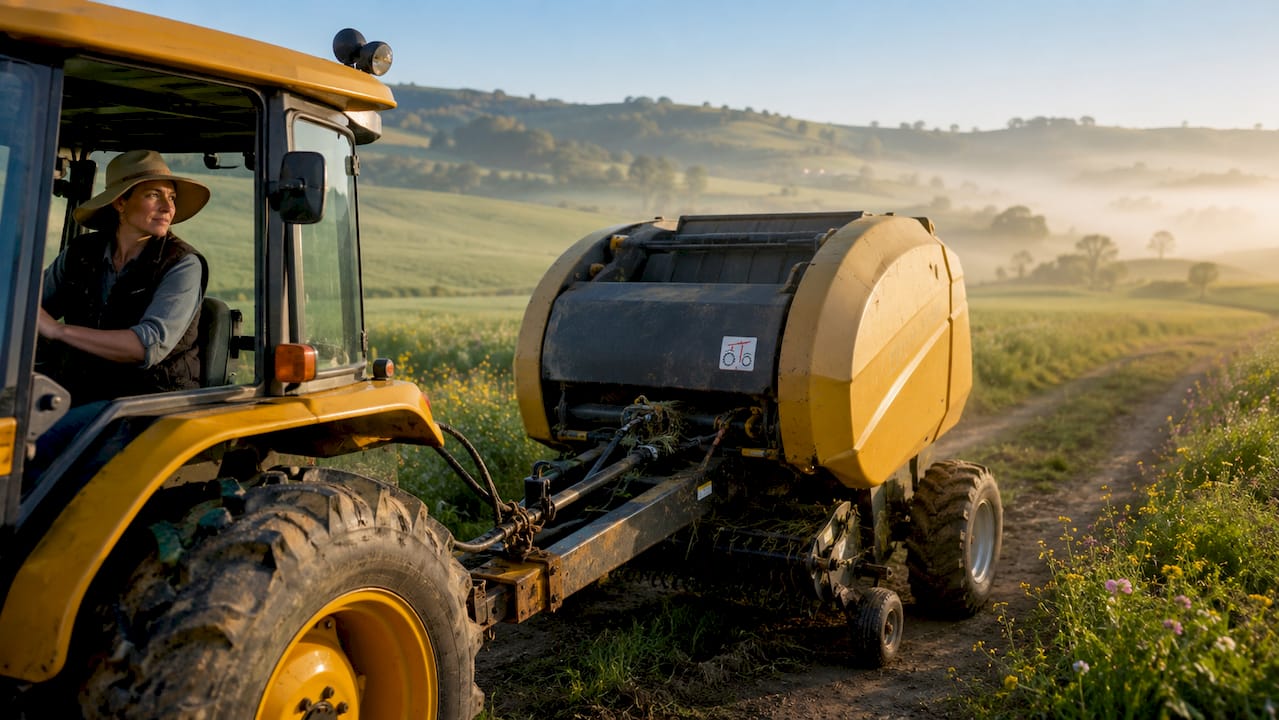
A drawbar transfers pulling force/05%3A_Implements_and_Field_Operations/5.02%3A_Drawbars_and_Three-Point_Hitches) from the tractor to trailing implements like plows, harrows, seed drills, and harvesters. The critical distinction is that drawbar-towed implements carry their own weight on wheels or skids. The tractor simply pulls them forward. It does not lift, support, or control their depth.
Common implements pulled by a tractor drawbar include:
- Disk harrows and field cultivators that ride on gauge wheels
- Grain drills and seed drills with their own transport frames
- Wagons and trailers for hauling grain, silage, or equipment
- Subsoilers and chisel plows with depth-control wheels
- Manure spreaders and liquid application tanks
This is where the drawbar’s function on a tractor separates from a three-point hitch. A three-point hitch lifts and positions implements that are fully supported by the tractor. The drawbar simply pulls. That simplicity is exactly what makes it the right tool for heavy towing tasks where hydraulic control is unnecessary.
Pro Tip: When pulling a loaded grain wagon on a slope, always connect to the drawbar rather than improvising a higher hitch point. A higher connection shifts the pull angle upward and dramatically increases rear overturn risk.
How does a drawbar affect tractor stability and traction?
Drawbar geometry is one of the most underappreciated factors in tractor safety. Ideal drawbar height sits just below the rear axle centerline/03%3A_Tractor_Drive_Control_and_Auxiliary_Systems/3.13%3A_Drawbars_and_Hitch_Systems-_The_Tractor’s_Connection_to_the_Field), directing the pull forward and slightly downward. This geometry keeps the rear tires pressed firmly into the soil, maximizing grip and minimizing wheel slip.
When the hitch point is too high, the pulling force rotates the tractor rearward around the rear axle. The front wheels lift off the ground, steering is lost, and rear overturn becomes a real risk. This is the most common cause of fatal tractor accidents in field operations. When the hitch point is too low, the force vector pushes downward at the rear, reducing the weight on the drive wheels and causing the tires to spin rather than pull.
“Small changes in hitch height shift weight transfer considerably, which impacts field operational stability.” — Workforce LibreTexts, Tractor Operations/05%3A_Implements_and_Field_Operations/5.02%3A_Drawbars_and_Three-Point_Hitches)
Operators are trained to always hitch at the designated drawbar point/05%3A_Implements_and_Field_Operations/5.02%3A_Drawbars_and_Three-Point_Hitches), never substituting higher or lower attachment points. This is not a suggestion. It is a fundamental safety rule taught in every tractor operations course. The physics are unforgiving. A few inches of height difference can mean the difference between a productive field day and a rollover incident.
Key stability factors to keep in mind:
- Hitch too high: front lift, loss of steering, overturn risk
- Hitch at correct height: balanced weight transfer, maximum traction
- Hitch too low: rear weight loss, tire slippage, reduced pulling efficiency
- Heavy loads on slopes: always reduce speed and check hitch height before descending
What are the different types of drawbars?
Drawbars come in several types/05%3A_Implements_and_Field_Operations/5.02%3A_Drawbars_and_Three-Point_Hitches): fixed, swinging, offset, telescoping, and hammerstrap. Each serves a different operational need. Choosing the right type is not just about convenience. It directly affects how implements track behind the tractor and how loads are distributed during turns.
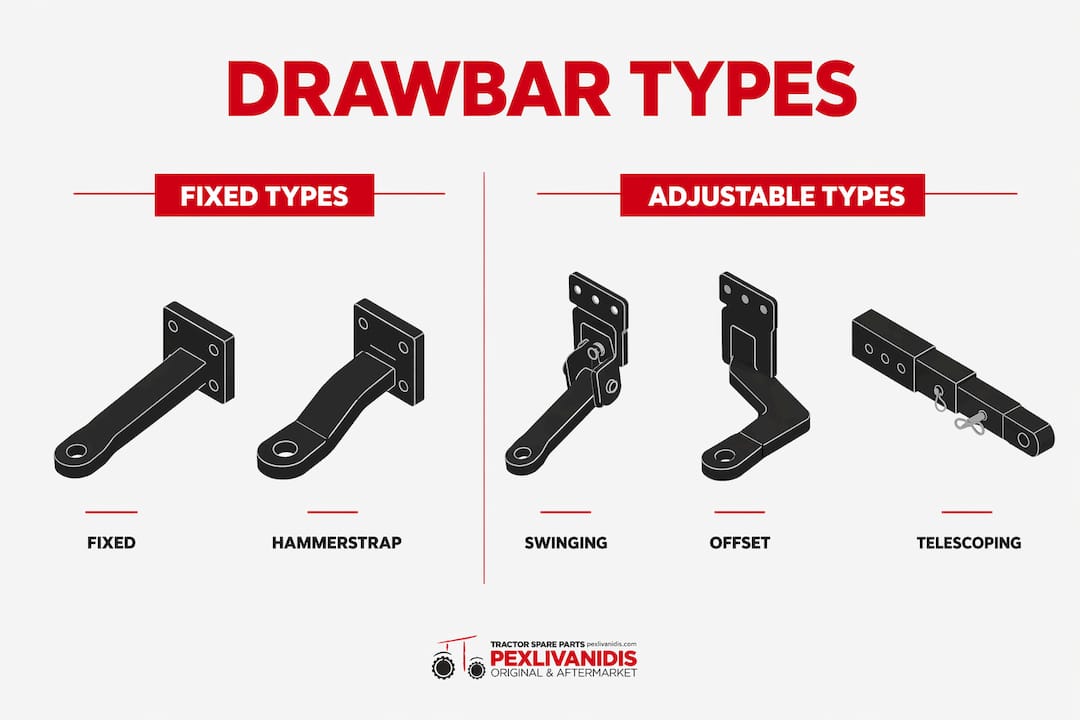
| Drawbar type | Best use | Key advantage |
|---|---|---|
| Fixed drawbar | Straight-line heavy towing | Maximum rigidity and load stability |
| Swinging drawbar | Row-crop work and tight turns | Pivots side to side for better maneuverability |
| Offset drawbar | Asymmetric implement alignment | Positions implement outside tractor’s wheel path |
| Telescoping drawbar | Varying implement distances | Adjustable length for different hitch requirements |
| Hammerstrap drawbar | Very heavy loads and specialty equipment | Reinforced connection for extreme pulling demands |
Fixed drawbars are the most common on utility and row-crop tractors. They lock the implement directly behind the tractor, which is ideal for straight-line work like plowing or pulling a loaded trailer. Swinging drawbars pivot left and right, which reduces binding and uneven loads during turns. This is particularly valuable in row-crop operations where the tractor must navigate tight headlands without dragging the implement sideways.
Adjustable drawbars with telescoping designs include multiple pin holes for height and length variation, increasing versatility across different implements and terrain types. A hammerstrap drawbar replaces the standard clevis pin with a reinforced strap connection, distributing load across a wider surface area. This design handles very heavy towing demands that would stress a standard pin connection.
Pro Tip: If you regularly switch between a grain drill and a heavy wagon, a telescoping drawbar with multiple pin positions saves significant setup time and reduces the need for adapter hardware.
How does a drawbar compare to a three-point hitch?
Drawbars are simpler and better for heavy towing/05%3A_Implements_and_Field_Operations/5.02%3A_Drawbars_and_Three-Point_Hitches) but lack the hydraulic depth and lift control that a three-point hitch provides. Understanding when to use each system is a practical skill every tractor operator needs.
A three-point hitch uses two lower lift arms and a top link to attach implements directly to the tractor’s rear frame. The hydraulic system raises and lowers the implement, controls working depth, and transfers implement weight onto the tractor’s rear axle for added traction. This is the right system for moldboard plows, rotary tillers, rear blades, and post-hole diggers. These implements have no wheels of their own and depend entirely on the tractor for support and positioning.
The drawbar, by contrast, is a fixed steel connection point. It has no hydraulics and no lift capability. Its heavy steel construction with clevis or hitch pins makes it reliable for towing without the complexity or maintenance demands of a hydraulic system. For pulling wagons, trailers, and large wheeled implements across long distances, the drawbar is the correct choice.
Situations where the drawbar wins:
- Towing heavy grain wagons or silage trailers across fields and roads
- Pulling large seed drills or air seeders with their own gauge wheels
- Connecting to implements that exceed the three-point hitch’s weight rating
- Long-distance transport of wheeled equipment between fields
Situations where the three-point hitch wins:
- Implements requiring precise depth control, like a chisel plow or subsoiler without gauge wheels
- Rear-mounted equipment needing to be raised for transport, like a rotary cutter
- Tasks requiring hydraulic down-pressure for consistent soil engagement
How to safely hitch and maintain a tractor drawbar
Safe hitching starts before you connect anything. Walk the connection point, check the drawbar for cracks, wear, or bent steel, and confirm the hitch pin is the correct diameter for your implement’s clevis. A loose or undersized pin creates dangerous play that worsens under load.
Follow these steps for safe drawbar connection:
- Position the tractor so the drawbar aligns directly with the implement’s hitch eye. Never drag the implement sideways to force alignment.
- Insert the hitch pin through the drawbar and implement clevis, making sure it passes fully through both.
- Secure with a locking pin or hammer strap to prevent vertical lift or side-to-side movement. Locking pins and hammer straps/05%3A_Implements_and_Field_Operations/5.02%3A_Drawbars_and_Three-Point_Hitches) are not optional. They prevent the implement from separating under load.
- Check drawbar height against the implement’s hitch point. Adjust pin hole position if needed to achieve a level connection.
- Test at low speed before full field operation. Listen for unusual noise and watch for implement bounce or misalignment.
For maintenance, inspect the drawbar after every 50 hours of heavy towing use. Check for elongated pin holes, which indicate wear and allow dangerous movement. Misadjusted drawbar connections commonly cause implement bounce or inconsistent ground contact, and this is often mistaken for a hydraulic problem. If your implement is bouncing or skipping across the field, check the hitch connection height and implement support before assuming the hydraulics need attention.
For guidance on correct assembly procedures, Pexlivanidis has published a detailed resource on hitching agricultural implements safely and correctly. Keeping the drawbar clean, lubricated at pivot points, and free of rust extends its service life significantly. A well-maintained drawbar on a John Deere 6R or a New Holland T7 should last the life of the tractor with basic care.
Pro Tip: Carry a spare hitch pin and locking clip in your tractor toolbox. Losing a pin in a field during planting season costs far more time than the part is worth.
Key takeaways
The tractor drawbar is the most reliable and direct method for heavy towing in agricultural operations, and correct hitch height is the single most important factor in both safety and performance.
| Point | Details |
|---|---|
| Core drawbar function | Transfers pulling force to trailing implements that carry their own weight on wheels or skids. |
| Hitch height is critical | Too high risks rear overturn; too low wastes traction. Hitch just below the rear axle centerline. |
| Choose the right type | Fixed for straight towing, swinging for row crops, telescoping for versatility, hammerstrap for heavy loads. |
| Drawbar vs. three-point hitch | Use the drawbar for heavy towing; use the three-point hitch for implements needing lift and depth control. |
| Maintenance prevents failures | Inspect pin holes for wear, secure all connections, and troubleshoot implement bounce at the hitch before checking hydraulics. |
Why the drawbar still matters more than most operators realize
After years of working with agricultural machinery and the farmers who depend on it, I keep coming back to the same observation: the drawbar gets taken for granted until something goes wrong. Operators spend hours learning hydraulic settings and GPS guidance systems, but many have never been formally taught why the drawbar hitch point height matters so much. That gap in knowledge is where accidents happen.
The most common mistake I see is improvised hitching. A farmer needs to pull a heavy load, the drawbar feels inconvenient, and they attach to a higher point on the tractor frame. The physics of that decision are immediate and unforgiving. Despite advances in hydraulic hitch systems, the drawbar remains indispensable for heavy towing tasks precisely because of its simplicity and strength. There is no hydraulic seal to fail, no control valve to stick, and no electronics to troubleshoot. It is steel pulling steel.
My honest recommendation for anyone managing a mixed fleet of implements: invest in a quality swinging or telescoping drawbar rather than relying on a fixed bar for every task. The flexibility pays off in reduced wear on both the tractor and the implement, especially during headland turns. And always check your drawbar condition as part of your pre-season inspection. Pexlivanidis has a solid resource on tractor preventative maintenance that covers this in practical detail.
The drawbar is not a legacy component waiting to be replaced by hydraulics. It is the right tool for a specific and important job, and understanding it makes you a better, safer operator.
— George
Explore tractor parts and maintenance resources at Pexlivanidis
Keeping your drawbar and tractor attachments in working order starts with having the right parts and the right information. Pexlivanidis carries an inventory of over 20,000 agricultural machinery parts, including tractor hitch components, pins, and attachment hardware for a wide range of tractor brands. Whether you are replacing a worn hitch pin or sourcing a replacement drawbar assembly, the catalog covers both retail and wholesale needs across Greece and the surrounding region. For a broader look at what goes into keeping farm equipment running, the guide to agricultural machinery parts is a practical starting point. You can also find detailed advice on maintaining agricultural machinery for peak performance throughout the season.
FAQ
What is a drawbar on a tractor?
A tractor drawbar is a heavy steel bar at the rear of the tractor that provides a fixed hitch point for pulling trailing implements and trailers. It transfers the tractor’s pulling force to attachments that carry their own weight on wheels or skids.
What is a tractor drawbar used for?
The drawbar is used for towing implements like grain wagons, seed drills, disk harrows, manure spreaders, and trailers that have their own wheels or ground support. It is the correct connection point for any towed load that does not need to be lifted or depth-controlled by the tractor.
What is the difference between a drawbar and a three-point hitch?
A drawbar is a fixed mechanical tow point with no hydraulic function, suited for heavy towing. A three-point hitch uses hydraulics to lift, lower, and control the depth of implements that are fully supported by the tractor.
How do I attach an implement to a tractor drawbar?
Align the tractor drawbar with the implement’s hitch eye, insert the correct-diameter hitch pin through both, and secure it with a locking pin or hammer strap to prevent movement. Always confirm hitch height is at or just below the rear axle centerline before operating.
Why does drawbar height matter for tractor safety?
Hitch height directly affects the pull angle and weight transfer between the tractor and implement. Hitching too high risks front wheel lift and rear overturn, while hitching too low reduces rear tire traction and causes wheel slip.