

TL;DR:
- Correct spare parts selection for agricultural machinery depends on precise serial number identification, compatibility verification, and choosing the appropriate quality tier based on failure analysis.
- Operators who treat serial numbers as sacred and compare new parts physically with old ones greatly reduce wrong orders and installation issues.
- Matching part tiers to specific repair needs, planning inventory around failure frequency, and understanding calibration requirements are essential for maximizing uptime and long-term reliability.
Selecting the right spare parts for agricultural machinery is defined by three factors: exact machine identification, verified compatibility, and informed quality-tier selection. Get any one of these wrong and you face installation failures, repeat labor, and machinery sitting idle during critical harvest windows. Knowing how to choose spare parts correctly protects your uptime, your budget, and the long-term reliability of equipment that your operation depends on every season. This guide covers the full process, from reading a serial number plate to stocking a field-ready parts inventory.
How to choose spare parts: what machine information do you need first?
The single most important step before ordering any replacement component is gathering precise machine identification data. Model number, serial number, and PIN (Product Identification Number) are not interchangeable. Manufacturers like John Deere split their parts catalogs by serial-number revisions to separate engineering changes that affect critical interfaces. A part that looks identical to the one you removed may fail critical tolerances if it belongs to a different production revision.
Start by locating the serial number plate on your tractor or implement. On most tractors, this plate sits on the frame near the front axle or on the firewall. For implements like planters or balers, it is typically on the main frame near the hitch. Write down every number and letter exactly as printed, including prefix codes, because those prefixes often indicate the manufacturing plant and production run.
Once you have the serial number, use the manufacturer’s parts catalog or an exploded-view diagram to cross-reference the component you need. Accurate part selection depends heavily on production and version details, and exploded views show exactly which sub-assembly your specific machine uses. Searching by model or product code narrows variants far faster than keyword searches and eliminates the guesswork that causes wrong orders.
- Record model number, serial number, and PIN before contacting any supplier
- Locate the parts catalog edition that matches your machine’s serial range
- Use exploded-view diagrams to identify the exact sub-assembly and component number
- Note any suffix codes on the part number, since these indicate revision levels
- Photograph the old part and the identification plate together for supplier reference
Pro Tip: If your machine’s serial plate is worn or missing, check the operator’s manual cover page or the registration documents. Many manufacturers also stamp the serial number on the frame in a secondary location.
How to evaluate compatibility and fit before ordering
Compatibility verification goes beyond confirming a part number matches. Mechanical fit and connection compatibility including size, shape, and connectors must be confirmed before you place an order, because a part that bolts on incorrectly costs you double labor and potentially damages surrounding components.
Follow this sequence when evaluating any candidate part:
- Compare physical dimensions. Measure the old part’s length, diameter, thread pitch, and mounting hole spacing. Even a 2mm difference in a hydraulic fitting can cause a leak under pressure.
- Check connector and port types. Electrical connectors, hydraulic ports, and pneumatic fittings must match exactly. A different connector body style will not seat correctly even if the pin count is the same.
- Assess mounting orientation. Some sensors and solenoids are directional. Installing them in the wrong orientation causes incorrect readings or restricted flow.
- Verify electronic requirements. Parts requiring programming or calibration after installation must be ordered with that process planned in advance. A new ECU or injection pump controller may bolt on perfectly but trigger fault codes until it is calibrated to the machine’s parameters.
- Inspect surrounding components. If the part failed due to wear from an adjacent component, that adjacent component must also be assessed. Installing a new part into a worn environment shortens its service life significantly.
Pro Tip: Place the candidate part side by side with the old part before installation. Physical comparison of connectors, mounting points, and dimensions prevents costly returns and repeat trips to the field.
| Compatibility check | What to verify |
|---|---|
| Physical dimensions | Length, diameter, thread pitch, mounting hole spacing |
| Connectors and ports | Electrical pin count, hydraulic port size and thread type |
| Electronic calibration | Programming, relearn, or calibration required post-install |
| Surrounding wear | Condition of adjacent components that contact the new part |
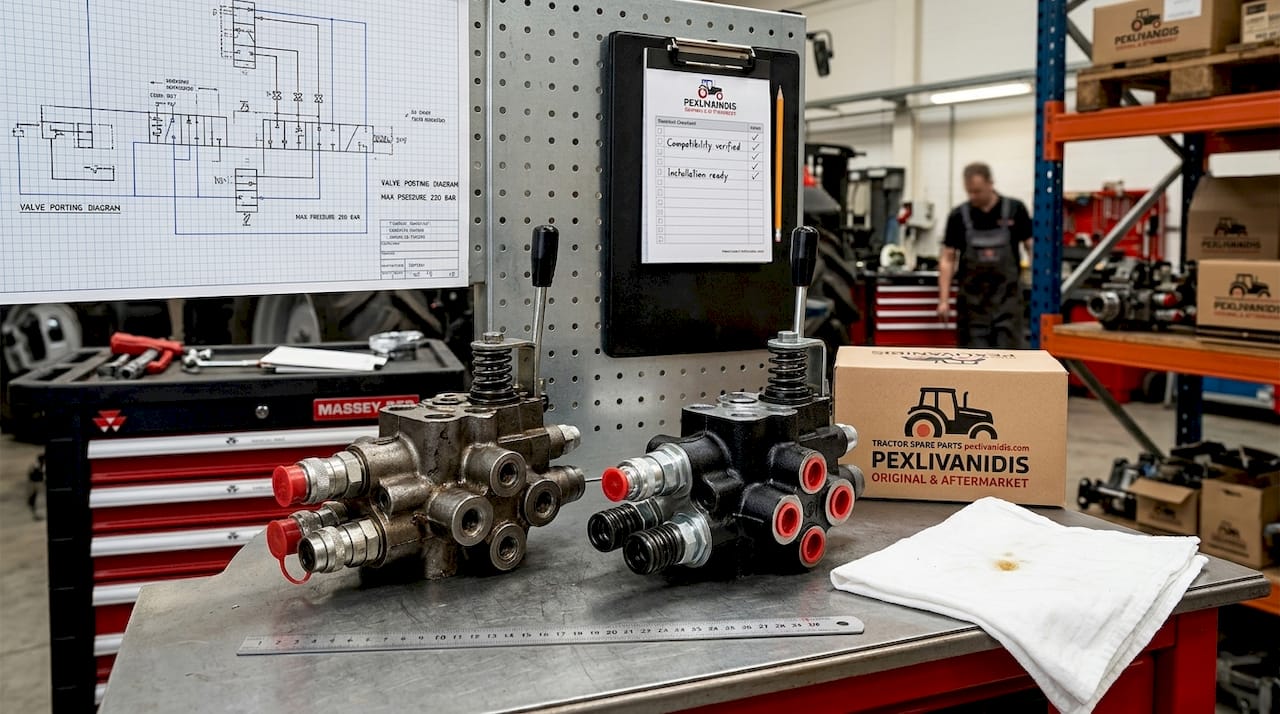
For parts compatibility on tractors and implements, the fit criteria above apply across every category from drivetrain seals to GPS guidance sensors.
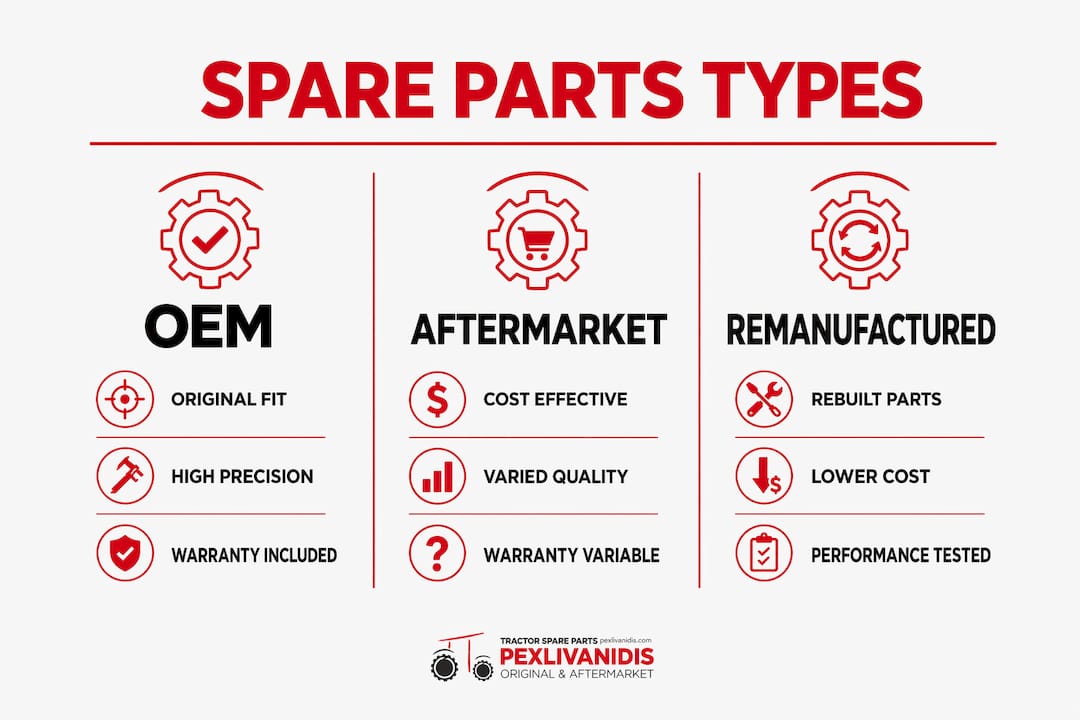
What are the differences between OEM, aftermarket, and remanufactured parts?
Part source tier is one of the most consequential decisions in the selection process, and it should be made after diagnosing the failure cause, not before. Selecting a part tier based on failure analysis and equipment usage leads to better outcomes than defaulting to the cheapest or most familiar brand.
OEM (Original Equipment Manufacturer) parts are produced by or for the original machine manufacturer to the same specification as the part installed at the factory. They carry the highest confidence for fit and function, particularly for sensors, control units, and hydraulic assemblies where tolerances are tight. The trade-off is cost, which can be 30 to 60 percent higher than aftermarket equivalents.
Aftermarket parts are produced by third-party manufacturers to a specification that meets or approximates the OEM standard. Quality varies significantly by supplier. Reputable aftermarket brands with documented warranty coverage and ISO certification are viable for wear parts like filters, belts, and bearings. For complex electronics or precision-machined components, the risk of dimensional variance is higher.
Remanufactured parts are used cores that have been disassembled, cleaned, inspected, and rebuilt to a defined standard. Quality depends entirely on the rebuild process. A remanufactured injection pump from a certified rebuilder with a 12-month warranty is a credible option. A rebuilt alternator from an unknown source with no warranty is a gamble.
| Part type | Best use case | Key risk |
|---|---|---|
| OEM | Sensors, ECUs, hydraulic valves, precision assemblies | Higher cost per unit |
| Aftermarket | Filters, belts, bearings, wear items from reputable brands | Variable quality by supplier |
| Remanufactured | Injection pumps, starters, alternators from certified rebuilders | Rebuild quality not always transparent |
For a deeper look at how OEM parts affect agricultural repair outcomes, the differences in tolerance and warranty coverage are worth understanding before you commit to a supplier.
How to plan spare parts inventory to minimize downtime
Field service parts are defined as components stocked close to the point of use to reduce machine downtime and avoid expensive emergency shipments. Inventory positioning balances availability and cost, and well-positioned stock improves first-time fix rates by 15 to 30 percent. For farm operations, that difference can mean finishing a harvest on schedule or losing yield to a breakdown.
The practical approach to inventory planning for agricultural machinery follows three levels:
- Technician or field stock. High-frequency consumables like filters, belts, fuses, and common seals. These should be on the vehicle or in the field workshop at all times. Replenish after every use, not on a calendar schedule.
- Central workshop stock. Mid-frequency parts like water pump assemblies, alternators, and hydraulic cylinders. These are ordered based on machine population and historical failure rates, not on demand.
- Supplier-sourced on demand. Low-frequency, high-cost parts like engine blocks, transmission housings, and specialized electronic modules. Stocking these is rarely cost-effective. Establish a reliable supplier relationship and confirm lead times in advance.
A Pareto analysis of your repair history will show that roughly 20 percent of part numbers account for 80 percent of your repair events. Focus stocking investment on that 20 percent. Maintaining high fill rates above 85 percent links directly to first-time fix performance above 90 percent, which is the threshold where downtime penalties and SLA breaches become rare.
Pro Tip: Document every part used in a repair with the machine’s serial number and the date. This traceability record supports warranty claims, identifies repeat failures, and builds the usage data you need for smarter stocking decisions.
Common mistakes to avoid when ordering replacement parts
Most ordering errors follow a predictable pattern. Recognizing them in advance saves time, money, and the frustration of a second trip to a machine that should already be running.
- Starting with price instead of diagnosis. Choosing the cheapest available part before understanding why the original failed is the most common and costly mistake. A failed water pump caused by a blocked coolant passage will destroy its replacement in the same timeframe if the root cause is not addressed first.
- Ordering by model year alone. Model year does not capture mid-year engineering changes. Always include the serial number when contacting a supplier. Two tractors with the same model designation built six months apart may require different injector return lines or fuel pump variants.
- Skipping the physical comparison step. Before installing any part, place it next to the removed component and compare every feature. Connectors, mounting tabs, port locations, and overall length must match. This step takes two minutes and prevents hours of rework.
- Ignoring return and warranty terms. Confirm the supplier’s return policy before ordering, particularly for electrical components. Many suppliers do not accept returns on electrical parts once they have been installed, even if the part was incorrect.
- Communicating vaguely with suppliers. “I need a fuel pump for a tractor” is not enough information. Send the serial number, the part number from the old component if visible, and a photograph. Clear communication at the order stage eliminates the most common source of wrong deliveries.
For guidance specific to tractor spare parts selection, matching the right component to your machine’s exact configuration is the foundation of every successful repair.
Key takeaways
Correct spare parts selection for agricultural machinery requires serial-number precision, compatibility verification, and quality-tier decisions grounded in failure diagnosis rather than price.
| Point | Details |
|---|---|
| Serial number is non-negotiable | Always use the full serial number to identify parts, not just model year or name. |
| Verify fit before installation | Compare dimensions, connectors, and mounting points against the old part every time. |
| Match part tier to repair goal | Choose OEM for precision assemblies, reputable aftermarket for wear items, certified reman for rebuilt components. |
| Stock by failure frequency | Use Pareto analysis to focus inventory investment on the 20% of parts that drive 80% of repairs. |
| Diagnose before ordering | Identify the failure cause first so the replacement part addresses the actual problem. |
What I’ve learned after years of watching parts decisions go wrong
After working closely with farm equipment operators and repair professionals across northern Greece, one pattern stands out above everything else: the operators who experience the fewest repeat breakdowns are the ones who treat the serial number as sacred. They never order without it. They never assume that “same model” means “same part.” That discipline alone eliminates the majority of wrong-part orders.
The second thing I’ve observed is that the OEM-versus-aftermarket debate is often framed incorrectly. The real question is not which tier is better in general. The question is what this specific repair demands. A belt on a baler does not need to be OEM. A fuel injection control unit on a precision planting tractor almost certainly does. Matching the part tier to the repair context is a skill that develops with experience, but the framework is straightforward once you internalize it.
On inventory planning, I’ve seen operations lose entire harvest days because a $15 seal was not on the truck. The cost of stocking that seal for a full season is less than one hour of downtime. The Pareto approach to stocking is not a theoretical exercise. It is the difference between a farm that recovers from a breakdown in two hours and one that waits two days for a courier.
Finally, electronics are changing the game in agricultural machinery faster than most operators realize. Calibration requirements after part replacement are no longer limited to injection systems. Steering sensors, load monitoring units, and even some hydraulic valves now require a relearn procedure. Knowing this before you order, not after you install, is what separates a clean repair from a diagnostic headache.
— George
Find the right agricultural parts at Pexlivanidis
Pexlivanidis carries over 20,000 agricultural machinery parts, with inventory covering tractor accessories, hydraulic components, drivetrain parts, and precision electronics for farm equipment. Whether you are sourcing a single seal or building out a workshop stock list, the catalog is searchable by part number, model, and category. Start with the essential parts categories guide to understand which component families matter most for your machinery type. For operators focused on long-term reliability, the machinery maintenance guide pairs directly with parts selection to keep equipment running at full capacity through every season. Free shipping applies within Greece on orders over 100€, with B2B wholesale options available for dealers and fleet operators.
FAQ
What information do I need to order the correct spare part?
You need the machine’s full serial number, model number, and the part number from the old component if it is still legible. Serial numbers identify the exact production revision, which determines which parts catalog applies to your machine.
How do I know if an aftermarket part is reliable enough?
Check whether the aftermarket supplier holds ISO certification and offers a documented warranty. Reputable aftermarket parts work well for wear items like filters, belts, and bearings, but OEM is the safer choice for sensors, control units, and precision hydraulic assemblies.
What does it mean if a replacement part requires calibration?
Some parts, particularly electronic control units, sensors, and injection components, must be programmed or calibrated to the machine’s parameters after installation. Installing them without completing this step causes fault codes or incorrect operation even if the part fits physically.
How should I stock spare parts to reduce downtime?
Focus your stocking investment on the 20 percent of part numbers that account for most of your repair events. Keep high-frequency consumables on the field vehicle, mid-frequency assemblies in the workshop, and source low-frequency specialty parts from a supplier with confirmed lead times.
Can I use the old part to verify a new one before installing it?
Yes, and you should. Placing the new part next to the removed component and comparing connectors, mounting points, and overall dimensions is the most reliable way to catch a mismatch before it becomes a labor problem.