

TL;DR:
- Proper preventative maintenance, combining usage and time-based schedules, helps farmers avoid costly repairs and breakdowns. Regular inspections, fluid changes, lubrication, and record-keeping ensure equipment stays reliable throughout its operational lifespan. Adapting routines to seasonal conditions and documenting tasks enhances overall farm machinery safety and efficiency.
A broken combine at the start of harvest. A tractor that won’t start on the first cold morning of the season. These aren’t bad luck. They’re almost always the result of skipped preventative maintenance. Planned preventive maintenance (PPM) involves scheduled inspections and servicing while equipment operates normally, with task frequency tied to usage hours or manufacturer recommendations. For farmers, that means catching problems before they cost you a full day of work, an expensive repair bill, or worse. This article walks you through specific preventative maintenance examples for tractors, implements, and harvest equipment you can apply starting today.
Key takeaways
| Point | Details |
|---|---|
| Schedule by hours and calendar | Combine usage-based and calendar-based triggers so no maintenance window gets missed on any piece of equipment. |
| Implements need special attention | Greasing PTO U-joints every 8-10 hours and checking gearbox oil annually prevents the failures most operators overlook. |
| Tractor checklists save lives | Safety-critical systems like brakes, steering, and tires require daily inspection because failures here cause injuries and major losses. |
| Document every task | Recording what you did, when, and what you found turns a one-time check into a reliable trend-detection system. |
| Harvest prep is non-negotiable | Pre-harvest combine inspections and daily during-harvest checks are the two layers that prevent costly mid-harvest breakdowns. |
How to design effective preventative maintenance schedules
The industry standard term for what most farmers call “preventative maintenance” is planned preventive maintenance, or PPM. The core idea is simple. You perform defined tasks at set intervals before failures occur, rather than reacting after something breaks. But designing a PPM schedule that actually works in agriculture requires more than copying a generic checklist.
Two scheduling methods apply to farm equipment. Usage-based maintenance triggers tasks at specific operating hour thresholds, such as changing engine oil every 250 hours. Calendar-based maintenance triggers tasks by time regardless of use, such as inspecting hydraulic hoses before each season begins. Most farm equipment benefits from combining both. A tractor that only runs 50 hours a year still needs annual coolant checks because fluids degrade over time regardless of use.
Tracking operating hours matters more than most operators realize. Documenting maintenance tasks and frequencies with a simple logbook or spreadsheet helps you stay on schedule and spot patterns. If your air filter needs replacement every 100 hours under normal conditions but you’re seeing clogging at 60 hours during dry soil cultivation, you know your environment demands a tighter interval.
Speaking of environment: dust, mud, and high-moisture conditions all accelerate wear on seals, filters, and electrical connections. Adjust your maintenance frequency accordingly.
- List all equipment on one master sheet, with its make, model, and hours meter reading
- Record every task with the date, hours at service, and what you found
- Flag items that failed inspection so they carry forward to the next check
- Set calendar reminders for implements that have no hour meters
Pro Tip: Use a maintenance template or free spreadsheet to standardize your records across all equipment. Without pass/fail criteria written down, assessments vary between operators and you lose the ability to detect accelerating wear trends over time.
1. Daily walk-around inspection for tractors
The daily walk-around is the single most cost-effective maintenance task in farming. It takes five minutes and catches the issues that, left unnoticed, become expensive repairs. A tractor PM checklist covering 12 critical systems gives you a structured framework for this.
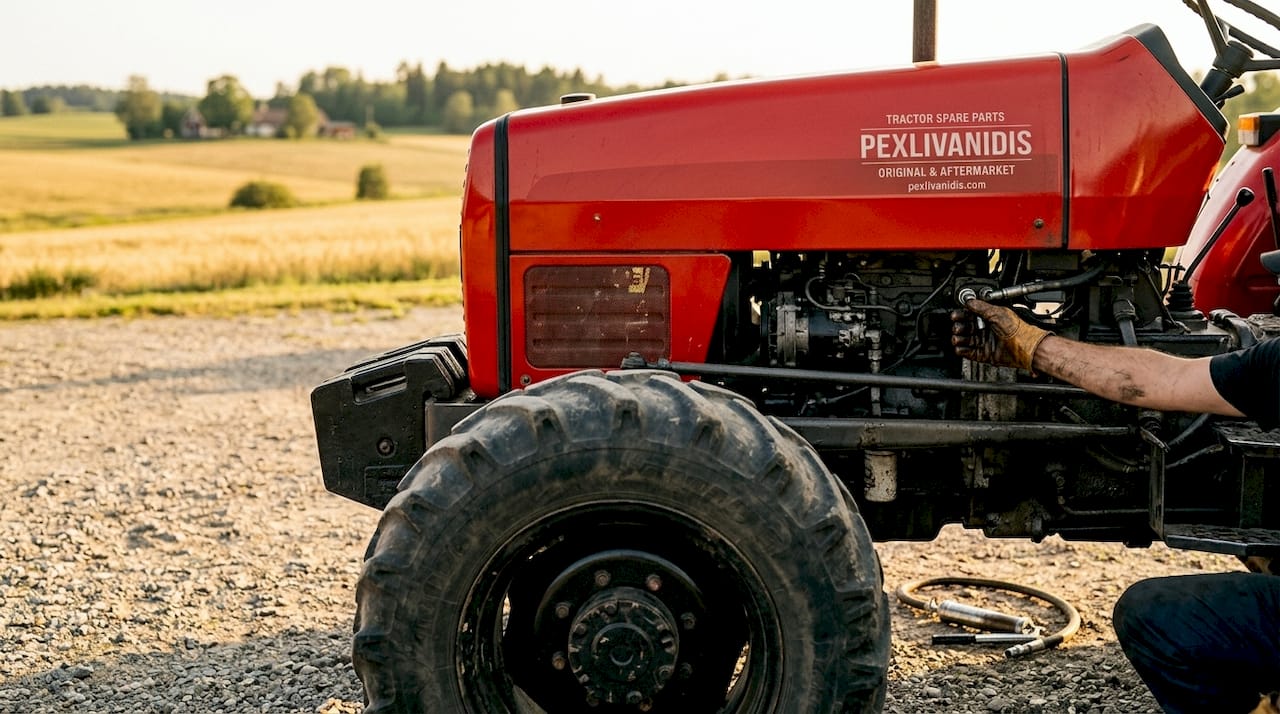
Before you start the engine each morning, check engine oil level, coolant level, hydraulic fluid reservoir, and fuel. Look for any visible leaks underneath the machine. Walk around and inspect all four tires for cuts, correct inflation, and embedded objects. Check that all lights function and that the ROPS structure has no visible damage. Once running, listen for unusual knocking or vibration and verify that all gauges read normally within the first few minutes of operation.
Pro Tip: Keep a printed walk-around card laminated in the cab. When the check becomes a routine backed by a physical prompt, nothing gets skipped during busy planting or harvest periods.
2. Engine oil and filter changes
Engine oil changes are the most recognized of all planned maintenance system examples, and for good reason. Dirty oil loses viscosity, carries abrasive particles, and accelerates bearing wear. For most agricultural tractors, that means an oil and filter change every 200 to 250 operating hours. Always follow your manufacturer’s specifications.
Don’t just drain the old oil. Inspect it. Black oil with a burnt smell is normal at interval. Milky or gray-colored oil signals coolant contamination and requires immediate investigation before the next start. Gray metallic particles in the oil mean internal wear that needs attention beyond a simple change.
3. Air filter maintenance and fuel system care
Tractors working in dusty conditions need air filter checks more frequently than the service manual assumes, because manuals are written for average operating environments. Tap and inspect the primary filter element every 50 hours in high-dust conditions. Replace it, not just clean it, when it shows physical damage or heavy discoloration that cleaning cannot correct.
For the fuel system, drain water separators weekly during active seasons. Water in diesel fuel causes injector damage that costs far more than a few minutes of attention. Change the fuel filter at the manufacturer’s interval, typically every 500 hours, and never run a tank to empty. Pulling sediment from the tank bottom through the fuel system is one of the more avoidable causes of injector wear.
4. Lubrication and greasing schedule for tractors
Every grease point on your tractor has a specific interval for a reason. Most front axle pivot points and steering linkages need grease every 50 to 100 hours. Universal joints on PTO shafts and drivelines require grease more often, especially under heavy load.
Core PM activities across all industries include lubrication as a primary task, and in agriculture it’s one of the highest-return maintenance habits you can build. Carry a grease gun in the cab. Five minutes of greasing during a fuel stop prevents seized pins, worn bushings, and cracked steering components.
5. Hydraulic system preventive care
Hydraulic failures during field operations are particularly disruptive because they affect implements, steering assistance, and three-point linkage simultaneously. Change hydraulic fluid according to manufacturer recommendations, usually every 1,000 hours for modern tractors. More importantly, inspect hydraulic hoses every season for cracking, abrasion marks, and fitting condition.
A hose that looks intact externally can have internal delamination. The test is simple: flex each hose by hand. Any hose that feels stiff, shows surface cracking, or has a fitting that moves independently of the hose body should be replaced before the season starts.
6. Tire and brake inspection
Safety-focused PM checklists prioritize components where failure risks injury or high-cost incidents, and tires and brakes top that list on tractors. Check tire pressure weekly during active use. Under-inflated tires increase fuel consumption, cause uneven wear, and reduce stability on slopes. Replace tires when tread depth becomes insufficient for safe traction on the surfaces you operate on.
Brake adjustment on older tractors with mechanical linkage requires periodic checking and equalization between left and right pedals. An out-of-balance tractor that pulls hard on brake application is a rollover risk on side slopes. Address it before it becomes a serious problem.
7. PTO driveline and U-joint maintenance for implements
This is where most operators fall short. Greasing PTO driveline U-joints every 8-10 operating hours is not a suggestion. It’s the minimum interval that prevents U-joint seizure and catastrophic driveline failure. A seized U-joint at operating speed can destroy a gearbox, damage the tractor’s PTO stub, and create a genuine safety hazard.
The difficulty is that implements don’t have hour meters. You can’t rely on the same usage tracking you use for the tractor. Instead, set a phone reminder to grease PTO components after a set number of working days or at the end of each day during intensive operations.
- Grease all U-joints before every extended working session
- Inspect driveline shields for cracks or missing fasteners
- Check slip clutch discs annually and clean disc surfaces if they show glazing
8. Gearbox oil inspection and shear bolt checks
Implement gearboxes are sealed and out of sight, so they get overlooked. An annual gearbox oil inspection should be part of every farm’s maintenance schedule examples. Remove the fill plug and check oil level. More importantly, look at the oil condition. Milky or cloudy gearbox oil means water contamination, typically from a failed seal, and continued operation will cause bearing and gear damage within hours.
Shear bolts are a designed sacrificial component in many implements, protecting gearboxes from overload. Keep a supply in the toolbox and replace them with the correct specification. Using a stronger bolt “to avoid the hassle” transfers shock loads directly to the gearbox and causes far more expensive damage.
9. Pre-harvest combine maintenance routine
Effective harvest PM requires two layers: a thorough pre-harvest inspection and daily during-harvest quick checks. Before the first day of cutting, perform these tasks:
- Clean all crop residue from the engine compartment, radiator, and exhaust areas completely. Combine fires are a serious and preventable risk
- Inspect the header: check knife sections, guards, auger condition, and reel fingers
- Check all belts and chains for wear, proper tension, and missing links
- Inspect the threshing cylinder and concave clearance
- Check all bearings by hand for roughness or play
- Test all functions at slow speed in a short run before entering the first field
During harvest, perform a brief daily check each morning. Add lubrication to designated points, inspect the cleaning shoe and sieves for blockages, and check for any unusual noise or vibration from the previous day’s operation.
Pro Tip: Do your pre-harvest combine work at least two weeks before you expect to start cutting. Parts like knife sections, belts, and bearings take time to source, and finding a problem the night before harvest starts puts you in a very difficult position.
Preventative maintenance task comparison by interval
This table organizes common farm equipment maintenance tasks by frequency and priority to help you build a realistic maintenance schedule.
| Task | Frequency | Criticality | Equipment |
|---|---|---|---|
| Walk-around inspection | Daily | High: safety and breakdowns | Tractor, combine |
| Tire pressure check | Weekly | High: safety and fuel use | Tractor |
| PTO U-joint greasing | Every 8-10 hours | High: driveline failure | Implements |
| Oil and filter change | Every 200-250 hours | High: engine longevity | Tractor |
| Air filter inspection | Every 50 hours (dusty conditions) | Medium: performance | Tractor |
| Hydraulic hose inspection | Seasonal | High: system failure | Tractor, implements |
| Gearbox oil inspection | Annual | High: gearbox damage | Implements |
| Hydraulic fluid change | Every 1,000 hours | Medium: system wear | Tractor |
| Pre-harvest full inspection | Before season | Critical: harvest downtime | Combine, header |
| Fuel filter replacement | Every 500 hours | Medium: injector protection | Tractor |
Smaller operations with one or two tractors benefit most from the daily and hourly tasks in the table above, since they lack the resources to absorb a major unplanned repair. Larger operations with multiple machines should also consider rotating equipment so no single unit accumulates disproportionate hours without service. For reducing downtime with structured workflows, the frequency and consistency of scheduled tasks matters more than any individual service interval.
My take on maintenance that actually gets done
I’ve seen maintenance programs fail not because farmers don’t understand what needs doing, but because the schedule is too rigid to survive real farm life. Harvest doesn’t wait. Planting windows close. When you’re two days behind and the weather turns, the grease gun gets forgotten.
What I’ve learned is that the best maintenance routine is the one you actually complete, even if it’s slightly less thorough than the ideal. A daily five-minute walk-around done consistently beats a 30-point inspection that only happens when things are slow. Adapt your intervals to the season. Double the check frequency during harvest. Drop back to monthly inspections in the off-season. The equipment tells you what it needs if you’re paying attention.
Documentation also matters more than most people expect. I’ve watched operators catch a hydraulic hose showing early cracking because their log showed the same hose was flagged at the previous inspection. Without that written record, it would have been missed until it failed in the field. Small consistent habits, written down, compound into real reliability over time. That’s the honest truth about preventive maintenance for farmers.
— George
Keep your equipment running with Pexlivanidis
Knowing what maintenance to do is only half the equation. Having the right parts available when you need them is the other half. Pexlivanidis stocks over 20,000 agricultural machinery parts and spare components, with free shipping within Greece on orders over 100€. Whether you’re sourcing replacement filters, hydraulic hoses, shear bolts, or PTO components, you’ll find them in one place without the delays that come from hunting parts across multiple suppliers. Start with the essential machinery parts guide to understand exactly which components matter most for long-term reliability. For hands-on guidance tailored to your equipment, the complete machinery maintenance guide covers the full range of service tasks in practical detail.
FAQ
What are the most common preventative maintenance examples for tractors?
The most common tasks include daily oil and coolant level checks, air and fuel filter replacement at set hour intervals, hydraulic hose inspection, grease application to all pivot points, and tire pressure verification. A structured tractor maintenance checklist organized by 12 critical systems covers all major failure-related areas.
How often should implement U-joints be greased?
PTO driveline U-joints should be greased every 8 to 10 operating hours. Because most implements lack hour meters, setting a calendar or phone reminder after each working session is the most practical way to stay on schedule.
What is a planned preventive maintenance example for a combine?
A classic planned preventative maintenance example for a combine is the pre-harvest inspection: cleaning crop residue from the engine and exhaust area, checking all belts and chains, inspecting knife sections on the header, and performing a short test run before the first day of harvest.
Why does documenting maintenance matter on a farm?
Without written records and pass/fail criteria, maintenance assessments vary between operators and early wear trends go undetected. Documentation turns routine checks into a reliable system for catching problems before they become costly failures.
What is the difference between usage-based and calendar-based maintenance?
Usage-based maintenance triggers tasks at specific hour thresholds, such as an oil change every 250 hours. Calendar-based maintenance triggers tasks by time regardless of hours logged, which is particularly useful for implements without hour meters and for fluid inspections where degradation happens over time even without heavy use.