

TL;DR:
- Effective spare parts storage combines environmental controls, material-specific packaging, and organized retrieval systems to minimize degradation and equipment downtime. Proper data management, routine inspections, and staff training are essential for maintaining inventory accuracy and preventing long-term deterioration. Implementing a structured maintenance and monitoring approach transforms storerooms into reliable assets for operational efficiency.
Spare parts storage is the process of organizing, protecting, and tracking inventory so parts remain available and usable when equipment fails. Done right, it cuts emergency procurement costs, prevents degradation, and keeps machinery running through scheduled maintenance rather than crisis response. The agricultural sector knows this pressure acutely: a tractor breakdown during harvest is not an inconvenience, it is a financial event. Systems like ZERUST corrosion prevention, VCI packaging, and CMMS software have made it possible to store parts for years without loss. This guide covers the full process, from environmental controls to digital tracking.
How to store spare parts: environment and tools
The single most damaging force in any parts storeroom is uncontrolled humidity. Rust prevention requires humidity below 50%, combined with temperature stability, cleaned and dried parts before storage, and scheduled inspections every three to six months. That combination is not optional for metal components. It is the baseline.
Every part category demands a different protective approach. Category-specific storage practices break down as follows:
| Part category | Primary risk | Recommended protection |
|---|---|---|
| Metals | Corrosion, rust | VCI wraps, desiccants, humidity control |
| Rubber and plastics | UV degradation, ozone cracking | Opaque or UV-resistant bags, dark storage |
| Electronics | Static discharge, moisture | Anti-static packaging, dry cabinets |
| Fluids and lubricants | Contamination, spills | Upright storage, spill containment trays |
For metals, VCI (Vapor Corrosion Inhibitor) packaging releases a protective vapor that coats metal surfaces and blocks oxidation. For rubber and plastic parts, storing them away from sunlight in opaque packaging prevents the UV exposure and ozone contact that causes cracking and brittleness. Electronics require anti-static bags and, for long-term storage, dry cabinets that maintain relative humidity at or below 5%.
Your physical storage infrastructure matters just as much as packaging. Heavy-duty steel shelving handles weight and resists moisture better than wood. Stackable bins with clear labeling reduce search time. Hygrometers mounted in each storage zone give you real-time humidity readings. Desiccant packets placed inside sealed containers provide a secondary moisture barrier. None of these tools are expensive individually. The cost of not using them, measured in scrapped parts and unplanned downtime, is far higher.
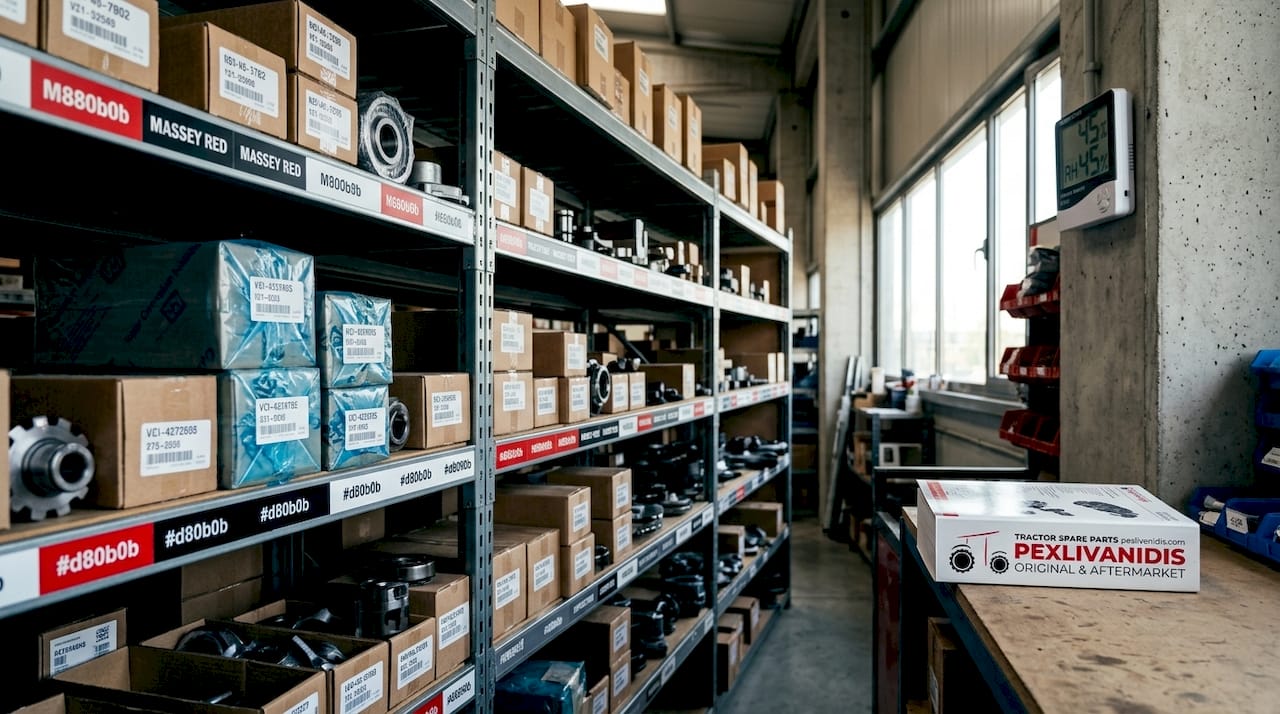
Pro Tip: Clean every part before placing it in storage. Grease, soil, and metal shavings accelerate corrosion and contaminate packaging. A clean part in proper packaging lasts years. A dirty part in the same packaging degrades in months.
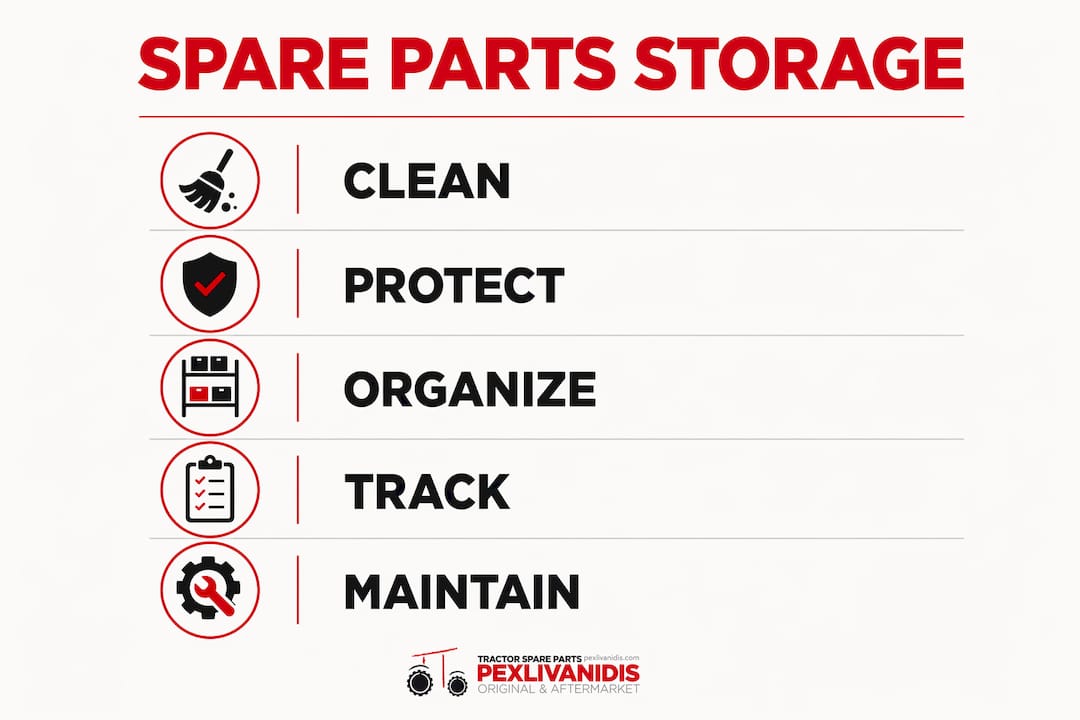
How to categorize and organize spare parts for efficient retrieval
Spare parts organization starts with a sorting decision: group by material sensitivity first, then by usage frequency. This two-axis approach prevents a common mistake where fast-moving parts end up stored next to chemically incompatible materials, or where critical components get buried behind slow-movers.
Usage frequency drives physical placement. Fast-moving parts belong at waist-to-shoulder height on shelving closest to the storeroom entrance. Medium-movers go on mid-level shelves further back. Slow-movers and long-term spares occupy floor-level or overhead storage. This layout alone reduces technician retrieval time significantly. Prioritized placement for high-frequency spares combined with secure storage for high-value items is the standard recommended by maintenance engineering specialists.
ABC analysis adds a criticality and value layer on top of frequency sorting:
- A-class parts: High value or critical to operations. Store securely with restricted access and detailed tracking.
- B-class parts: Moderate value and usage. Standard shelving with bin labels and regular cycle counts.
- C-class parts: Low cost, high volume. Bulk storage bins with visual reorder indicators.
Bin numbering and coordinate systems turn a storeroom into a searchable database. Label every shelf with a zone code (A, B, C), a row number, and a bin position. A part stored at B-3-07 is findable in seconds. Without that system, a technician searching for a specific seal or bearing wastes time that compounds across every maintenance event.
Designing storage zones by material sensitivity rather than convenience prevents premature degradation. This is the insight most storerooms miss. Convenience-based layouts feel logical until a rubber gasket cracks because it was stored next to a heat source, or an electronic control module fails because it shared a shelf with a leaking fluid container.
Pro Tip: Photograph each storage zone after initial setup and post the image at the zone entrance. New staff and temporary workers can locate parts without asking, which reduces interruptions and retrieval errors.
What are the best practices for part identification and tracking?
Accurate identification is the foundation of any spare parts management strategy. IBM defines spare parts management as a lifecycle process covering planning, procuring, storing, tracking, and distributing parts to minimize downtime and lead time. Every step in that chain depends on clean, consistent part data.
Start by assigning a unique part number to every SKU in your inventory. Standardize naming conventions so the same component is never entered as “seal,” “O-ring seal,” and “hydraulic seal” in three separate records. Duplicate SKUs and inaccurate naming cause frequent retrieval errors and inventory confusion. This is one of the most common and most preventable failures in storeroom management.
The recommended tracking workflow follows four steps:
- Tag every part with a barcode or QR code label at the point of receiving.
- Integrate labels with a CMMS (Computerized Maintenance Management System), EAM (Enterprise Asset Management), or ERP platform for real-time stock visibility.
- Maintain a cloud-based parts database accessible by mobile devices so technicians can check availability from the field.
- Run cycle counts on a rotating schedule rather than one annual physical inventory. Counting 20% of stock each month catches discrepancies before they become operational problems.
Digital tracking paired with routine audits and secure access policies balances theft prevention with inventory visibility. SafetyCulture recommends this combination as the standard for accountability and forecasting accuracy.
Inventory rotation policy is equally non-negotiable. FIFO (First-In, First-Out) applies to most parts. FEFO (First-Expiry, First-Out) applies to anything with a defined shelf life, including lubricants, seals, and certain electronic components. Arranging parts so older stock is easiest to access prevents obsolescence and reduces the risk of installing a degraded part on critical equipment.
For agricultural machinery specifically, understanding part numbering systems is the prerequisite to building accurate item master data. A misidentified tractor part creates a cascade of problems from incorrect reorder to wrong installation.
How to maintain stored spare parts and prevent degradation
Storage is not a one-time setup. Parts degrade, packaging fails, and conditions change. A maintenance schedule for the storeroom itself is as necessary as a maintenance schedule for the equipment it supports.
Schedule physical inspections every three to six months. During each inspection, check for:
- Visible corrosion or rust on metal parts
- Cracking or discoloration on rubber and plastic components
- Compromised or torn packaging on any category
- Desiccant saturation (color-change indicators signal replacement is needed)
- VCI material effectiveness (replace per manufacturer schedule, not just when visible damage appears)
Replacing desiccants and corrosion inhibitors on scheduled intervals is non-negotiable for long-term protection. One-time packaging without follow-up maintenance is insufficient for parts stored beyond six months.
Electronics require the most rigorous monitoring. Moisture-sensitive electronics must be stored in moisture barrier bags with desiccants and humidity indicator cards, following IEC/EN 60749-20-1 standards. Dry cabinets maintaining relative humidity at or below 5% are the correct long-term solution for control modules, sensors, and circuit boards. ESD-sensitive components benefit from conductive storage drawers grounded to prevent static buildup, functioning as Faraday cages.
Security controls are part of storage maintenance. Implement access permissions for high-value storage zones, require sign-out procedures for every part removed, and cross-reference sign-out logs against physical counts during audits. Theft and misplacement are both inventory problems, and both are solved by the same controls.
Staff training closes the loop. A well-designed storeroom fails if technicians bypass procedures under time pressure. Train every person who accesses the storeroom on correct retrieval, proper resealing of opened packaging, and the sign-out process. The role of spare parts in farm operations extends directly into how parts are handled at every stage, not just how they are initially stored.
Key takeaways
Effective spare parts storage requires a system that combines environmental controls, material-specific packaging, logical organization, digital tracking, and scheduled maintenance to prevent degradation and reduce equipment downtime.
| Point | Details |
|---|---|
| Control the environment | Keep humidity below 50% and temperature stable to prevent corrosion and packaging failure. |
| Match packaging to material | Use VCI wraps for metals, UV-resistant bags for rubber, and anti-static dry cabinets for electronics. |
| Organize by frequency and criticality | Place fast-movers at accessible heights and apply ABC analysis to prioritize secure storage. |
| Track with clean data | Assign unique part numbers, use barcode or QR systems, and run monthly cycle counts to maintain accuracy. |
| Inspect on a schedule | Check every three to six months and replace desiccants, VCI materials, and protective coatings as needed. |
What I’ve learned from years of watching storerooms fail
Most storeroom failures I have seen come down to one root cause: the item master data was never cleaned up before the system went live. Bins get labeled, shelves get organized, software gets installed, and then a technician searches for a hydraulic seal and finds three different entries for the same part under three different names. The physical storeroom looks right. The data is a mess. The system fails at the moment it is needed most.
The second pattern I see repeatedly is the inspection schedule that exists on paper but never happens. VCI packaging gets installed once and assumed to be permanent. Desiccants turn saturated and stay in place for two years. A part that cost significant money to procure gets scrapped because no one checked it. The discipline of scheduled maintenance for stored parts is genuinely harder to build than the initial setup, because it requires consistent follow-through rather than a one-time project.
What actually works, in my experience, is treating the storeroom as a piece of equipment in its own right. It has a maintenance schedule. It has performance metrics, specifically fill rate, retrieval time, and inventory accuracy. It has responsible owners. When you manage it that way, the culture around it changes. Technicians stop treating it as a free-for-all and start treating it as a system worth protecting.
The tractor parts inventory management guide from Pexlivanidis covers the agricultural-specific layer of this in detail, and it is worth reading alongside this article if your focus is farm equipment.
— George
Explore Pexlivanidis resources for agricultural parts storage
If your spare parts inventory includes agricultural machinery components, the principles in this article apply directly, but the specifics matter. Pexlivanidis has built a library of practical resources for farmers, mechanics, and agricultural businesses managing tractor and machinery parts. Start with the guide on agricultural machinery parts types to understand which categories require the most careful storage handling. From there, the agricultural machinery maintenance guide connects storage practices directly to equipment lifecycle management. With over 20,000 parts in inventory and B2B wholesale options, Pexlivanidis supports both the parts supply and the knowledge side of keeping agricultural equipment running.
FAQ
What humidity level is safe for storing spare parts?
Humidity below 50% is the standard threshold for preventing corrosion on metal parts. Use a hygrometer to monitor levels and a dehumidifier to maintain them in high-risk storage zones.
What is VCI packaging and when should I use it?
VCI (Vapor Corrosion Inhibitor) packaging releases a protective vapor that coats metal surfaces and prevents oxidation. Use it for any metal parts stored longer than a few weeks, particularly in environments with variable humidity.
How often should I inspect stored spare parts?
Inspect stored parts every three to six months. Check for corrosion, packaging integrity, and desiccant saturation, and replace protective materials on schedule rather than waiting for visible damage.
What is the best inventory rotation method for spare parts?
FIFO (First-In, First-Out) is the standard for most parts. Use FEFO (First-Expiry, First-Out) for parts with defined shelf lives, including seals, lubricants, and moisture-sensitive electronics.
How do I prevent electronic spare parts from being damaged in storage?
Store electronics in moisture barrier bags with desiccants and humidity indicator cards, following IEC/EN 60749-20-1 standards. For long-term storage, dry cabinets maintaining relative humidity at or below 5% provide the most reliable protection.