

TL;DR:
- Greek agri supply chains face high risks from post-harvest spoilage and infrastructure gaps.
- Technology like IoT and blockchain can improve traceability and reduce waste in agriculture.
- Success requires combining digital tools with organizational changes and trusted supply chain networks.
When 14% of the world’s food is lost between harvest and retail, the numbers hit Greek agricultural professionals directly in the pocket. Inefficiencies in storage, transport, and processing don’t just shrink margins — they threaten the entire value you’ve worked a season to build. Greece’s smallholder-dominated farming sector is particularly exposed, where a single weak link can cascade into income collapse. This guide breaks down exactly what the agri supply chain is, where it fails, how local conditions shape its risks, and what tools and strategies can help you build a more resilient, profitable operation from field to final consumer.
Table of Contents
- Defining the agri supply chain: Key phases and actors
- The agri supply chain in Greece: Challenges and local realities
- Food loss, wastage and risk points: Where supply chains break down
- How technology is transforming agri supply chains
- Why true supply chain transformation in Greece requires more than tech
- Boosting your agricultural operations with the right support
- Frequently asked questions
Key Takeaways
| Point | Details |
|---|---|
| Supply chain structure | The agri supply chain links inputs, farming, processing, logistics, and delivery to consumers. |
| Greek market challenges | Greek producers face unique hurdles like low technology use, policy shifts, and supply disruptions. |
| Major loss points | Most food loss happens post-harvest due to inefficiencies in handling, storage, and logistics. |
| Smart technology adoption | Tools like IoT and blockchain offer better traceability and loss prevention for proactive farmers. |
| Beyond technology | Real supply chain resilience requires collaboration, training, and new business models, not just digital upgrades. |
Defining the agri supply chain: Key phases and actors
The term gets used loosely, but precision matters here. An agricultural supply chain is the full sequence of activities, actors, and infrastructure that moves a raw agricultural product from production to consumer consumption. It covers everything from the seeds and machinery you use on the farm, right through to the shelf where a retailer sells your tomatoes or olive oil.
There are five core stages every Greek producer operates within, whether they realize it or not:
| Stage | Description |
|---|---|
| Agricultural production | Planting, growing, harvesting |
| Post-harvest handling and storage | Sorting, grading, cold storage |
| Processing and transformation | Packaging, milling, pressing |
| Distribution and logistics | Transport, warehousing, delivery |
| Retail and foodservice | Final sale to consumers or restaurants |
Each stage adds value. Each stage can also add risk. The actors involved shift as the product moves forward:
- Farmers and cooperatives produce and initially aggregate supply
- Processors transform raw goods into market-ready products
- Distributors and logistics providers bridge geography and time
- Retailers and foodservice operators connect supply to demand
- Input suppliers (machinery, fertilizer, fuel) support production capacity
Most Greek producers interact daily with input suppliers and logistics providers without thinking of them as supply chain partners. That mindset shift matters more than most farmers realize. When you see your operation as part of a connected system rather than an isolated farm, you make decisions differently, from how you time your harvest to how you choose your parts supplier.
For a closer look at how these relationships work in the Greek context, the guide on Greek agri supply chains provides a practical breakdown worth reading.
Pro Tip: Map your own operation against these five stages and identify which one you have the least visibility into. That blind spot is almost always where your biggest losses hide.
The agri supply chain in Greece: Challenges and local realities
Greece’s agricultural sector operates under a unique set of pressures that make standard supply chain advice insufficient on its own. Greek agri supply chains face crises including delayed subsidies, livestock disease outbreaks, EU Common Agricultural Policy (CAP) reform pressures, and intensifying climate stress — all of which can trigger income collapse and market disruptions simultaneously.
The structural data tells an uncomfortable story:
| Metric | Greece | EU Average |
|---|---|---|
| Precision ag adoption | 5% | ~30% |
| Farmers trained in new tech | 6.7% | ~25% |
| Productivity trend (recent) | -8.8% | +9.2% |
Source: The lost fruit of innovation
These numbers reflect real operational gaps, not just policy failures. When fewer than 7 in 100 farmers are trained in modern technology, the downstream effects on logistics, quality control, and processing efficiency are significant. The knowledge gap compounds the infrastructure gap.
Here are the steps Greek producers can take right now to track and anticipate supply chain risk:
- Document seasonal patterns in your input costs, transport delays, and spoilage rates to identify recurring failure points
- Monitor CAP subsidy timelines and plan cash flow so a payment delay doesn’t stall operations
- Build relationships with multiple suppliers to avoid single-point-of-failure dependencies
- Join or form a local cooperative to pool logistics resources and negotiate better transport rates
- Stay connected with regional extension services for early warnings on disease outbreaks and climate advisories
Adopting even basic precision agriculture tools can meaningfully reduce some of these vulnerabilities, particularly around timing and resource use. And understanding how supply chain disruptions propagate helps you act before a problem becomes a crisis.
Food loss, wastage and risk points: Where supply chains break down
The 14% global food loss figure from FAO doesn’t happen randomly. It concentrates at specific, predictable points in the chain — and the post-harvest stage carries the highest spoilage risk. For Greek producers, that means the hours and days immediately following harvest are where your profit margin is most vulnerable.
The key loss points follow a recognizable pattern:
- Post-harvest handling errors: Bruising, contamination, and temperature breaks during initial processing
- Inadequate cold chain infrastructure: Interruptions in refrigeration during transport or storage
- Processing delays: Backlogs at facilities that push produce past quality thresholds
- Logistics fragmentation: Multiple handoffs between small operators increase damage and delay risk
- Documentation and traceability gaps: Lost or incomplete records that trigger rejection at retail or export inspection
Beyond physical spoilage, key supply chain risks include environmental and climate shocks, supply disruptions affecting smallholders, and technology gaps that prevent early detection and response. The research points to mitigation through digital tools, blockchain-based traceability, policy support, and shorter supply chains as the most effective countermeasures.
Shorter chains are particularly relevant for Greece. When a producer in Kavala ships directly to a local processor rather than routing through a regional distributor, they cut two handoff points and reduce spoilage risk measurably. Coordination, not capital spending, drives that improvement.
Digital monitoring tools, including sensor-based crop management, allow you to catch temperature deviations, humidity spikes, and storage anomalies in real time — before they become losses.
Pro Tip: Install a low-cost temperature logger in your storage facility for one full season. The data almost always reveals 2-3 recurring risk windows you didn’t know existed, giving you specific intervention points instead of vague concerns.
How technology is transforming agri supply chains
Fix the weak links with the right tools and the efficiency gains compound quickly. Industry 4.0 technologies, including IoT (Internet of Things), blockchain, and AI-driven analytics, are demonstrably improving traceability, reducing logistics risk, and cutting waste across agri-food supply chains globally.
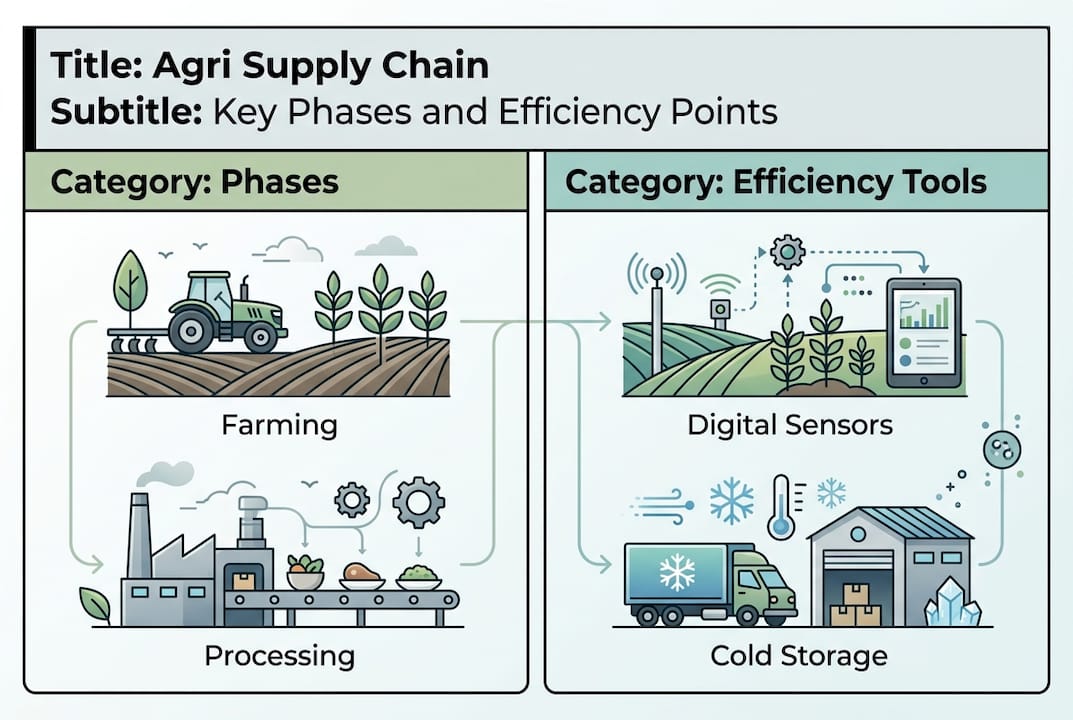
Here’s a quick overview of what each technology actually does in practice:
| Technology | Function in supply chain |
|---|---|
| IoT sensors | Real-time monitoring of temperature, humidity, location |
| Blockchain | Tamper-proof record of product origin and handling |
| AI and data analytics | Demand forecasting, quality prediction, route optimization |
| Digital platforms | Connecting buyers and sellers, reducing transaction friction |
For Greek producers, the realistic adoption ladder looks like this:
- Start with digital record-keeping for inputs, yields, and logistics using a basic farm management app
- Add sensor monitoring for critical storage and transport stages
- Connect to a digital marketplace or B2B platform to access more buyers and reduce distribution intermediaries
- Explore blockchain traceability as export volumes grow and buyers demand verified provenance
- Use predictive analytics for harvest timing and inventory planning as data accumulates
On the institutional side, ELGO-DIMITRA’s modernization of systems like ARTEMIS 2 is bringing traceability infrastructure and precision agriculture training closer to Greek producers. These programs directly address the training gap visible in the comparison data above and provide a credible path toward competitiveness within the EU framework.
For a deeper look at how these tools apply specifically to field operations, the precision farming guide walks through practical applications step by step. You can also explore how agricultural e-commerce innovations are shortening supply chains and improving margins for Greek producers.
Pro Tip: Don’t try to adopt every technology at once. One well-implemented tool that solves a real bottleneck creates more value than five half-used platforms running in parallel.
Why true supply chain transformation in Greece requires more than tech
Here’s the uncomfortable reality most technology vendors won’t tell you: the majority of supply chain failures in Greek agriculture don’t come from a lack of gadgets. They come from habits, fragmented information, and the absence of trust between chain participants.
A farmer who doesn’t share harvest timing data with their logistics partner creates delays. A processor who doesn’t communicate capacity constraints forces post-harvest bottlenecks. These failures are cultural and organizational, not technical.
The operations that genuinely improve their supply chain performance do so by combining tools with coordinated behavior. They share data with partners, participate in cooperative buying and selling, and treat input suppliers as long-term relationships rather than transactional vendors. Understanding B2B strategies in agriculture is as important as understanding any specific technology.
The hard-won lesson from working within this sector is this: networks outperform tools. Build yours intentionally.
Boosting your agricultural operations with the right support
Applying supply chain principles without the right equipment and parts is like building a logistics plan with unreliable vehicles. Every efficiency gain you create upstream gets erased by a tractor breakdown or a parts delay at harvest. At Pexlivanidis, we stock over 20,000 essential agri machinery parts with free shipping across Greece on orders over 100€, so equipment downtime doesn’t become your supply chain’s weakest link. For producers and agribusinesses ready to go further, our B2B supply chain solutions provide wholesale access and dedicated support. You can also explore farm supply e-commerce options to streamline your procurement and reduce input sourcing friction.
Frequently asked questions
What are the main stages of the agri supply chain?
The five main stages are agricultural production, post-harvest handling and storage, processing and transformation, distribution and logistics, and retail or foodservice delivery to the final consumer.
Why is the post-harvest stage so critical for Greek farmers?
Most food loss concentrates at the post-harvest stage due to inadequate cold chain infrastructure, rough handling, and processing backlogs — all of which directly cut into product quality and farm income.
How can technology improve agri supply chain efficiency?
IoT, blockchain, and AI tools increase traceability, automate monitoring, optimize routing, and reduce waste across every stage from input use to final delivery.
What challenges are unique to Greece’s agricultural supply chain?
Greek supply chains face a distinct combination of low technology adoption, CAP reform pressures, climate-related disruptions, disease outbreaks, and delayed subsidy payments that compound each other in ways most EU frameworks don’t fully address.
What first step should Greek producers take to modernize their supply chain?
Begin by mapping your current bottlenecks in storage, transport, and recordkeeping, then seek out ELGO-DIMITRA training programs and digital tools that address the specific gaps you identify rather than adopting technology for its own sake.