

TL;DR:
- Choosing the right agricultural implements requires understanding their specific functions and how they fit local soil and crop needs.
- Proper selection, evaluation, and maintenance of tools can significantly improve Greek farmers’ productivity and cost-efficiency.
Walk into any agricultural supply store near Thessaloniki or Kavala and you’ll hear the words “implements” and “machinery” used interchangeably. That mix-up costs farmers real money. When you don’t know exactly which tool does what job, you end up either over-investing in expensive power equipment or under-equipping yourself for the actual field work that drives your harvest. This guide cuts through the confusion, walks you through every major implement category, and gives you practical selection criteria tailored to the soil types, crops, and operating conditions typical across Greek agricultural regions.
Table of Contents
- What are agricultural implements?
- Main types of agricultural implements and their functions
- Choosing the right implements for productivity and efficiency
- Modern innovations and historical perspective
- A fresh perspective: What most guides miss about agricultural implements
- Find the right implements and maintenance solutions
- Frequently asked questions
Key Takeaways
| Point | Details |
|---|---|
| Implement categories clarified | Agricultural implements cover everything from crop preparation to post-harvest, not just tillage tools. |
| Selection impacts efficiency | Choosing the right implement for soil and crop stage maximizes farm productivity and resource use. |
| Modern meets traditional | Advanced designs build on age-old principles, with both old and new tools playing vital roles. |
| Cost benchmarks guide upgrades | Economic comparisons help farmers decide when it’s worthwhile to invest in new implements. |
| Continuous innovation | Power-driven tools and geometry improvements further boost energy efficiency and tillage quality. |
What are agricultural implements?
The term “agricultural implement” gets thrown around loosely, but precision matters here. An agricultural implement is a specific tool or device used to perform a defined task in farming, whether that’s breaking up soil, sowing seed, spraying chemicals, or collecting harvested crop. These tools span every stage of the production cycle.
Agricultural implements are farm tools used across crop preparation, cultivation, planting, crop protection, harvesting, and post-harvest handling. That definition is broader than most farmers expect. A simple hand hoe counts as an implement. So does a complex PTO-driven rotary tiller mounted to a 100-horsepower tractor. The category is about function and purpose, not size or power source.
Here’s where the confusion with “machinery” creeps in. A tractor is a machine. It powers or pulls implements but rarely performs a farming task on its own. The implement is the business end of the operation. The tractor just delivers force and movement. Understanding this split changes how you budget, how you shop, and how you troubleshoot problems in the field. If your plow isn’t cutting cleanly, the issue might be the plow’s blade angle, not your tractor’s horsepower.
If you want a deeper look at how this distinction plays out across farm operations, the agricultural implements explained resource breaks it down across equipment categories.
Common implement examples include:
- Plows for primary tillage and inverting soil
- Harrows for secondary tillage and seedbed preparation
- Seeders and planters for precise seed placement
- Sprayers for pesticide and fertilizer application
- Balers for compressing and packaging harvested forage
- Cultivators for weed control between crop rows
“The implement performs the work. The machine delivers the power. Understanding this distinction is the foundation of smart equipment investment.”
Main types of agricultural implements and their functions
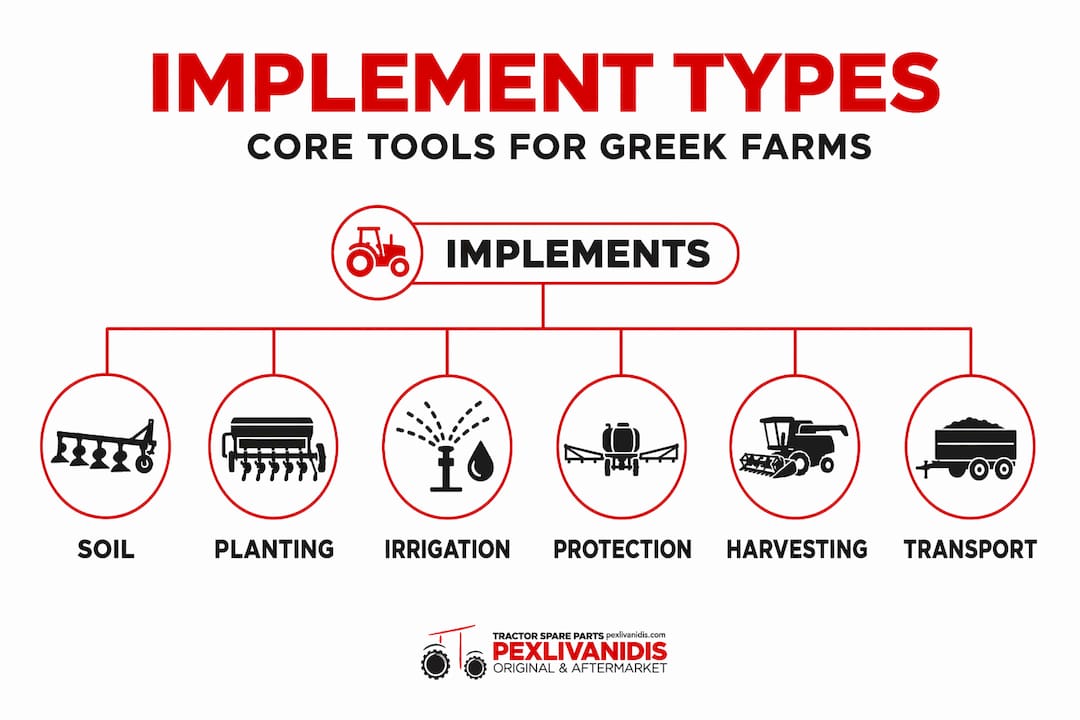
Common mechanized implement categories span the full production cycle: soil cultivation, planting and seeding, irrigation, crop protection and fertilizing, harvesting, and post-harvest processing and transport. Let’s walk through each one with practical context for Greek farming conditions.
1. Soil cultivation implements
These are your foundation tools. Plows, subsoilers, disc harrows, and rotary tillers break compacted earth, incorporate residue, and prepare a seedbed. In Greek terrain, which ranges from the flat plains of Macedonia and Thessaly to hillier plots in the Peloponnese, the right tillage implement depends heavily on slope, stoniness, and soil moisture. A disc harrow handles stony, dry soils better than a moldboard plow in many cases.
2. Planting and seeding implements
Once the seedbed is ready, precision seeders and broadcast spreaders place seed at the correct depth and spacing. Mechanical seeders are standard for row crops like corn, sunflowers, and cotton. Pneumatic seeders offer higher accuracy and speed for larger operations. The difference in seed-to-soil contact between a basic seeder and a precision unit can translate directly to germination rates and final yield.
3. Irrigation implements
Drip lines, sprinkler systems, and water pump attachments are implements too. In southern Greek regions where summer drought is consistent, choosing efficient irrigation delivery tools is as important as any tillage decision. Drip irrigation reduces water use significantly compared to overhead sprinklers and is increasingly favored for olive groves and vineyards.
4. Crop protection and fertilizing implements
Boom sprayers, knapsack sprayers, and fertilizer spreaders fall into this group. Timing and accuracy matter enormously. Uneven spreader distribution wastes input costs and creates patchy crop growth that’s hard to manage at harvest.
5. Harvesting implements
Combines, grape harvesters, olive shakers, and hay mowers are the most visible implements at harvest time. In Greece, olive harvesting implements deserve special mention because the country holds one of the world’s largest olive cultivation areas. Tree shakers and over-row harvesters have transformed what used to be entirely manual labor into manageable mechanized operations.
6. Post-harvest and transport implements
Trailers, front loaders, grain augers, and crop cleaners move product from field to storage. These are easy to overlook but critical for maintaining crop quality after harvest.
| Implement category | Primary function | Typical power source |
|---|---|---|
| Soil cultivation | Tillage, seedbed prep | Tractor PTO or draft |
| Planting/seeding | Seed placement | Tractor draft |
| Irrigation | Water delivery | Engine or PTO pump |
| Crop protection | Spraying, spreading | Tractor PTO or manual |
| Harvesting | Crop collection | Self-propelled or PTO |
| Post-harvest | Transport, processing | Tractor or electric |
Pro Tip: Match your implement to the crop stage, not just the crop itself. Using a cultivator too early in the season, before root systems are established, can damage the very plants you’re trying to protect from weeds.
You can find practical farm implement examples for each of these categories, along with guidance on which tools suit which crops. For soil-specific decisions, the tillage equipment guide covers Greek soil types in detail.
Choosing the right implements for productivity and efficiency
Understanding how implements work is just the beginning. Selecting the right tools for your specific operation is where real efficiency gains come from.
Implement selection can be evaluated economically using machinery cost benchmarks, which help farmers determine whether investing in more efficient implements actually reduces cost per unit of output. For corn and soybean farms in North America, benchmarked machinery costs run anywhere from $150 to $350 per acre depending on scale and equipment age. While Greek farm economics differ, the principle applies directly: calculate what each implement costs you to own, operate, and maintain per acre, and then compare that against the output gain it enables.
For productivity and efficiency, matching the implement to soil condition and crop stage matters as much as the implement type itself. Energy consumption and tillage quality depend heavily on tool design and operating parameters. A plow that works beautifully in deep clay soil near Larissa may perform poorly in the shallow, rocky soils common in parts of Crete. Field-level selection is not optional.
Key factors to evaluate before buying or leasing any implement:
- Farm scale: A 5-hectare olive grove has completely different needs than a 100-hectare wheat operation in Thessaly.
- Crop type: Root crops like sugar beets need deeper tillage implements than cereal crops.
- Soil texture and structure: Sandy soils need different tillage tools than heavy clay.
- Tractor compatibility: Check PTO speed requirements, three-point hitch category, and hydraulic flow rates before purchasing any mounted implement.
- Maintenance availability: An advanced implement is useless if spare parts take weeks to arrive and no local technician knows how to service it.
- Energy costs: Fuel is a significant operating expense in Greek agriculture. A more efficient rotary tiller that uses 15% less fuel than an older model can pay for itself within a few seasons.
| Factor | Low-scale farms (under 10 ha) | Large-scale farms (over 50 ha) |
|---|---|---|
| Plow type | Single-bottom or reversible | Multi-bottom or disc |
| Seeder type | Manual or basic mechanical | Pneumatic precision seeder |
| Sprayer type | Knapsack or small boom | Large boom or self-propelled |
| Cost focus | Low upfront, simple maintenance | Cost per acre, efficiency gains |
Pro Tip: Before purchasing a new implement, calculate the total annual ownership cost (purchase price divided by useful years, plus maintenance and fuel). Then compare it against the cost of hiring a contractor to do the same work. In smaller Greek operations, custom hiring often beats ownership on a pure cost basis.
For tractor-specific decisions, reviewing tractor plow types and the essentials of tractor PTO basics will sharpen your selection process before you commit to a purchase.
Modern innovations and historical perspective
Once you’ve chosen the right implements, it helps to understand how their design has evolved and why certain core principles remain unchanged in Greece’s farming tradition.
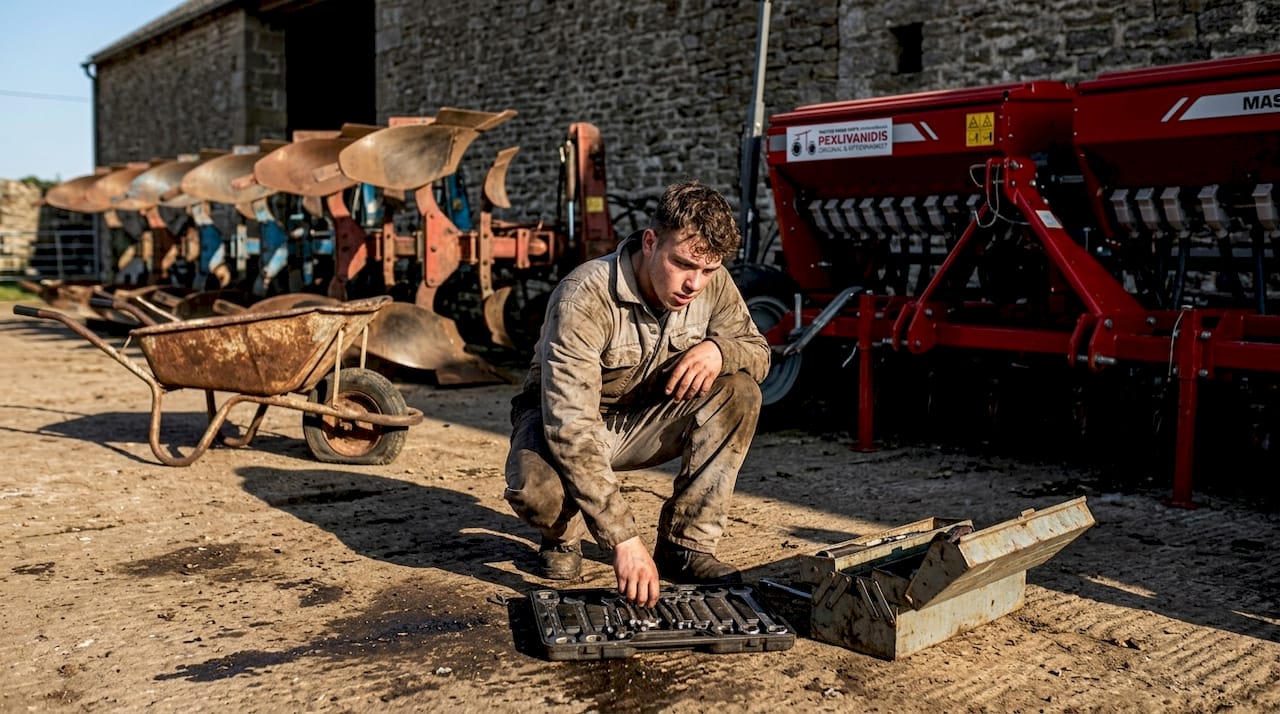
Some implements are PTO-driven, such as rotary tillage tools, and published research confirms that improvements in blade edge geometry and angle can meaningfully improve energy efficiency and tillage quality. This isn’t abstract engineering. A rotary tiller blade that enters the soil at the optimal angle cuts through compacted layers with less resistance, consuming less fuel and leaving a more uniform seedbed. Manufacturers have refined these geometries considerably over the past two decades, and the difference between a 1990s-era tiller and a current model in terms of fuel consumption and soil structure outcomes is measurable.
The power take-off itself represents one of the most significant leaps in implement technology. Before PTO-driven tools became standard, almost all implements were either manually operated or relied on the draft force of animals or tractors. PTO coupling allowed implements to use the tractor’s engine power directly for active work like milling, pumping, and rotating, rather than just pulling. That shift fundamentally changed what implements could accomplish.
Historically, ploughing implements such as the ploughshare and plough-tail, used in ancient Greece and documented in works attributed to Hesiod, illustrate that the fundamental purpose of soil cultivation has changed very little. Greek farmers were inverting soil, managing weed competition, and preparing seedbeds thousands of years ago with tools whose basic geometry we still recognize today. Modern plows use high-carbon steel and hydraulic adjustment, but they still cut, invert, and break soil because that’s what crops need.
Key evolutionary milestones in implement design:
- Animal-drawn implements: Basic plows, harrows, and seed drills powered by oxen or horses
- Draft-powered tractor implements: Tools pulled by early tractors without PTO engagement
- PTO-driven implements: Active tools using tractor engine power for rotation, vibration, or pumping
- Precision-guided implements: GPS-integrated planters and sprayers that adjust application rates in real time
- Variable-rate technology: Implements that change seed rate, fertilizer dose, or spray volume based on field data
“The plow that broke ground in ancient Macedonia and the hydraulic reversible plow working those same plains today share the same fundamental purpose. The soil doesn’t know the difference — only the efficiency does.”
For a broader look at how tillage equipment has developed and what that means for your farm today, the tillage equipment overview covers the full range from traditional to modern systems.
A fresh perspective: What most guides miss about agricultural implements
Most guides about implements read like product catalogs. They list the categories, describe the functions, and leave you to figure out what actually matters for your farm. Here’s what those guides consistently miss.
The implement itself is often not the variable that determines success. The preparation before deploying that implement is. Greek farmers working in mixed terrain deal with soil variability within a single field. A hillside plot near Veria might have three distinct soil zones across 4 hectares. If you treat that entire field with the same implement settings, you’re optimizing for the average and under-performing everywhere else.
The real skill is in ongoing evaluation. After each pass with a tillage implement, you should be reading the result. Is the inversion complete? Is the seedbed too fine or too coarse? Are you seeing smearing at the bottom of the furrow, which indicates you’re working wet soil? These observations should feed back directly into your implement settings and operating depth for the next pass.
We also see farmers underestimate the cost of deferred maintenance on implements. A worn plow share doesn’t just work harder and use more fuel. It changes the soil structure in ways that affect the next three operations: seedbed preparation, germination uniformity, and root development. The compaction from a blunt share can persist through an entire growing season.
The implements breakdown we reference here is useful not just as a category list but as a starting point for building an evaluation framework specific to your land.
Adaptability matters more than any single implement choice. A farmer who understands what each tool should achieve, monitors results after every pass, and adjusts settings or swaps attachments based on actual field conditions will consistently outperform one who bought the most expensive setup and runs it on autopilot.
Find the right implements and maintenance solutions
If you’re ready to put these principles into practice, the resources available through pexlivanidis.com can help you act on what you’ve learned here. Whether you need guidance on selecting the correct parts for your current implements or you’re considering upgrading specific attachments, understanding agricultural machinery parts is a logical next step. For keeping your equipment running at peak performance through the busy season, the machinery maintenance tips guide provides practical, field-tested advice. With over 20,000 parts in inventory and free shipping within Greece on orders above 100€, pexlivanidis.com supports both single-farm operators and wholesale B2B buyers across Thessaloniki, Kavala, and surrounding regions.
Frequently asked questions
What is the difference between agricultural implements and machinery?
Agricultural implements are specific tools used for defined farming tasks, while machinery refers to powered equipment like tractors that deliver force to those tools. An implement can be a simple hand tool or a complex tractor-mounted attachment, as agricultural implements span every stage from crop preparation through post-harvest handling.
How should Greek farmers choose implements for their fields?
Farmers should base their selection on local crop requirements, soil texture, field scale, and tractor compatibility. Matching the implement to soil condition and crop stage directly affects energy consumption and tillage quality, so field-specific evaluation always outperforms generic recommendations.
What are some examples of modern agricultural implements?
Modern implements include tractor-mounted reversible plows, rotary tillers, pneumatic precision seeders, boom sprayers, and round balers. Many are PTO-driven tools where blade geometry improvements continue to increase energy efficiency and output quality.
Are old-style tillage tools still used in Greek agriculture?
Yes. Fundamental ploughing tools like the ploughshare persist in modern form alongside high-tech equipment, because the core task of soil inversion and cultivation has not changed, only the materials and mechanisms have.
How does the cost of implements affect farming decisions?
Cost benchmarks help farmers compare the per-acre ownership cost of an implement against its productivity benefit. Machinery cost benchmarks give farmers a systematic way to evaluate whether a new implement will reduce operating costs or simply add to them.