

TL;DR:
- Most failures in Perkins marine engines stem from neglected cooling systems and fuel contamination rather than engine core issues. Regular maintenance of these supporting systems is crucial for long engine life, especially in salty, hot Greek farming environments. Proper upkeep, timely parts sourcing, and disciplined service routines significantly improve reliability and reduce costly repairs.
Most farmers assume that when a Perkins marine engine fails, the problem is buried deep inside the engine block. That assumption is wrong, and it costs operators real money every season. Reliability problems in marine diesel engines most often trace back to the supporting systems, particularly cooling circuits and fuel filtration, not the core engine itself. For Greek farmers running Perkins-powered equipment in hot, salty, and dust-heavy conditions, understanding this distinction is the single most important step toward keeping machines running longer, cutting repair bills, and avoiding unplanned downtime during critical harvest windows.
Table of Contents
- Why Perkins marine engines are a trusted choice in agriculture
- Major threats to reliability: Cooling and fuel contamination
- Essential maintenance routines for long engine life
- Comparing Perkins marine engines to other options
- The real secret to marine engine longevity in Greek farm equipment
- Find the right parts and expertise for your Perkins marine engine
- Frequently asked questions
Key Takeaways
| Point | Details |
|---|---|
| Supporting systems matter most | Failure in cooling or fuel filtration causes most Perkins marine engine downtime, not the engine block. |
| Regular maintenance is vital | Service your engine every 100–250 hours and clean the cooling system every 2–3 years to extend life. |
| Greek climate raises the stakes | Salt and heat stress in Greece require more disciplined maintenance of marine engines. |
| Proactive care saves money | Scheduled checks and filter replacements prevent costly repairs and lost productivity. |
| Perkins engines offer great value | With the right care, Perkins marine engines can deliver years of reliable service on Greek farms. |
Why Perkins marine engines are a trusted choice in agriculture
Perkins has built its name over decades by producing diesel engines that balance power output with practical serviceability. Greek agricultural operators have gravitated toward Perkins marine engines for good reason. These engines were originally engineered for demanding marine environments, which means they are built to handle heat, moisture, and continuous load cycles better than many land-only alternatives.
Farmers across Thessaloniki, Kavala, and the broader northern Greek agricultural belt use Perkins marine engines in irrigation pumps, generator sets, and various field machinery. The design allows them to run long hours under heavy loads without the thermal sensitivity that plagues lighter, less robust power units. That raw durability is the foundation of their appeal.
Here are the core reasons Greek farmers keep coming back to Perkins marine engines:
- Strong power-to-size ratio: Delivers competitive horsepower in a compact, mountable frame suitable for diverse machinery configurations.
- Widely available spare parts: A well-established global supply chain means sourcing replacement components in Greece is faster and more predictable than with many competing brands.
- Proven performance in variable conditions: Built for marine environments, these engines tolerate temperature swings and moisture that would challenge less robust units.
- Long service intervals compared to smaller engines: When maintained correctly, Perkins marine engines are genuinely long-lived investments that reward farmers who follow proper maintenance schedules.
- Ease of local servicing: Familiarity among Greek mechanics and parts suppliers reduces labor time when repairs are needed.
Pro Tip: Even the best-built engine will fail ahead of schedule if the cooling and fuel systems surrounding it are neglected. Treat the supporting systems as equal priorities to the engine block itself.
Before you can protect your engine, you need to understand the specific threats that Greek farm conditions create. Explore our Perkins engine parts list tips to stay ahead on component sourcing before problems arise.
Major threats to reliability: Cooling and fuel contamination
Greece presents a specific and demanding set of environmental challenges for any diesel engine. High summer temperatures, coastal salt air in many farming regions, dusty harvesting environments, and hard water with mineral deposits all place extra stress on Perkins marine engine systems. The damage does not usually come suddenly. It builds slowly in the cooling circuits and fuel lines until the engine fails at the worst possible moment.
“Cooling system restrictions and fuel contamination are among the most common causes of Perkins marine engine problems. Routine service every 100 to 250 hours and heat-exchanger service every 2 to 3 years are the recommended baseline for keeping these engines running reliably.” — Perkins Marine Diesel Engines FAQ
This is not abstract advice. In Greek conditions, where salt air accelerates corrosion and summer heat pushes cooling systems to their limits, disciplined cooling maintenance is what separates engines that last 10,000 hours from those that fail at 3,000.
What damages your Perkins engine most in Greece
| Threat | Where it strikes | Risk level in Greek conditions |
|---|---|---|
| Salt corrosion | Raw-water cooling circuit, heat exchanger | Very high in coastal regions |
| Mineral scale buildup | Heat exchanger tubes and water jackets | High due to hard water |
| Fuel contamination | Injectors, fuel pump, filters | High due to storage and transport issues |
| Dust and debris ingestion | Air and fuel filtration | High in harvest and dry seasons |
| Overheating from blocked cooling | Cylinder head, head gasket, pistons | Very high in summer months |
The cooling system failures are particularly destructive because they often go unnoticed until overheating causes major internal damage. A blocked heat exchanger does not announce itself loudly. It just gradually raises operating temperatures until something expensive gives way.
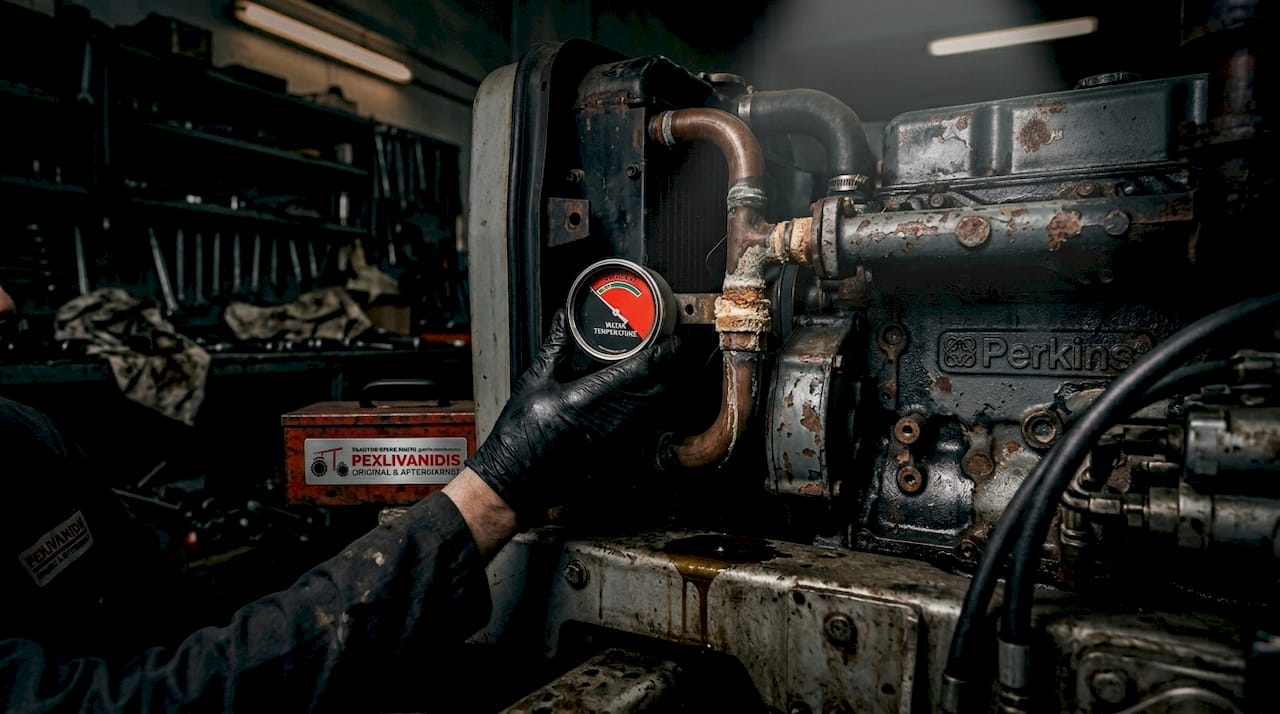
Fuel contamination follows a similar pattern. Diesel stored in farm tanks can accumulate water and microbial growth, especially over winter. When that contaminated fuel reaches the injectors, it causes premature wear and erratic engine behavior that is often misdiagnosed as an engine block problem.
Key warning signs you should never ignore:
- Rising coolant temperature gauge readings over multiple operating sessions
- Unusual smoke color (white or black) during startup or under load
- Loss of power without obvious cause, especially on warmer days
- Increased fuel consumption without a change in workload
- Rough idling or hard starting after refueling from storage tanks
Reviewing your agricultural machinery maintenance guide regularly gives you a broader framework for catching these warning signs before they escalate.
Essential maintenance routines for long engine life
Knowing the threats is only half the job. The other half is acting on a consistent, well-timed maintenance schedule. Most Greek farmers do oil changes regularly. Far fewer follow a structured cooling and fuel maintenance program. That gap is where engine life is lost.
Here is a practical, step-by-step maintenance routine for Perkins marine engines used in agricultural machinery:
- Every 100 hours of operation: Inspect the raw-water strainer for debris and clean if needed. Check coolant level and condition. Replace the primary fuel filter or check and drain the water separator. Inspect hoses and clamps on the cooling circuit for signs of wear or corrosion.
- Every 250 hours of operation: Replace the secondary fuel filter completely. Flush and inspect the freshwater cooling circuit for scale deposits. Check the raw-water impeller (the rubber pump component that moves cooling water through the system) and replace if worn or cracked. Inspect the thermostat for correct operation.
- Every 2 to 3 years, or as conditions demand: Service the heat exchanger fully, meaning remove it, clean the internal tubes, check for corrosion, and replace the zinc anodes (sacrificial metal components that attract corrosion away from valuable engine parts). In coastal or hard-water zones in Greece, this should be done closer to the 2-year mark.
- At the start of every growing season: Drain and test stored diesel before using it. Run the engine through a full warm-up and check operating temperature. Inspect all rubber components in the cooling circuit for UV and heat-related degradation.
- At the end of every season: Treat stored fuel with a biocide and stabilizer to prevent microbial growth over winter. Flush the cooling system if the engine will sit unused for more than 60 days.
Pro Tip: Set a digital calendar reminder for every 100-hour milestone. Most engine problems do not happen because farmers are careless. They happen because busy harvest schedules push maintenance windows out of mind. An automated reminder costs nothing and can save thousands of euros in repairs.
Pairing this routine with the guidance in our peak machinery maintenance resource and reviewing our routine checks for machinery checklist will help you build a complete, season-proof maintenance program.
Comparing Perkins marine engines to other options
Before committing to a long-term maintenance investment in Perkins, it makes sense to understand how these engines compare to other power units commonly found in Greek agricultural machinery. No engine is perfect, and different operations have different priorities.
| Feature | Perkins marine engines | Other common alternatives |
|---|---|---|
| Parts availability in Greece | Excellent, wide distributor network | Varies, some brands require long wait times |
| Serviceability by local mechanics | High, well-known platform | Mixed, some brands require specialist tools |
| Performance in heat and moisture | Strong, marine-spec construction | Variable, land-spec engines less tolerant |
| Initial purchase cost | Mid to high range | Often lower upfront |
| Long-term reliability with maintenance | Very high | Comparable if maintained equally |
| Fuel efficiency under load | Competitive | Some alternatives claim better economy |
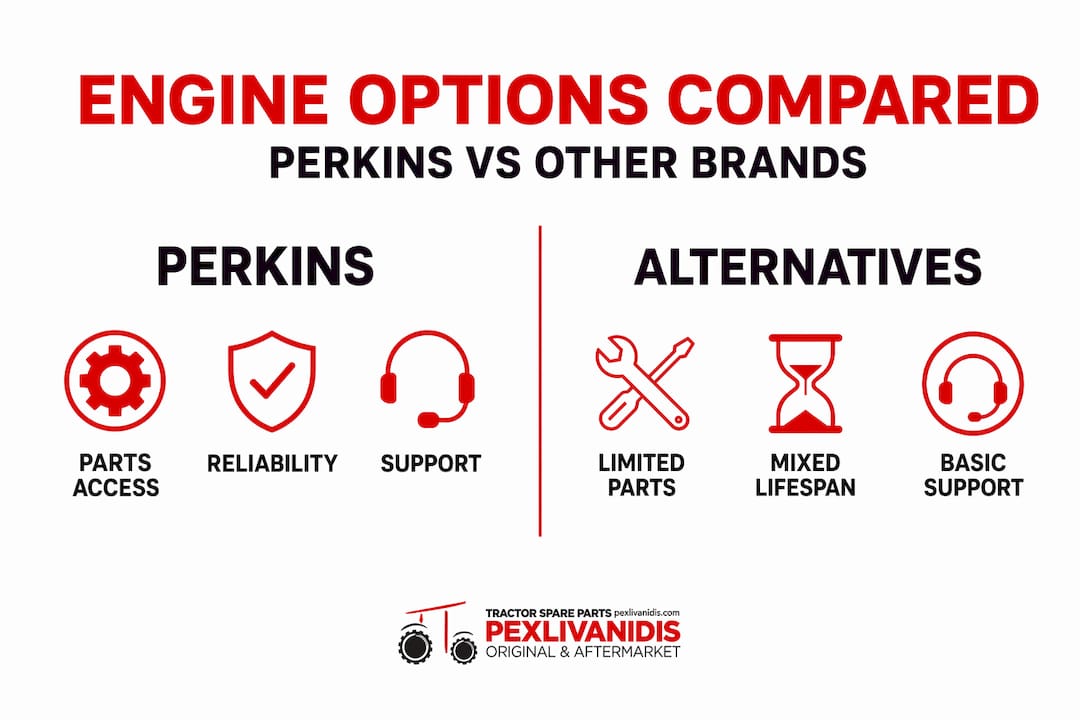
The reputation for reliability that Perkins has built is directly tied to how well the supporting systems are maintained. An alternative engine that is better maintained will often outlast a neglected Perkins unit. The engine brand matters less than the maintenance discipline of the operator.
That said, Perkins offers a specific edge that matters a great deal in regional markets like northern Greece: parts are accessible, mechanics know the platform, and the design was built with harsh environments in mind from the start.
Key points favoring Perkins for Greek agricultural use:
- Marine-grade corrosion resistance built into the cooling circuit components from the factory
- Robust raw-water cooling design that tolerates the impure and mineral-heavy water sources common in Greek farming regions
- Established local knowledge among mechanics in Thessaloniki, Kavala, and surrounding areas
- Wide compatibility with both older and newer agricultural machinery frames
For a detailed breakdown of how to source and identify the right components for your setup, our guide on using Perkins parts lists is a practical starting point.
The real secret to marine engine longevity in Greek farm equipment
Here is the perspective that most engine guides avoid saying plainly: the majority of Greek farmers who lose a Perkins marine engine to failure did not fail because the engine was bad. They failed because they treated a cooling or fuel filtration problem as someone else’s concern until it was too late.
The industry tends to focus on oil change intervals and engine hour ratings because those are easy to measure and easy to sell service contracts around. What gets less attention is the unglamorous work of cleaning heat exchanger tubes, replacing raw-water impellers on schedule, and testing stored fuel before it reaches the injection system. Yet that disciplined approach to cooling and filtration is the single most reliable predictor of long engine life in the salt and heat conditions that Greek farms face.
Consider a typical scenario: a farmer in the Kavala region runs an irrigation pump through a long, dry summer. He changes the oil faithfully every 200 hours. But the heat exchanger has not been serviced in four years because it requires removing the unit and inspecting the tubes, a job that feels optional when the engine is running fine. By late summer, operating temperatures creep up slightly. Nothing alarming. Then one day the cylinder head gasket fails from sustained thermal stress. A repair that would have cost 40 euros in impeller replacement now costs over 1,200 euros in gasket and machining work, plus lost irrigation days during a dry spell.
That scenario plays out across Greece every season. It is not unique to Perkins. But Perkins engines, because they are trusted and often left to run without intervention for too long, become the undeserved target of the frustration.
The solution is simple but demands structure. Keep a maintenance log. Record every service action with the hour reading. Set reminders. And build your seasonal farm calendar to include the engine checks the same way you plan planting and harvest schedules. A quick review of tractor maintenance tips can help you build that habit across all your machinery, not just your marine engine installations.
Find the right parts and expertise for your Perkins marine engine
Understanding how to maintain your Perkins marine engine is only the first step. Having the right parts ready before a failure occurs is what turns that knowledge into real uptime savings. At pexlivanidis.com, we stock over 20,000 agricultural machinery parts with free shipping within Greece on orders above 100 euros, so you can keep filters, impellers, and cooling components on your shelf without waiting for an emergency. Our agricultural machinery parts guide breaks down the essential categories you need for a fully prepared parts inventory, and our machinery maintenance tips resource gives you the practical framework to schedule those checks correctly. For B2B wholesale accounts in the Thessaloniki and Kavala regions, we also offer dedicated membership options to support larger farm operations.
Frequently asked questions
How often should I service a Perkins marine engine used in farm equipment?
You should perform routine service every 100 to 250 hours of operation and clean the cooling system’s heat exchanger every 2 to 3 years depending on how salty, hot, or mineral-heavy your operating environment is.
What’s the main cause of Perkins marine engine failure in Greece?
Most failures come from blocked or neglected cooling systems and poor fuel filtration, not the engine block itself, with supporting system neglect being the dominant root cause in hot, salty Greek conditions.
Does regular oil change alone keep my Perkins engine safe?
No. Ignoring cooling and fuel filtration maintenance will still lead to engine failure even if you change the oil on schedule, because heat and contamination damage builds independently of oil condition.
What should I check during routine Perkins engine maintenance?
Always inspect the cooling system for corrosion, scale, and blockage, and replace fuel filters regularly to prevent injector wear and fuel system contamination from degraded stored diesel.