
TL;DR:
- B2B agricultural machinery trading involves complex, long sales cycles with multiple decision-makers.
- Digital platforms and AI are transforming lead generation, research, and marketplace dynamics.
- Hybrid strategies combining relationships with online presence are essential for success in Greek markets.
Agricultural machinery trading is almost entirely B2B, meaning businesses sell to other businesses rather than to individual consumers. Yet a striking reality reshapes how this works: 57% of buyers complete their research and shortlist vendors before ever speaking to a sales representative. For Greek wholesalers and distributors, this shift is not a minor adjustment. It fundamentally changes how deals are won, how relationships are built, and which players thrive. This guide breaks down the mechanics, market dynamics, and practical strategies you need to stay ahead in agricultural machinery trading across Greece and beyond.
Table of Contents
- Understanding the B2B machinery trading landscape
- Key B2B mechanics: Channels, marketing, and buyer behavior
- Market dynamics and emerging trends in B2B machinery trading
- Practical strategies for wholesalers and distributors in Greece
- Why hybrid B2B models and digital adaptation are the real game-changers
- Connect with leading B2B solutions for agricultural machinery
- Frequently asked questions
Key Takeaways
| Point | Details |
|---|---|
| B2B sells most machinery | Business-to-business trading is the primary channel for agricultural machinery sales, involving manufacturers, distributors, and dealers. |
| Digital channels dominate | Buyers increasingly use online platforms and digital marketing before contacting sales, making digital-first strategies critical. |
| Hybrid models boost growth | Blending dealer networks with online marketplaces and AI tools creates broader reach and greater efficiency. |
| Greek wholesalers face global opportunity | Local Greek distributors can expand via B2B platforms, strategic branding, and service differentiation amid EU-wide market growth. |
| Service is a differentiator | After-sales support and maintenance are key for building trust and securing repeat B2B business in machinery trading. |
Understanding the B2B machinery trading landscape
B2B (business-to-business) in agricultural machinery means transactions happen between companies, not between a company and an end consumer. B2B dominates machinery trading, involving sales of heavy equipment between manufacturers, wholesalers, distributors, and large farms. This is a fundamentally different game from retail.
The stakeholders in this ecosystem each play a distinct role:
- Manufacturers produce tractors, harvesters, and implements at scale
- Wholesalers purchase in bulk and supply regional distributor networks
- Distributors manage local market relationships and logistics
- Dealers handle end-customer sales and service
- Procurement teams and farm managers make the final purchasing decisions
What makes B2B machinery trading uniquely complex is the combination of long sales cycles, high investment values, multiple decision-makers, and significant customization needs. A single tractor purchase can involve six or more stakeholders and take months to finalize. This is not a market where impulse buying exists.
| Feature | B2B machinery trading | Retail consumer sales |
|---|---|---|
| Sales cycle | Months to years | Days to weeks |
| Decision-makers | Multiple (3 to 10+) | Usually one |
| Average deal value | High (tens of thousands) | Low to moderate |
| Customization | Frequent and complex | Rare |
| Relationship importance | Critical | Moderate |
One of the most significant shifts in this space is the move away from face-to-face trade shows toward digital platforms. 98% of manufacturers now generate leads through digital channels, reflecting how buyers research independently before engaging any vendor.
“The buyer’s journey in B2B machinery is largely invisible to sellers. By the time a prospect reaches out, they’ve already formed strong opinions based on online research, peer reviews, and content.”
For Greek wholesalers managing B2B supply chains in Greece, this means your digital presence is now your first handshake, not your booth at a regional agricultural fair.
Key B2B mechanics: Channels, marketing, and buyer behavior
Understanding how B2B machinery trading actually happens means looking at both the channels used and the psychology driving purchasing decisions.
Multi-channel marketing combining trade shows, dealer networks, SEO, LinkedIn, and educational content is essential because buyers often decide before contacting sales. No single channel wins alone. The most effective approach layers them strategically.
Here is how the main channels compare:
| Channel | Strengths | Weaknesses |
|---|---|---|
| Trade shows | Relationship building, demos | High cost, limited reach |
| Dealer networks | Local trust, service proximity | Slow to scale digitally |
| SEO and content | Long-term lead generation | Takes time to build |
| LinkedIn outreach | Targeted decision-maker access | Requires consistent effort |
| Online marketplaces | Global reach, price discovery | Competitive pricing pressure |
Buyer personas in this market break into three main groups:
- Procurement managers who prioritize price, delivery reliability, and compliance documentation
- Fleet and operations managers who focus on equipment performance, maintenance costs, and downtime risk
- Business owners and executives who weigh ROI, brand reputation, and long-term partnership value
Each persona responds to different content. Procurement managers want specs and pricing. Operations managers want case studies and maintenance data. Executives want market analysis and strategic fit. Tailoring your outreach to each group dramatically improves conversion rates.
Case studies and ROI proof are among the strongest decision triggers in this market. A distributor who can show a Greek farm cooperative how a specific tractor model reduced fuel costs by 18% over two seasons is far more persuasive than any brochure.
Pro Tip: Combine a traditional dealer visit with a follow-up digital sequence, including a product video, a relevant case study, and a LinkedIn connection request. This hybrid approach keeps you present across all the channels your buyer uses to validate their decision.
For a deeper look at how aftersales differentiation builds long-term B2B relationships, it is one of the most underused levers in Greek machinery distribution.
Also worth studying are broader agricultural machinery B2B marketing frameworks that apply directly to how Greek distributors can structure their outreach.
Market dynamics and emerging trends in B2B machinery trading
The global tractor market tells a clear story about where this industry is heading. The global tractors market is set to grow from $68.2 billion in 2025 to $111.4 billion by 2033, with the used tractors segment already valued at $3.287 billion in 2025 and growing at a 4.9% CAGR. These are not small numbers. They signal sustained demand across both new and used equipment categories.
For Greek distributors, the used machinery segment deserves particular attention. Margins can be strong, entry barriers for buyers are lower, and demand from smaller farm operations remains steady even during economic downturns.
Key trends reshaping the market right now include:
- AI-powered prospecting: Machine learning tools now score leads based on digital behavior, firmographics, and engagement history, dramatically improving sales efficiency
- Digital-first platforms: Marketplaces like Mascus and TractorHouse have replaced regional fairs as the primary discovery channels for used equipment
- Export opportunity growth: EU export flows represent a major opportunity, particularly for distributors with established logistics and compliance capabilities
- Brand concentration: Major brands including John Deere and New Holland dominate the Greek import market, making authorized dealer partnerships a strategic priority
The shift from agents and fairs to AI prospecting in sourcing is accelerating. Distributors who still rely primarily on personal contacts and regional events are operating with a structural disadvantage.
For Greek wholesalers planning equipment cycles, the farming equipment upgrade checklist for 2026 offers a practical framework for timing purchases and advising your farm clients on when to upgrade versus repair.
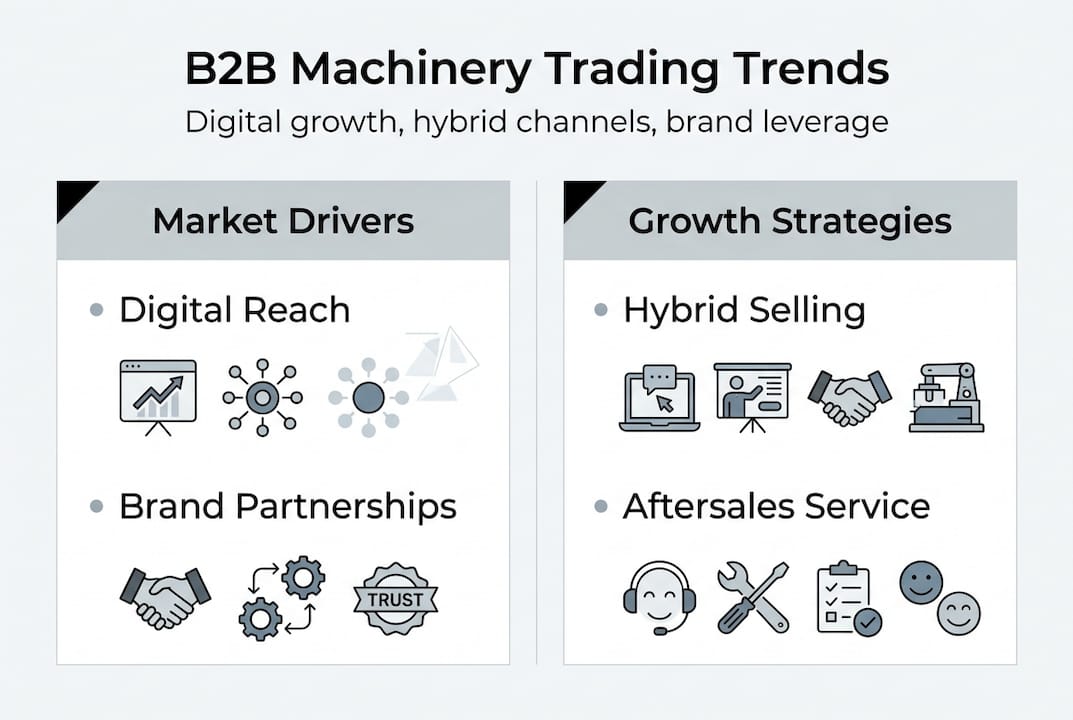
The broader market dynamic is clear: distributors who combine local relationships with digital reach and data-driven lead management will capture a disproportionate share of growth.
Practical strategies for wholesalers and distributors in Greece
Knowing the trends is useful. Knowing what to do about them is what separates growing businesses from stagnant ones. Here are the most actionable strategies for Greek B2B machinery professionals in 2026.
Platform adoption is non-negotiable. Listing inventory on Mascus, TractorHouse, and relevant Alibaba categories gives you global visibility at a fraction of the cost of traditional trade show participation. Greek agricultural machinery trading relies heavily on local wholesalers and distributors for sales, service, and imports of major brands, but digital platforms are rapidly expanding the competitive field beyond local boundaries.
Actionable steps to implement now:
- Register and optimize your profiles on at least two major B2B machinery platforms
- Publish monthly content (technical guides, maintenance tips, market updates) targeting procurement managers and fleet operators
- Invest in SEO for Greek-language and English-language search terms relevant to your equipment categories
- Use LinkedIn Sales Navigator to identify and connect with procurement decision-makers at large farm operations and cooperatives
- Build an aftersales program with documented service intervals, parts availability guarantees, and training resources
Partnering with major brands is a force multiplier. Authorized dealer status for John Deere or New Holland signals credibility and opens access to manufacturer marketing support, training programs, and preferred parts pricing.
Pro Tip: Use B2B platforms for machinery not just for sales listings but as research tools. Monitoring competitor pricing, equipment availability, and buyer inquiry patterns gives you real market intelligence without expensive research subscriptions.
Finally, invest in your service capability. Distributors who offer reliable tractor maintenance programs retain clients longer, generate recurring parts revenue, and earn the referrals that no marketing budget can buy.
Why hybrid B2B models and digital adaptation are the real game-changers
Here is the uncomfortable truth most traditional Greek machinery distributors do not want to hear: your relationships are valuable, but they are no longer sufficient. The buyers you have known for years are now researching alternatives online before they call you. If your digital presence does not reinforce the trust your personal relationships built, you are losing deals you never even knew were in play.
The distributors winning right now are not the ones with the biggest trade show budgets. They are the ones who combine dealer networks with online marketplaces, use AI and machine learning for lead prioritization, and publish educational content that keeps them visible during the long research phase buyers go through independently.
This is not about abandoning relationships. It is about protecting them with a digital layer that keeps you present when your buyer is not yet ready to call. The hybrid model is more resilient because it does not depend on any single channel. When trade shows get canceled, when a key contact changes jobs, when a competitor undercuts your price online, a hybrid operation absorbs the shock.
Dealers who have integrated telematics for Greek farms into their service offering are a perfect example. They are not just selling equipment. They are selling continuous value, which makes switching costs real and loyalty durable.
Connect with leading B2B solutions for agricultural machinery
You now have a clear picture of how B2B machinery trading works, where the market is heading, and which strategies deliver results for Greek wholesalers and distributors. The next step is putting these insights into practice with the right resources behind you. Pexlivanidis offers an extensive inventory of over 20,000 agricultural machinery parts, with wholesale B2B membership options designed specifically for distributors and wholesalers operating at scale. Explore the agricultural machinery parts guide to identify the components your clients need most, follow the maintenance tips guide to build a service program that retains clients, and review the upgrade tips for machinery to advise your customers on high-value equipment decisions.
Frequently asked questions
What is the main role of B2B in agricultural machinery trading?
B2B enables manufacturers, wholesalers, and distributors to efficiently sell, customize, and support agricultural machinery for large farms and businesses, covering everything from initial sales to ongoing service contracts.
How are B2B sales channels evolving in agricultural machinery?
Sales channels are shifting from trade shows and agents to digital platforms and AI-driven lead generation, with 95% of buyers shortlisting vendors before making first contact with a sales team.
What opportunities exist for Greek wholesalers and distributors?
Greek wholesalers can expand by leveraging B2B machinery platforms, adopting digital lead scoring, forming brand partnerships, and targeting EU export markets amid strong global market growth.
Why is after-sales service important in B2B machinery trading?
After-sales service differentiates B2B offerings, builds long-term client loyalty, and ensures reliable equipment performance that keeps farm operations running without costly downtime.
How do B2B platforms improve machinery trading?
B2B platforms increase global reach, improve price discovery and liquidity, and enable machine learning-powered lead prioritization that helps distributors focus on the highest-value prospects first.