
TL;DR:
- Farm equipment includes tools and machinery used for various agricultural tasks to improve productivity.
- The terms equipment, machinery, and implements have distinct legal and practical meanings in farming.
- Correct classification is essential for purchases, subsidies, and compliance in Greek agriculture.
Walk into any agricultural supply conversation in Greece and you’ll hear “equipment,” “machinery,” and “implements” used almost interchangeably. But these terms are not the same, and mixing them up can lead to expensive purchasing mistakes, missed subsidies, or compliance issues. Farm equipment means the machinery and tools used in agricultural operations, yet that simple definition barely scratches the surface of what farmers and operators actually need to know before spending serious money on the field.
Table of Contents
- What does ‘farm equipment’ actually mean?
- Farm equipment vs machinery vs implements: What’s the difference?
- Key types of farm equipment and their uses
- Context matters: Everyday use vs legal definitions
- How to choose farm equipment: Factors for buyers in Greece
- Why common terms still cause real mistakes: A practical perspective
- Find the right equipment for your farm with expert resources
- Frequently asked questions
Key Takeaways
| Point | Details |
|---|---|
| Clear definition matters | Knowing what ‘farm equipment’ means helps avoid purchasing mistakes and legal issues. |
| Terms are not interchangeable | ‘Equipment,’ ‘machinery,’ and ‘implements’ have meanings that can affect buying and compliance. |
| Context is crucial | Regulations or policies might use stricter definitions than everyday language. |
| Choose equipment wisely | Match farm needs, size, and local requirements for best results. |
| Use expert resources | Consult detailed buying guides and professional support to make informed decisions. |
What does ‘farm equipment’ actually mean?
The confusion starts because “farm equipment” is used in so many different ways. A salesperson, a government subsidy form, and a machinery catalog might all use the same phrase to mean slightly different things. Getting clear on the definition is not just academic. It has direct consequences for what you buy, what you can claim in subsidies, and how you manage your operation.
“Farm equipment means machinery and tools used in agricultural operations to perform fieldwork and improve productivity and efficiency.”
At its broadest level, farm equipment is an umbrella category that covers everything a farm uses to operate. This ranges from a simple hand trowel to a GPS-guided combine harvester worth hundreds of thousands of euros. The key idea is that the item must serve an agricultural purpose, whether that is preparing soil, planting seeds, applying chemicals, irrigating crops, or bringing in a harvest.
In everyday usage, farmers in Greece and across Europe typically use “farm equipment” to describe:
- Power units: Tractors, loaders, and self-propelled machines
- Soil preparation tools: Plows, harrows, cultivators, and subsoilers
- Planting and seeding equipment: Seeders, planters, and transplanters
- Crop care tools: Sprayers, fertilizer spreaders, and irrigation systems
- Harvesting machines: Combines, olive harvesters, and grape pickers
- Storage and handling tools: Grain augers, conveyors, and trailers
Understanding this range matters because when you purchase equipment, you need to match the item to the specific task your farm demands, not just to a general category.
Farm equipment vs machinery vs implements: What’s the difference?
This is where things get genuinely complicated, and where many buyers make errors they only discover later. The words “machinery,” “equipment,” and “implements” each carry their own meaning, both in everyday practice and in formal or legal documents.
Here is a side-by-side comparison to make this clear:
| Term | General meaning | Legal or regulatory use | Common examples |
|---|---|---|---|
| Farm equipment | All tools and machines for agricultural work | Broad umbrella, varies by context | Tractors, irrigation pipes, hand tools |
| Farm machinery | Powered systems with moving mechanical parts | Often specifically defined; may exclude simple tools | Tractors, combines, sprayers |
| Farm implements | Attachments or towed tools that perform a task | Usually tractor-mounted or towed tools | Plows, seeders, harrows |
| Attachments | Add-on components for existing machines | Parts that modify or extend a machine’s function | Front loaders, backhoes, mowers |
The legal distinction is important to understand. Some legal codes define “machinery” and “equipment” separately, where equipment often refers to tangible property that does not qualify as a machine under the technical definition. This kind of distinction shows up in tax codes, depreciation schedules, and import regulations.
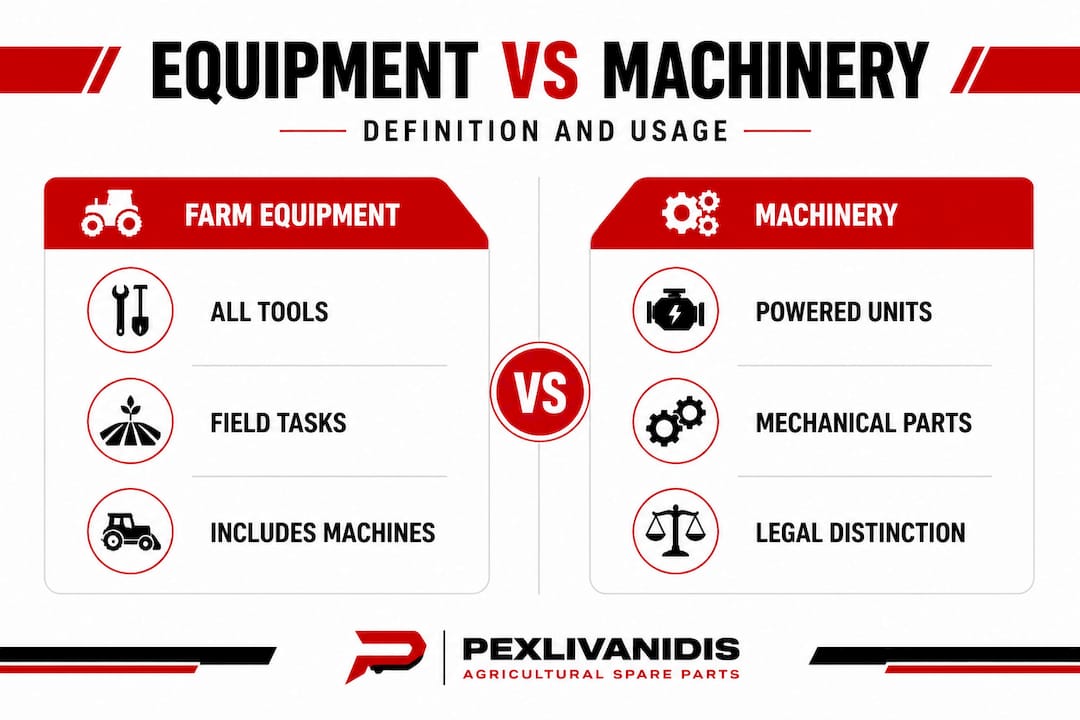
For practical purposes, though, most buyers should treat ‘farm equipment’ as the umbrella term that covers both power units like tractors and task-specific implements and attachments. The difference between machinery and implements matters most when you are filling out a subsidy application, signing a purchase contract, or reviewing a customs invoice.
You can find different implements explained in more detail if you want to go deeper into specific categories before making a purchase. Reviewing key implement examples is also a practical way to connect these abstract definitions to the tools you actually see in the field.
Pro Tip: Before signing any purchase agreement or applying for EU farm subsidies, ask the seller or the subsidy office to specify exactly which category your equipment falls under. A plow and a tractor may both be “farm equipment” in casual speech, but they could fall into entirely different categories on an official form.
Key types of farm equipment and their uses
Understanding terminology is only step one. The next step is knowing what types of equipment actually exist, what they do, and which ones matter most for agricultural operations in Greece.
1. Tractors
The tractor is the backbone of almost every farm. It provides the power that drives most other equipment through its engine and power takeoff (PTO) shaft. Tractors in Greece range from compact 25-horsepower machines used in vineyards to heavy-duty 200-horsepower models for large grain operations.
2. Soil preparation equipment
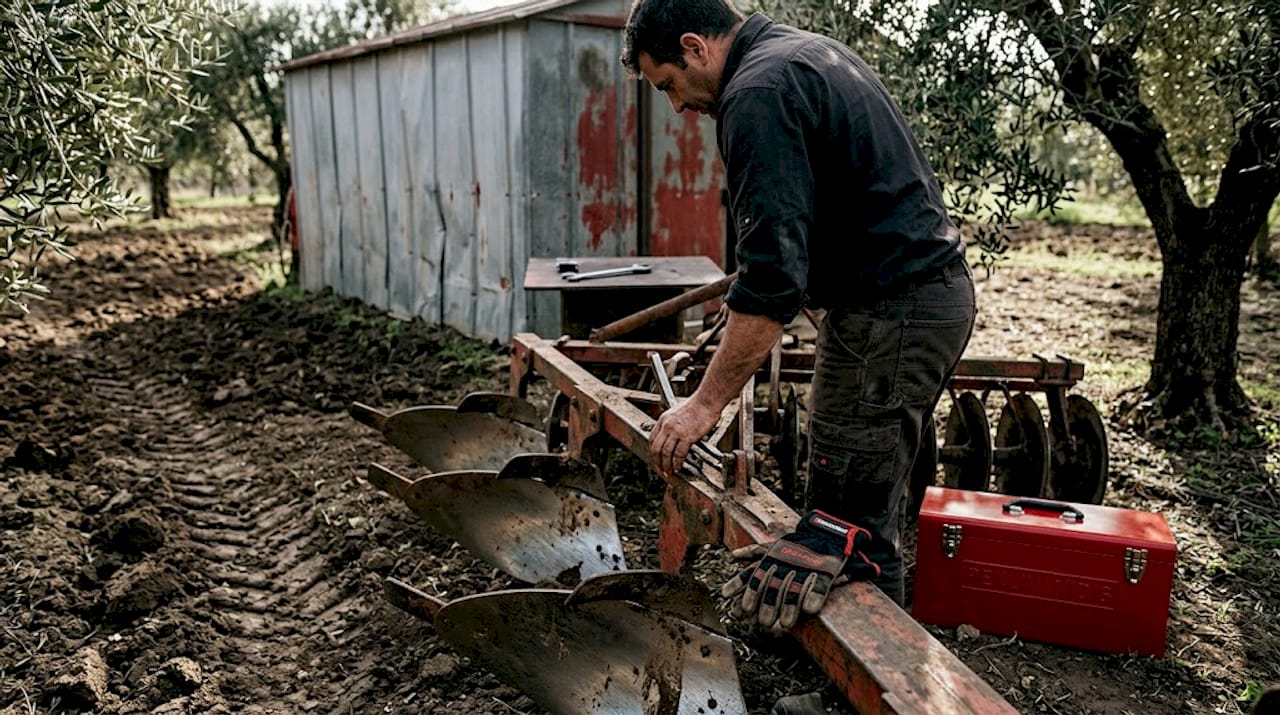
This category includes plows, disc harrows, rotary tillers, and subsoilers. These tools break up compacted soil, remove weeds, and create the ideal seedbed for planting. In Greece’s rocky terrain, subsoilers and disc plows are especially common.
3. Planting and seeding equipment
Seeders, precision planters, and transplanters control how seeds go into the ground. Precision planters, for example, place seeds at exact depths and spacing to maximize yield and minimize waste.
4. Irrigation systems
Given the Mediterranean climate in Greece, irrigation is not optional for most crops. Drip irrigation systems, sprinklers, and pivot systems keep crops alive through dry summers. Irrigation equipment can account for a significant portion of a farm’s total investment.
5. Crop care equipment
Sprayers distribute pesticides, herbicides, and fertilizers across crops. Fertilizer spreaders handle bulk applications efficiently. These tools are critical for managing crop health throughout the growing season.
6. Harvesting equipment
Examples like tractors, plows, harvesters, and irrigation systems represent the full cycle of agricultural production. For Greece specifically, olive harvesting equipment, grape pickers, and combine harvesters for wheat are among the most commonly used machines.
Here is a quick reference for how these types connect to specific farm operations:
| Equipment type | Primary use | Relevance for Greece |
|---|---|---|
| Tractors | Power source and transport | Essential for all farm sizes |
| Disc harrow | Soil breaking and mixing | Critical for cereal and vegetable farms |
| Drip irrigation | Water delivery to root zone | Vital in dry summer months |
| Olive harvester | Mechanical olive picking | High demand in Thessaloniki, Kavala regions |
| Combine harvester | Grain cutting and threshing | Used on larger northern Greek plains |
| Sprayer | Pesticide and fertilizer application | Used across virtually all crop types |
If you want a closer look at how these tools connect to daily farm operations, common equipment details breaks this down further. You can also check farming must-haves to see which tools experienced operators consider non-negotiable.
It is worth noting that the Greek agricultural sector is diverse. Farms in the Peloponnese growing olives have very different equipment needs from wheat farmers on the Thessalian plain. Matching your equipment type to your actual crop and terrain is the starting point for any smart purchase.
Context matters: Everyday use vs legal definitions
Here is something many buyers in Greece overlook: the word “equipment” does not always mean the same thing depending on where it appears. In conversation, “equipment” is a catch-all. In a legal document or a government subsidy program, it may have a very specific meaning that excludes certain items.
Legal contexts sometimes exclude ‘machinery’ from the definition of “equipment,” treating them as two separate categories entirely. This means:
- A tractor might qualify as “machinery” but not “equipment” under a specific tax rule
- Irrigation pipes might count as “equipment” but not “machinery” for depreciation purposes
- A hand-powered seeder might qualify as a “tool” rather than either category under certain subsidy programs
This is not just a legal technicality. In Greece, EU-funded agricultural subsidy programs administered through OPEKEPE (the Greek Payment Authority for Agriculture) require precise declarations of equipment categories. Filing incorrectly can delay payments or trigger audits.
Pro Tip: Keep a copy of every purchase invoice and check that the equipment classification on the invoice matches the classification required by your subsidy program. When in doubt, call the subsidy office directly before you buy, not after.
The practical lesson here is that you should never assume your vendor’s category label and the government’s category label are the same. They often are not. Exploring available equipment upgrades with context-specific guidance can also help you stay on the right side of these distinctions when modernizing your operation.
How to choose farm equipment: Factors for buyers in Greece
With all the terminology and context understood, the real question becomes: how do you actually choose? Here is a structured approach tailored to Greek agricultural conditions.
Match equipment to your specific farm type and size. A smallholder growing olives on 5 hectares in Halkidiki has completely different needs from a 200-hectare grain farm in the Thessaly plain. Always start with your actual operation, not with what a catalog or salesperson recommends.
Use this numbered process as a buying framework:
- Define your primary tasks. List every operation you need to perform: plowing, planting, irrigating, spraying, harvesting. This list drives every equipment decision.
- Identify what you already have. Existing tractors, irrigation infrastructure, or storage facilities affect what you need to add or replace.
- Check subsidy eligibility first. EU and Greek national programs often support specific equipment categories. Buy what qualifies before you buy what does not.
- Verify parts availability and service support. Equipment that cannot be repaired locally is a liability. Confirm that spare parts and maintenance support are accessible in your region.
- Evaluate total cost of ownership. The purchase price is just one number. Fuel consumption, maintenance costs, parts prices, and resale value all matter over the life of the machine.
Additional factors to keep in mind:
- Terrain compatibility: Rocky or sloped land in much of Greece requires equipment with higher ground clearance and robust build quality
- Climate resilience: Dust, heat, and humidity in summer demand machines with durable seals and cooling systems
- Attachment compatibility: If you already own a tractor, check that new implements match the PTO speed, hydraulic capacity, and hitch type
Choosing the right equipment means considering intended use, regulations, and effectiveness from the very start. For practical advice on how the right machine can make a measurable difference, see how improving productivity connects directly to equipment selection.
Why common terms still cause real mistakes: A practical perspective
We have seen this pattern repeat itself over many years of working with farmers and operators across northern Greece. A buyer walks in confident they know what they need. They ask for “equipment.” The seller lists options. A purchase is made. Then, three months later, the subsidy claim is rejected because the invoice says “machinery” and the program requires “equipment,” or vice versa.
The problem is not ignorance. Most experienced farmers understand their land and their crops. The problem is that the agricultural sector uses these words inconsistently, and nobody flags it until money is at stake.
Importers, distributors, and even manufacturers sometimes use “equipment,” “machinery,” and “implements” based on their own internal conventions. There is no universal standard in everyday commerce. A plow sold by one supplier might be categorized as “machinery” on the invoice, while the same plow from a different supplier is listed as an “implement.”
The solution is not to memorize every possible definition. The solution is to always work from written definitions. Before any significant purchase, ask: “How is this item classified on the invoice?” Then check that classification against the specific regulation, subsidy program, or tax code you are working with. This simple habit eliminates most of the confusion.
Real farm purchasing scenarios in Greece also teach another lesson: the cheapest equipment is rarely the best long-term value. A machine that saves you 2,000 euros upfront but requires parts you cannot source in Greece will cost you far more in downtime. Local support, parts availability, and service network are as important as the machine itself.
If you want to avoid these pitfalls when modernizing your operation, reviewing proven equipment upgrade strategies can give you a structured way to approach the decision without the usual guesswork.
Find the right equipment for your farm with expert resources
Understanding farm equipment terminology is the foundation. The next step is finding tools, guides, and resources that make your actual buying decisions easier and more accurate. At pexlivanidis.com, you will find detailed guides covering agricultural machinery types explained so you can match parts and equipment to your specific operation. Whether you are still evaluating options or ready to upgrade, the machinery buying guide walks you through the key criteria without the marketing noise. And if you want a prioritized list of what experienced Greek farmers consider essential, farming equipment essentials gives you exactly that. With over 20,000 parts in stock and free shipping across Greece for orders over 100€, pexlivanidis.com is built to support both retail buyers and wholesale B2B operators in Thessaloniki, Kavala, and surrounding regions.
Frequently asked questions
What is the meaning of farm equipment in simple terms?
Farm equipment means all tools and machines used for fieldwork, planting, and harvesting on a farm, from basic hand tools to complex powered machinery.
How is farm equipment different from farm machinery?
Farm machinery refers mainly to powered machines with mechanical moving parts, while farm equipment covers all farm tools including both machines and simple implements. Machinery and equipment carry distinct meanings in some legal contexts, so the distinction matters beyond everyday speech.
What are examples of farm equipment used in Greece?
Common farm equipment in Greece includes tractors, plows, irrigation systems, olive harvesters, and grape pickers. Examples like tractors, plows, harvesters, and irrigation equipment reflect the full range from basic to specialized.
Why do definitions of farm equipment sometimes change based on context?
Regulation, taxes, or subsidies might define farm equipment differently than everyday usage, so always check the specific context before filing documents or purchasing. Legal context can change the definition of equipment versus machinery in ways that directly affect subsidy eligibility or tax classification.