

TL;DR:
- Farm machinery risk assessment involves evaluating hazards throughout equipment lifecycles to prevent accidents and enhance safety. The most dangerous hazards include tractor rollovers and PTO shaft entanglement, both of which are preventable with proper hazard analysis. Regular reassessment and focus on engineering controls over administrative measures substantially reduce the risk of farm injuries.
Farm machinery risk assessment is the structured evaluation of hazards associated with agricultural equipment throughout its lifecycle to prevent accidents and ensure operator safety. The formal industry term for this process is machinery hazard analysis, and it covers everything from tractor rollovers to PTO shaft entanglement. Agriculture carries a fatality rate roughly 7 times the all-industry average in the U.S. That number reflects how much is at stake when operators skip or rush through hazard evaluation. Standards like ISO 12100 provide the framework, but the real work happens on the ground, with the people running the machines every day.
What are the main hazards in farm machinery risk assessment?
The three most dangerous hazards in agricultural equipment safety are tractor rollovers, PTO shaft entanglement, and machinery failures during operation or maintenance. Each one kills and injures operators every year, and each one is preventable with proper hazard analysis.
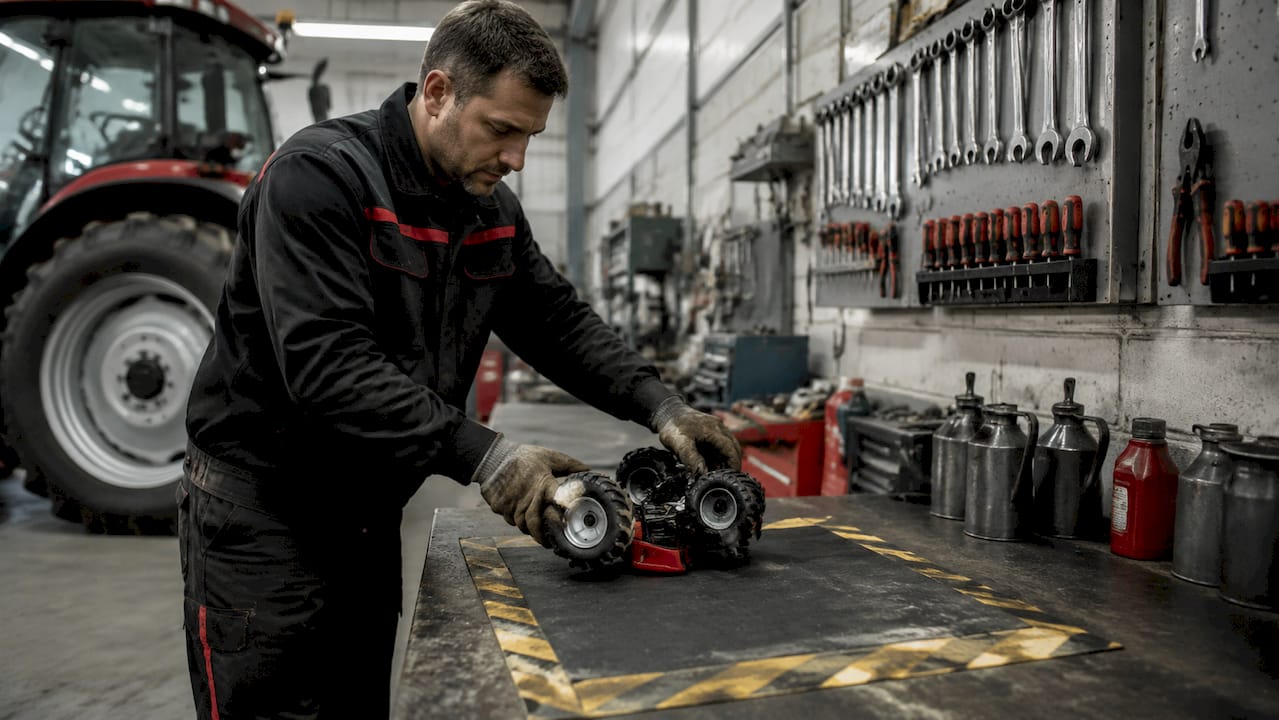
Tractor overturns are the single deadliest event in farm machinery operations. Approximately 90 deaths per year result from tractor overturns in the U.S., caused mainly by side overturns on slopes and rear overturns from improper hitching. That figure represents a consistent, predictable pattern, which means it is also a preventable one.
PTO shaft entanglement is the second major threat. PTO shafts rotate at 540 or 1,000 RPM, which means entanglement happens in fractions of a second. Operators frequently remove PTO guards to save time, treating it as a minor shortcut. It is not a minor shortcut. Guard removal is a critical failure in safety culture, and it turns a manageable hazard into a fatal one.
Machinery failures during maintenance add another layer of risk. Workers who service equipment without locking out power sources face crush injuries, hydraulic line bursts, and unexpected machine starts. These accidents cluster during peak seasons when operators are tired and moving fast. Understanding these specific hazards is the starting point for any credible machinery hazard analysis.
How to conduct a farm machinery risk assessment step-by-step
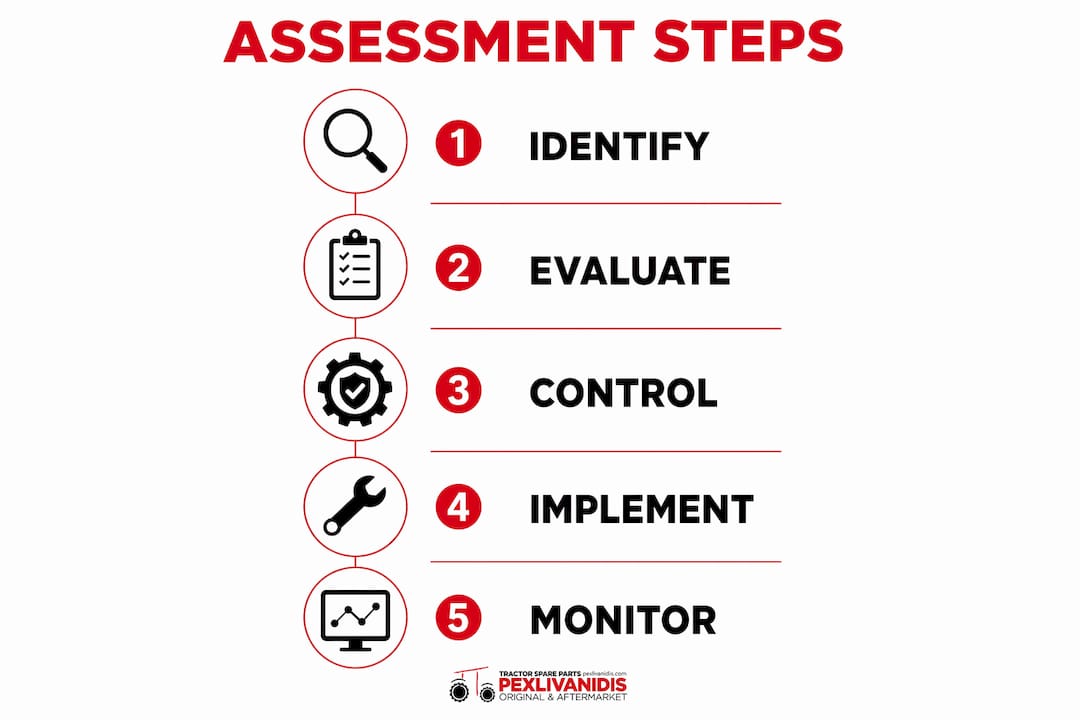
A structured machinery risk assessment follows a defined sequence. Skipping steps does not save time. It creates gaps that show up later as incidents, injuries, or legal liability.
- Define machine limits and intended use. Document what the machine does, who operates it, where it operates, and under what conditions. Include transport, commissioning, and decommissioning, not just normal operation. ISO 12100 requires hazard evaluation across all lifecycle stages, including fault-finding and maintenance phases that operators often overlook.
- Identify all hazards systematically. Walk through every phase: startup, normal operation, adjustment, cleaning, maintenance, and shutdown. Use a structured checklist and involve the operators who run the machine daily. They know where the machine behaves unexpectedly.
- Estimate risk for each hazard. Combine severity and likelihood to score each risk. Pairing qualitative and quantitative methods produces a defensible ALARP (As Low As Reasonably Practicable) risk case that satisfies both internal reviewers and external auditors.
- Prioritize and apply controls. Follow the hierarchy of controls: eliminate the hazard first, then substitute, then engineer controls, then administrative controls, then personal protective equipment. Engineering controls like guards and rollover protection structures come before training and signage.
- Document the worst-case event for every hazard. Documenting worst-case events is critical for legal defensibility. Boards, insurers, and lenders all review this documentation when evaluating farm risk exposure.
- Reassess after any change. Equipment modifications, relocations, incidents, and near-misses all trigger a new assessment cycle. A risk assessment completed three years ago does not cover a machine that has been retrofitted or moved to a new field layout.
Pro Tip: Involve your most experienced operator in the hazard identification step. They will flag risks that no checklist captures, including the informal workarounds that have become routine.
An agricultural equipment safety checklist built around these six steps gives you a repeatable process that holds up under audit and actually reduces incidents in practice.
Engineering controls vs. administrative controls: which works better?
The honest answer is that engineering controls outperform administrative controls every time. A physical guard prevents entanglement whether or not the operator remembers the training. A safety sign does not.
| Control type | Example | Benefit | Limitation |
|---|---|---|---|
| Engineering | ROPS with seat belt | Prevents ejection during rollover | Ineffective without seat belt use |
| Engineering | PTO shaft guard | Blocks entanglement at source | Operators sometimes remove them |
| Engineering | Automated shutoff | Stops machine on fault detection | Requires proper calibration |
| Administrative | Operator training | Builds hazard awareness | Relies on consistent behavior |
| Administrative | Standard operating procedures | Standardizes safe practices | Not enforced in the field automatically |
| PPE | High-visibility clothing | Improves visibility | Last line of defense only |
One misconception stands out above the rest. Many operators believe that ROPS alone guarantees safety during a rollover. It does not. A seat belt is what keeps the operator inside the protection zone when the machine tips. ROPS without a seat belt leaves the operator exposed to being thrown clear of the cab and crushed. Older tractors that lack ROPS should be retrofitted before they go back into service.
Funding support for these upgrades exists. Programs like Ireland’s TAMS III offer up to 60% grant aid for safety equipment investments up to €90,000. Similar grant programs operate in other regions. Checking with your national agricultural authority before purchasing safety equipment can significantly reduce the cost of compliance.
Pro Tip: When retrofitting older machines, prioritize ROPS installation and PTO guard replacement first. These two controls address the two highest-fatality hazards in agricultural operations.
How should you maintain and reassess farm machinery risk over time?
A one-time risk assessment is not a risk management program. Machinery changes, operators change, and field conditions change. The assessment has to keep up.
The key triggers for reassessment include:
- Equipment modifications. Any change to machine configuration, attachments, or power systems requires a new hazard review. A tractor fitted with a new front loader has a different center of gravity and different rollover risk than the base unit.
- Incident and near-miss reports. Every near-miss is a data point. Safety experts treat formal risk assessment as the spine of operational risk programs, and near-miss data feeds directly into that spine.
- Seasonal changes. Operator fatigue during planting and harvest seasons is a primary driver of accidents. Safety routines need to adapt to operational tempo, not stay fixed to a calendar schedule. Shorter shifts, mandatory breaks, and buddy checks during peak periods are not optional extras.
- Personnel changes. A new operator on a familiar machine is still a new risk. Induction training and supervised operation periods reduce the gap between what the machine demands and what the operator knows.
Linking your risk assessment to your overall machinery lifecycle management process keeps documentation current and gives you a clear audit trail. Risk assessment is also increasingly relevant beyond safety. Risk assessment now influences ESG ratings and farm capital access, which means documentation gaps carry financial consequences, not just regulatory ones.
Key Takeaways
Farm machinery risk assessment is the most direct tool operators have to reduce fatalities, meet compliance requirements, and protect farm capital.
| Point | Details |
|---|---|
| Start with hazard identification | Cover all lifecycle stages including transport, maintenance, and decommissioning, not just normal operation. |
| Use ISO 12100 as your framework | This international standard structures hazard identification, risk estimation, and risk reduction in sequence. |
| Engineering controls come first | Guards, ROPS with seat belts, and automated shutoffs outperform training and signage as primary controls. |
| Reassess after every change | Equipment modifications, incidents, and seasonal shifts all require a new assessment cycle. |
| Document worst-case events | Legal defensibility, insurer reviews, and ESG ratings all depend on thorough, current documentation. |
The familiarity trap is the real killer
After years of working with agricultural machinery operators, one pattern stands out above all others. The operators most likely to get hurt are not the new ones. They are the experienced ones who have run the same machine for a decade without incident.
Familiarity breeds a specific kind of carelessness. You stop seeing the PTO shaft as a hazard because you have walked past it a thousand times. You skip the pre-operation check because the machine has never failed you before. You remove the guard because it takes thirty seconds to reattach and you are already behind schedule. This is the familiarity trap, and it is responsible for a disproportionate share of serious farm injuries.
The fix is not more training sessions. Training alone does not break ingrained habits. The fix is embedding risk awareness into the physical environment. Guards that are difficult to remove. Checklists that require a signature before the machine starts. Peer accountability systems where operators check each other, not just themselves.
Documentation gaps are the second most common failure I see. Operators complete a risk assessment, file it, and never look at it again. Then the machine gets a new attachment, the field layout changes, or a new hire joins the team. The assessment is now outdated, but nobody knows it. When an incident happens, the documentation does not reflect current conditions. That gap has legal and financial consequences that far exceed the cost of keeping the paperwork current.
The farms that get this right treat risk assessment as a living process, not a compliance checkbox. They review it at the start of each season, update it after every incident, and involve operators in every revision. That culture is what actually reduces fatalities.
— George
Pexlivanidis and your farm machinery safety needs
Keeping machinery safe starts with keeping it in good condition. Worn parts, missing guards, and degraded components are the physical root causes behind many of the hazards covered in this guide. Pexlivanidis carries over 20,000 agricultural machinery parts, including tractor accessories and spare parts, to support operators across Greece and the surrounding region. Whether you are replacing a PTO guard, sourcing ROPS components, or maintaining aging equipment before the next season, having the right parts available matters. The essential agricultural machinery parts guide on the Pexlivanidis site covers the components that most directly affect safety and performance, and it is a practical starting point for any equipment review.
FAQ
What is a farm machinery risk assessment?
A farm machinery risk assessment is a structured evaluation of hazards associated with agricultural equipment across its full lifecycle, from commissioning to decommissioning. It identifies risks, estimates their severity, and applies controls to reduce them to an acceptable level.
How often should you reassess farm machinery risks?
Reassessment is required after any equipment modification, incident, near-miss, or significant change in operating conditions. Seasonal shifts, particularly during planting and harvest, also warrant a review of fatigue-related risks.
What does ROPS mean and why does it matter?
ROPS stands for Rollover Protective Structure. It protects tractor operators during overturns, but only when paired with a seat belt. ROPS without a seat belt does not prevent the operator from being thrown clear of the cab.
Which hazards cause the most farm machinery fatalities?
Tractor overturns and PTO shaft entanglement cause the most fatalities in agricultural machinery operations. Tractor overturns account for approximately 90 deaths per year in the U.S. alone.
What is ISO 12100 and how does it apply to farm machinery?
ISO 12100 is the international standard for machinery risk assessment. It provides a lifecycle framework covering hazard identification, risk estimation, and risk reduction that applies directly to agricultural equipment evaluation and compliance.