

TL;DR:
- Greek farm conditions accelerate machinery wear, requiring customized maintenance schedules.
- Early signs of part wear include vibrations, overheating, leaks, and abnormal noises.
- Proactive, condition-based maintenance extends equipment lifespan and prevents costly breakdowns.
Even experienced farmers can miss the early signs of part wear. Dust, uneven terrain, and Greece’s intense agricultural seasons create conditions where damage builds quietly beneath the surface. By the time you notice a problem, it may already be costing you downtime, emergency repairs, and lost harvests. This guide will show you exactly what to look for, how to interpret both obvious and hidden warning signs, and what practical steps you can take to stay ahead of failures before they happen in your fields around Thessaloniki, Kavala, and beyond.
Table of Contents
- Why part wear matters: The hidden costs for Greek farmers
- Common signs of part wear in tractors and equipment
- Beyond sight: Diagnosing hidden wear using performance clues
- Best practices for preventing wear and prolonging part life
- The overlooked nuances: Expert lessons from Greek fields
- Get the most from your machinery: Next steps with Pexlivanidis
- Frequently asked questions
Key Takeaways
| Point | Details |
|---|---|
| Spot subtle wear | Changes in power and performance often reveal hidden part wear before visible damage appears. |
| Adjust maintenance routines | Greek farmers should inspect and service parts more frequently to combat regional dust and terrain challenges. |
| Track machine signals | Monitor overheating, power drops, and uneven wear patterns to detect issues early and prevent breakdowns. |
| Use expert-backed tips | Follow practical checklists and professional advice to extend machinery lifespan and reduce costly repairs. |
Why part wear matters: The hidden costs for Greek farmers
A single breakdown during wheat harvest or olive picking can mean thousands of euros in lost yield, not counting the repair bill. That is the reality many farmers in northern Greece face when wear goes undetected for too long. The financial hit is not just from the broken part itself. It is the emergency call-out fee, the shipping time for a replacement, and the missed window in the growing season that you cannot get back.
Greece’s agricultural regions present conditions that push machinery harder than manufacturer manuals typically assume. Rocky terrain in the foothills around Kavala, heavy dust during summer harvest in the Thessaloniki plain, and high UV exposure on rubber components all accelerate wear patterns significantly. Northern Greek dust and terrain accelerates filter and engine wear, requiring adjusted maintenance intervals well beyond what the standard manual recommends.
Key insight: Most tractor manufacturers design maintenance schedules for average field conditions. Greek conditions are not average. Treat factory intervals as a starting point, not a finish line.
Here is what undetected wear actually costs you in practical terms:
- Unplanned downtime during peak planting or harvest windows
- Cascading damage when one worn part stresses adjacent components
- Higher fuel consumption as engines work harder to compensate for failing parts
- Emergency part sourcing costs, including expedited shipping or premium prices for urgent orders
- Labor and diagnostic time that could have been spent in the field
The good news is that most wear follows predictable patterns. Farmers who learn to read the signs of worn tractor parts early can schedule repairs between seasons and choose when to fix problems, instead of scrambling when something fails mid-field.
Pro Tip: Adjust your maintenance intervals based on your actual field conditions. If you work in dusty terrain, cut your filter check interval in half. Your machine is telling you what it needs; you just need to know how to listen.
Common signs of part wear in tractors and equipment
Some warning signs shout at you. Others whisper. Knowing both is what separates a farmer who stays productive from one who gets caught off guard.
Here are the most common symptoms that signal wear in progress:
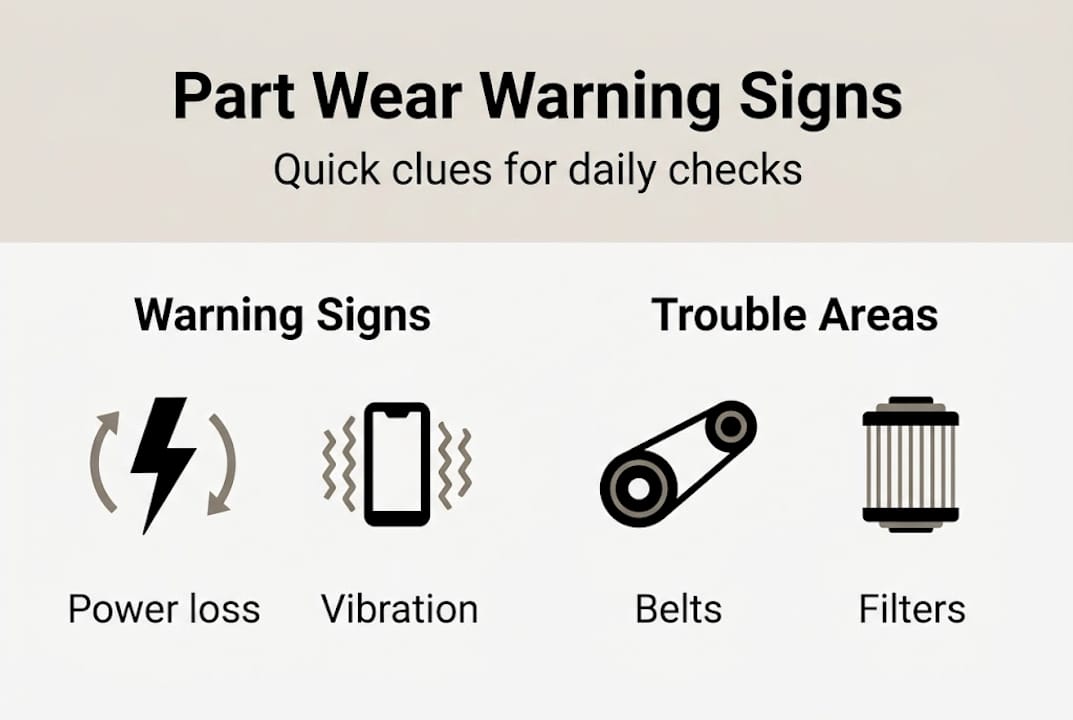
- Vibrations you did not feel six months ago, especially under load
- Overheating that appears after an hour or more of continuous work
- Power loss during heavy pulls or on inclines
- Oil, hydraulic fluid, or coolant leaks around fittings, seals, or hoses
- Abnormal noises, including grinding, knocking, or squealing during operation
- Uneven tire wear, which often points to alignment or suspension issues
- Sluggish hydraulic response when lifting implements
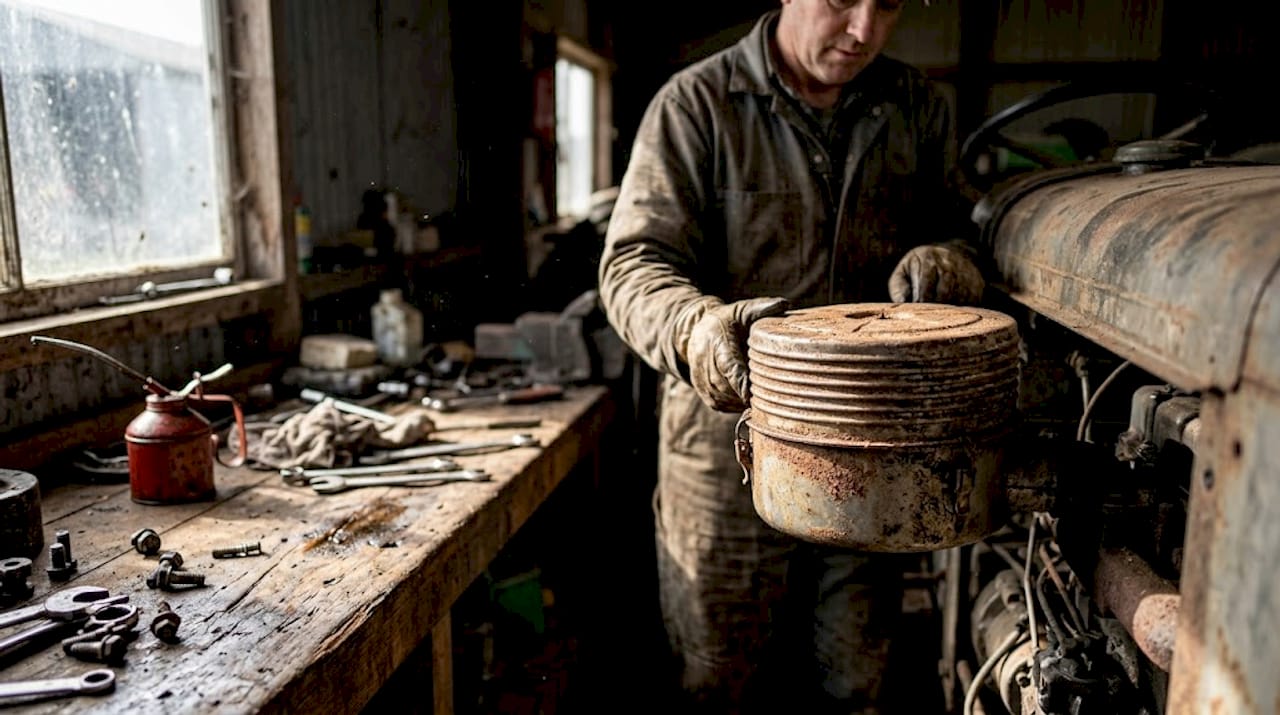
In-tank fuel screens can clog unnoticed over time, and a clogged radiator or fuel filter often only reveals itself through overheating after an hour of load work. That is a subtle sign that most farmers initially misread as an engine problem.
Use this table to tell the difference between subtle and obvious wear signals:
| Sign | Type | Likely part affected |
|---|---|---|
| Gradual power loss over days | Subtle | Fuel filter, air filter |
| Sudden engine cutout under load | Obvious | Fuel pump, in-tank screen |
| Slight vibration in steering wheel | Subtle | Tie rods, front bearings |
| Loud grinding when turning | Obvious | Steering gear, wheel bearing |
| Small coolant puddle after parking | Subtle | Hose fitting, water pump seal |
| Steam from engine bay | Obvious | Radiator, coolant hose failure |
| Uneven front tire tread | Subtle | Alignment, toe settings |
| Hydraulic arm drifting slowly | Subtle | Hydraulic seal, control valve |
When you spot multiple subtle signs together, that is your real red flag. One vibration might be a loose bolt. Vibration plus power loss plus a small leak means something more serious is developing.
For faster troubleshooting, understanding identifying tractor spare parts correctly helps you describe problems accurately to suppliers and mechanics. Also, some parts wear in groups, so knowing parts to replace together prevents you from fixing one thing and watching the adjacent part fail a week later.
Pro Tip: Uneven tire wear is not just a tire problem. It almost always signals misalignment, and misalignment puts extra stress on wheel bearings, axle seals, and steering components. Fix the root cause, not just the symptom.
Beyond sight: Diagnosing hidden wear using performance clues
Some of the most damaging wear in agricultural machinery is completely invisible until it is too late. You will not see it during a walkaround inspection. You will only feel it when your machine starts behaving differently in the field.
Here is how to connect performance changes to likely worn components:
| Performance symptom | Probable cause | Action |
|---|---|---|
| Power fades after 60 minutes under load | Clogged in-tank fuel screen or radiator | Check fuel filter, clean radiator fins |
| Engine temp rises steadily during long pulls | Coolant system restriction or fan wear | Inspect water pump, thermostat, hoses |
| Increased fuel consumption over weeks | Air filter clog, injector wear | Replace air filter, test injectors |
| Hydraulics respond slowly after warm-up | Hydraulic fluid degradation or seal wear | Check fluid viscosity, inspect seals |
| Tractor pulls left or right under load | Differential wear or brake drag | Inspect brakes, differential gears |
A well-documented case involves the John Deere 5075E losing power after roughly 60 minutes of heavy work due to a clogged fuel filter or restricted radiator. The machine runs perfectly until heat and sustained load expose the restriction. Many operators initially assume engine failure because the symptom is dramatic. The actual cause is a filtration issue that costs a fraction of an engine repair to fix.
“A machine that runs fine for the first hour and then cuts out is almost never an engine problem. It is a heat management or fuel delivery problem. The engine is fine. The support systems are struggling.”
Here is a simple diagnostic process you can use in the field:
- Note when the symptom starts. Is it immediately, after 30 minutes, or only under full load?
- Record the conditions. Was it hot outside? Full load? Uphill terrain?
- Check the simplest causes first. Filters, coolant level, fan belt tension.
- Look for patterns across multiple working days. One event is a clue. Three events is a trend.
- Cross-reference with recent maintenance history. When were filters last changed?
For selecting the right replacement components once you identify the issue, reviewing guidance on choosing the right spare parts ensures you source compatible, quality parts the first time.
Best practices for preventing wear and prolonging part life
Spotting wear is valuable. Preventing it is even better. Farmers in northern Greece need to treat preventive maintenance as a core part of field operations, not an afterthought.
Start by adjusting your intervals. Greek dust and terrain conditions accelerate filter and engine wear significantly, so standard manufacturer intervals will not protect you adequately. Cut air and fuel filter check intervals by 30 to 50 percent during dusty summer months.
Here is a practical inspection routine organized by frequency:
Daily checks (before startup):
- Engine oil level and color
- Coolant level
- Tire pressure and visible damage
- Any new fluid puddles under the machine
- Hydraulic fluid level
Weekly checks:
- Air filter restriction indicator or physical inspection
- Fuel filter condition
- Belt tension and visible cracking
- Battery terminal condition
- Check all grease points on moving joints
Monthly checks:
- Full fluid analysis if possible (oil, hydraulic)
- Inspect brake wear indicators
- Check alignment by observing tire wear patterns
- Inspect all rubber hoses for cracking or swelling
- Review your maintenance log for accelerating trends
Protect rubber components and belts by parking in the shade whenever possible. UV exposure in a Greek summer is severe, and belts exposed to direct sunlight between uses degrade measurably faster than those stored in shade or covered. This simple habit extends belt life by a meaningful margin.
For a full guide to extending your equipment’s productive life, read this resource on tractor longevity strategies and combine it with a solid preventative maintenance routine built around your actual working conditions.
Pro Tip: Keep a written maintenance log for each machine. Record every filter change, fluid top-up, and repair with the date and hours. After six months, you will start seeing patterns: which part wears faster, how your intervals really compare to factory specs, and where your next failure is likely coming from.
The overlooked nuances: Expert lessons from Greek fields
Here is something most maintenance guides will not tell you: the conditions your machines face around Thessaloniki and Kavala are not fully reflected in any manual written outside of Greece. Factory engineers test in controlled environments. Your tractor works in summer dust, sticky clay soils, and rocky edges that grind through rubber and filters far faster than any lab predicts.
The farmers who consistently avoid expensive breakdowns are not necessarily better mechanics. They are better record keepers and observers. They track maintenance patterns over time, compare notes with neighbors, and treat their machines as data sources, not just tools.
Relying only on what you can see or hear is not enough. Performance data, written logs, and proactive replacement schedules built around real Greek field conditions give you a genuine edge. The most experienced operators we hear from share one common habit: they replace filters and wear items before failure, not after. That single mindset shift saves them more money annually than any single repair ever could.
Get the most from your machinery: Next steps with Pexlivanidis
If this guide helped you think differently about how you inspect and maintain your equipment, the next step is putting it into practice with the right resources and parts behind you. At Pexlivanidis, we stock over 20,000 agricultural machinery parts with free shipping across Greece on orders over 100 euros. Whether you need filters, belts, seals, or hydraulic components, our inventory is built around the real needs of farmers in Thessaloniki, Kavala, and the surrounding regions. Explore our guides on agricultural machinery parts and follow a structured machinery maintenance guide to build a system that keeps your equipment running reliably through every season.
Frequently asked questions
What are the first signs that tractor parts are wearing out?
Early warning signs include unusual vibrations, unexplained power loss, overheating during sustained work, fluid leaks, and uneven tire wear. Catching two or more of these at once signals a developing problem worth investigating immediately.
How often should I check for part wear on my equipment in Greece?
Check key wear components weekly during active season and shorten your filter inspection intervals in dusty northern regions, since Greek conditions accelerate wear far faster than standard schedules account for.
Where should I look for hidden wear that’s not visible?
Watch for performance changes under sustained load, especially power loss or overheating that appears after an hour of work. In-tank screens and filters clog silently and only reveal themselves through these field symptoms.
How can I reduce wear and extend the life of my machinery parts?
Adjust maintenance intervals to match your actual field conditions, use shade to protect rubber components, keep a written log, and replace wear items proactively. Adapted maintenance intervals are the single most impactful habit for extending part life in Greek agricultural conditions.