

TL;DR:
- Tractor hitch categories, ranging from 0 to 4, are standardized attachment systems that ensure implements fit and operate safely. The three-point hitch improves performance through weight transfer, rigid connection, and precise height adjustment, making it superior to drawbar systems. Using the correct category, verified by measurement or the thumb-and-pinky test, is essential for safe, efficient machinery operation.
Tractor hitch types are standardized attachment systems that determine which implements your tractor can safely carry and operate. The three-point hitch is the most widely used system worldwide, divided into five categories based on tractor horsepower and pin dimensions. Brands like John Deere, Case IH, and New Holland all build to the same ASABE standards, meaning a Category 2 plow from one manufacturer fits a Category 2 tractor from another. Understanding these categories is the single most important factor in matching your tractor to the right implement.
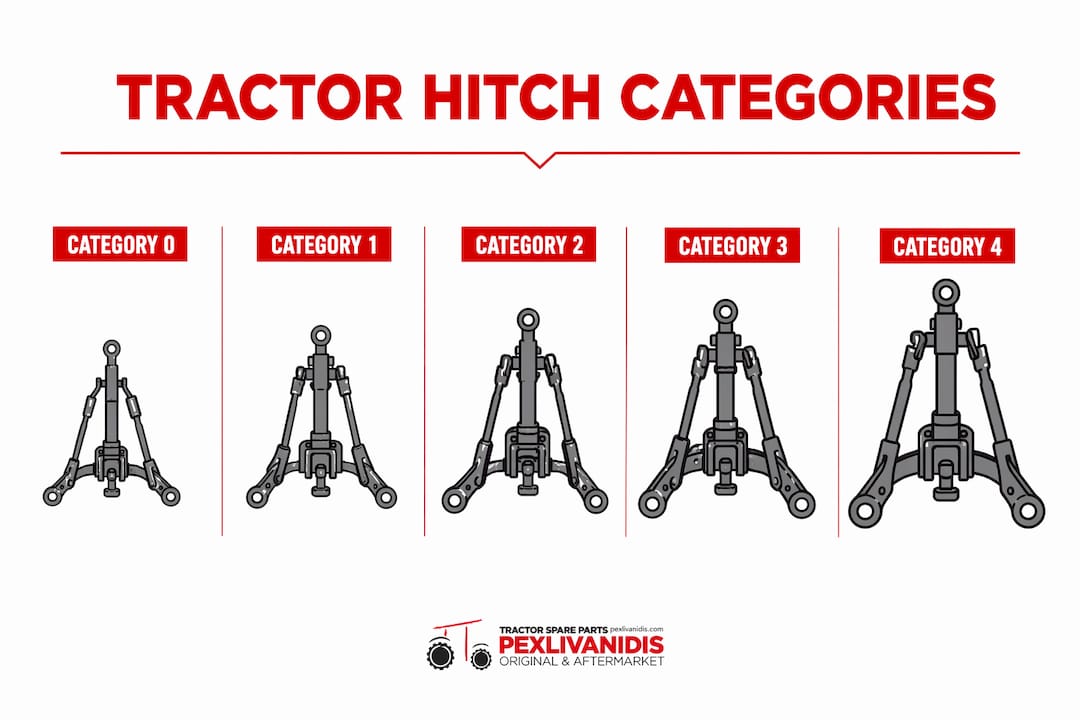
What are the five tractor hitch types and their specifications?
The three-point hitch categories run from 0 to 4, each defined by pin diameter, lower link spacing, and compatible tractor horsepower. Getting the category wrong means the implement either won’t attach or will create dangerous stress on the tractor’s hydraulic system.
| Category | Horsepower Range | Lift Pin Diameter | Typical Implements |
|---|---|---|---|
| Category 0 | Under 20 HP | 5/8″ | Garden tractors, small tillers |
| Category 1 | 20–45 HP | 7/8″ | Small plows, box blades, seeders |
| Category 2 | 40–100 HP | 1-1/8″ | Mid-size plows, rotary cutters, spreaders |
| Category 3 | 80–225 HP | 1-7/16″ | Large tillage tools, heavy balers |
| Category 4 | Over 180 HP | 2″ | Industrial-scale implements |
Category 1 and Category 2 overlap in the 40–45 HP range. That overlap is intentional. It gives operators with mid-range tractors some flexibility, but you still need to verify hydraulic lift capacity before choosing the heavier Category 2 implement.
Pro Tip: Always check your tractor’s rated lift capacity at the lower link ends, not just the horsepower. A 45 HP tractor with a weak hydraulic pump will struggle with a heavy Category 2 implement even if the pins fit.
Three-point hitches are standardized by ASABE to guarantee cross-brand compatibility within the same category. That universality is what makes the three-point hitch the backbone of modern farm implement design.
How does the three-point hitch improve performance vs. other hitch types?
The three-point hitch outperforms drawbar and single-point systems for one core mechanical reason: weight transfer. The three-point hitch transfers implement weight directly onto the tractor’s rear drive wheels, increasing traction without burning extra fuel. A drawbar pulls the implement from behind, which actually lifts weight off the rear axle and reduces grip.
The three-point hitch is the only statically determinate way to connect an implement to a tractor. That means the connection has no unwanted flex or play. For precision tasks like plowing, cultivating, or seeding, that rigidity translates directly into straighter rows and more consistent soil engagement.
The top link is the third point of the triangle, and it does more than most operators realize. Adjusting the top link length changes the working angle of the implement, controlling how aggressively it cuts into the soil. Shorten the top link and the implement nose tilts down, increasing depth. Lengthen it and the implement runs shallower.
Key advantages of the three-point system over drawbar and single-point hitches:
- Weight transfer: Rear wheel traction increases under load, not decreases.
- Rigid connection: No swaying or lateral drift during field operations.
- Height control: Hydraulic lift raises and lowers implements with precision.
- Top link adjustment: Fine-tunes implement angle without stopping to add or remove ballast.
- Lift and transport: Implements ride above ground between fields, reducing wear.
“Adjusting the top link length is a commonly overlooked but highly effective way for operators to optimize implement performance and soil engagement.” — FarmMod
The drawbar still has its place for towed implements like grain wagons and trailers, where the implement needs to pivot freely. But for any tool that works the soil, the three-point hitch is the correct choice.
What are quick-attach systems and narrow category variants?
Quick-attach systems are mechanical frames that mount permanently to the tractor’s lower links and top link, letting you swap implements in seconds without manually threading pins. Quick-attach devices are available for Category 1, 2, and 3 hitches, covering the vast majority of farm tractors in use today.
The operational benefit is significant. Without a quick hitch, connecting a three-point implement typically requires one person to back the tractor slowly while another guides the lower link pins into the implement brackets. With a quick hitch, one operator can do the entire job from the tractor seat. Quick hitches improve operational safety by eliminating the need to stand behind a moving tractor during hookup.
How to use a quick-attach system correctly:
- Back the tractor slowly toward the implement until the quick hitch frame contacts the implement’s upper and lower attachment points.
- Engage the locking mechanism on both lower hooks before applying any hydraulic pressure.
- Raise the hitch slightly to verify both lower hooks are fully seated and locked.
- Connect the top link to the implement’s top pin and adjust length before field use.
- Confirm all safety pins or clips are in place before driving to the field.
Narrow category variants, labeled with an “N” suffix (such as Category 2N), solve a specific compatibility problem. N variants use the larger pin size of the next category but with narrower arm spacing. This design lets a Category 2N quick hitch connect to implements built for standard Category 1 dimensions. The pin strength stays high while the arm width stays narrow enough to fit smaller implement brackets.
Pro Tip: If you run a quick hitch on a Category 2 tractor but frequently use Category 1 implements, look specifically for a Category 2N quick hitch. It bridges the gap without requiring adapter bushings on every implement.
How can you identify your tractor’s hitch category?
The fastest field method requires no tools at all. If your thumb fits comfortably through the lift arm ball holes, the tractor is likely Category 2. If only your pinky fits, it is likely Category 1. This thumb-and-pinky test is used by mechanics worldwide precisely because it works when a tape measure is not available.
For a definitive measurement, use a caliper or ruler on the lower link pin holes. Match the diameter to the category table above. Cross-check that measurement against your tractor’s rated horsepower and hydraulic lift capacity, both listed in the operator’s manual.
Common identification and compatibility checks to run before attaching any implement:
- Measure pin hole diameter on both lower links and compare to category specifications.
- Check hydraulic lift capacity in the operator’s manual, measured in pounds or kilograms at the lower link ends.
- Verify tractor weight relative to implement weight. A heavy rear-mounted implement can lift the front axle and cause steering loss.
- Inspect lower link ends for wear, cracks, or bent pins that could cause unexpected detachment under load.
- Read the implement’s manual for its rated category and maximum tractor horsepower requirement.
Using implements too large for the tractor’s hitch category risks steering instability, hydraulic failure, and serious safety hazards. This is not a theoretical risk. An overloaded Category 1 hitch on a 35 HP tractor attempting to run a Category 2 rotary cutter will stress the hydraulic pump, reduce front wheel contact with the ground, and create an unpredictable machine.
Hydraulic lift pump capacity and tractor weight distribution must both be factored in alongside the hitch category number. The category tells you the pin size fits. It does not automatically confirm the tractor can safely handle the implement’s weight. Always verify all three factors: category, lift capacity, and tractor weight.
For a practical walkthrough of connecting implements safely, the guide on assembling tractor attachments covers the full process step by step.
Key Takeaways
The three-point hitch is the universal standard for farm implement attachment, and matching your tractor’s category to the implement is the single most important step for safe, efficient operation.
| Point | Details |
|---|---|
| Five standardized categories | Categories 0 through 4 are defined by pin size and horsepower, not brand. |
| Weight transfer advantage | The three-point hitch increases rear wheel traction under load, unlike a drawbar. |
| Top link adjustment | Changing top link length controls implement working angle and soil depth. |
| Quick-attach safety | Quick hitches for Categories 1, 2, and 3 let one operator connect implements safely. |
| Category identification | Use the thumb-and-pinky test or measure pin hole diameter to confirm your category. |
What I’ve learned from years of watching operators get this wrong
The most common mistake I see is operators assuming that if the pins physically fit, the match is correct. They are not the same thing. A Category 1 implement pin can sometimes be forced into a Category 2 lower link with an adapter bushing, but the implement was never designed for the forces a 90 HP tractor generates. The bushing hides the mismatch. The hydraulic system and the implement frame reveal it, usually at the worst possible moment in the middle of a field.
The second thing I have seen consistently underused is top link adjustment. Operators set it once during initial attachment and never touch it again. That is leaving real performance on the table. A plow running at the wrong angle drags harder, burns more fuel, and leaves uneven furrows. Two minutes with a wrench on the top link can fix all three problems at once.
Quick-attach systems get dismissed as an extra expense, but the safety argument alone justifies them. Standing behind a tractor while someone else backs it toward you is genuinely dangerous. A quick hitch removes that risk entirely. For any operation running multiple implement changes per day, the time savings add up fast as well.
My honest recommendation: buy the best quick hitch your category supports, learn your top link settings for each implement you run, and never skip the hydraulic lift capacity check. The category number is the starting point, not the finish line.
— George
Pexlivanidis: parts and resources for your hitch system
Pexlivanidis stocks over 20,000 agricultural machinery parts, including hitch components, lower link pins, top link assemblies, and quick-attach accessories for Categories 1 through 3. Whether you are replacing worn lift arm pins or upgrading to a quick-attach frame, the catalog covers the full range of three-point hitch hardware. The guides on agricultural machinery parts and machinery maintenance give you the technical background to make the right purchase the first time. Pexlivanidis ships free within Greece on orders over 100€ and supports wholesale B2B accounts for operators managing larger fleets.
FAQ
What is a three-point hitch on a tractor?
A three-point hitch is a standardized attachment system using two lower links and one top link to connect implements to the rear of a tractor. It transfers implement weight to the drive wheels, improving traction and giving the operator precise hydraulic control over implement height and angle.
What are the main three-point hitch categories?
There are five categories (0 through 4), each defined by pin diameter and compatible horsepower range. Category 1 covers 20–45 HP tractors with 7/8″ pins, while Category 2 covers 40–100 HP tractors with 1-1/8″ pins.
How do I know which hitch category my tractor uses?
Measure the pin hole diameter on the lower links and compare it to the category specifications. A quick field test: if your thumb fits through the lower link ball hole, it is likely Category 2; if only your pinky fits, it is likely Category 1.
What is a quick-attach hitch and do I need one?
A quick-attach hitch is a frame that mounts to your three-point hitch and lets you connect or disconnect implements from the tractor seat without manual pin alignment. It is available for Categories 1, 2, and 3, and it significantly reduces both labor time and the safety risks of manual hookup.
Can I use a Category 1 implement on a Category 2 tractor?
Not directly without adapter bushings, and even then it is not recommended for heavy-duty use. The implement is not built for the forces a larger tractor generates. Use N-variant quick hitches or category-matched implements to maintain safe operation.