

Running agricultural machinery across Thessaloniki and Kavala means depending on every part to perform when it counts. Facing unexpected breakdowns in the middle of a busy season can put your entire operation at risk and quickly drive up costs. That makes the difference between an express and implied warranty more than legal jargon—it is your safety net when a spare part fails or falls short. This guide explains what these warranty protections truly cover, how they impact your purchase decisions, and how to safeguard your investment in vital equipment.
Table of Contents
- Defining Warranty For Machinery Parts
- Types Of Warranty And Their Coverage
- How Warranty Works For Spare Parts
- Legal And Safety Aspects Of Warranty
- Financial Impact And Risk Management
- Common Mistakes When Handling Warranty
Key Takeaways
| Point | Details |
|---|---|
| Understand Warranty Types | Familiarize yourself with express and implied warranties to ensure adequate protection against part failures. |
| Review Warranty Terms | Always read the warranty details before purchasing to avoid unexpected exclusions that could leave you unprotected. |
| Document Warranty Claims | Keep all receipts and warranty information organized to facilitate quick claims processing when needed. |
| Monitor Replacement Policies | Evaluate suppliers based on warranty practices to mitigate financial risks associated with faulty parts. |
Defining Warranty for Machinery Parts
When you purchase a spare part for your agricultural machinery, you’re entering into a contract. That part comes with protections whether you realize it or not. A warranty is fundamentally an express or implied promise from the seller that the machinery part will perform as represented and conform to certain standards. For agricultural operators and repair services in Thessaloniki and Kavala, understanding this distinction matters because it directly affects your recourse if a part fails prematurely or doesn’t perform as expected.
There are two main types of warranties you’ll encounter with machinery parts. Express warranties are the promises made explicitly, either written on packaging, in documentation, or stated by the seller. When a distributor says a transmission belt will last 2,000 operating hours, that’s an express warranty. Implied warranties arise automatically from the nature of the sale itself. The law recognizes that any product should be free from defects and fit for its intended purpose, even if nobody states this in writing. If you purchase a hydraulic pump, the law implies it should actually work as a hydraulic pump should, without defects in material or workmanship. This legal framework exists to protect you, the buyer, from getting stuck with faulty parts that compromise your equipment’s reliability.
For machinery operations, this distinction shapes everything about your purchasing decision. A part with a strong express warranty backed by clear documentation gives you defined protection. You know exactly what’s covered, for how long, and what steps to take if something goes wrong. Without warranties, you’d be absorbing all the risk of failure yourself, which in the context of critical agricultural equipment means potential downtime during harvest season or unexpected repair costs that weren’t budgeted. That’s why reliable suppliers typically stand behind their products with clear warranty terms. When evaluating parts, especially for essential equipment like engines, transmissions, or hydraulic systems, always confirm what warranty protection exists and whether it’s clearly documented.
Pro tip: Always request warranty details in writing before purchasing machinery parts, and store your receipts with warranty documentation in one accessible location so you can reference coverage terms if a part fails or needs replacement.
Types of Warranty and Their Coverage
Not all warranties are created equal, and understanding the differences can save you significant money and headaches. The main distinction comes down to full warranties versus limited warranties. A full warranty means the seller covers repair or replacement of defective parts at no cost to you within the warranty period. With a limited warranty, coverage is restricted in some way, perhaps covering only certain components, requiring you to pay for labor, or limiting the duration to a shorter timeframe. When you’re running agricultural machinery operations in Thessaloniki or Kavala, the type of warranty you receive on critical components like engines, alternators, or hydraulic systems directly affects your operational costs and downtime risk.
Federal warranty law distinguishes between full and limited coverage terms, outlining what sellers must clearly communicate about duration, conditions, and remedies. Most machinery parts come with limited warranties because manufacturers need to define boundaries. A limited warranty might cover defects in materials and workmanship for 12 months, but exclude wear and tear, misuse, or improper installation. It might cover the part itself but not installation labor. You might also encounter warranties that cover only specific failure modes. For example, a bearing might be warranted against manufacturing defects but not against failure caused by contaminated oil or improper lubrication. This is where reading the fine print becomes critical. The warranty document should clearly state what is covered, what is excluded, how long protection lasts, and what you must do to make a claim.
One important protection exists at the federal level: sellers cannot tie warranty coverage to the exclusive use of their branded parts or services without providing those items for free. If a distributor wants to warranty a component only if you use their branded lubricants, they must supply those lubricants at no charge. This rule protects you from being forced into expensive aftermarket dependency. When evaluating warranty options for replacement parts, compare not just the duration but what specific remedies you get. Does the warranty include replacement parts, repair labor, or just the cost of the part itself? Can you choose your repair technician, or must you use an authorized service center? These details determine whether a warranty genuinely protects your operation or simply shifts certain risks without meaningful coverage.
Here’s a side-by-side comparison of full and limited warranties for machinery parts:
| Aspect | Full Warranty | Limited Warranty |
|---|---|---|
| Repair/Replacement | Free during coverage period | May require payment for labor or parts |
| Coverage Scope | All defects in materials/workmanship | Specific issues or components only |
| Duration | Clearly stated, usually longer | Often shorter, duration may vary |
| Claim Requirements | Simple, straightforward process | May have extra conditions or exclusions |
| Examples | Engine guaranteed for 2 years, all costs | Bearing covered only for 12 months |
Pro tip: Request a warranty comparison table from your parts supplier listing coverage terms, duration, and remedies for your most critical components, then store it alongside your purchase receipts for quick reference when failures occur.
How Warranty Works for Spare Parts
When a spare part fails within the warranty period, the process for getting it repaired or replaced is straightforward but requires you to follow specific steps. Warranties typically require repair or replacement without charge within a reasonable timeframe when defects are discovered. The key word here is “defects.” A bearing that wears out after 3,000 hours of normal use is not a defect; a bearing that seizes after 300 hours due to a manufacturing flaw is. Understanding this distinction helps you know when you actually have a valid warranty claim versus when you’re dealing with normal wear and tear that falls outside coverage.
The actual process typically starts with documentation. You’ll need your proof of purchase—keep those receipts and invoices safe—and you’ll need to notify the warrantor promptly when the problem appears. Spare parts warranty claims generally require presenting proof of purchase and describing the failure. Most suppliers ask you to provide the part number, the date purchased, and what went wrong. Don’t assume a failure is your fault; let the manufacturer or authorized dealer inspect it. Federal law limits what conditions suppliers can impose on you to secure a warranty remedy. They cannot require you to jump through unreasonable hoops. What they can require is reasonable notification and the ability to inspect the failed part. Some warranties allow a limited number of repair attempts before the warrantor must offer replacement or refund.

For agricultural machinery operators in the Thessaloniki and Kavala regions, this matters because downtime is money lost. When you contact your parts supplier about a warranty claim, be clear and factual about when the part failed, what symptoms appeared, and under what conditions it was operating. Did it fail during normal operation, or was there an accident? Was the part installed correctly? Were maintenance schedules followed? Honest answers help speed the process. Most reputable suppliers want to resolve warranty claims quickly because they know you cannot afford extended equipment downtime during critical seasons. The warranty remedy might be a replacement part shipped immediately, a repair if the issue is fixable, or a refund if replacement cannot be arranged. A good warranty process should feel invisible to you; you report the problem, and the solution arrives with minimal friction.
Pro tip: Create a simple spreadsheet tracking all spare parts purchased, including part numbers, dates, suppliers, and warranty expiration dates, so you know at a glance which parts still have active coverage when failures occur.
Legal and Safety Aspects of Warranty
Warranty is not just a commercial transaction; it sits at the intersection of legal protection and safety responsibility. The Magnuson-Moss Warranty Act establishes federal minimum standards that protect you when purchasing machinery parts. This law requires warrantors to fix defects without charging you within a reasonable timeframe, and it prevents manufacturers from unfairly limiting how long implied warranties last. The Act also restricts their ability to disclaim responsibility for consequential damages, which matters significantly in agricultural operations. If a faulty fuel pump fails and causes engine damage worth thousands of dollars, you cannot simply be told the warranty covers only the pump itself. The law recognizes that parts are interdependent, and failures cascade through machinery systems.
Beyond federal warranty law, safety standards add another critical layer. Machinery parts must meet rigorous safety requirements, particularly for control systems and safety functions. Safety-related parts of control systems in machinery must comply with performance standards that specify how they function and fail safely. When you purchase a brake component, hydraulic valve, or steering system part, that part has been engineered and tested to prevent harm if it malfunctions. Warranty coverage should align with these safety responsibilities. A supplier cannot warranty a part while simultaneously ignoring safety standards that govern its operation. If a part fails to meet safety requirements, the warranty becomes void because the part should never have been sold in the first place. This distinction protects you from being trapped between a failed part and a warranty denial.
For repair services and operators in Thessaloniki and Kavala, understanding these legal protections matters when selecting suppliers. A reputable parts distributor stands behind products not just because of warranty terms but because those parts comply with applicable safety standards. When evaluating suppliers, ask whether parts meet relevant safety certifications and whether warranty coverage explicitly includes defects that would compromise safety functions. Cheap parts without proper warranty or safety certification might seem economical initially, but they create liability exposure for your operation. If an unsafe part causes an accident or injury, your operation faces legal consequences regardless of warranty disclaimers. Legal protections and safety standards work together to ensure parts are both reliable and safe.
Pro tip: When purchasing critical safety-related components like brakes, hydraulics, or steering parts, request documentation confirming safety standard compliance and ensure warranty coverage explicitly addresses safety function defects, not just cosmetic failures.
Financial Impact and Risk Management
Warranty decisions carry direct financial consequences for your agricultural operation. When you purchase a part with strong warranty coverage, you’re transferring risk from your balance sheet to the supplier’s. A bearing with a 24-month warranty protects you from bearing replacement costs during that window. Without that warranty, you absorb the full replacement cost plus labor plus downtime expenses. Over time, these costs accumulate significantly. Consider this: if you operate 50 pieces of equipment and each requires 15 major spare parts annually, you’re purchasing 750 parts per year. If even 5 percent fail prematurely, that’s 37 unexpected failures. With warranty coverage, those failures become the supplier’s problem. Without it, each failure costs you money and productivity.
Effective warranty management reduces unnecessary expenses through root cause analysis and efficient claims processing, directly improving your financial performance. When suppliers track warranty claims, they identify problematic parts and address manufacturing issues before more failures occur. This collaborative approach benefits you because future batches of the same part become more reliable. Additionally, a well-documented warranty process means faster claim resolutions. Instead of waiting weeks for replacement parts, you get replacements within days. That speed reduces the duration of equipment downtime, which in agricultural operations can mean the difference between meeting harvest deadlines and losing crops. The financial impact extends beyond the part cost to include opportunity costs and revenue protection.
Risk management in machinery parts purchasing means evaluating suppliers based on their warranty practices and track record. Supply chain risk management strategies include identifying risks and implementing controls to reduce financial exposure. A supplier with transparent warranty terms, documented processes, and low warranty claim rates represents lower risk than a competitor offering cheaper parts with vague warranty language. Budget for parts procurement should reflect warranty considerations. Yes, Parts A and B might have identical purchase prices, but if Part A carries a comprehensive 36-month warranty and Part B carries a limited 12-month warranty, Part A delivers better financial value. For repair services in particular, warranty choices ripple through your reputation. If you install cheap, poorly-warranted parts and they fail within months, customers blame your workmanship. Strong warranty selection protects both your finances and your credibility.
Pro tip: Calculate your total cost of ownership for machinery parts by adding the purchase price plus estimated failure replacement cost plus average downtime expense, then multiply by the warranty period to understand true financial value versus initial price alone.
Common Mistakes When Handling Warranty
Most warranty problems don’t stem from bad parts alone. They stem from how people handle warranties. The first major mistake is not reading warranty terms before purchasing. You assume coverage exists for situations that actually fall outside the warranty scope. Then when a part fails, you discover exclusions that leave you unprotected. A hydraulic seal might be warranted against manufacturing defects but not against degradation from contaminated fluid. An engine component might be covered for 24 months but excluded if maintenance records cannot be provided. These details matter, yet many operators and repair services skip this step entirely, assuming all warranties work the same way.
The second critical mistake involves poor documentation and record keeping. Inadequate tracking of warranty claims and insufficient communication with suppliers leads to delayed resolutions and increased costs. You purchase a part, receive it, install it, and when it fails months later, you cannot find your receipt or warranty documentation. The supplier asks for proof of purchase, and you scramble through files searching for invoices or emails. This delay extends the time before you get a replacement, meaning longer equipment downtime. Additionally, if you cannot prove when the part was purchased, the supplier might claim it falls outside the warranty period. Even worse, some operators mix parts from different suppliers into one storage system, losing track of which parts came from whom and when they were purchased.
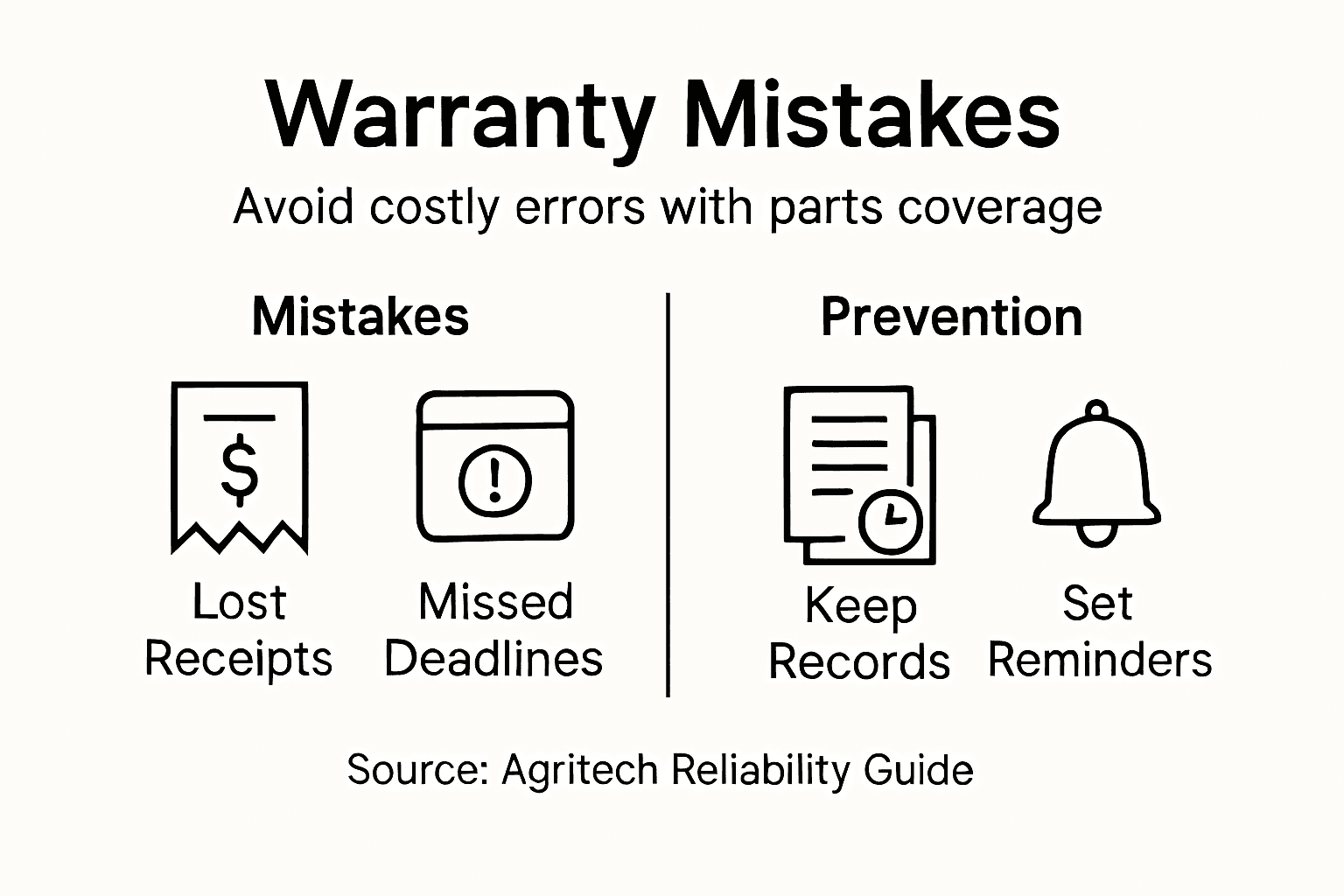
A third mistake involves imposing conditions on yourself that suppliers never required. Some people believe they must attempt repairs themselves before claiming warranty coverage, or they think they need authorization before contacting the supplier. Federal law prohibits unreasonable conditions on consumers seeking warranty remedies, yet people create unnecessary barriers anyway. You don’t need written approval to report a failed part. You don’t need to diagnose the root cause yourself. Contact the supplier immediately when you discover a defect, provide clear information about the failure, and let them determine next steps. The fourth mistake is waiting too long to report problems. Warranty claims have time limits. If you discover a part failure six months after purchase but the warranty expires at month seven, you might be outside the coverage window depending on when the failure actually occurred versus when you reported it. Prompt notification protects your rights.
This summary table outlines common warranty errors and ways to prevent them:
| Common Mistake | Prevention Method |
|---|---|
| Not reviewing warranty details | Read terms before purchase and ask questions |
| Losing purchase receipts | Store all documentation centrally |
| Delaying claim notifications | Report problems immediately upon discovery |
| Misunderstanding claim process | Contact supplier first, follow their steps |
Pro tip: Create a simple warranty checklist for each parts purchase including supplier name, part number, purchase date, warranty expiration date, and warranty contact information, then attach it to your equipment or file it centrally so you have all necessary details when claims become necessary.
Protect Your Agricultural Machinery Investments with Reliable Warranty Coverage
Understanding the critical role that warranties play in safeguarding your agricultural machinery parts can save you time, money, and operational disruptions. The challenge many face is unclear warranty terms that leave them exposed to unexpected repair costs and downtime during peak seasons. If you value clear express and implied warranty protections and want to avoid costly mistakes like poor documentation or late claim reporting, it is essential to choose suppliers that back their products with transparent, comprehensive warranties. From engines to hydraulic systems, knowing what is covered and having prompt support can make all the difference for operations in Thessaloniki, Kavala, and beyond.
Take control of your machinery parts purchasing today by partnering with a trusted source that offers a vast inventory of over 20,000 agricultural parts, competitive warranty terms, and free shipping within Greece on qualifying orders. Explore how Pexlivanidis can help you reduce risk and improve your equipment reliability with easy access to detailed product information, warranty support, and responsive customer service. Start protecting your investments now by visiting our online store and securing parts that come with the peace of mind you deserve.
Frequently Asked Questions
What is a warranty for machinery parts?
A warranty for machinery parts is an express or implied promise from the seller that the part will perform as represented and meet certain standards. It provides protections to the buyer and outlines what recourse is available if the part fails or does not perform as expected.
What are the differences between express and implied warranties?
Express warranties are explicitly stated by the seller, either in writing or verbally, such as a claim about a part’s lifespan. Implied warranties arise automatically by law, ensuring that any product should be free from defects and fit for its intended purpose, even if not explicitly stated.
How do I file a warranty claim for a defective part?
To file a warranty claim, you need to gather documentation, including proof of purchase. Notify the supplier promptly about the defect, providing details about the failed part, its purchase date, and the symptoms. Most suppliers will require you to present this information to start the claim process.
What should I look for in warranty coverage for machinery parts?
When assessing warranty coverage, look for the scope of coverage (full vs. limited), duration, and whether it covers labor costs in addition to parts. Check for specific exclusions, conditions for making a claim, and any safety standards compliance to ensure robust protection for your equipment.