

TL;DR:
- Regular machinery servicing reduces unexpected breakdowns and repair costs, ensuring equipment runs efficiently. Implementing scheduled checks and tracking results build a safety, safety, and productivity culture that prevents costly failures and extends equipment lifespan.
Regular machinery servicing is defined as a scheduled program of inspections, adjustments, lubrication, and part replacements that keeps agricultural equipment running at full capacity. For farmers and machinery operators, skipping this program is not a minor oversight. Reactive repairs cost three to five times more than planned maintenance. That gap alone makes the importance of regular machinery servicing one of the most consequential financial decisions on any farm.
1. What are the direct benefits of regular machinery servicing?
Structured preventive maintenance programs reduce unexpected breakdowns by 25–35% and cut total repair costs by 40%. Those numbers translate directly to fewer days lost during planting and harvest, when every hour counts.
The benefits stack up across several areas:
- Reduced downtime. Companies report a 12% decrease in equipment downtime with structured programs. On a working farm, that means fewer emergency calls and more predictable schedules.
- Lower repair bills. Catching a worn bearing early costs a fraction of replacing a seized gearbox. Small fixes stay small when you find them on time.
- Extended equipment life. A tractor or harvester that receives consistent care lasts significantly longer before requiring replacement. That delays a capital expense that can run into tens of thousands of dollars.
- Improved operator safety. Early fault detection catches failing brakes, cracked guards, and hydraulic leaks before they cause accidents. Documented servicing reduces liability risks and supports insurance validity.
- Compliance and insurance protection. Insurers and site inspectors require proof of regular servicing. Without it, claims can be invalidated and legal exposure increases.
Pro Tip: Keep a physical or digital service log for every machine. Date, task, and technician name. That record protects you legally and helps you spot patterns before they become failures.
2. How preventive and predictive maintenance differ
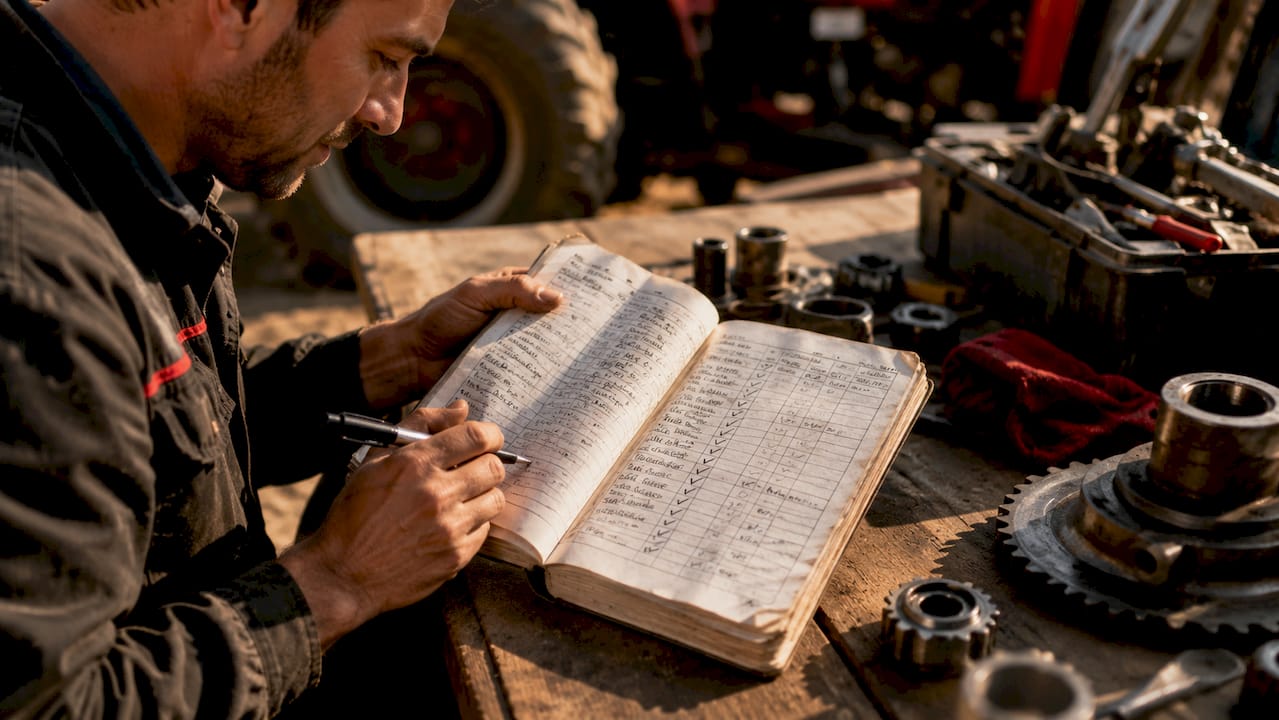
Preventive maintenance, the industry standard term for scheduled upkeep, covers fixed-interval tasks: oil changes, filter replacements, belt inspections, and lubrication. You do these tasks on a calendar or hour-meter schedule, regardless of whether the machine shows symptoms. This approach is the foundation of any sound maintenance program.
Predictive maintenance goes one step further. It uses sensor data, vibration analysis, and oil sampling to flag problems before they trigger a failure. Rather than replacing a part on a schedule, you replace it when data shows it is actually degrading.
| Feature | Preventive maintenance | Predictive maintenance |
|---|---|---|
| Trigger | Time or usage interval | Sensor data or condition signal |
| Cost to implement | Low to moderate | Moderate to high |
| Best for | All farm equipment | High-value assets like combines |
| Data required | Service logs | Real-time monitoring tools |
| Primary benefit | Reduces breakdown frequency | Minimizes unnecessary part replacement |
Transitioning from corrective to preventive maintenance decreases lifecycle costs by 8–10%, increases mean time between failures by 15%, and decreases mean time to repair by 10%. Predictive maintenance pushes cost reductions further, by an additional 12–18%. For most farmers, starting with a solid preventive program and adding predictive tools for critical machines is the most practical path.
3. Recommended maintenance schedules for agricultural machinery
A layered schedule is the most reliable structure for farm equipment. Tasks are grouped by frequency, and each layer catches different failure modes.
- Daily checks. Fluid levels, tire pressure, visible leaks, and safety guards. These take five to ten minutes and catch the problems most likely to cause a breakdown mid-field.
- Weekly tasks. Lubrication points, belt tension, air filter condition, and battery terminals. Weekly checks catch wear that daily visual scans miss.
- Monthly inspections. Hydraulic hose condition, brake function, electrical connections, and fuel system integrity. These require more time but protect the systems that are expensive to repair.
- Seasonal servicing. Full fluid changes, filter replacements, and a complete inspection before and after each major season. Pre-season work prevents failures during peak demand. Post-season work prevents corrosion and deterioration during storage.
Effective maintenance checklists must be per-machine, with tasks linked to each machine’s serial number and a named owner responsible for completion. Generic checklists applied across all equipment miss machine-specific wear patterns.
World-class PM compliance targets 90% or higher for scheduled tasks completed on time. Farms that track this metric consistently outperform those that treat maintenance as informal. Computerized maintenance management systems, known as CMMS, make tracking straightforward even for small operations.
Pro Tip: OEM manuals give you a starting point for intervals, but adjust them for your conditions. Dusty grain fields and wet harvests accelerate filter clogging and corrosion. Operational stress like dust or moisture demands shorter intervals than the manual suggests.
4. How regular servicing impacts farm productivity and safety
Optimized maintenance strategies reduce unplanned downtime by 18% and cut maintenance costs by 10%. Higher equipment reliability directly correlates with improved production throughput. When your combine runs without interruption during a narrow harvest window, you capture yield that a breakdown would cost you.
The productivity gains show up in several ways:
- Schedule reliability. Planned servicing happens on your terms. Breakdowns happen on the machine’s terms, usually at the worst possible moment.
- Output quality. A well-maintained seeder delivers consistent seed depth. A worn one does not. Equipment condition directly affects crop uniformity and yield.
- Accident prevention. Faulty brakes, hydraulic failures, and PTO guard damage are leading causes of farm injuries. Routine machinery checks catch these before they injure someone.
- Reduced secondary damage. Run-to-failure approaches cause catastrophic secondary damage, escalating costs far beyond the original failed part. A seized bearing that destroys a gearbox is a clear example.
Maintenance is not an operational expense to minimize. Investment in maintenance promotes production continuity and functions as a financial lever that protects revenue. Farms that treat servicing as a production tool, not a cost center, consistently outperform those that defer it.
5. Signs your machinery needs servicing now
Waiting for a breakdown is the most expensive maintenance strategy available. Certain warning signs tell you a machine needs attention before it fails completely.
Unusual vibration or noise during operation is the clearest signal. Bearings, belts, and gears all produce characteristic sounds when they begin to fail. A change in how a machine sounds or feels is a direct instruction to stop and inspect.
Fluid leaks, even small ones, indicate seal or hose degradation. Left alone, a minor hydraulic leak becomes a major hydraulic failure at the worst possible time. Increased fuel consumption without a change in workload points to engine inefficiency, often caused by dirty filters or injector wear.
Slower-than-normal operation, difficulty starting, and warning lights are all signals that require immediate attention. The cost of diagnosing and fixing a minor issue is always lower than the cost of a full breakdown plus lost work time. For tractor-specific warning signs and maintenance of tractors, a dedicated inspection protocol makes the process faster and more consistent.
6. How to build a maintenance culture on your farm
The biggest gap in agricultural maintenance is not knowledge. It is execution. Most farmers know servicing matters. Fewer have a system that makes it happen consistently.
Assign ownership. Every machine needs one person responsible for its maintenance log. Shared responsibility means no responsibility. Named accountability changes behavior.
Set non-negotiable service intervals tied to hour meters, not just the calendar. A tractor that runs 200 hours in six weeks needs service on hours, not months. Hour-based intervals match actual wear far better than calendar-based ones.
Use pass/fail criteria on every checklist item. “Check oil” is not a task. “Oil level between min and max marks: pass/fail” is a task. Maintenance tasks require specific pass/fail criteria to enable trend analysis and prevent inconsistent reporting. When you track pass/fail data over time, you see failure patterns emerging before they cause breakdowns. That is the foundation of a predictive approach, even without expensive sensors.
Key Takeaways
Regular machinery servicing is the single most cost-effective investment a farmer can make to protect equipment uptime, reduce repair bills, and prevent accidents on the job.
| Point | Details |
|---|---|
| Preventive maintenance cuts costs | Structured programs reduce repair costs by 40% and unexpected breakdowns by 25–35%. |
| Reactive repairs are far more expensive | Unplanned repairs cost three to five times more than scheduled maintenance. |
| Layered schedules prevent failures | Daily, weekly, monthly, and seasonal checks catch different failure modes before they escalate. |
| Named ownership drives compliance | Assigning one person per machine to a service log ensures tasks are completed consistently. |
| Maintenance protects safety and insurance | Documented servicing reduces liability, supports insurance claims, and prevents workplace accidents. |
What I’ve learned from watching farmers skip service intervals
George here. After years of working closely with agricultural machinery operators, the pattern I see most often is not ignorance of maintenance. It is the belief that a machine running fine today will still be fine tomorrow. That belief is expensive.
The farmers I’ve seen handle equipment best treat their service schedule the way they treat their planting calendar. Non-negotiable. Tied to real conditions, not just a date on a wall. They adjust intervals when the season is harder than usual, and they never defer a service because harvest is coming. They defer it because harvest is coming is exactly when a breakdown costs the most.
The mindset shift that makes the biggest difference is simple: stop thinking of servicing as time lost and start thinking of it as production time protected. A two-hour service that prevents a two-day breakdown is not a cost. It is a return on investment that most financial instruments cannot match.
If you are starting from scratch, pick one machine, build a proper checklist for it, assign one person, and track it for one season. The results will convince you to do the rest. For practical guidance on agricultural machinery maintenance tips, the resources at Pexlivanidis give you a solid starting point.
— George
Pexlivanidis resources for keeping your equipment field-ready
Pexlivanidis stocks over 20,000 agricultural machinery parts, from filters and belts to hydraulic components and tractor accessories, so you can source what you need without delays. When a service interval comes up, having the right part on hand is the difference between a two-hour job and a two-day wait. The Pexlivanidis guide to maintaining agricultural machinery walks you through best practices for every major equipment type. For a full breakdown of what goes into your machines, the essential machinery parts guide covers the components most critical to your maintenance program. Free shipping within Greece applies to orders over 100€.
FAQ
How often should agricultural machinery be serviced?
Service intervals depend on machine type and usage hours, not just the calendar. Daily checks take five minutes; full seasonal servicing should happen before and after each major growing season.
What is the difference between preventive and predictive maintenance?
Preventive maintenance follows fixed time or hour-meter intervals. Predictive maintenance uses sensor data and condition monitoring to trigger service only when a component shows actual signs of wear.
Why does regular servicing reduce repair costs?
Catching small faults early prevents them from damaging connected components. Reactive repairs cost three to five times more than planned maintenance, making early intervention the lower-cost option every time.
Does regular servicing affect farm insurance coverage?
Yes. Insurers require documented servicing to validate claims. Undocumented equipment failures can result in denied claims and increased legal liability after an accident.
What should a basic machine maintenance checklist include?
A basic checklist covers fluid levels, lubrication points, filter condition, belt tension, hydraulic hoses, and safety guards. Each item should have a pass/fail outcome tied to a specific machine by serial number.