

TL;DR:
- Contacting support with accurate equipment details helps ensure quick parts replacement and reduces machine downtime. Proper preparation, including serial numbers, OEM diagrams, and photos, enables support teams to identify correct components efficiently. Using the appropriate communication channel based on urgency and verifying parts before ordering minimizes errors and delays.
Contacting support for parts is the process of reaching the right customer service resource with accurate equipment details to obtain replacement or repair components without delay. For agricultural machinery operators, this process directly determines how long a tractor or implement sits idle during a critical planting or harvest window. Experienced parts support teams average 13 years of tenure, which means they can identify the correct component quickly when you give them the right information. The key identifiers you need are serial numbers, model numbers, and OEM exploded diagrams. Arriving at a support call without these details is the single most common cause of incorrect orders and wasted days.
What information do you need before contacting parts support?
Preparation is the difference between a five-minute call and a three-day back-and-forth. Before you reach out for parts replacement assistance, gather every piece of identifying information attached to your machine.
The four most critical data points are:
- Serial number: Found on the chassis plate or frame. This number filters thousands of parts down to the exact configuration of your machine.
- Model number and build ID: Confirms the production year and specification tier, which affects part compatibility.
- OEM exploded diagram: A numbered schematic showing every component in its assembly position. Most manufacturers publish these in their service manuals or online portals.
- Part description: Use the official name from the diagram, not a colloquial term. “Hydraulic lift cylinder seal kit” is actionable. “The rubber thing on the arm” is not.
Locating the serial number before contact drastically reduces incorrect orders. Support specialists use that number to pull up the exact parts catalog for your machine’s production run, not a generic model list.
Photos are equally important. High-quality photos showing the part’s mounting location and visible wear help support teams verify fitment when part numbers are worn or missing. Take at least two shots: one close-up of the part itself and one wider shot showing its position in the assembly.
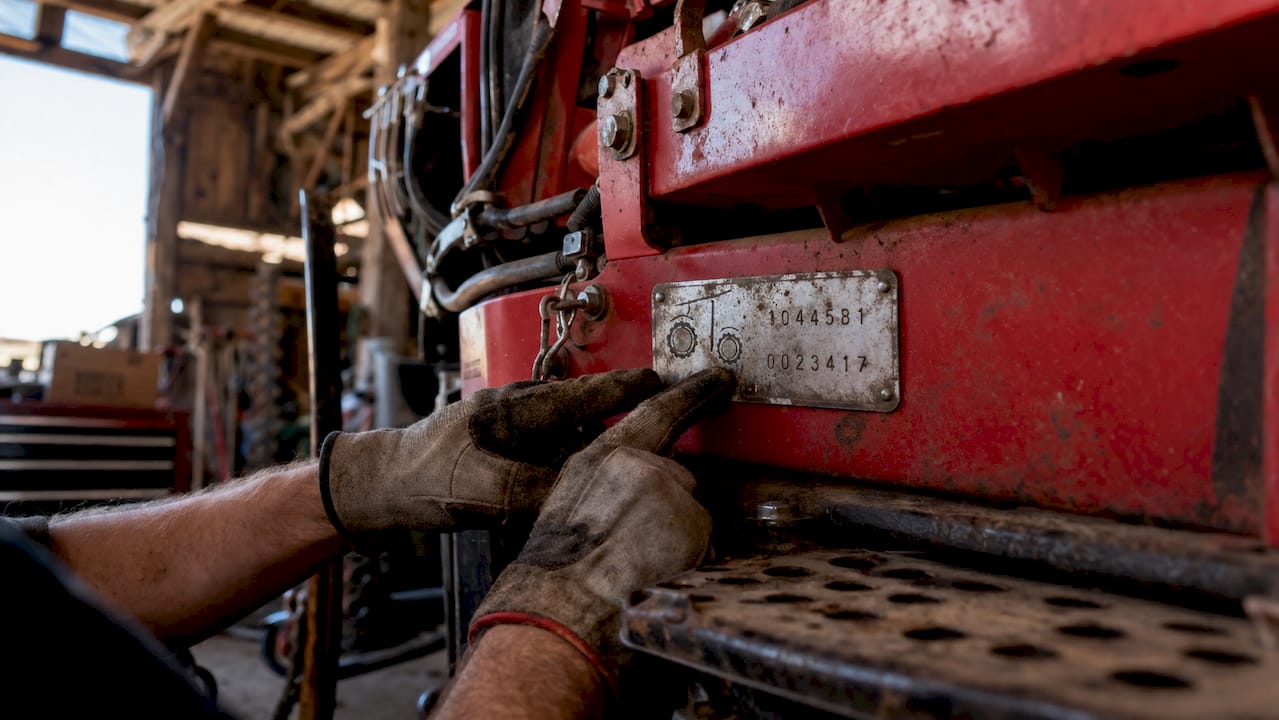
Pro Tip: Gather your serial number, OEM diagram, and two photos before you pick up the phone or open an email. Comprehensive documentation can accelerate parts identification by several days, especially for older or legacy machinery.
| Information | Why it matters |
|---|---|
| Serial number | Identifies your machine’s exact production configuration |
| Model number and build ID | Confirms compatibility with the correct parts catalog |
| OEM exploded diagram | Provides official part numbers and assembly context |
| Part description (official name) | Eliminates ambiguity in verbal or written requests |
| High-quality photos | Verifies fitment when labels are worn or numbers are missing |
How do you contact customer service for agricultural parts?
Support channels for agricultural machinery parts fall into four categories: phone, email, online portals, and emergency lines. Each serves a different urgency level and complexity of request.
Phone support works best for urgent or complex requests where you need real-time confirmation of stock and lead times. Prepare your serial number and part description before dialing. Speak in short, specific statements. “I need the hydraulic pump seal kit for a 2018 model, serial number 4X7291” gets results faster than a long description of symptoms.
Email and inquiry forms suit non-urgent requests or situations where you need to attach photos and diagrams. Write a clear subject line that includes the machine model and part name. Keep the body of the message to three points: machine identification, part needed, and your preferred contact method for follow-up.
Self-service portals are the fastest route for straightforward requests. Online customer portals offer access to availability, pricing, ordering, and shipment tracking in one place. These portals also solve the majority of basic inquiries without requiring any human contact, which means you get answers at any hour.
Emergency lines exist for critical breakdowns during harvest or planting. Emergency after-hours support often requires fees and is not offered by every supplier. Confirm your supplier’s emergency policy before you need it, not during a breakdown at 9 PM.
Here is a practical sequence for reaching parts support by phone or email:
- Confirm the supplier’s operating hours. Standard call center hours are generally 7:00 AM to 8:00 PM EST on weekdays.
- Have your serial number, model number, and OEM diagram open and ready.
- State your machine identification first, then the part needed.
- Ask for the official part number if you do not already have it.
- Request confirmation of stock availability and estimated lead time before ending the call.
Pro Tip: Call early in the morning on weekdays. Support queues are shortest before 9:00 AM, and specialists have more time to work through complex identification requests without time pressure.
What is the step-by-step process for requesting spare parts support?
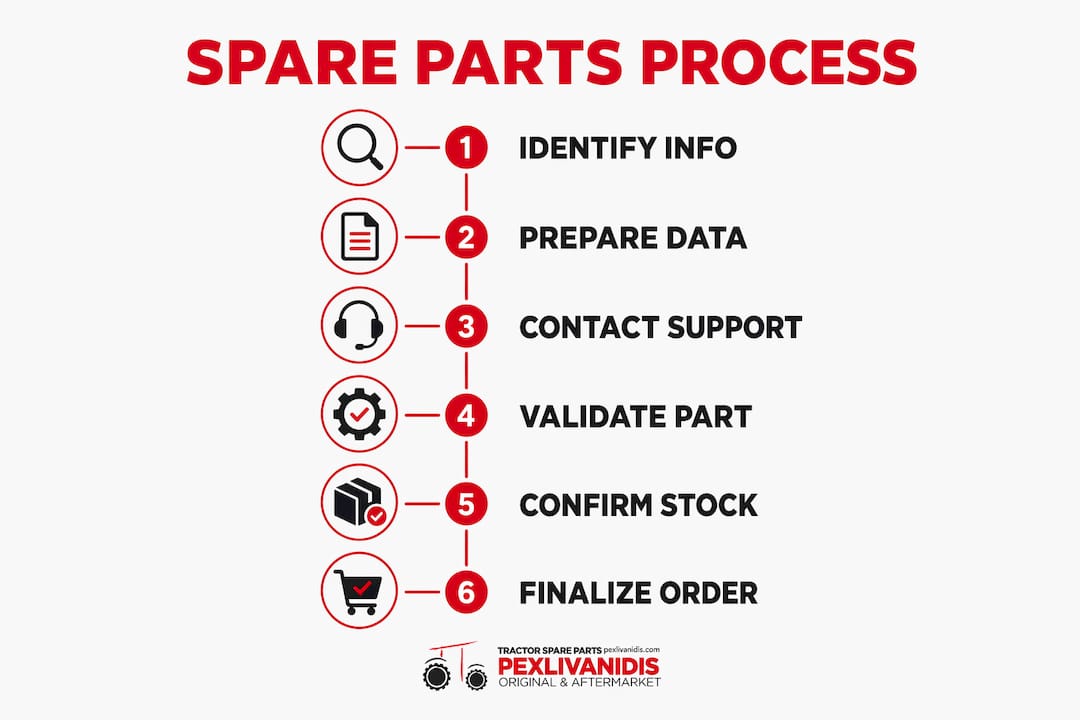
Industry-standard spare parts support follows a three-step validation process: confirm equipment identifiers, verify the part against a diagram or description, and check stock and lead times before ordering. Building your own process around this framework prevents the most common and costly errors.
Step 1: Identify and gather all equipment information
Pull the serial number, model number, and build ID from the machine’s chassis plate. Locate the relevant page in your OEM service manual or download the exploded diagram from the manufacturer’s portal. Note the official part number if it is visible on the component.
Step 2: Initiate contact with your prepared data
Choose your channel based on urgency. For a broken tractor during harvest, call. For a planned maintenance order, use the online portal or email. Open with your machine’s serial number and model. This single habit cuts the average call length significantly because the specialist can pull your exact catalog immediately.
Step 3: Validate the part with the support specialist
Share your OEM diagram reference or photo. Providing clear part descriptions that reference official OEM diagrams ensures accurate fitment and reduces errors caused by visual similarity. Ask the specialist to confirm the part number matches your machine’s production year and configuration.
Step 4: Confirm stock availability and lead times
Ask directly: Is this part in stock? If not, what is the lead time? For agricultural operators, a two-week lead time during planting season is operationally unacceptable. Knowing this upfront lets you source locally or arrange a temporary fix.
Step 5: Finalize the order and record confirmation details
Get a written confirmation number, expected delivery date, and the specialist’s name or ID. Store this information with your machine’s service records. If the part arrives incorrect, this documentation speeds up the return and reorder process.
| Step | Required action | Expected outcome |
|---|---|---|
| Gather equipment info | Serial number, model, OEM diagram | Correct parts catalog identified |
| Initiate contact | Choose channel, lead with serial number | Specialist pulls exact configuration |
| Validate part details | Share diagram reference or photo | Fitment confirmed before ordering |
| Confirm availability | Ask for stock status and lead time | No surprises after ordering |
| Finalize order | Record confirmation number and delivery date | Clear reference for follow-up |
Common mistakes when contacting parts support and how to avoid them
Most parts ordering errors trace back to three predictable mistakes. Recognizing them before you call saves time, money, and frustration.
- Relying on visual similarity. Two parts can look identical and be completely incompatible. Misidentifying parts based on appearance is common. Only serial numbers and official OEM diagrams guarantee the correct fit.
- Providing incomplete equipment information. Giving only a model name without a serial number forces the specialist to guess which production run your machine belongs to. Different production years use different components, even for the same model.
- Not checking hours of operation. Calling outside business hours and expecting a full-service response wastes time. Most parts departments operate within standard business hours, and emergency after-hours lines may carry additional fees.
- Skipping photo documentation. When part numbers are worn off or the component has been modified, a photo is the only reliable way to confirm fitment. Skipping this step often results in a second call and a delayed order.
- Using informal part descriptions. Describing a part by its function or location without an official name creates ambiguity. Always cross-reference the OEM parts catalog before you contact support.
Pro Tip: Before your next support call, photograph every major component on your tractor and store the images with the machine’s serial number in a dedicated folder. When a part fails, you already have the documentation ready.
Understanding how to identify tractor spare parts before reaching out to support cuts the time from first contact to confirmed order dramatically.
Key Takeaways
Effective parts support contact depends on preparation: the right identifiers, the right channel, and the right documentation reduce incorrect orders and machine downtime.
| Point | Details |
|---|---|
| Gather identifiers first | Serial number, model number, and build ID must be ready before any contact. |
| Use OEM diagrams and photos | Official diagrams and high-quality photos prevent fitment errors caused by visual similarity. |
| Match channel to urgency | Use phone for critical breakdowns, portals for planned orders, and email for complex requests with attachments. |
| Confirm stock and lead times | Always ask about availability before finalizing an order to avoid delays during peak seasons. |
| Record every confirmation | Store order numbers, specialist names, and delivery dates with your machine’s service records. |
What I’ve learned from years of watching parts requests go wrong
The most expensive mistake I see agricultural operators make is not the wrong part. It’s the avoidable delay. A farmer calls support without the serial number, gets a part number that fits “most” machines in that model line, and receives the wrong component three days later. The tractor sits for another week. The cost is not the part. It’s the lost harvest days.
Preparation is not bureaucratic. It is the fastest path through the system. Specialists who handle agricultural part numbers every day can resolve a well-prepared request in minutes. The same request without proper documentation can take days of back-and-forth.
Digital tools have changed this process for the better. Self-service portals now let you cross-reference part numbers, check real-time stock, and place orders without waiting on hold. The operators who use these tools effectively treat them like a second service manual. They are not a shortcut. They are a more reliable path to the right answer.
My honest recommendation: build a simple documentation habit now, before anything breaks. A folder with photos, serial numbers, and OEM diagrams for each machine on your farm is worth more than any extended warranty when a hydraulic line fails at 6 AM during harvest.
— George
Pexlivanidis: your resource for agricultural machinery parts
Pexlivanidis carries over 20,000 agricultural machinery parts, including tractor accessories and spare components, serving customers across Thessaloniki, Kavala, and the surrounding region. Whether you are preparing for a support call or ready to order, the catalog gives you the part numbers and specifications you need to communicate accurately with any support team. Start with the essential machinery parts guide to identify the correct component category before you reach out. For operators focused on reducing parts replacement frequency, the machinery maintenance guide covers the practices that extend component life and reduce emergency support calls. Orders over 100€ ship free within Greece.
FAQ
What information do I need before contacting parts support?
You need the machine’s serial number, model number, build ID, and the official OEM part name or diagram reference. High-quality photos of the part and its mounting location are also recommended.
How do self-service portals help with spare parts inquiries?
Self-service portals provide real-time access to availability, pricing, ordering, and shipment tracking without requiring a phone call. They resolve the majority of basic parts inquiries at any hour of the day.
What are standard hours for parts support contact?
Most parts departments operate on weekday business hours, typically 7:00 AM to 8:00 PM EST. Emergency after-hours lines may exist but often carry additional fees and are not universally available.
Why does visual similarity cause parts ordering errors?
Two components can appear identical but belong to different production runs or machine configurations. Only official part numbers from OEM diagrams guarantee the correct fit for your specific machine.
How do I speed up the parts identification process?
Gather your serial number, OEM exploded diagram, and photos before making contact. Comprehensive documentation can accelerate identification by several days, particularly for older or legacy agricultural machinery.