

TL;DR:
- Proper repair techniques restore machinery to full function and prevent repeated failures. Matching the repair method to the failure type, following a structured workflow, and choosing between shop and field repairs ensure durability and efficiency.
Machinery repair techniques are specialized methods used to restore heavy equipment to its original working condition, minimizing costly downtime on farms and in industrial operations. For mechanical technicians and farmers, the difference between a fast, durable fix and a repeat failure often comes down to method selection. Submerged Arc Welding (SAW), Plasma Transferred Arc Welding (PTAW), precision line boring, and epoxy compound repairs each address different failure types in tractors, gearboxes, pumps, and hydraulic systems. Specialized repair shops deliver 50–70% faster turnaround on pumps and gearboxes compared to traditional replacement timelines. That speed advantage only holds when the right technique is matched to the right failure.
What are the primary machinery repair techniques for agricultural equipment?
The four core repair categories for agricultural machinery are welding restoration, precision machining, epoxy compound repair, and component replacement. Each targets a different class of failure, and choosing the wrong method wastes both time and money.
Welding restoration addresses structural cracks, worn surfaces, and metal loss on frames, shafts, and wear plates. Three welding processes dominate industrial equipment repair:
- Submerged Arc Welding (SAW): Best for large flat surfaces and high-volume metal deposition. SAW deposits weld metal up to 10 times faster than manual Gas Tungsten Arc Welding, making it the go-to method for rebuilding large worn components quickly.
- Plasma Transferred Arc Welding (PTAW): Applies wear-resistant alloy overlays to surfaces exposed to abrasion, such as tillage tool edges and pump impellers. PTAW significantly extends wear life in high-abrasion environments.
- Gas Tungsten Arc Welding (GTAW): Used for exotic alloys, thin-walled components, and code-compliant repairs where metallurgical precision matters most.
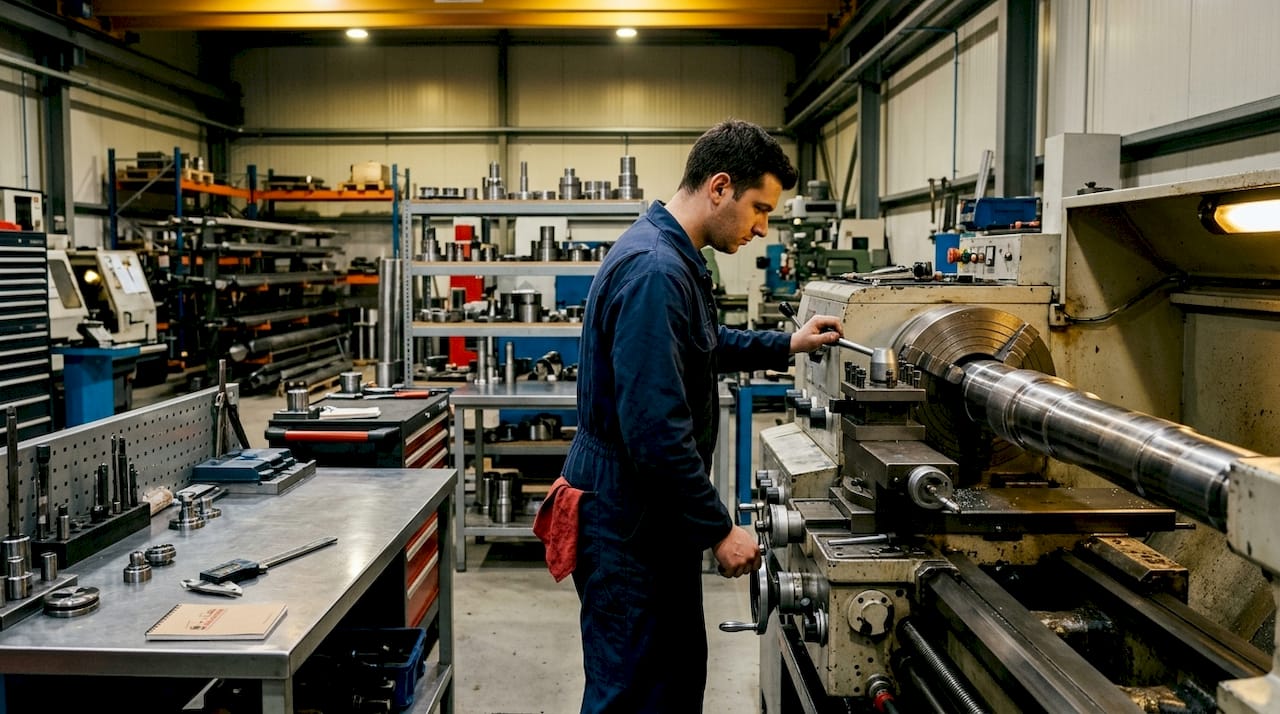
Precision machining repairs restore dimensional accuracy to bores, flanges, and shafts that have worn beyond tolerance. Line boring realigns bearing housings after impact damage. Flange facing restores sealing surfaces on hydraulic and pump assemblies. Both processes require rigid fixturing and calibrated tooling to hit original specifications.
Epoxy compound repairs fill surface voids, seal cracks, and rebuild worn metal on components where welding heat would cause distortion. Surface preparation is critical for epoxy adhesion. Improper substrate cleaning or incorrect mixing ratios cause failure weeks after the repair appears complete.
Pro Tip: Before applying any epoxy compound, grind or grit-blast the substrate to bare metal, degrease with acetone, and apply the compound within the pot life window specified by the manufacturer. Skipping any one of these steps is the leading cause of premature epoxy failure in field conditions.
Bearings, seals, and hydraulic fittings typically fall under direct component replacement rather than restoration. Knowing which category a failure belongs to before starting work is the first decision that separates a durable repair from a temporary fix. For a broader look at which parts wear fastest, the essential agricultural machinery parts guide from Pexlivanidis is a practical reference.
How to follow a standardized machinery repair process
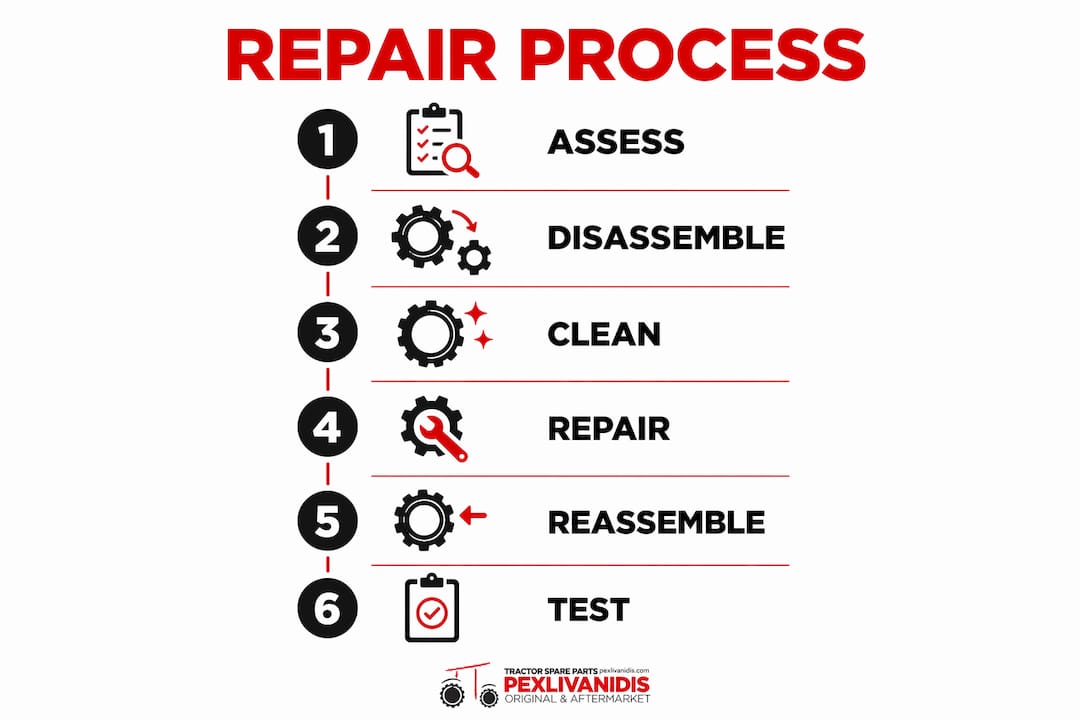
A structured repair process is the single most reliable way to prevent the broken-fixed-broken cycle that costs farms entire growing seasons. A six-step corrective maintenance workflow covers every phase from failure report to final sign-off. Skipping diagnosis or documentation consistently increases repeat breakdowns.
The six steps are:
- Intake and report: Record the failure symptom, operating conditions at the time of failure, and the equipment’s service history. Vague intake notes lead to misdiagnosis.
- Prioritize: Rank the repair against active field schedules. A broken tractor during harvest demands a different response than a worn gearbox in the off-season.
- Root cause diagnosis: Root cause analysis must complement initial inspection to identify the true failure origin. Treating only the symptom, such as replacing a failed bearing without checking shaft alignment, guarantees the same failure returns.
- Repair execution: Apply the correct technique from the method categories above. Match the process to the material, tolerance requirement, and available downtime window.
- Test and verify: Run the repaired component under load before returning it to service. Pressure-test hydraulic assemblies. Check bearing temperatures after 30 minutes of operation.
- Document and review: Record what was found, what was done, and what parts were used. This log becomes the diagnostic baseline for the next failure event.
Repair viability depends on restoring original tolerances within the available downtime window. When a repair cannot meet that standard, replacement or component redesign is the correct call, not a shortcut repair that will fail again under load.
Pro Tip: Kit all replacement parts before starting disassembly. Pulling a gearbox apart and then waiting two days for a seal kit extends downtime far more than the repair itself. Pre-kitting is the single fastest way to cut repair time on the shop floor.
The farm machinery workflow guide from Pexlivanidis walks through how this process applies specifically to agricultural equipment, with practical checkpoints for each stage.
Shop repairs versus on-site field repairs: what to choose
The location of a repair determines its quality ceiling. Not every fix belongs in the field, and not every failure justifies pulling equipment off-site.
Shop-based repairs are the right choice when the work requires precision machining, component rewinds, or controlled welding environments. Line boring a worn differential housing, for example, demands rigid fixturing that a farm workshop cannot replicate. Shops also carry 12–24 month warranties as standard on pump and gearbox repairs, which reflects the quality assurance that a controlled environment provides.
On-site field repairs suit software diagnostics, control wiring, and modular component swaps. Replacing a sensor, swapping a hydraulic valve block, or updating a tractor’s electronic control unit are all tasks that field technicians handle without quality loss. The key is recognizing where the quality ceiling sits for each repair type.
Portable precision machining with rigid mounting fixtures bridges the gap for large components that cannot be moved. A portable line boring rig anchored directly to a machine frame can restore bore dimensions on-site, saving the weeks of downtime that equipment removal would require. This approach works well for large agricultural combines, irrigation pump housings, and structural frames where transport is impractical.
| Repair type | Best location | Key requirement |
|---|---|---|
| Precision machining (line boring, flange facing) | Shop or portable rig | Rigid fixturing, calibrated tooling |
| Welding restoration (SAW, PTAW, GTAW) | Shop preferred | Controlled environment, certified welder |
| Epoxy compound repair | Field or shop | Substrate prep, temperature control |
| Modular component swap | Field | Correct part, basic hand tools |
| Software diagnostics and wiring | Field | Diagnostic interface, wiring diagrams |
The decision rule is straightforward. If the repair requires holding tolerances tighter than what field conditions allow, move it to a shop or bring a portable rig to the site.
How do advanced welding techniques improve repair quality?
Welding is the highest-impact repair method for agricultural machinery because it restores both structural integrity and surface wear resistance. The three processes used in industrial equipment repair each fill a distinct role.
- SAW handles high-volume metal deposition on large flat components. Its 10x speed advantage over GTAW makes it the practical choice for rebuilding worn bucket teeth, frame rails, and large shaft journals where deposition volume is the priority.
- PTAW applies metallurgically bonded wear overlays. The process fuses carbide or chrome alloy powders directly into the base metal, creating a surface that resists abrasion far longer than a standard weld deposit. Tillage blades, plowshares, and pump impellers are prime candidates.
- GTAW delivers the tightest metallurgical control. High-quality repair plans reference standards like ASME and API for code-compliant welds, and GTAW is the process that meets those standards on exotic alloys and pressure-containing components.
Welding failures in agricultural repairs almost always trace back to two causes: wrong process selection and unqualified welders. A GTAW repair on a high-carbon steel shaft without proper preheat will crack within weeks. A SAW deposit on a thin-walled component will warp it beyond use.
Pro Tip: Always request the welder’s current certification documentation before authorizing a structural repair. A certified welder working to a written weld procedure specification (WPS) is the minimum standard for any load-bearing agricultural component. This single check prevents the majority of weld-related repeat failures.
For technicians looking to extend equipment life through both welding and maintenance planning, the tractor life extension guide from Pexlivanidis covers how PTAW overlays and scheduled maintenance combine to reduce total repair frequency.
Key Takeaways
Effective machinery repair requires matching the right technique to the failure type, following a structured six-step workflow, and choosing between shop and field repair based on the precision the job demands.
| Point | Details |
|---|---|
| Match technique to failure type | Use SAW for volume deposition, PTAW for wear surfaces, GTAW for code-compliant or exotic alloy repairs. |
| Follow the six-step workflow | Intake, prioritize, diagnose root cause, repair, test under load, and document every repair event. |
| Epoxy prep is non-negotiable | Clean substrate to bare metal and mix compounds correctly; skipping either step causes premature failure. |
| Field vs. shop decision | Move precision machining to a shop or portable rig; reserve field repairs for diagnostics and modular swaps. |
| Root cause over symptom | Treating only the symptom without identifying the root cause guarantees the same breakdown returns. |
What I’ve learned from watching repairs fail and succeed
The most common mistake I see in agricultural machinery repair is skipping the root cause step because the fix looks obvious. A gearbox comes in with a failed bearing, the bearing gets replaced, and the machine goes back to work. Three weeks later, the same bearing fails because the shaft was misaligned and nobody checked it. That cycle is expensive and completely avoidable.
The second mistake is treating the repair location decision as a cost question rather than a quality question. Field repairs are faster and cheaper until they aren’t. A weld done in a dusty field with a portable MIG welder on a structural frame component is not the same repair as one done in a shop with proper fixturing and a certified welder. The cost difference looks small on day one and enormous six months later when the weld cracks under load.
What actually works is a combination of both approaches used deliberately. Use the field for what the field does well: diagnostics, sensor swaps, hydraulic line replacements, and modular part changes. Use the shop for what the shop does well: precision machining, certified welding, and full component rebuilds. The farms and operations that minimize downtime are the ones that have made this distinction clearly and built their repair process around it.
Documentation is the part most technicians skip and most regret skipping. A repair log that records what failed, why it failed, and what was done to fix it is worth more than any single repair. It turns every breakdown into a data point that makes the next repair faster and cheaper.
— George
Pexlivanidis: parts and guidance for agricultural machinery repair
Pexlivanidis stocks over 20,000 agricultural machinery parts, from tractor accessories to hydraulic components, with free shipping within Greece on orders over 100€. Whether you need a replacement bearing for a gearbox rebuild or a hydraulic seal kit to complete a field repair, the catalog covers the components that mechanical technicians and farmers need most. The agricultural machinery maintenance guide on the Pexlivanidis website pairs well with the repair techniques covered here, offering maintenance schedules and part selection guidance that reduce how often repairs are needed in the first place. For wholesale buyers and B2B customers in Thessaloniki, Kavala, and surrounding regions, Pexlivanidis also offers dedicated membership options with volume pricing.
FAQ
What are the most effective machinery repair techniques for tractors?
Welding restoration using PTAW for wear surfaces, precision line boring for worn housings, and epoxy compound repair for surface voids are the most effective methods for tractor repairs. The correct choice depends on the component type and the tolerance the repair must restore.
How does root cause analysis improve the machinery repair process?
Root cause analysis identifies the true origin of a failure rather than just its visible symptom, preventing the same breakdown from recurring. Skipping this step is the leading cause of repeat failures in gearbox and bearing repairs.
When should a field repair be moved to a shop?
Move a repair to a shop when it requires precision machining, certified welding, or tolerance restoration that field conditions cannot support. On-site repairs are reliable for diagnostics, wiring, and modular component swaps.
What makes epoxy repairs fail on agricultural equipment?
Epoxy repairs fail when the substrate is not cleaned to bare metal or when the compound is mixed outside the specified ratio. Improper substrate preparation is the primary cause of premature epoxy bond failure in field conditions.
How do I know if a repair is viable or if replacement is better?
A repair is viable when it can restore the component to its original specified tolerances within the available downtime window. When those conditions cannot be met, replacement or redesign is the correct decision.