

TL;DR:
- Effective farm machinery support increases crop yields, reduces harvest losses, and improves labor efficiency.
- Timely maintenance, quick technician access, and spare parts availability are crucial for operational continuity and cost savings.
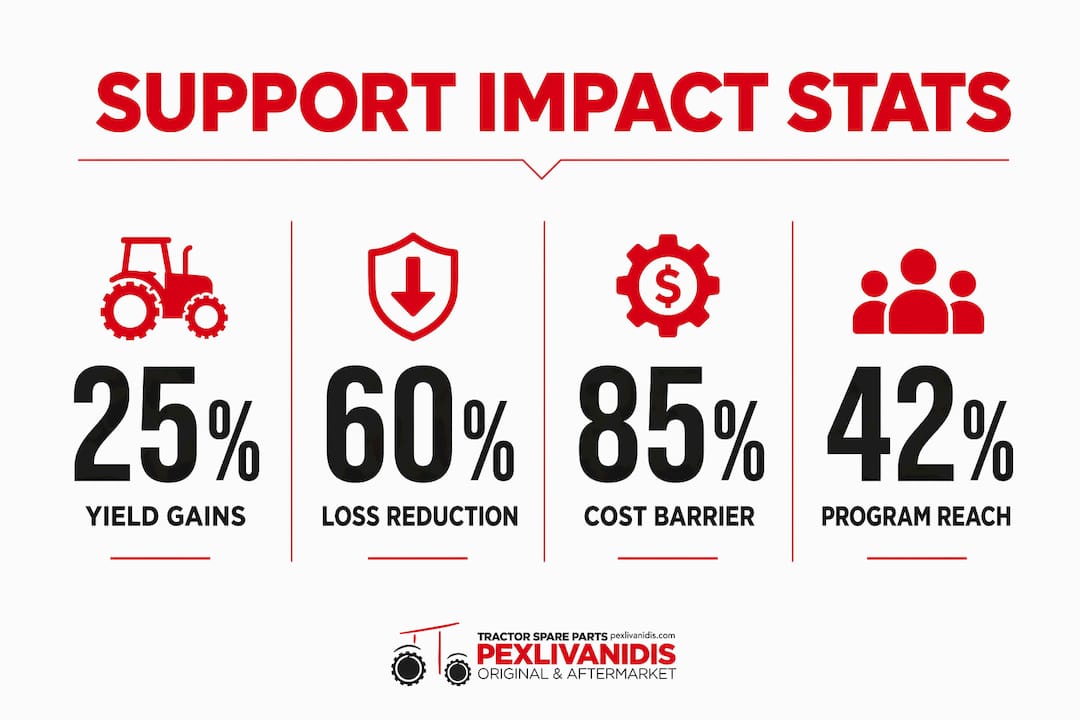
Farm machinery support is defined as the combination of maintenance, spare parts availability, technical assistance, and operator training that keeps agricultural equipment running at full capacity. The impact of support on farm machinery is direct and measurable: targeted mechanization support can increase crop yields by 21–25%, reduce harvest loss by 58–60%, and improve labor efficiency by up to 45%. For farm operators managing tight seasonal windows and rising input costs, the quality of support services is not a secondary concern. It is the single biggest variable between a productive season and a costly breakdown.
How does support affect farm machinery performance?
Effective support for farm equipment starts before a machine ever enters the field. Factory acceptance testing and pre-delivery operator training are two practices that directly reduce early-season failures. When operators understand calibration settings, safety limits, and basic diagnostics from day one, they catch problems before they become expensive repairs.
Preventive maintenance is the backbone of machinery reliability. After-sale support programs that include preventive maintenance kits tailored to specific machine types maximize uptime and return on investment. A tractor running on a scheduled oil change and filter replacement cycle will outlast one serviced only when something breaks. The difference shows up in fuel efficiency, hydraulic response, and overall output per hour.
Technician access matters as much as the maintenance schedule itself. Local support with quick technician access and stocked spare parts reduces downtime and operational risk significantly. A technician who can reach your farm within hours versus one who requires a multi-day appointment changes the math on every breakdown. For farm operators in regions like northern Greece, where Pexlivanidis serves customers across Thessaloniki and Kavala, proximity to reliable parts and technical help is a real operational advantage.
Modern precision agriculture machinery adds a layer of complexity that older equipment did not have. Fixing mechanical parts often requires digital recalibration of precision agriculture software to restore full efficiency. This means support today is not just a wrench and a parts catalog. It requires access to diagnostic interfaces and software tools.
Key support activities that improve machine uptime include:
- Scheduled preventive maintenance using model-specific kits
- Pre-season operator training on calibration and diagnostics
- Rapid technician dispatch for field breakdowns
- Software recalibration after mechanical repairs
- Regular inspection of hydraulic systems, belts, and filters
Pro Tip: Build a curated on-site inventory of high-wear parts. Gauge wheel arms, hydraulic filters, and belts are the components most likely to fail mid-season. Having them on hand eliminates the delay between a breakdown and a repair.
Why does spare parts availability determine operational continuity?
Parts availability is the most underrated factor in farm equipment reliability. A machine sitting idle waiting for a part is not just a maintenance problem. It is a production loss that compounds daily during planting or harvest windows.
High-performing parts programs anticipate seasonal demand and wear patterns. They stock components before peak periods rather than reacting to failures. On-farm parts storage, where a cabinet of critical components lives in the equipment shed, reduces trips to suppliers and cuts the time between failure and return to work. Maintaining an on-site curated inventory of high-wear parts is a critical strategy that prevents costly downtime during peak seasons.
The table below shows how parts delay length affects operational impact:
| Delay Length | Operational Impact |
|---|---|
| Under 4 hours | Minimal. Repair completed within the same work shift. |
| 4–24 hours | Moderate. One full day of field work lost. |
| 1–3 days | Significant. Planting or harvest window narrows. |
| Over 3 days | Severe. Yield loss and potential crop quality damage. |
Operators who track parts usage by machine model and season gain a clear picture of what to stock and when. This is not guesswork. It is data collected from your own operation over time.
Key strategies for parts availability include:
- Maintain a minimum stock of high-wear components on-site
- Order parts ahead of peak seasons, not during them
- Use a supplier with a large catalog and fast delivery
- Track which parts fail most often by machine type and age
- Build a relationship with a parts supplier who understands your equipment
Pro Tip: Log every parts replacement with the date, machine model, and hours on the meter. After two seasons, you will have a reliable forecast for what to order and when.
What financial and policy barriers affect machinery support adoption?
Cost is the primary barrier to machinery support, and the data is clear. High equipment costs affect 85.1% of farmers seeking mechanization support, while 69.1% cite limited credit access as a major obstacle. These numbers come from research in Zambia, but the pattern holds across smallholder farming communities globally. When capital is tight, maintenance budgets are the first to shrink, and that decision accelerates equipment degradation.
Government programs exist to address this gap, but their effectiveness varies. The same research found that 42.6% of farmers report government support as ineffective. That figure points to a design problem, not a funding problem. Programs that deliver subsidies without pairing them with technical training often fail to change outcomes.
Subsidy-based policies reduce adoption risks, and technical training amplifies the value of machinery services. The combination works better than either alone. A farmer who receives a subsidized part but does not know how to install it correctly has not received effective support. A farmer who receives training alongside the part can apply that knowledge across the machine’s entire service life.
Smallholder operators face a different set of constraints than larger farms. They have less capital to absorb a breakdown, less storage space for spare parts, and less access to specialized technicians. Policy interventions that account for these differences, such as mobile technician programs and group purchasing arrangements, deliver better results than one-size-fits-all approaches.
Practical steps for overcoming financial barriers include:
- Apply for agricultural mechanization grants and subsidy programs
- Join cooperative purchasing groups to reduce parts costs
- Prioritize maintenance spending on the highest-use machines first
- Use right-to-repair access to reduce dealer-only repair costs
How does technology improve support for farm equipment?
Telematics and fleet management platforms have changed what support for farm equipment looks like in practice. Integrated fleet management platforms allow proactive monitoring of machine health and enable data-driven maintenance scheduling. Instead of waiting for a warning light or a breakdown, operators receive alerts when a system reading moves outside its normal range. That shift from reactive to condition-based maintenance is one of the most significant changes in agricultural equipment care in the past decade.

The EPA’s recognition of farmers’ right to repair nonroad diesel equipment has opened access to diagnostic tools that were previously restricted to authorized dealers. This policy change enables farm operators to run their own diagnostics, identify fault codes, and in many cases perform repairs without waiting for a dealer appointment. The result is an average repair cost reduction of 45% for operators who use independent repair channels.
Digital support tools also include remote diagnostic services, where a technician reviews machine data off-site and advises on the repair before arriving. This reduces the time a technician spends diagnosing on-site and gets the machine back to work faster. Software calibration, which must follow mechanical repairs on precision ag equipment, is increasingly available through authorized remote sessions rather than requiring a dealer visit.
Key technology-enabled support practices include:
- Use telematics platforms to monitor engine hours, fuel use, and fault codes
- Set up automated alerts for oil pressure, temperature, and hydraulic readings
- Run diagnostic scans before and after any major repair
- Access right-to-repair diagnostic tools for independent fault identification
- Schedule software recalibration as a standard post-repair step
Key Takeaways
Effective machinery support is the most direct lever farm operators have for protecting yield, reducing costs, and extending equipment life.
| Point | Details |
|---|---|
| Support drives yield gains | Targeted mechanization support increases crop yields by 21–25% and cuts harvest loss by up to 60%. |
| Parts availability is critical | Delays over three days during peak season cause severe yield loss and crop quality damage. |
| Financial barriers are real | 85.1% of farmers cite high equipment costs as the top barrier to accessing adequate machinery support. |
| Technology reduces repair costs | Right-to-repair access and telematics can cut repair costs by an average of 45%. |
| Training multiplies support value | Technical training paired with subsidies delivers better outcomes than financial aid alone. |
What I’ve learned about treating support as a system, not a service call
Most farm operators I talk to think about machinery support the way they think about insurance. They pay attention to it only when something goes wrong. That mindset costs more than it saves.
The operators who get the most out of their equipment treat support as a system. They schedule maintenance before the season, not during it. They stock the parts they know will fail. They invest in training so their team can handle first-level diagnostics without waiting for a technician. And they use every policy incentive available to reduce the cost of doing all of this.
The right-to-repair movement is one of the most practically useful developments for farm operators in years. The ability to run your own diagnostics and access independent repair channels changes the economics of ownership. But it only works if you also invest in the knowledge to use those tools correctly. Access without understanding is just a new way to make the same mistakes.
The future of farm machinery support will be condition-based, not calendar-based. Telematics will tell you when a machine needs attention, not just when the hours say it should. Operators who build that capability now will have a real advantage as equipment becomes more complex and repair windows stay just as tight. The agricultural aftersales model is shifting, and the operators who adapt early will protect both their machines and their margins.
— George
Pexlivanidis and the parts behind your machinery’s uptime
Pexlivanidis carries over 20,000 agricultural machinery parts and tractor accessories, with free shipping within Greece on orders over 100€. Farm operators in Thessaloniki, Kavala, and surrounding regions use Pexlivanidis as their primary source for the high-wear components that keep equipment running through peak seasons. The catalog covers everything from hydraulic filters and gauge wheel arms to full tractor accessory kits. For operators building an on-site parts inventory, the essential machinery parts guide is a practical starting point. For those focused on extending machine life, the peak performance maintenance guide covers the full service cycle from pre-season checks to post-harvest storage.
FAQ
What is the impact of support on farm machinery output?
Targeted machinery support increases crop yields by 21–25% and reduces harvest loss by 58–60%. Labor efficiency improves by up to 45% when support includes both equipment maintenance and operator training.
How does parts availability affect farm equipment reliability?
Parts delays of more than three days during planting or harvest cause severe production losses and potential crop quality damage. Maintaining an on-site inventory of high-wear components is the most direct way to prevent this.
What role does right-to-repair play in machinery support?
The EPA recognizes farmers’ right to repair nonroad diesel equipment, which enables access to independent diagnostic tools and repair channels. This access reduces average repair costs by 45% compared to exclusive dealer reliance.
How does technical training improve the benefits of machinery support?
Technical training amplifies the value of machinery services by giving operators the skills to apply support correctly. Subsidies paired with training deliver better outcomes than financial aid alone, according to agricultural mechanization research.
What technology tools support farm machinery maintenance?
Integrated fleet management platforms monitor machine health in real time and enable condition-based maintenance scheduling. Telematics alerts and remote diagnostic services reduce both downtime and the cost of each repair event.