

TL;DR:
- Effective machinery care involves scheduled maintenance, contamination control, and asset-specific strategies to prevent costly failures. Operators’ daily inspections and accurate documentation are vital for extending equipment lifespan and reducing unplanned downtime. Maintenance programs must adapt based on real failure data and operational conditions to remain effective over time.
Effective machinery care is defined as a structured set of maintenance activities that maximize equipment uptime, extend service life, and prevent costly unplanned failures. For agricultural machinery operators, the best practices for machinery care center on preventive maintenance programs built around OEM guidelines, contamination control, and condition-based monitoring. Reactive maintenance costs 3 to 5 times more per repair than scheduled preventive work. That gap makes the choice between proactive and reactive approaches one of the most consequential decisions you make for your operation’s budget and productivity.
1. Why preventive maintenance is the foundation of machinery care
Preventive maintenance is the single most effective strategy for controlling repair costs and keeping agricultural equipment in the field. 88% of manufacturing operations use preventive maintenance as their primary reliability strategy. That near-universal adoption reflects a simple truth: waiting for something to break is always more expensive than stopping it from breaking in the first place.
The core of any preventive program is a schedule tied to operating hours and calendar time. OEM manuals specify service intervals at 250, 500, 1,000, and 2,000 hours, with calendar dates as backup triggers when equipment sits idle. Following these intervals is not optional. Skipping a 500-hour service to save a few hours of downtime routinely leads to failures that cost ten times more to fix.
Automated work order scheduling removes the human error from this process. When a CMMS (Computerized Maintenance Management System) or even a simple spreadsheet triggers service reminders, nothing falls through the cracks. Compliance tracking then gives you a record that proves the work was done, which matters for warranty claims and resale value.
- Schedule services at OEM-specified hour intervals, not just when problems appear
- Use calendar-based triggers as a backup for low-use equipment
- Automate work order generation to prevent missed services
- Track compliance rates to identify gaps in your maintenance program
2. How to schedule and document step by step machinery servicing
Good documentation turns a maintenance program from a guess into a system. The starting point is your OEM manual, which defines baseline intervals. From there, you adjust based on actual site conditions: dusty harvests, heavy loads, and extreme temperatures all shorten intervals beyond what the manual assumes.
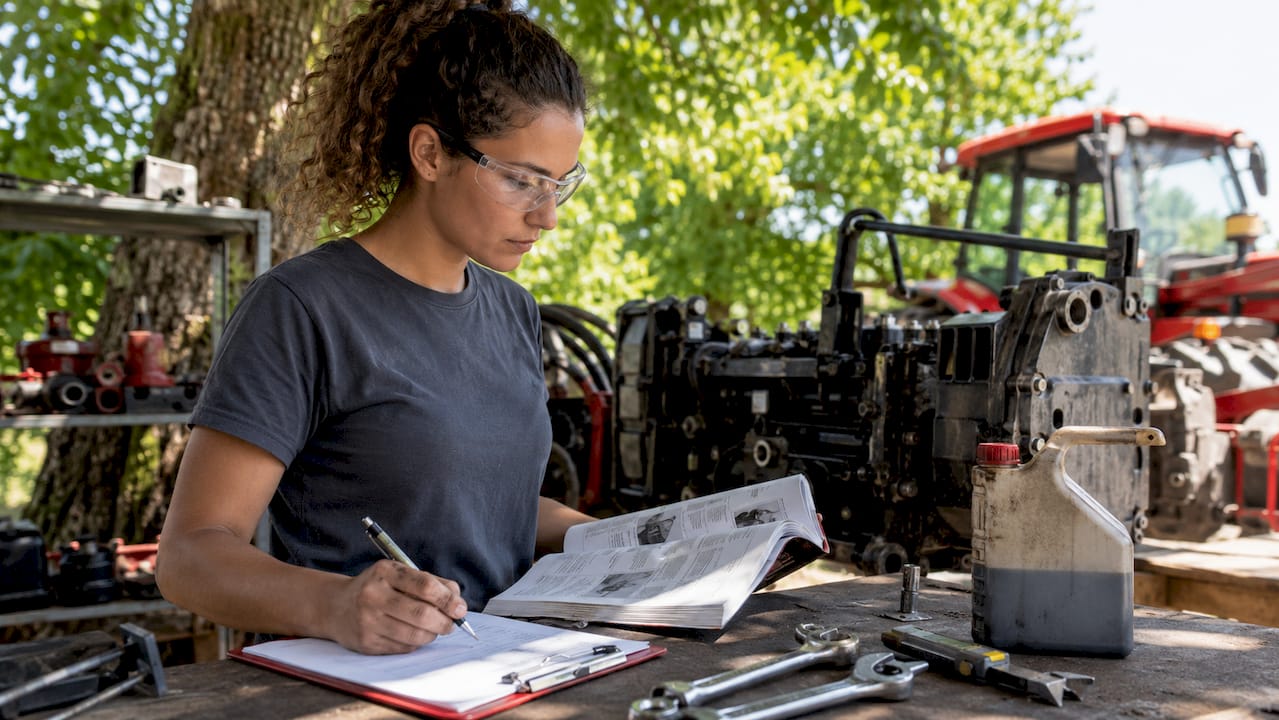
Checklists are only useful when they are specific. Checklists must include quantitative pass/fail criteria such as temperature ranges and pressure thresholds, not vague instructions like “inspect belt.” A technician who records “belt OK” tells you nothing. A technician who records “belt tension at 45 lbs, within 40–50 lb spec” gives you a trend you can act on.
Every completed work order should capture labor hours, parts used, and total cost. Over time, this data reveals which components fail most often, which machines consume the most resources, and where your intervals need adjustment. That feedback loop is what separates a living maintenance program from a static checklist.
- Pull the OEM manual and list every service task with its specified interval
- Adjust intervals based on local conditions and your own failure history
- Rewrite vague checklist items as specific, measurable pass/fail criteria
- Log every work order with labor, parts, cost, and technician notes
- Review logs quarterly to identify recurring failures and adjust intervals
Pro Tip: Digital checklists that specify exact measurement criteria, such as vibration limits and temperature thresholds, reduce false positives and produce maintenance records that are actually useful for trend analysis.
3. Lubrication and contamination control in agricultural equipment care
Lubrication is not a consumable task. Treating oil as a precision component rather than a routine fluid change dramatically increases asset reliability. The difference between a bearing that lasts 3,000 hours and one that fails at 800 hours is often the cleanliness and viscosity of the lubricant it ran on.
Contamination is the primary cause of hydraulic and bearing failures in field equipment. Particles, moisture, and cross-contamination from using the wrong lubricant all degrade system performance faster than wear alone. Lubricants must be stored and transferred using sealed, filtered equipment to prevent contamination from entering the system before the oil even reaches the machine.
Routine oil analysis that tracks viscosity, acidity, wear metals, and moisture turns lubrication into a diagnostic tool. A single oil sample can reveal bearing wear, coolant ingress, or fuel dilution weeks before any external symptom appears. Plants that use oil analysis as a standard practice experience fewer random failures and catch developing problems while repair costs are still low.
Best practices for contamination control include:
- Use dedicated, labeled transfer containers for each lubricant type
- Filter all new oil before it enters the machine, not just when changing
- Store lubricants in a clean, dry, temperature-stable environment
- Schedule oil analysis at every major service interval to track wear trends
- Replace breathers and seals on schedule to block moisture ingress
4. Tailoring maintenance intervals to asset criticality and conditions
Not every piece of equipment on your farm deserves the same maintenance intensity. Asset criticality and failure modes should guide which machines get condition-based monitoring and which follow standard time-based schedules. A primary tractor that runs 1,200 hours per season demands a different approach than a trailer used twice a year.
Criticality analysis asks three questions: How likely is this component to fail? What are the consequences if it does? Can you detect the failure before it becomes catastrophic? High-consequence, hard-to-detect failures justify more frequent monitoring. Low-consequence, easily detected failures can run on longer intervals without meaningful risk.
Over-frequent maintenance introduces its own risks. Unnecessary disassembly and reassembly can introduce new defects, a phenomenon known as iatrogenic failure. Every time you open a sealed system, you create an opportunity for contamination, incorrect torque, or misalignment. The goal is the right maintenance at the right interval, not the most maintenance possible.
| Asset type | Recommended strategy | Key monitoring method |
|---|---|---|
| Primary tractor | Condition-based monitoring | Oil analysis, vibration checks |
| Harvesting equipment | OEM interval with adjustments | Hour-based checklists |
| Irrigation pumps | Time-based with seasonal review | Pressure and flow readings |
| Low-use trailers | Calendar-based annual service | Visual inspection |
Pro Tip: Factor in site-specific conditions when setting intervals. Dusty grain harvests and heavy clay soils accelerate filter and seal wear far beyond what OEM manuals assume for average conditions. Adjust your maintenance schedule accordingly.
5. What daily operational practices sustain machinery performance
The best maintenance program in the world cannot compensate for poor daily operating habits. Operators are the first line of defense against developing failures. A 10-minute pre-shift inspection catches the loose fitting, the low oil level, or the cracked hose before it becomes a field breakdown.
Daily and pre-operation checks should focus on critical wear points and early warning signs:
- Check engine oil, coolant, and hydraulic fluid levels before every shift
- Inspect belts, hoses, and fittings for visible wear, cracks, or leaks
- Clear debris from radiator screens, air filters, and cooling fins
- Monitor operating temperatures and pressures during the first 15 minutes of use
- Listen for unusual noises from bearings, gearboxes, and hydraulic systems
- Record any anomaly immediately, even if it seems minor
Keeping machines clean is not cosmetic. Debris packed around bearings, seals, and cooling systems accelerates wear and traps moisture. A pressure wash after a muddy harvest followed by a visual inspection takes less than 30 minutes and routinely reveals damage that would otherwise go unnoticed until failure.
Prompt reporting matters as much as the inspection itself. An operator who notices a vibration and mentions it at the end of the week has lost days of lead time. A written anomaly report filed the same day gives the maintenance team time to schedule a repair before the next operating window. Build that reporting habit into your daily routine, and your unplanned downtime will drop.
6. Building a regular maintenance checklist for agricultural machinery
A regular maintenance checklist is the operational backbone of any machinery upkeep strategy. Without a written checklist, tasks get skipped, intervals drift, and institutional knowledge walks out the door when an experienced technician leaves. The checklist is the system, not the person.
Structure your checklist in three tiers: daily operator checks, periodic technician services, and major overhaul tasks. Daily checks take minutes and require no tools. Periodic services align with OEM hour intervals and require parts and labor. Major overhauls address components with long service lives, such as hydraulic pumps, gearboxes, and engine rebuilds.
Each checklist item needs four elements: the task description, the acceptance criterion, the result recorded by the technician, and the date and signature. That structure creates accountability and a paper trail. When a component fails prematurely, you can trace back through the records to find whether the maintenance was done correctly and on time. That information is invaluable for warranty claims and for improving your program going forward.
Key Takeaways
Consistent preventive maintenance, contamination control, and asset-specific scheduling are the three pillars that determine whether agricultural machinery lasts or fails prematurely.
| Point | Details |
|---|---|
| Preventive maintenance pays | Reactive repairs cost 3 to 5 times more than scheduled preventive work. |
| Checklists need specifics | Use quantitative pass/fail criteria, not vague “inspect” instructions. |
| Oil is a precision component | Treat lubrication and contamination control as reliability tools, not routine tasks. |
| Match intensity to criticality | Critical assets need condition-based monitoring; low-risk assets can follow time-based schedules. |
| Operators are the first defense | Daily pre-shift checks and same-day anomaly reporting prevent most field breakdowns. |
Why checklists alone won’t save your machinery program
I’ve seen maintenance programs that looked perfect on paper and failed completely in practice. The checklists were detailed, the intervals were correct, and the records were filed. But the machines kept breaking down. The problem was that the program never changed. It was built once, filed in a binder, and treated as finished.
Maintenance programs must evolve based on actual failure and compliance data, not remain static documents. When a gearbox fails at 600 hours on a 1,000-hour interval, that is data. It tells you the interval is wrong for your conditions. When the same technician consistently misses the same checklist item, that is a training gap or a procedure problem. Both require a response, not just a note in the file.
The operators who work these machines every day carry knowledge that no manual captures. They know which field is dusty, which slope puts extra load on the hydraulics, and which bearing started making a new sound last Tuesday. Integrating that knowledge into your maintenance decisions is not optional. It is the difference between a program that improves over time and one that stays mediocre. Treat your maintenance program as a living system, and it will reward you with fewer surprises and lower costs every season.
— George
Pexlivanidis: parts and resources for your maintenance program
Agricultural machinery maintenance only works when you have the right parts available before a service is due, not after a breakdown forces your hand. Pexlivanidis stocks over 20,000 agricultural machinery parts and spare components, with free shipping within Greece on orders over 100€. Whether you need filters, belts, seals, or hydraulic components, the catalog covers the full range of agricultural machinery parts needed to execute a complete preventive maintenance program. Pexlivanidis also publishes practical guides on machinery upgrade tips and buying decisions to help operators make informed choices at every stage of their equipment’s service life.
FAQ
What is the most cost-effective machinery maintenance strategy?
Preventive maintenance is the most cost-effective strategy. Reactive repairs cost 3 to 5 times more per incident than scheduled preventive work.
How often should agricultural machinery be serviced?
OEM manuals specify service intervals at 250, 500, 1,000, and 2,000 operating hours, with calendar-based triggers as a backup for low-use equipment.
Why is contamination control critical for machinery reliability?
Contamination from particles and moisture is the leading cause of hydraulic and bearing failures. Strict contamination control through filtered transfer equipment and routine oil analysis directly reduces random failures.
Can too much maintenance damage equipment?
Yes. Over-frequent disassembly introduces iatrogenic failures by creating opportunities for contamination, incorrect torque, and misalignment. Maintenance intervals should match actual asset condition and operating environment.
What should a daily machinery inspection include?
Check fluid levels, inspect belts and hoses for visible wear, clear debris from cooling systems, and monitor operating temperatures during the first 15 minutes of use. Report any anomaly in writing the same day.