

TL;DR:
- A structured maintenance checklist organized by frequency helps prevent equipment failure and extend machine life. It must include core components such as asset ID, safety protocols, measurable tasks, logging fields, and formal sign-off. Regularly updating tasks based on failure data and accurate logging improves maintenance effectiveness.
An equipment maintenance checklist is a frequency-layered list of specific inspection, lubrication, cleaning, and repair tasks designed to prevent downtime and extend the life of agricultural machines. In professional maintenance practice, this is also called a preventive maintenance checklist for machines. The industry standard structures these tasks across daily, weekly, monthly, and quarterly intervals, each targeting a different layer of machine health. Farmers who follow a structured checklist catch problems before they become field failures.
1. What are the core components of an equipment maintenance checklist?
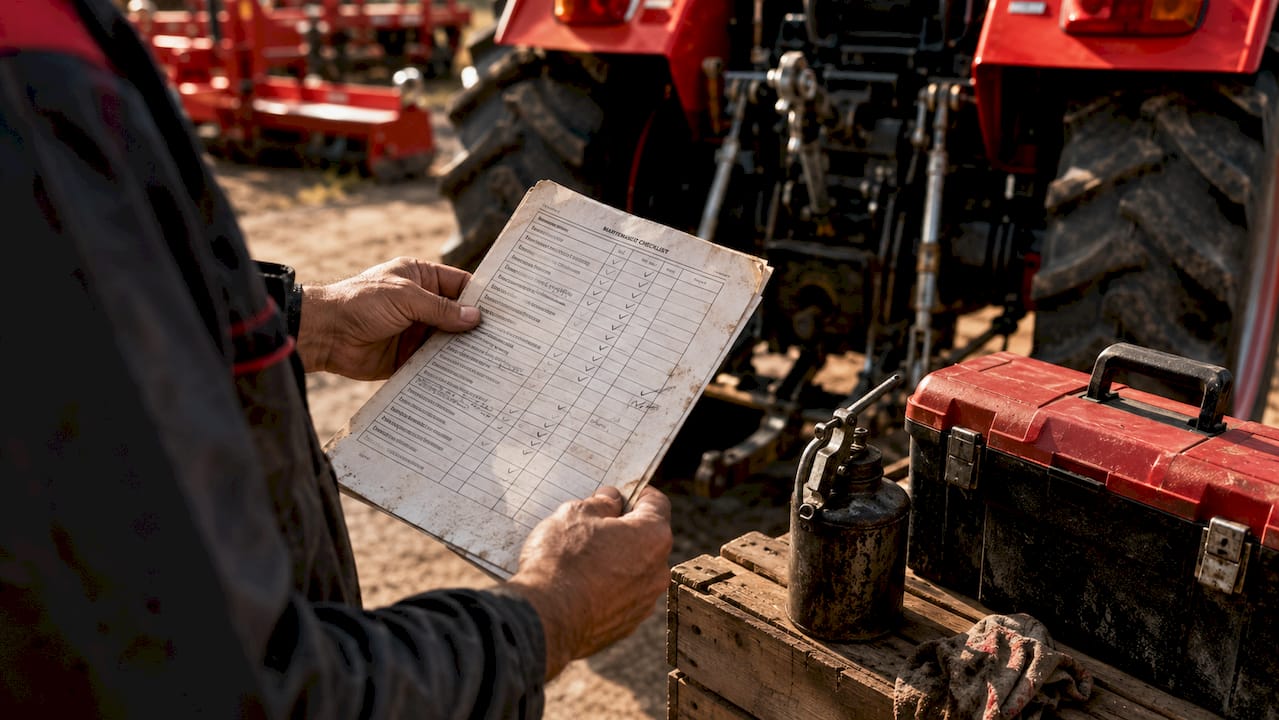
Eight standardized components define every effective machine maintenance checklist. Skipping any one of them creates gaps that lead to missed faults and unclear accountability.
Every checklist should include:
- Asset identification. Record the machine’s ID number, serial number, model, and physical location. This ties every task to a specific piece of equipment, not just a machine type.
- Scope and prerequisites. List required permits, lockout/tagout procedures, and any pre-task conditions that must be met before work begins.
- Safety protocols and PPE requirements. Specify gloves, eye protection, and any other gear required for each task. Never leave safety requirements implied.
- Specific tasks with measurable criteria. Write tasks with exact pass/fail thresholds. Measurable instructions like “check oil level between 60 and 80 on the dipstick” eliminate guesswork and reduce human error.
- Data capture fields. Include spaces for pressure readings, temperature values, photos, and written notes. Blank fields invite skipped steps.
- Exception handling and escalation paths. Define what happens when a task fails. Who gets notified? What is the hold procedure?
- Role-based ownership. Assign each task to a named role, not just “the operator.” Accountability requires a name attached to a task.
- Formal sign-off. Require a dated signature from the technician and a supervisor. This closes the loop on every completed inspection.
A checklist missing any of these elements is incomplete. Treat each component as non-negotiable.
2. How to organize a layered frequency schedule for farm equipment
Layered frequency is the backbone of any preventive maintenance guide for agricultural machinery. Each frequency tier targets a different risk level.
- Daily (shift-start inspections). Check fluid levels, look for leaks, test safety interlocks, and listen for abnormal noise. Daily routines catch the issues that cause surprise downtime. A five-minute walk-around before the first pass of the day costs nothing compared to a mid-harvest breakdown.
- Weekly checks. Clean air filters, inspect belts for wear, check tire pressure, and test all lighting and warning systems. Weekly tasks address the subsystems that degrade faster than monthly cycles can catch.
- Monthly tasks. Perform lubrication of all grease points, check alignment on drive components, and inspect hydraulic hoses for cracking or chafing. Monthly tasks require more time but prevent the failures that ground a machine for days.
- Quarterly tasks. Replace filters, test battery condition, inspect structural welds and frame integrity, and calibrate sensors. Quarterly work is the layer where most chronic problems surface if earlier tiers were skipped.
- Annual overhauls. Full fluid changes, belt replacements, and OEM-recommended calibrations belong here. Annual tasks reset the machine’s baseline and are the right time to compare current condition against the machine’s service history.
Assign a named owner to each frequency tier. When everyone is responsible, no one is responsible.
Pro Tip: Adjust intervals using your own failure history, not just OEM schedules. If a specific bearing fails every eight months on your tractor, add a quarterly inspection for that bearing rather than waiting for the annual overhaul.
3. Checklist tasks for key agricultural machines
Every machine type needs its own customized checklist tied to its serial number and use history. Generic lists miss the failure modes specific to your equipment and your conditions.
Tractor checklist tasks
- Oil level: check dipstick reading against OEM min/max marks before each shift
- Engine coolant level: verify within the marked range on the overflow reservoir
- Air filter: inspect for clogging or damage weekly; replace per hour-meter reading
- Safety guards and PTO shields: confirm all guards are in place and secured before operation
- Tire pressure: check against OEM specification for field versus road use
- Hydraulic fluid level: inspect sight glass or dipstick; look for milky color indicating water contamination
Pexlivanidis publishes a detailed tractor preventive maintenance guide covering these tasks with OEM-aligned intervals.
Harvester checklist tasks
- Belt tension: measure deflection against OEM specification; replace belts showing fraying or glazing
- Hydraulic system: check pressure at test ports; inspect all hoses for leaks before each shift
- Cutting blades: inspect for chips, cracks, or dullness; sharpen or replace per cutting hours logged
- Grain elevator chains: check tension and lubrication weekly during harvest season
Sprayer checklist tasks
- Nozzle condition: inspect each nozzle for wear, blockage, or drip; replace nozzles that exceed a 10% flow deviation from specification
- Pump pressure: verify operating pressure matches the application rate chart
- Fluid calibration: test output per nozzle against target rate before each field application
- Tank and boom: inspect for cracks, corrosion, and seal integrity after every chemical fill
| Machine | Key task | Measurement standard |
|---|---|---|
| Tractor | Engine oil level | Between min and max on dipstick |
| Harvester | Belt tension | OEM deflection spec in mm |
| Sprayer | Nozzle flow rate | Within 10% of rated output |
| All machines | Hydraulic fluid | No milky color; within sight glass range |
4. Best practices for logging, reporting, and continuous improvement
Logging is where most farm maintenance programs fail. A completed task with no recorded outcome is nearly useless for tracking machine health over time.
The logging rule is simple: every checklist item must close with one of three statuses. OK, corrected, or needs escalation. “Silent fixes,” where an operator corrects something without recording it, hide recurring failures from the people who need to see them. A problem fixed silently three times in a row looks like no problem at all until the machine fails completely.
“Maintenance is a system, not a task list. Frequency, ownership, logging, and escalation must all work together or the system breaks down.”
Shift handoffs deserve the same discipline. Documented shift handoffs that record symptoms, the time they appeared, what was attempted, and the machine’s current operational state give the incoming operator a real picture of what they are working with. A verbal “it was running fine” is not a handoff.
Pro Tip: Keep a physical or digital log per machine, not per operator. When you search for a recurring fault, you need to see the full history of that specific machine, not scattered notes across multiple operator logs.
Key logging practices to follow:
- Record every reading, not just failures. Trending data shows degradation before it becomes a fault.
- Attach photos to any abnormal finding. A photo of a cracked hose is worth more than a written description.
- Date and time-stamp every entry. Maintenance patterns are only visible when you can sequence events accurately.
- Review logs monthly to identify tasks that repeatedly show “corrected” status. Recurring corrections signal an underlying problem that a task alone cannot fix.
5. How to customize and evolve your checklist for your operation
An equipment preventive maintenance checklist is never finished. Starting with OEM manuals gives you a baseline, but your operation’s specific failure modes must be added over time.
The most effective approach uses Mean Time Between Failures (MTBF) data collected from your own logs. MTBF is the average time a machine runs between failures. When your logs show a component failing at a shorter interval than the OEM schedule suggests, shorten that task’s interval. When a component never fails, you can extend its interval and redirect that labor elsewhere.
Steps to evolve your checklist:
- Start with the OEM manual for each machine and build the initial checklist from it.
- Log every failure, including the date, component, and operating hours at failure.
- Calculate MTBF for each recurring failure after six months of data.
- Adjust task intervals to match your actual failure patterns, not just the manual’s defaults.
- Add condition-monitoring tasks triggered by sensor alerts where IoT equipment is available.
- Review the full checklist with operators every six months and incorporate their field observations.
Condition-based maintenance integrating IoT sensor data represents the current best practice for operations with the equipment to support it. Sensors that monitor vibration, temperature, or hydraulic pressure can trigger a checklist task based on actual machine condition rather than a fixed calendar date. This approach reduces unnecessary maintenance on healthy components while catching real problems earlier.
Balancing calendar-based and condition-based tasks is the goal. Calendar tasks provide a safety net. Condition-based tasks provide precision. Most farm operations benefit from both working together.
Key takeaways
A structured, frequency-layered equipment maintenance checklist is the single most effective tool for preventing unplanned downtime and extending agricultural machinery life.
| Point | Details |
|---|---|
| Use eight core components | Every checklist needs asset ID, safety protocols, measurable tasks, logging fields, and formal sign-off. |
| Layer tasks by frequency | Assign daily, weekly, monthly, quarterly, and annual tasks to catch failures at every stage. |
| Write measurable criteria | Replace vague instructions with exact thresholds, such as oil level between 60 and 80 on the dipstick. |
| Log every status clearly | Record OK, corrected, or needs escalation for every task. Silent fixes hide recurring failures. |
| Evolve with MTBF data | Adjust task intervals based on your own failure history, not just OEM defaults. |
What I’ve learned about checklists that most guides won’t tell you
The biggest mistake I see on farms is treating a checklist as a compliance exercise rather than a diagnostic tool. Operators check boxes to say they checked boxes. The log shows all green, and then the combine goes down during the first week of harvest.
The problem is almost always the same. Tasks are written too vaguely to catch real problems, and logging discipline is treated as optional. When a task says “check hydraulic system” with no measurement standard, every operator interprets it differently. One person looks at the reservoir. Another checks the pressure. A third glances at the hoses. All three mark it complete.
Per-machine health history is the asset most farms never build because they start logging too late or stop after one season. The farms that avoid expensive surprises are the ones that have three or four years of data on each machine. They know which bearing on which tractor fails first. They know which sprayer pump starts losing pressure after 400 hours. That knowledge comes from consistent logging, not from experience alone.
My honest recommendation: start with three machines, build the checklist properly for those three, and log every task for a full year before expanding. A small, well-executed system beats a large, ignored one every time.
— George
Pexlivanidis resources for farm machinery maintenance
Keeping machinery running through a full season requires more than a good checklist. It requires access to the right parts at the right time. Pexlivanidis carries over 20,000 agricultural machinery parts and spare components, with free shipping within Greece on orders over 100€. The agricultural machinery maintenance guide on the Pexlivanidis website covers practical maintenance strategies aligned with the frequency-based approach described here. For farmers who need to go deeper on specific components, the essential machinery parts guide explains the seven critical part categories that affect machine reliability most. Both resources are built for operators who want to maintain their equipment, not just repair it after it breaks.
FAQ
What is an equipment maintenance checklist?
An equipment maintenance checklist is a structured list of inspection, lubrication, cleaning, and repair tasks organized by frequency to prevent machine failures and extend service life.
How often should farm equipment be inspected?
Effective preventive maintenance uses layered intervals: daily fluid and safety checks, weekly subsystem inspections, monthly lubrication and alignment tasks, and quarterly or annual overhauls.
What makes a checklist task effective?
Tasks with specific, measurable criteria outperform vague instructions. Writing “oil level between 60 and 80 on the dipstick” produces consistent results across all operators and shifts.
What is a silent fix and why does it matter?
A silent fix is when an operator corrects a problem without recording it. Silent fixes hide recurring failures from supervisors and make it impossible to identify chronic problems before they cause a breakdown.
How do I customize a checklist for my specific machines?
Start with the OEM manual, then add tasks based on your own failure history. Calculate MTBF for recurring failures and adjust task intervals to match your actual operating conditions rather than generic defaults.