

Agricultural losses don’t start in the field. Global food loss exceeds 13% between harvest and retail, and most of that waste traces back to logistical weaknesses, not poor harvests. Greek agribusinesses often invest heavily in production while underestimating how much value evaporates before products reach buyers. This article cuts through that misconception. You’ll find practical, Greece-focused strategies for transportation, cold chain management, digital tools, and clustering initiatives that can genuinely move the needle on efficiency and profitability.
Table of Contents
- Understanding logistics in agricultural supply chains
- Core challenges in Greek agricultural logistics
- Key methodologies for logistics optimization
- Balancing resilience, cost, and sustainability: Transport mode comparisons
- Trends and future directions in Greek agrilogistics
- What Greek agribusinesses often overlook in logistics
- Connect with expert solutions for your logistics needs
- Frequently asked questions
Key Takeaways
| Point | Details |
|---|---|
| Logistics defines supply success | Efficient logistics is a foundation for timely, cost-effective delivery from farm to market. |
| Tackle Greek challenges directly | Infrastructure gaps, perishability, and fragmented chains are major efficiency hurdles in Greece. |
| Adopt proven optimization techniques | Cold chain, route optimization, and digital tracking are essential for reducing losses. |
| Choose sustainable transport wisely | Railways balance cost and emissions; multimodal strategies address rural limitations. |
| Embrace green and clustered logistics | Clustering and EU-backed green practices elevate Greek agribusiness competitiveness. |
Understanding logistics in agricultural supply chains
Logistics in agriculture is far more than moving crates from point A to point B. It’s the entire system that determines whether your product reaches the market on time, in good condition, and at a cost that still leaves room for profit.
According to established frameworks, logistics covers planning, movement, and storage from farms to markets, including transportation, warehousing, inventory management, and order processing. Each of those activities is a potential failure point. Miss one, and the whole chain suffers.
Here’s what agricultural logistics actually covers in practice:
- Transportation: Moving goods from farm to storage, processing facility, or end market using road, rail, or water
- Warehousing: Storing products under the right conditions to prevent spoilage or quality loss
- Inventory management: Tracking stock levels in real time to avoid both shortages and waste
- Order processing: Coordinating purchase orders, fulfillment timelines, and delivery scheduling
“Effective logistics is not just a cost center. It is the infrastructure that determines whether agricultural value is captured or lost between the field and the fork.”
For Greek agribusinesses, understanding these layers is the first step toward identifying where your operation is leaking money. Many farms and distributors focus on production metrics while ignoring how their logistics strategies for farm supply directly affect margins. The good news is that each of these activities can be measured, benchmarked, and improved with the right approach.
Logistics efficiency also has a compounding effect. When transportation runs on time, warehouses don’t overflow, and inventory data is accurate, the entire supply chain moves faster and cheaper. That’s the goal.
Core challenges in Greek agricultural logistics
Greece presents a unique set of logistical obstacles that aren’t always visible until you’re operating inside them. The country’s geography, infrastructure gaps, and market fragmentation create friction at nearly every stage of the supply chain.
Key challenges include:
- Serious lack of logistics infrastructure for cereals and bulk commodities
- Fragmented supply chains with too many intermediaries adding cost without adding value
- Seasonal demand spikes that overwhelm storage and transport capacity
- High transportation costs driven by rural road conditions and limited rail access
- Spoilage risks from inadequate cold chain infrastructure
These aren’t abstract concerns. Greek supply chain barriers are well documented, and their financial impact is measurable. Food loss exceeds 13% globally between harvest and retail, and Greece’s infrastructure gaps push local losses even higher for perishables.
| Challenge | Primary impact | Stage affected |
|---|---|---|
| Poor rural road infrastructure | Delayed delivery, higher fuel costs | Transportation |
| Fragmented intermediaries | Inflated margins, reduced transparency | Sales and distribution |
| Inadequate cold storage | Spoilage, quality degradation | Storage |
| Seasonal volatility | Overcapacity or shortages | All stages |
| Limited rail access | Dependence on costly road transport | Transportation |
The AgriLogistiCluster initiative between Greece and Italy has formally identified these pain points, confirming that fragmented supply chains and seasonality are among the most damaging structural issues for Greek agribusinesses.
Pro Tip: Don’t try to fix everything at once. Use data from your own operation to identify whether losses concentrate at the sales stage, the storage stage, or in transit. That focus will give you a much faster return on any investment in logistics improvement. Tools like precision agriculture in Greece can help you collect that operational data systematically.
Key methodologies for logistics optimization
Knowing the obstacles, let’s explore actionable logistics methodologies for improvement. The good news is that proven tools exist, and many are now accessible even for mid-size Greek operations.
Here are the most impactful methods, ranked by their relevance to Greek agricultural conditions:
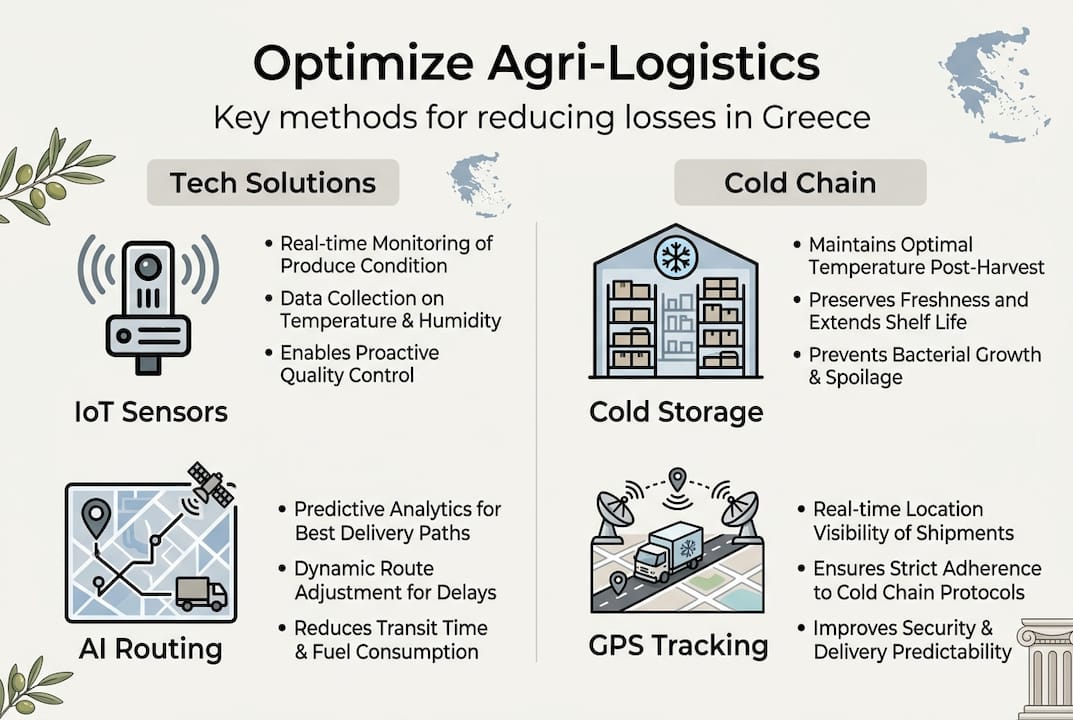
- Cold chain management: Maintaining consistent temperature from harvest to delivery is non-negotiable for perishables like fruits, vegetables, and dairy. Even short breaks in the cold chain cause measurable quality loss.
- AI-powered route optimization: Software that calculates the fastest, most fuel-efficient delivery routes in real time reduces both costs and delivery times significantly.
- GPS fleet tracking: Real-time vehicle monitoring lets you respond immediately to delays, reroute drivers, and provide accurate delivery estimates to buyers.
- IoT sensor networks: Sensors placed in storage facilities and transport vehicles monitor temperature, humidity, and vibration, alerting operators before conditions cause damage.
- Blockchain traceability: A shared digital ledger that records every step in the supply chain, making it easier to verify product origin and quality for export markets.
- Predictive analytics: Using historical data to forecast demand, optimize stock levels, and schedule maintenance before equipment failures disrupt operations.
Cold chain, AI routing, and IoT sensors are now recognized as the leading methods for agricultural logistics optimization globally.
| Method | Cost level | Implementation speed | Best for |
|---|---|---|---|
| GPS tracking | Low | Fast | Transport fleets |
| IoT sensors | Medium | Medium | Storage facilities |
| AI route optimization | Medium | Medium | Distribution networks |
| Blockchain traceability | High | Slow | Export-focused operations |
Pro Tip: Start with IoT sensors in agriculture for your cold storage units before investing in more complex systems. The data you collect will justify and guide every subsequent technology decision. You can also benchmark your spoilage rates against the global 13% food loss figure to measure your actual improvement over time. Explore digital logistics innovations to understand what tools are already being adopted across the sector.
Balancing resilience, cost, and sustainability: Transport mode comparisons
Having discussed logistics optimization methods, now we’ll weigh practical decisions on transport modes. This is where many Greek agribusinesses make expensive assumptions.
The three primary transport modes each come with distinct tradeoffs:
- Road (highways): Highly flexible and widely available in Greece, but expensive per ton-kilometer and carrying significant emissions. Road transport offers high redundancy, meaning alternative routes exist when one is blocked.
- Rail: Lower cost and lower emissions than road, with better capacity for bulk goods. Greece’s rail network is limited in rural areas, but it remains a viable option for certain corridors.
- Waterways: The lowest cost and lowest emissions option per ton-kilometer, but with limited flexibility and slower delivery times. Greece’s island geography makes coastal shipping relevant for specific routes.
Research on transport mode emissions and costs shows that highways carry cost and emissions 60 to 1,000 times higher than waterways, while railways sit in the middle ground. That’s a striking gap that most logistics planners underestimate.
| Transport mode | Relative cost | Emissions | Redundancy | Greek availability |
|---|---|---|---|---|
| Road | High | High | High | Widespread |
| Rail | Medium | Medium | Medium | Limited rural access |
| Waterway | Low | Low | Low | Coastal and island routes |
“Resilience and sustainability are not opposites. A well-designed multimodal network can achieve both, but it requires deliberate planning rather than defaulting to the most familiar option.”
For most Greek agribusinesses, a multimodal approach combining road for last-mile delivery with rail or coastal shipping for longer hauls offers the best balance. The key is mapping your specific routes against available infrastructure. Check logistics infrastructure in Greece for current options relevant to your region.
Trends and future directions in Greek agrilogistics
As transport mode choices evolve, let’s look forward to future trends transforming Greek agricultural logistics. Several forces are reshaping the sector right now, and early movers will have a clear advantage.
Clustering initiatives are gaining momentum. The AgriLogistiCluster program between Greece and Italy is a practical model for shared infrastructure, where multiple businesses pool resources for storage, transport, and distribution. This reduces per-unit costs and improves bargaining power with carriers.
Key trends shaping Greek agrilogistics in 2026:
- Green logistics adoption driven by EU Common Agricultural Policy (CAP) requirements and export market expectations
- Digitalization of supply chain records for traceability and compliance
- Educational programs targeting logistics managers in the agricultural sector
- Clustering models that allow smaller producers to access infrastructure previously available only to large operators
- Drone and autonomous vehicle pilots for last-mile rural delivery
Statistic to watch: Infrastructure deficiencies in cereal logistics remain one of Greece’s most persistent supply chain weaknesses, with limited dedicated storage and handling facilities outside major urban centers.
The EU’s CAP framework is pushing Greek producers toward greener, more documented supply chains. That’s both a compliance requirement and a market opportunity. Buyers in northern Europe increasingly demand verified sustainability credentials, and Greek producers who build that traceability now will have a competitive edge. Follow agrilogistics trends in Greece to stay current as these developments unfold.
What Greek agribusinesses often overlook in logistics
Most discussions about agricultural logistics focus on what to do. Fewer address what Greek businesses consistently fail to prioritize, and why that gap is so costly.
The biggest blind spot is treating logistics as a fixed cost rather than a variable that can be actively managed. When a refrigerated truck breaks down mid-route, the loss isn’t just the repair bill. It’s the spoiled cargo, the missed delivery window, and the buyer relationship that takes months to rebuild. That’s the real cost of deferred maintenance and poor contingency planning.
Research specifically focused on Greek agribusiness logistics confirms that cold chain investment, green logistics practices, clustering, and AI-driven tools are the highest-leverage areas for efficiency gains. Yet adoption remains low among small and mid-size operators.
The second overlooked area is export resilience. Greek producers who rely on a single transport route or a single cold storage facility are one disruption away from significant losses. Multimodal planning and digital traceability aren’t luxuries for exporters. They’re baseline requirements.
Pro Tip: Invest in predictive analytics before you need it. Knowing that a storage unit is trending toward failure or that a route will be congested next week is worth far more than reacting after the damage is done. Pair that with precision agriculture expertise to build a data-driven operation from field to market.
Connect with expert solutions for your logistics needs
Applying these insights can be easier with the right support and tools. Here’s where your next steps begin.
At Pexlivanidis, we work directly with Greek agricultural professionals who need reliable equipment to keep their supply chains moving. A logistics strategy is only as strong as the machinery behind it. Explore our B2B agricultural solutions for wholesale access to over 20,000 parts, or browse our full range of agricultural machinery parts to find what your operation needs. If you’re focused on reducing downtime, our machinery maintenance guide gives you a practical framework for keeping equipment in peak condition. Free shipping within Greece applies to orders over 100€.
Frequently asked questions
What are the main logistics activities in the agricultural supply chain?
Key activities include transportation, warehousing, inventory management, and order processing to move products efficiently from farm to market. Each activity must work in sync to prevent delays, waste, or cost overruns.
How can Greek agribusinesses reduce post-harvest losses?
By investing in cold chain technology, IoT sensors, and route optimization, losses can be reduced significantly. These tools address the most common failure points in perishable supply chains.
What transport modes offer the best balance between cost and sustainability?
Railways usually provide a middle ground, balancing cost, emissions, and redundancy. Research confirms that highways carry emissions 60x to 1,000x higher than waterways, making rail the practical compromise for most Greek corridors.
What is agrilogistics clustering and how can it help Greek agricultural businesses?
Clustering provides shared infrastructure, reduces per-unit costs, and enables smarter, greener logistics practices for local businesses. It’s especially valuable for smaller producers who can’t afford dedicated logistics infrastructure on their own.