

TL;DR:
- A structured spare parts workflow helps farmers and repair services keep machinery operational with minimal downtime and cost.
- Using classification systems and CMMS integration ensures efficient inventory management, accurate forecasting, and reduced emergency orders.
A spare parts selection workflow is defined as the structured process of identifying, classifying, sourcing, and procuring the correct parts to keep agricultural machinery running without costly interruptions. For tractor operators and repair services, this process is the difference between a machine back in the field within hours and one sitting idle for days. A well-structured procurement process follows a defined 7-step framework covering everything from work order creation to final receipt and inspection. Classification standards like ABC analysis and VED (Vital, Essential, Desirable) analysis give operators a data-driven way to prioritize which parts to stock and which to order on demand. Getting this process right cuts both downtime and unnecessary inventory costs at the same time.
What are the key steps in a spare parts selection workflow?
A structured spare parts selection process begins with a work order. The work order documents the equipment, the fault or scheduled task, and the parts likely needed. Every step after that builds on this record, creating a data trail that supports better forecasting over time.
The 7-step procurement framework breaks down as follows:
- Work order creation. The technician or operator logs the maintenance need, triggering the parts process. Without this trigger, procurement becomes reactive and disorganized.
- Part identification and specification. Identify the exact part by OEM number, dimensions, and any acceptable substitutes. Vague identification at this stage causes wrong deliveries and wasted time.
- Inventory check and reservation. Check current stock levels before placing any external order. If the part is available, reserve it against the work order immediately.
- Requisition and approval. Submit a formal requisition for parts not in stock. Managerial approval at this stage controls spending and prevents unauthorized purchases.
- Supplier selection and RFQ. Send a request for quotation (RFQ) to approved suppliers. Compare price, lead time, and part quality before committing.
- Purchase order management. Issue a formal purchase order once a supplier is selected. The PO creates a binding record and simplifies invoice matching later.
- Receipt and quality inspection. Inspect every incoming part against the original specification before it enters stock or goes directly to the job. A part that fails inspection at this stage costs far less than one that fails in the field.
Each step generates a data record. Over months, those records reveal which parts fail most often, which suppliers deliver on time, and where your stock levels are consistently wrong.
Pro Tip: Link every work order to a specific machine ID in your records. This single habit makes demand forecasting far more accurate and reduces emergency orders significantly.

How to classify spare parts inventory using the VED-ABC-XYZ matrix
Classification is the foundation of any efficient parts selection process. Treating every part the same, whether it is a tractor filter or a gearbox shaft, wastes both capital and storage space.
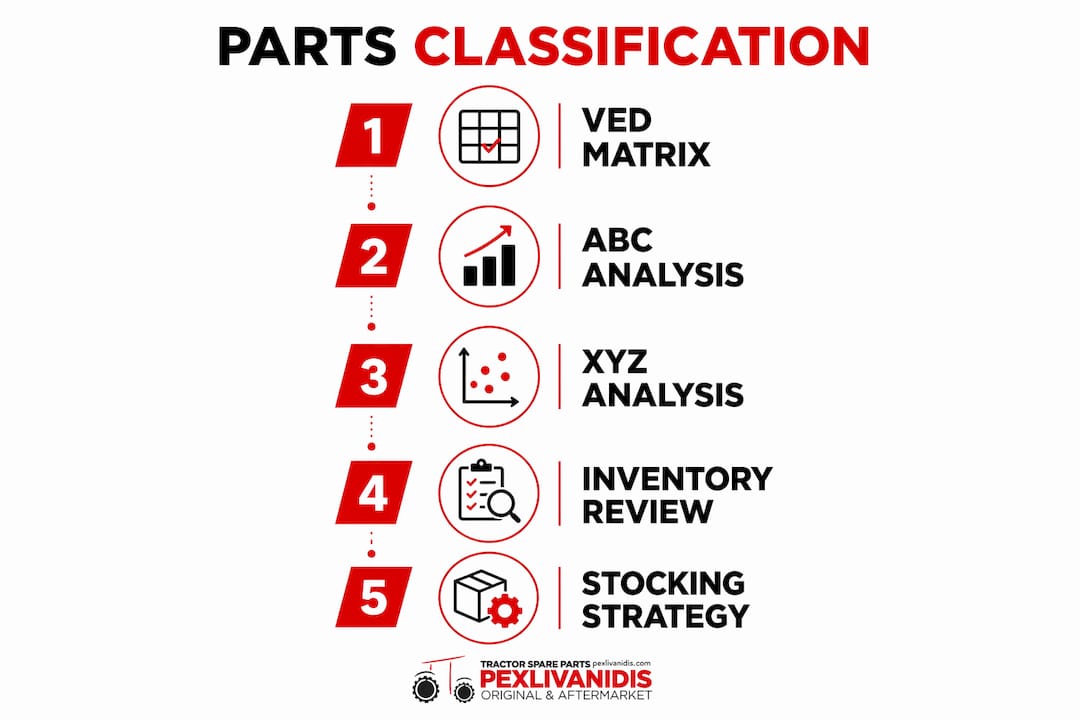
The VED-ABC-XYZ matrix combines three separate analyses into one prioritization system:
ABC analysis ranks parts by total annual spend. A-class parts represent roughly 80% of inventory value but only 20% of items. These parts demand tight control, frequent review, and accurate reorder points. B-class parts sit in the middle. C-class parts are low value but often high volume, such as bolts, seals, and filters.
VED analysis ranks parts by operational criticality. Vital parts cause an immediate machine stoppage if unavailable. A vital part on a combine harvester during harvest season requires a near 100% service level, regardless of cost. Essential parts cause a partial slowdown. Desirable parts can wait without halting operations.
XYZ analysis ranks parts by demand predictability. X-class parts have stable, predictable demand and suit continuous replenishment. Y-class parts have seasonal or variable demand. Z-class parts are consumed irregularly and are the hardest to stock efficiently.
Combining all three dimensions produces a stocking policy for every part in your catalog:
| Classification | Stocking approach | Review frequency |
|---|---|---|
| AV-X (high value, vital, predictable) | Hold safety stock, tight reorder points | Weekly |
| CV-Z (low value, vital, unpredictable) | Hold buffer stock regardless of cost | Monthly |
| AD-Y (high value, desirable, variable) | Order on demand, minimize stock | Quarterly |
| CE-X (low value, essential, predictable) | Bulk order, low review frequency | Quarterly |
The practical benefit is clear. Data-driven classification reduces dead stock tying up capital while preventing stockouts that cause costly downtime. Operators who skip classification end up either over-ordering cheap parts or running out of critical ones at the worst possible moment.
How can CMMS software improve your parts procurement workflow?
A Computerized Maintenance Management System (CMMS) is software that connects maintenance schedules, work orders, and parts inventory in one place. Without this connection, inventory and maintenance planning operate in separate silos, and that gap wastes time and money.
Integrating CMMS with procurement removes the manual steps that slow down parts ordering and create errors. The key benefits for agricultural operators include:
- Automated reorder triggers. When stock drops below a set threshold, the system generates a purchase requisition automatically. No one has to remember to check the shelf.
- PM-based demand forecasting. Linking parts to equipment and preventive maintenance (PM) schedules lets the system predict which parts will be needed before the job is due.
- Real-time stock visibility. Technicians see live inventory levels when creating work orders, which prevents duplicate orders and unnecessary purchases.
- Reduced administrative workload. CMMS integration cuts administrative labor by 5–10%, freeing technicians to focus on repairs rather than paperwork.
- Faster quotation generation. Automated systems generate supplier quotes within minutes rather than hours or days, accelerating the entire parts procurement workflow.
The long-term payoff compounds. Every work order completed through the system adds to a dataset that makes future forecasting more accurate. After one full season of tracked data, patterns emerge: which parts fail at harvest time, which suppliers consistently miss lead times, and which machines consume parts faster than expected.
Pro Tip: Set reorder points based on actual supplier lead times, not catalog estimates. Audit your lead time data every quarter and adjust reorder points accordingly.
What technical risks come with selecting equivalent spare parts?
Selecting an equivalent part is not simply a matter of finding something that fits. Equivalent part selection is a technical risk management task that requires verifying multiple dimensions of compatibility before the part goes anywhere near a machine.
The verification checklist must cover:
- Mechanical dimensions. Length, diameter, thread pitch, and tolerances must match exactly. A part that is close but not correct will wear faster or fail under load.
- Material specifications. A seal made from the wrong compound will degrade in contact with hydraulic fluid or fertilizer chemicals. Material matters as much as shape.
- Electrical ratings. For sensors, solenoids, and control modules, voltage, current, and signal type must match the OEM specification precisely.
- Operational conditions. Temperature range, pressure rating, and duty cycle all affect whether a substitute part will last as long as the original.
- Safety certifications. Some parts carry regulatory or safety ratings. Using an uncertified substitute can void machine warranties and create liability.
Prioritize OEM specifications whenever possible. When a substitute is necessary, document the approved equivalent in your parts catalog with the verification steps completed. An undocumented substitution that works once creates a dangerous precedent when a different technician repeats it without checking.
The consequences of skipping this process are severe. A wrong hydraulic seal on a tractor can cause fluid loss under pressure. A mismatched sensor on a planting unit can throw off seed rates across an entire field. The cost of a failed equivalent part is never just the part itself. It includes the labor, the downtime, and sometimes the crop damage that follows.
What common mistakes do operators make in spare parts selection and management?
The most expensive mistake in parts management is treating all parts equally. The second most expensive is buying on price alone without considering Total Cost of Ownership (TCO). A cheaper filter that fails twice as often costs more in labor and downtime than a premium one that lasts the full service interval.
Operators who want to sharpen their parts interchangeability practices and reduce downtime should avoid these recurring errors:
- Failing to link parts to specific machines. Without this link, you cannot forecast demand by equipment or catch patterns in premature failures.
- Ignoring supplier performance data. Lead time promises and actual delivery times often differ. Operators who do not track this end up with inaccurate reorder points and surprise stockouts.
- Overstocking low-criticality parts. Buying excess C-class parts ties up cash that should be reserved for safety stock on vital components.
- Skipping standardization. When the same function is served by three different part numbers across your fleet, you carry three times the stock. Standardizing parts across machines cuts inventory complexity sharply.
- Relying on memory instead of automated alerts. Automated reorder triggers and PM-linked procurement remove the human error that causes both stockouts and over-ordering.
A practical starting point is a farm machinery maintenance workflow that connects scheduled maintenance tasks directly to parts consumption records. When you know which parts a 200-hour service requires, you can pre-order them two weeks in advance and eliminate emergency freight costs entirely.
Key Takeaways
A structured spare parts selection workflow, combining a defined procurement process, classification matrices, and CMMS integration, is the most effective way to reduce agricultural machinery downtime and control inventory costs.
| Point | Details |
|---|---|
| Follow the 7-step process | Work order creation through receipt and inspection creates data records that improve forecasting over time. |
| Apply VED-ABC-XYZ classification | Classify every part by value, criticality, and demand predictability to set precise stocking policies. |
| Integrate CMMS with procurement | Automation cuts administrative labor by 5–10% and eliminates most emergency orders. |
| Verify equivalent parts fully | Check mechanical, material, electrical, and safety specs before accepting any substitute part. |
| Track TCO, not just price | Cheaper parts with higher failure rates cost more over a full season than premium alternatives. |
What I have learned from watching operators get this wrong
Working closely with agricultural machinery operators across northern Greece, the pattern I see most often is not ignorance of the right process. It is the belief that a formal workflow is something large operations need, not a 10-tractor family farm. That belief is expensive.
The operators who struggle most are the ones who keep parts knowledge in their heads rather than in a system. When the person who knows which filter fits which tractor is unavailable, the whole operation slows down. A simple parts catalog linked to machine IDs solves this completely, and it takes one afternoon to set up.
The second thing I have noticed is that price-driven purchasing feels disciplined but often is not. Buying the cheapest available seal for a hydraulic cylinder looks like good cost control until it fails during planting season. TCO thinking is not complicated. It just requires asking one extra question: how long will this part actually last under real working conditions?
The operators who run the tightest, most reliable fleets are not the ones with the biggest budgets. They are the ones who have taken the time to classify their parts, link them to their machines, and set up even basic automated alerts. The workflow does not need to be perfect from day one. It needs to exist and improve with each season.
— George
Pexlivanidis: parts and guidance for your agricultural fleet
Pexlivanidis carries over 20,000 agricultural machinery parts, including tractor accessories and components for a wide range of farm equipment. Whether you are building out a structured procurement process or sourcing a specific replacement part, the catalog covers both retail and wholesale needs. The essential types of agricultural parts guide helps operators identify exactly what they need before placing an order. For operators focused on keeping equipment in peak condition, the agricultural machinery maintenance guide connects maintenance planning directly to parts selection decisions. Wholesale B2B accounts are available for repair services and fleet operators who need consistent supply at volume pricing.
FAQ
What is a spare parts selection workflow?
A spare parts selection workflow is a defined process for identifying, classifying, sourcing, and procuring the correct parts for a specific machine and maintenance task. It typically follows a 7-step structure from work order creation through receipt and quality inspection.
How does ABC analysis apply to agricultural spare parts?
ABC analysis ranks parts by annual spend: A-class parts represent roughly 80% of inventory value and require tight stock control, while C-class parts are low value and can be ordered in bulk with less frequent review.
What does VED stand for in parts classification?
VED stands for Vital, Essential, and Desirable. Vital parts cause an immediate machine stoppage if unavailable, Essential parts cause a partial slowdown, and Desirable parts can wait without halting operations.
How does CMMS reduce emergency spare parts orders?
CMMS links parts inventory to maintenance schedules and generates automated reorder alerts when stock drops below set thresholds, preventing stockouts before they trigger emergency purchases.
When is it safe to use an equivalent spare part?
An equivalent part is safe to use only after verifying that it matches the OEM specification across mechanical dimensions, material composition, electrical ratings, operational conditions, and any applicable safety certifications.