

TL;DR:
- Walking tractors outperform larger machines in Greek small, irregular, and steep terrains.
- Proper PTO safety and overload protection are essential to prevent injuries and equipment damage.
- Versatile attachments and maintenance maximize productivity and lifespan of the walking tractor.
Walking-type agricultural tractors have a reputation problem. Many farmers assume they belong to a past era, replaced by bigger, more powerful machines. That assumption costs real money. Across Greece, from the olive groves of Crete to the terraced vineyards of northern Macedonia, walking tractors are quietly outperforming their ride-on cousins in the fields where it matters most. This guide covers how to select the right machine, use it safely with powered implements, protect your equipment from overload damage, and choose the accessories that will give your operation a genuine edge.
Table of Contents
- What is a walking type agricultural tractor?
- Key productivity benefits for Greek farmers
- PTO safety and proper implement use
- Overload protection: Shear bolts and slip clutches
- Choosing and maintaining the right accessories
- Walking tractors: What most guides miss
- Maximize your farm’s potential with the right tools
- Frequently asked questions
Key Takeaways
| Point | Details |
|---|---|
| Strong safety practices | Always engage PTO shields and disengage equipment for safe operation and servicing. |
| Use overload protection | Install and maintain shear bolts or slip clutches to prevent gearbox damage in challenging field conditions. |
| Choose smart accessories | Select compatible, task-appropriate implements for walking tractors to maximize farm productivity. |
| Regular maintenance pays | Routine inspection and care of both tractor and attachments ensures reliable performance and prolonged life. |
What is a walking type agricultural tractor?
A walking tractor, also called a walk-behind tractor or two-wheel tractor, is a compact, single-axle machine where the operator walks behind and steers using two handlebar arms. The engine drives the rear wheels, and a power take-off (PTO) shaft at the front or rear powers attached implements. Unlike a ride-on tractor, there is no cab, no seat, and no complex transmission system to maintain.
This simplicity is the point. A walking tractor weighs between 100 and 400 kilograms depending on the model, which means it can enter spaces a standard tractor cannot. Narrow vineyard rows, steep hillside terraces, and small vegetable plots that would stop a 60-horsepower machine in its tracks are perfectly suited for a well-configured walk-behind unit.
The key difference from conventional tractors is not just size. It is field access. Greek agriculture is defined by fragmented landholdings, with many farms covering just 1 to 5 hectares split across several plots. A ride-on tractor often cannot turn efficiently in tight spaces without damaging crops. A walking tractor pivots almost on the spot.
Walking tractors vs. ride-on tractors: a quick comparison
| Feature | Walking tractor | Ride-on tractor |
|---|---|---|
| Purchase cost | Low (€1,500 to €6,000) | High (€15,000 and up) |
| Fuel consumption | Very low | Moderate to high |
| Field access | Narrow rows, slopes, terraces | Open, flat fields |
| Operator fatigue | Higher over long shifts | Lower |
| Maintenance complexity | Simple | Complex |
| Attachment versatility | High | Very high |
Tasks where walking tractors excel:
- Soil cultivation and rotavation in small plots
- Inter-row weeding in vineyards and orchards
- Spraying in tight canopy conditions
- Hilling and furrowing for vegetable crops
- Transporting small loads with a trailer attachment
- Sowing and seeding in narrow-row configurations
The machine is not a compromise. For the right terrain and scale, it is the correct tool.
Key productivity benefits for Greek farmers
Greek farmland is not flat, uniform, or forgiving. Rocky hillsides, narrow terraces, and small irregular plots define much of the country’s agricultural geography. This is exactly where walking tractors earn their place.
Maneuverability on challenging terrain. A walking tractor can work on slopes up to 25 to 30 degrees, which covers a significant portion of Greek vineyard and olive grove land. Ride-on machines risk tipping on these gradients. Walk-behind units stay low and stable, letting you work confidently on ground that would otherwise require hand labor.
Lower investment and running costs. The initial purchase price of a quality walking tractor is a fraction of a ride-on model. Fuel consumption is dramatically lower, typically 1 to 2 liters per hour versus 5 to 10 liters for a mid-range ride-on unit. Spare parts are simpler, cheaper, and more available. For a small farm operation, this cost structure makes a real difference to annual margins.
Attachment versatility across the season. One walking tractor can handle cultivation in spring, spraying in summer, and harvesting assistance in autumn by switching implements. Rotavators, ridgers, sprayers, mowers, and trailers all connect to the same machine. This multi-season use maximizes the return on your investment.
Durability in Mediterranean conditions. Quality walking tractors are built for variable conditions. They handle the dry, dusty summers of the Greek lowlands and the wet, muddy winters of northern regions without the complex sealing and cooling systems that larger machines require.
“Two-wheel tractors are increasingly recognized as a high-efficiency solution for smallholder and fragmented-plot farming, offering labor-saving benefits comparable to larger machinery at a fraction of the operating cost.” — Agricultural mechanization research, FAO
How Greek farmers use walking tractors by crop type:
- Olives: Inter-row cultivation, grass management, and transport of harvested fruit in trailers
- Vines: Soil tillage between rows, spraying for disease control, and green cover management
- Vegetables: Bed preparation, furrowing, seeding, and irrigation channel maintenance
- Cereals (small plots): Soil preparation and light harvesting support
The machine adapts to the crop, not the other way around. That flexibility is worth more than raw horsepower on most Greek farms.
PTO safety and proper implement use
The power take-off (PTO) is the rotating shaft that transfers engine power to an attached implement such as a rotavator or sprayer pump. It is the most productive feature of a walking tractor. It is also the most dangerous if not handled correctly.
PTO entanglement injuries are severe and happen fast. Loose clothing, an unguarded shaft, or a moment of inattention can cause a wrap-point injury in less than a second. Understanding the risks and following a clear safety routine is not optional.
PTO safety checklist for walking tractor operators:
- Inspect the PTO shaft guard before every use. Replace cracked or missing guards immediately.
- Disengage the PTO completely before connecting or disconnecting any implement.
- Never step over or reach across a rotating PTO shaft, even briefly.
- Wear close-fitting clothing. Avoid loose sleeves, scarves, or untied laces near the PTO zone.
- Switch off the engine and wait for the shaft to stop completely before servicing any implement.
- Check that the implement is fully and correctly coupled before engaging the PTO.
- Keep bystanders, especially children, well away from the operating area.
PTO safety guidance emphasizes keeping shields and guards in place at all times, disengaging the PTO before any servicing, and never approaching a rotating driveline. This applies directly to the compact driveline setups common on walking tractors.
The same research on PTO hookup safety confirms that functional driveline shields and consistent disengagement practices are the primary defenses against entanglement and wrap-point hazards. These are not suggestions. They are the baseline.
For a deeper understanding of how the PTO system works on your machine, the tractor PTO explained guide covers the mechanics clearly. Pairing that knowledge with a solid preventative maintenance for tractors routine keeps both the machine and the operator safe.
Pro Tip: Before each work session, spend 60 seconds doing a visual walk-around of the PTO connection. Look for cracks in the guard, loose coupling pins, and any debris caught around the shaft. This habit catches problems before they become injuries.
Overload protection: Shear bolts and slip clutches
Greek fields are full of hidden obstacles. Buried rocks, old root systems, and compacted soil ridges can all cause a sudden spike in resistance on a rotating implement. Without protection, that shock load travels straight into the gearbox and PTO components, causing expensive damage.
Overload protection devices prevent this. The two most common types are shear bolts and slip clutches.
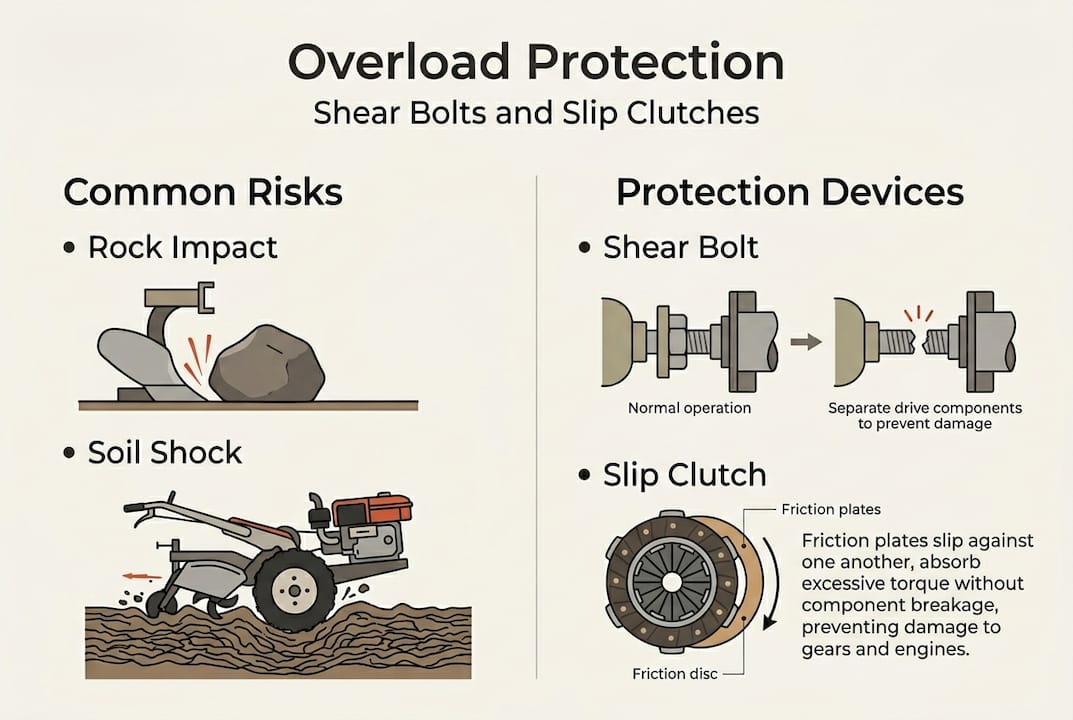
How they work. Shear bolts and slip clutches protect gearboxes by disconnecting the implement from the PTO drive when force exceeds a safe limit. A shear bolt is a specially rated fastener designed to break at a specific load. When it breaks, the implement stops turning, protecting everything behind it. A slip clutch uses friction plates that slip under overload, then re-engage automatically once the obstruction clears.
How overload protection works in a real task:
- You engage the PTO and begin rotavating a plot.
- The rotavator tines hit a buried rock with sudden force.
- The torque spike reaches the shear bolt in the driveline.
- The bolt breaks, disconnecting the implement from the drive.
- You stop the tractor, clear the obstruction, replace the shear bolt, and resume work.
This sequence saves your gearbox. Without the shear bolt, that same torque spike would transfer directly into the gearbox housing, potentially cracking it or stripping internal gears.
Overload protection is essential in rocky or obstacle-prone fields precisely because impacts transmit shock into gearbox components with no warning. In Greece’s stony soils, this is not a rare scenario. It is a regular working condition.
Always use the shear bolt specification listed in your implement’s manual. Using a stronger bolt to “avoid breakage” defeats the entire purpose and transfers the damage to far more expensive components.
Warning signs that a shear bolt needs immediate replacement:
- Visible deformation or bending of the bolt
- Implement stops turning during normal operation
- Unusual vibration or noise from the driveline
- Any recent impact with a hard obstacle
For guidance on keeping your entire drivetrain in working order, keeping your tractor in perfect condition is a practical resource worth bookmarking.
Pro Tip: In rocky fields, carry a small pouch of the correct replacement shear bolts in your tool kit. When a bolt breaks mid-task, you can swap it in minutes and keep working rather than losing half a day to a parts run.
Choosing and maintaining the right accessories
The walking tractor itself is only half the equation. The implement you attach determines what you can actually accomplish. Choosing the right accessory for each task and keeping it in good condition is where productivity is either gained or lost.
Must-have attachments for Greek farm operations:
- Rotavator: The most versatile implement. Breaks up compacted soil, incorporates organic matter, and prepares seedbeds. Essential for vegetable and grain plots.
- Sprayer: Boom or knapsack-style sprayers driven by the PTO pump allow precise application of fungicides and pesticides in vineyards and orchards.
- Ridger/furrower: Creates planting rows for potatoes, onions, and other root vegetables with consistent depth and spacing.
- Trailer: A small two-wheel trailer converts the walking tractor into a transport tool for harvested produce, tools, and supplies.
- Mower: Flail or rotary mowers manage grass and cover crops in orchards and along field margins.
Matching the tool to the task. A rotavator set too deep will bog down a lower-horsepower walking tractor and stress the PTO. A sprayer pump that draws more power than the engine can supply will reduce spray pressure and give uneven coverage. Always check the horsepower requirement of any implement against your tractor’s rated output before purchasing.
Pro Tip: When adding a new attachment, check both the power requirement and the total weight. A heavy implement on a light walking tractor shifts the balance point and makes the machine harder to control, especially on slopes.
Maintenance steps for walking tractor accessories:
- Clean all implements after each use to prevent soil and chemical buildup
- Lubricate moving parts including chains, bearings, and pivot points according to the manufacturer’s schedule
- Inspect blades, tines, and cutting edges for wear and replace before they become ineffective
- Check all bolts and fasteners for tightness before each use
- Store implements off the ground on stands or hooks to prevent rust and warping
- Flush sprayer tanks and lines thoroughly after every chemical application
Consistent maintenance extends the life of your implements significantly. A well-maintained rotavator can last 15 years or more. A neglected one may need replacement in five. For a broader view of how maintenance choices affect your entire fleet, ways to extend tractor life offers concrete strategies.
Walking tractors: What most guides miss
Most articles on walking tractors focus on specs and attachments. What they miss is the strategic value of these machines in the context of Greek agriculture specifically.
We see this regularly: a farmer invests in a larger ride-on tractor because it feels like an upgrade, then finds it cannot access half of their plots. The walking tractor they traded away was actually the more productive machine for their land. Bigger is not always better. It is often just more expensive to run and harder to maneuver.
The real advantage of a walking tractor is not any single feature. It is the combination of low cost, high access, and attachment flexibility that makes it irreplaceable on fragmented Greek farmland. Understanding tractor PTO basics and pairing that knowledge with proper safety habits and the right implements turns a simple machine into a serious productivity tool.
The farmers who get the most from these machines are the ones who treat them seriously, maintain them consistently, and match every implement choice to the actual conditions of their fields.
Maximize your farm’s potential with the right tools
Putting this knowledge into practice starts with having access to the right parts and the right information. At pexlivanidis.com, you will find an extensive agricultural machinery parts guide that helps you identify exactly what your walking tractor needs for each season and task. The tractor accessory installation guide walks you through fitting implements correctly so you get full performance from day one. And if you are still deciding which attachments to prioritize, the guide to choosing tractor accessories gives you a clear framework. With over 20,000 parts in stock and free shipping across Greece for orders over 100€, the right support is always close.
Frequently asked questions
What makes a walking tractor a good choice for Greek farms?
Walking tractors offer excellent maneuverability and adaptability for Greece’s small, uneven fields, making them highly practical for specialty crops like olives, vines, and vegetables.
How do I prevent PTO injuries when using implements?
Always disengage the PTO and ensure shields and guards are in place before servicing or connecting any implement on your walking tractor.
What does a shear bolt do in my walking tractor’s PTO?
A shear bolt is designed to break at a set load, protecting your tractor’s gearbox from damage. Shear bolts protect gearboxes by disconnecting the implement from the PTO drive during sudden overloads.
How often should I replace shear bolts or check PTO accessories?
Check shear bolts and PTO accessories before each use. Impacts transmit shock into gearbox components, so replace any bolt that shows deformation or breaks during operation immediately.
What are the most essential accessories for walking tractors in Greece?
Rotavators, sprayers, ridgers, trailers, and mowers are the most commonly used attachments, covering the major tasks required for olives, vines, and vegetable production across Greek farms.