

TL;DR:
- Choosing the right tractor type and size tailored to specific farm needs improves efficiency and cost savings. Regular preventive maintenance, especially in Greece’s demanding conditions, significantly extends machinery lifespan and reduces downtime. Consistent small routine checks are crucial for maximizing tractor performance and avoiding costly breakdowns.
Many Greek farmers run one tractor for every job on the farm, from plowing clay-heavy fields in Macedonia to navigating the narrow rows of an olive grove in Crete. That one-size-fits-all approach quietly costs money every season. The right tractor type, paired with the correct implements and a simple daily maintenance routine, can meaningfully increase the acreage you cover, reduce fuel burn, and extend machine life by years. This guide walks you through the core tractor categories, the accessories that matter most, and the maintenance habits that keep your equipment earning rather than sitting idle in the shed.
Table of Contents
- What is a tractor and why does it matter?
- Different types of tractors: Matching the machine to the task
- Essential tractor accessories: Tools for every season
- Maintenance for maximum uptime: Practical tips for Greek farms
- Why small wins in tractor care create big advantages
- Your next step: Get more from your tractor investment
- Frequently asked questions
Key Takeaways
| Point | Details |
|---|---|
| Not all tractors are alike | Choosing the right tractor for your farm’s size and needs is essential for productivity. |
| Accessories drive efficiency | The right implements for each season can expand your tractor’s usefulness and save time. |
| Regular, Greek-specific maintenance matters | Frequent checks and using OEM parts increase uptime, cut costs, and boost farm efficiency. |
| Small habits, big impact | Daily 5-10 minute checks can prevent major breakdowns and increase tractor lifespan. |
What is a tractor and why does it matter?
At its most basic, a tractor is a purpose-built farm vehicle designed to deliver pulling force at low speeds. A full tractor definition describes it as “an engineering vehicle designed for high pulling power at low speeds for tasks like plowing, tilling, and hauling.” That pulling force, called drawbar pull or tractive effort, is what separates a tractor from any other vehicle on your property.
On Greek farms, tractors are almost never optional. They plow, plant, spray, and move materials across terrain that ranges from flat coastal plains to steep Macedonian hillsides. Without the right machine, those tasks either take far longer or simply cannot be done safely.
Here is what a modern tractor actually handles on a typical Greek farm:
- Tillage: Breaking up and aerating soil before planting
- Planting and seeding: Operating seeders and fertilizer spreaders
- Crop protection: Pulling sprayers through vineyards and orchards
- Material transport: Moving harvested goods and supplies around the property
- Implements: Powering attachments via the power take-off (PTO) shaft
“Choosing the wrong tractor for your land is like using a lorry to navigate a goat path. The machine fights the terrain instead of working with it.”
Modern tractors are modular by design. That means one chassis can accept a front-end loader, a rear three-point hitch implement, and a mid-mount mower, all in the same week. For Greek farmers managing mixed operations, this flexibility is enormous. Check out these tractor performance tips to get the most out of whatever machine you already own.
The bottom line is simple: a tractor is not just a vehicle. It is the central hub around which every other piece of farm equipment rotates.
Different types of tractors: Matching the machine to the task
Common agricultural tractor types include utility, row crop, compact, high-horsepower, and specialty tractors, each built for different farm sizes and tasks. Picking the wrong category means either overpaying for power you cannot use, or underpowering a job that needs more muscle.
Here is a quick comparison to guide your thinking:
| Tractor type | Horsepower range | Best for |
|---|---|---|
| Compact | 20 to 50 HP | Small plots, orchards, greenhouses |
| Utility | 45 to 130 HP | Mixed-use Greek farms, general tillage |
| Row crop | 100 to 200 HP | Corn, sunflower, sugar beet fields |
| High-horsepower | 200 HP and up | Large-scale grain operations |
| Specialty | 40 to 100 HP | Vineyards, olive groves, narrow rows |
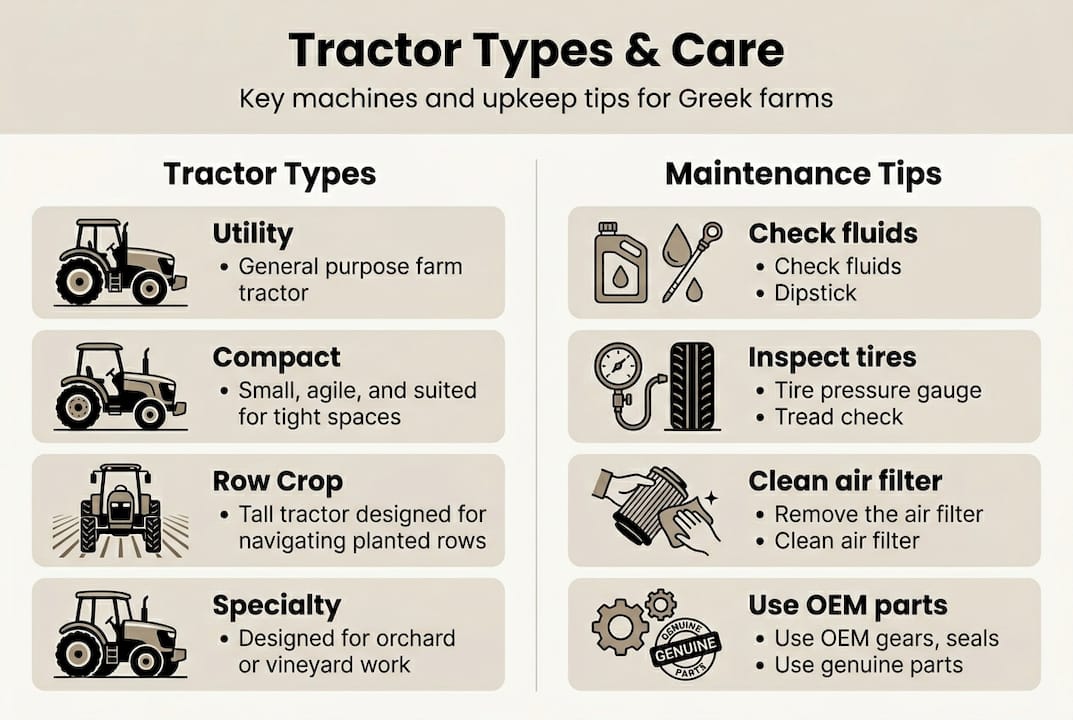
For most Greek farmers, the utility tractor is the workhorse. It handles plowing, mowing, transport, and light loader work without burning excessive diesel. Specialty tractors deserve special attention here. Greece has over 300,000 hectares of vineyards, and a standard utility tractor is often too wide to pass between rows. A narrow-body specialty tractor solves that problem immediately.
Key buying considerations before you commit:
- Current acreage and crop mix: A 40-hectare olive farm needs very different power than a 200-hectare wheat operation.
- Terrain: Hillside farms in Epirus or Crete need better weight distribution and four-wheel drive.
- Available implements: Make sure your chosen tractor’s PTO and three-point hitch match the implements you already own or plan to buy.
- Future growth: Buy for where you expect to be in five years, not just today.
Pro Tip: Do not overbuy. A 200 HP tractor on a 30-hectare farm wastes fuel, increases maintenance costs, and can compact your soil more than a lighter machine. Match engine size to your actual operating needs.
Essential tractor accessories: Tools for every season
A tractor without the right implements is like a socket wrench without sockets. The machine provides the power, but accessories convert that power into real farm work. Key implements like front-end loaders, plows, tillers, harrows, seeders, sprayers, mowers, backhoes, balers, and pallet forks are crucial for the full range of farming tasks.
Here is how the most important accessories map to seasonal work:
- Plow or subsoiler: Fall primary tillage, breaking compaction layers
- Rotary tiller or disc harrow: Spring seedbed preparation
- Seeder or combined seeder-fertilizer: Planting season efficiency
- Boom sprayer: Crop protection from spring through harvest
- Front-end loader: Year-round material handling, manure moving, loading
- Mower or mulcher: Orchard and vineyard floor management
- Baler: Post-harvest straw and hay management
Pro Tip: Combine implements where possible. A seeder with an integrated fertilizer hopper lets you plant and feed the crop in one pass, cutting fuel use and field hours by up to 40% compared to doing both tasks separately.
The real gains show up in daily acreage numbers. A properly matched tiller can prepare two to three times more land per day than a plow that is too light for your soil type. That difference compounds across an entire planting season. For a detailed breakdown, explore this tractor accessories list or read through the accessory installation guide before attaching anything new.
| Season | Priority implement | Key benefit |
|---|---|---|
| Fall | Plow or subsoiler | Deep tillage, weed control |
| Spring | Rotary tiller, seeder | Fast seedbed prep, single-pass planting |
| Summer | Boom sprayer, mower | Crop protection, orchard management |
| Year-round | Front-end loader | Versatile material handling |
Maintenance for maximum uptime: Practical tips for Greek farms
Choosing the right tractor and implements only matters if your machine is running at its best. Here is how to keep it that way.
Greek farm conditions are harder on tractors than many farmers realize. Dust from dry summer fields, intense heat, and the abrasive soil found in areas like Thessaly accelerate wear on air filters, oil, and seals. Fields in Greece need 50% more frequent air and oil changes than manufacturers typically recommend for temperate northern European conditions. Ignoring that adjustment is one of the fastest ways to destroy an engine prematurely.
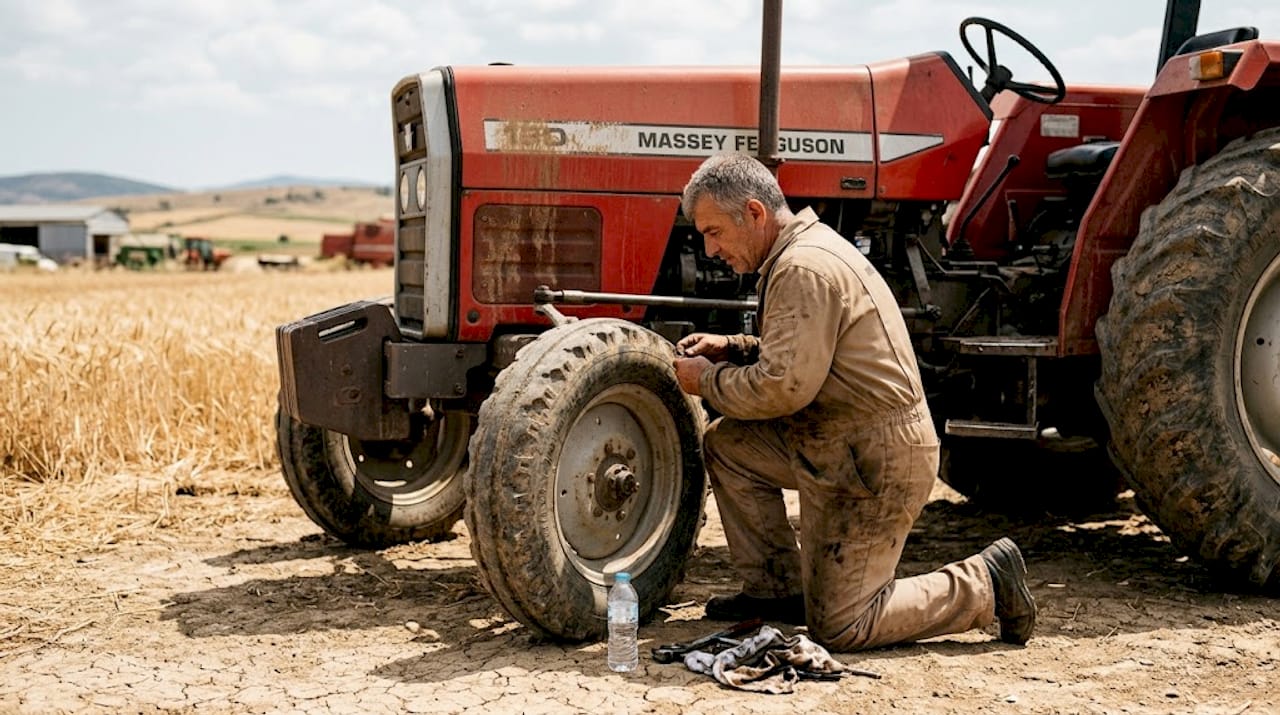
Research confirms the financial logic of staying on top of service. Preventive maintenance delivers a return of $2.50 to $3.50 for every $1 spent, and using OEM parts cuts component failures by 25% compared to generic alternatives.
Here is a practical seasonal maintenance checklist for Greek farms:
- Daily: Visual walkaround, fluid levels, tire pressure, check for leaks
- Weekly: Air filter inspection, grease all zerk fittings, clean radiator fins
- Monthly: Engine oil and filter change (or more often in dusty conditions), hydraulic fluid check
- Before winter: Coolant strength test, battery condition, full fluid flush if needed
- Before planting season: PTO shaft inspection, three-point hitch calibration, tire pressure adjustment for load
Pro Tip: Spend just 5 to 10 minutes on a walkaround check every morning before starting work. Fluid and hydraulic neglect accounts for 60% of field failures, and catching a small leak early is a 20-minute fix. Missing it until the pump seizes can cost $3,000 or more.
On the parts question, there is a clear winner. OEM parts are machined to the exact tolerances of your tractor’s design. Generic alternatives are often close but not exact, and that small gap in precision accelerates wear on surrounding components. Review the evidence on why use OEM tractor parts before your next service. For a full year-round plan, the maintenance checklist and seasonal care tips are solid starting points.
Why small wins in tractor care create big advantages
Here is something the agricultural equipment industry rarely says out loud: the gap between a profitable season and a frustrating one almost never comes down to which brand of tractor you own. It comes down to habits.
We have seen farms in northern Greece dramatically cut unplanned breakdowns simply by adding a five-minute morning walkaround to the daily routine. No expensive overhauls. No new equipment. Just consistency. Conventional wisdom focuses on the big repairs, the engine rebuilds and transmission failures. But those catastrophic events almost always trace back to something small that was ignored for weeks.
Greece’s climate makes this even more critical. The combination of fine dust, summer heat, and hard soil pushes machinery harder than operators often notice in the moment. That is why extending tractor lifespan starts with the smallest daily actions, not the largest annual service.
Better habits are genuinely simpler than most farmers expect. Check tire pressure. Top off fluids. Clean the air filter. These are not complicated tasks. But done consistently, they add years to your machine’s working life and thousands of euros back to your bottom line.
Your next step: Get more from your tractor investment
Putting these insights into practice is easier when you have the right support behind you. Whether you are sourcing parts for a routine service or looking to upgrade your implement lineup before the next planting season, having a reliable supply partner matters. Explore our detailed guide on agricultural machinery parts to understand what your tractor genuinely needs. If you want a step-by-step approach to keeping your fleet in shape, the guide on how to maintain agricultural machinery covers the full process. And before you attach any new implement, review the tractor accessory installation guide to avoid costly setup mistakes.
Frequently asked questions
What is the main function of a tractor on a Greek farm?
A tractor provides high tractive effort at low speeds for plowing, seeding, hauling, and powering a wide range of farm implements across varied terrain.
How do I choose the right tractor type for my crops?
Match tractor size and features to your primary crop and field conditions. Utility, row crop, compact, and specialty types each suit different operations, so start with your acreage and crop mix before comparing horsepower.
How often should tractor maintenance be performed in Greece?
Increase air and oil changes by 50% in dusty Greek fields compared to standard schedules, and check fluids and hydraulics every single day to stay ahead of failures.
Why use OEM parts instead of generic for tractor repairs?
OEM parts cut failures by 25% compared to generic alternatives and are machined to exact tolerances, which protects surrounding components from accelerated wear.