

TL;DR:
- Understanding the distinction between hand-held tools and powered machinery helps farmers select equipment aligned with their specific needs.
- Matching farm tools and machinery to production stages and land characteristics maximizes efficiency and reduces unnecessary expenses.
- Prioritizing safety, ergonomic design, and regular maintenance enhances long-term operation and protects farm workers and investments.
Many farmers assume that “farm tools” just means a hoe, a rake, and maybe a pair of pruning shears. That assumption costs real money. Modern agriculture in Greece demands a carefully chosen mix of hand implements, powered machinery, and specialized attachments, each matched to a specific stage of production. Whether you’re working a small olive grove near Kavala or managing a large cereal operation outside Thessaloniki, understanding what tools exist, what they do, and how to choose them strategically is one of the fastest ways to cut waste and boost output. This guide breaks it all down clearly.
Table of Contents
- What are farm tools and equipment? Definitions and categories
- Choosing the right tools and machines for your farm’s needs
- Tractors and power equipment: The backbone of modern farms
- Safety, ergonomics, and maintenance: Protecting your team and investment
- Why matching tools to farm strategy matters more than following tradition
- Explore essential machinery and expert guides for smarter farming
- Frequently asked questions
Key Takeaways
| Point | Details |
|---|---|
| Broad tool definitions | Farm tools include both simple hand-held implements and advanced machinery, each serving distinct purposes. |
| Strategic equipment selection | Matching tools to farm scale, stage, and crop is key to efficiency and cost savings. |
| Tractor centrality | Tractors power multiple farm tasks and amplify productivity, making them foundational on most modern farms. |
| Safety and ergonomics | Proper tool choice, ergonomic design, and regular maintenance protect workers and prolong equipment life. |
| Ongoing adaptation | Regularly reviewing and updating toolkits to match current farm strategy drives greater yields and less downtime. |
What are farm tools and equipment? Definitions and categories
Before you can make smart purchasing decisions, you need to know exactly what falls under the umbrella of “farm tools and equipment.” The two terms are often used interchangeably, but they carry distinct meanings in practice.
Farm tools and farm equipment generally cover both simple hand implements and mechanized machinery used across all stages of farming. A hand tool is typically something one person carries and operates manually. A pruning knife, a grafting tool, a soil probe. Farm equipment, on the other hand, refers to machines that either run on their own power source or attach to a tractor to perform work at scale. The line between the two blurs when you get into powered hand tools like electric pruners or backpack sprayers, which is why it helps to think in categories rather than strict definitions.
Here’s a practical breakdown of the main categories relevant to Greek farming operations:
- Soil preparation tools: Plows, rotary tillers, disc harrows, subsoilers, and ridgers. These are almost always tractor-mounted.
- Planting and seeding equipment: Seed drills, transplanters, broadcast spreaders, and manual dibbers for small plots.
- Crop protection tools: Knapsack sprayers, mounted sprayers, dusters, and boom sprayers for pesticide and fertilizer application.
- Harvesting tools: Combine harvesters, grape harvesters, olive shakers, pruning shears, and sickles.
- Post-harvest and logistics equipment: Trailers, front loaders, conveyors, and packaging stations.
- General hand tools: Hoes, rakes, spades, forks, pruners, and grafting knives.
The table below makes the distinctions sharper:
| Category | Example tools | Primary use | Complexity |
|---|---|---|---|
| Hand tools | Hoe, pruner, rake | Manual soil work, pruning | Low |
| Power hand tools | Electric pruner, backpack sprayer | Precision tasks at small scale | Medium |
| Tractor-mounted implements | Plow, disc harrow, seed drill | Large-scale soil and crop work | High |
| Self-propelled machinery | Combine harvester, sprayer | Full automation of key farm tasks | Very high |
| Transport and logistics | Trailer, front loader | Moving materials and crops | Medium to high |
Understanding where each tool fits on this spectrum helps you avoid a very common mistake: buying heavy machinery for tasks that a well-chosen hand tool could handle faster on your scale. For a full walkthrough of the most relevant items across all these categories, the common farm tools and equipment guide goes deep on use cases and what to look for.
Choosing the right tools and machines for your farm’s needs
Knowing the categories is one thing. Knowing which ones your specific operation actually needs is where the real efficiency gain happens.
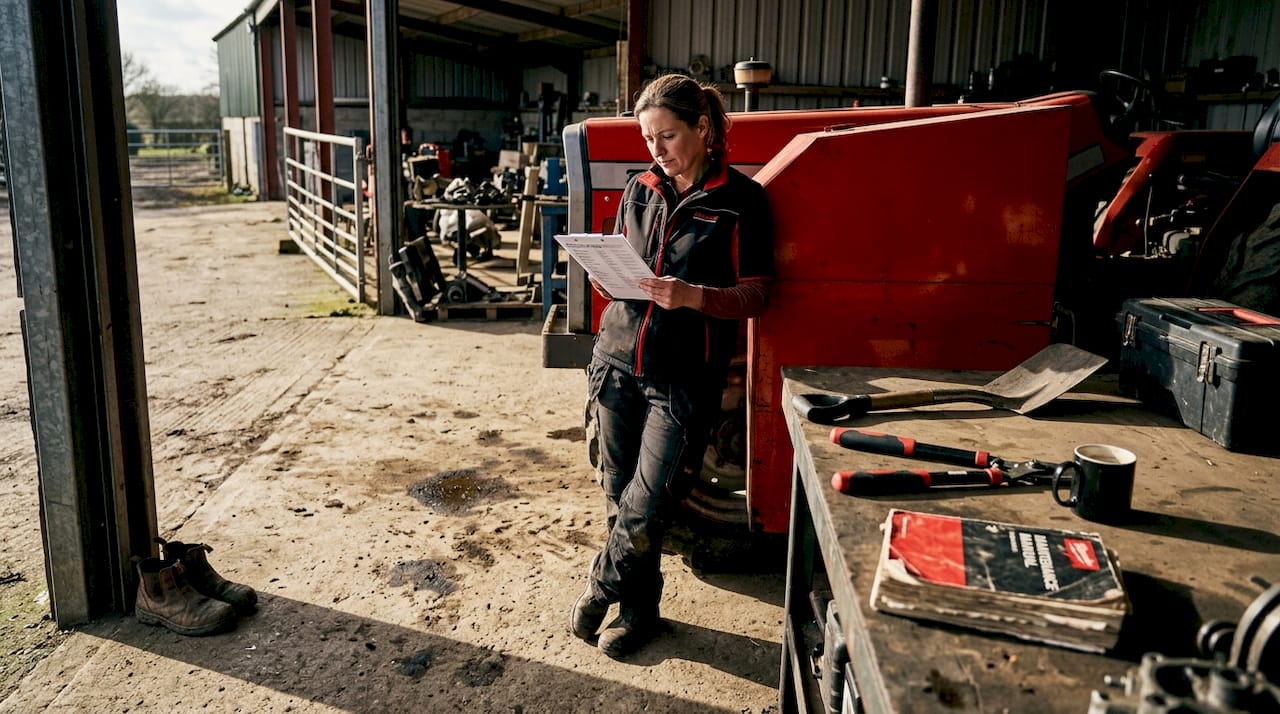
Matching implements to farming stage and farm scale, rather than making one-off purchases driven by habit or availability, is what separates productive operations from those drowning in unused or mismatched equipment. Many Greek farmers inherit a tool inventory from the previous generation and simply keep using it without ever auditing whether it fits their current operation.
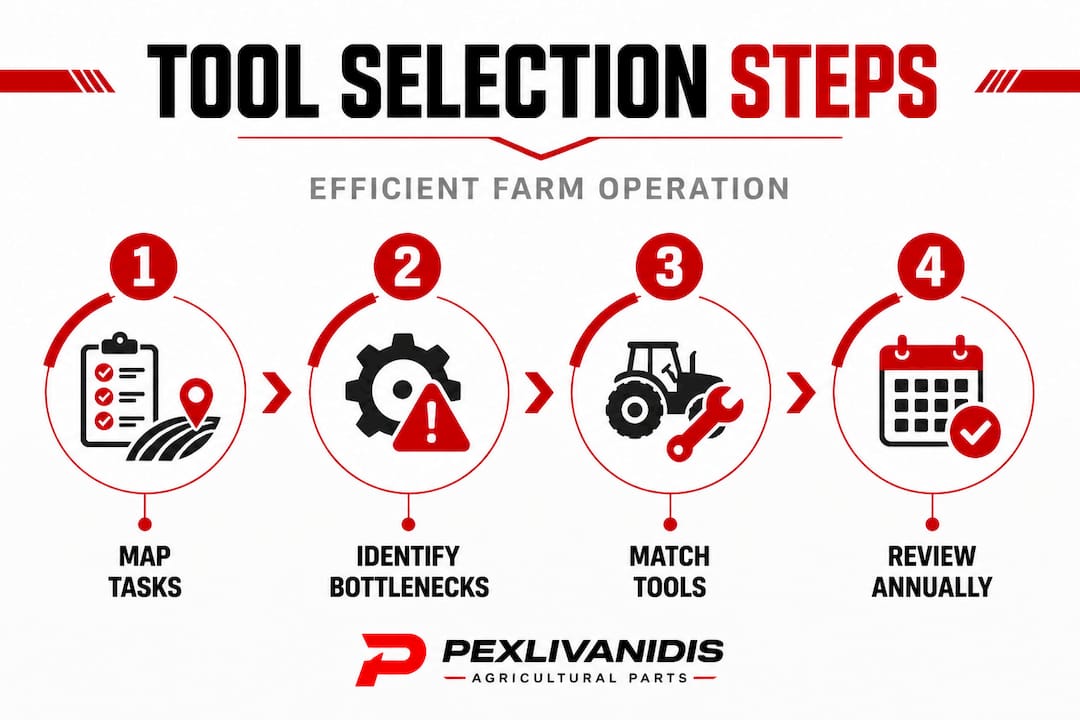
Here’s a practical, step-by-step process to assess what you actually need:
- Map your farming stages. Write out every stage of your production cycle: soil prep, planting, irrigation management, crop protection, harvest, and post-harvest handling. Each stage needs its own set of tools.
- Assess your land size and terrain. A 2-hectare terraced olive grove has completely different needs than a 50-hectare flat grain field. Larger flat areas benefit from wide, tractor-mounted implements. Smaller or irregular plots often need compact or manual tools.
- Identify your workforce capacity. If you have a small team, prioritize machinery that multiplies individual output. If you hire seasonal labor, balance manual tools against machinery rental or ownership costs.
- Review your crop mix. Mixed operations growing vegetables, fruit trees, and cereals need a versatile toolkit. Specialized monoculture farms can invest more deeply in crop-specific equipment.
- Account for seasonal peaks. Greek agriculture has very concentrated harvest periods. Identify your bottlenecks and prioritize equipment that addresses those specific crunch points.
- Calculate total cost of ownership. Purchase price is only part of the equation. Factor in fuel, maintenance, spare parts availability, and operator training when comparing options.
- Start with the highest-impact gap. Don’t try to upgrade everything at once. Identify the single stage where poor tooling is costing you the most time or yield, and start there.
Pro Tip: Before purchasing any piece of equipment, ask yourself which specific task it solves and at what scale. If you cannot answer that in one sentence, you probably don’t need it yet.
For farms looking to expand their tractor’s versatility without buying new machines, reviewing agricultural attachments for efficiency is often the most cost-effective first step. The right attachment can transform a basic tractor into a multi-stage workhorse.
Tractors and power equipment: The backbone of modern farms
If there is one piece of equipment that defines modern farming, it’s the tractor. Everything else can be debated based on farm type and size. The tractor is almost never optional once you move beyond a very small plot.
As a foundational piece of farm equipment, a tractor provides the power to run attachments and carry out multiple tasks across every stage of production. The real value of a tractor isn’t in the machine itself. It’s in the ecosystem of implements it enables.
“The tractor’s true productivity comes from its flexibility. A single tractor, properly matched with the right implements, can handle soil preparation in spring, planting in early summer, spraying during the growing season, and harvest support in autumn. That kind of seasonal versatility is what makes it an investment, not just an expense.” — Agricultural Machinery Advisory, Thessaloniki region
Here’s a clear view of what a tractor can power across a full production cycle:
| Implement | Job performed | Season |
|---|---|---|
| Rotary tiller | Seedbed preparation | Spring |
| Seed drill | Precision planting | Spring / Autumn |
| Boom sprayer | Pesticide or fertilizer application | Growing season |
| Mower / flail mower | Cover crop or weed management | Multiple seasons |
| Front loader | Moving materials, loading trailers | Year-round |
| Disc harrow | Secondary tillage and residue incorporation | Post-harvest |
| Grape harvester attachment | Mechanized grape picking | Late summer |
| Trailer | Transport of crops and inputs | Harvest season |
For Greek farmers managing multiple crop types, getting more from an existing tractor is almost always more economical than buying a second machine. Resources on maximizing tractor productivity can show you exactly how to do that. Paired with the right tractor attachments for improvement, a mid-range tractor can handle tasks that most farmers think require dedicated machinery.
One area that’s often overlooked is the tractor’s accessories, from PTO shafts to hydraulic couplings and cab comfort fittings. Maintaining tractor accessories properly extends the life of both the tractor and its implements, which directly reduces your annual operating cost.
Safety, ergonomics, and maintenance: Protecting your team and investment
Buying the right equipment is only half the job. Using it safely and keeping it in good working order is where most farms either gain or lose the long-term value of their investment.
Safety and usability in tool selection are increasingly recognized as critical dimensions, including universal design approaches that reduce slips, trips, and fatigue, and make farm tasks safer for a wider range of workers. Greek farms often rely on a mix of permanent staff and seasonal laborers, many of whom may not have deep experience with specialized equipment. That makes ergonomic design and safety features especially important.
Here’s what to look for when evaluating the ergonomics and safety of any farm tool or machine:
- Handle grip and vibration control. For power tools and hand implements used for hours at a time, look for padded, non-slip grips that reduce vibration transfer to the hands and wrists.
- Weight distribution. A well-balanced tool reduces fatigue dramatically. A backpack sprayer with a poorly designed harness, for example, causes back strain even when it’s functioning perfectly.
- Guard and shield placement. Any rotating part on tractor-mounted implements should have a fully intact shield. PTO shaft guards are a legal requirement in Greece and a genuine lifesaver.
- Clear controls and labeling. Machinery with intuitive, clearly marked controls reduces operator error, especially for seasonal workers encountering the machine for the first time.
- Visibility from the cab. When operating large implements, the operator needs clear sightlines. Consider mirrors, cameras, or additional lighting for low-visibility conditions.
- Tool storage and transport safety. Sharp tools stored loosely in a shed or vehicle cause more injuries than they do in the field. Proper racks, sheaths, and storage systems matter.
Pro Tip: Build a simple weekly safety and maintenance checklist into your workflow. Ten minutes of inspection before each use can prevent hours of downtime and costly repairs.
For a structured approach to keeping your workforce safe, the guide on preventing farm injuries covers the most common risk points in Greek farm operations. The equipment safety checklist is a practical starting point. For maintenance specifically, both the machinery maintenance tips guide and the detailed machinery maintenance guide offer step-by-step routines for keeping equipment performing at its best through every season.
Why matching tools to farm strategy matters more than following tradition
Here’s something most farming advice won’t tell you directly: the tool inventory you inherited is probably holding you back.
This isn’t a criticism of tradition. Many traditional Greek farming practices are genuinely efficient and well-adapted to local conditions. But the tools and equipment that made sense for one crop mix, one market, and one labor situation twenty years ago may not match what your operation needs today.
Farmers who review their explained farm tool selection annually, rather than defaulting to what’s always been in the shed, consistently report lower machinery downtime and better alignment between their costs and their actual production needs. The shift isn’t about buying more. It’s about buying right.
The deeper issue is that tools shape behavior. If your default soil preparation tool is an aging disc plow that compacts your subsoil, you’ll keep farming around compaction problems without ever addressing the root cause. If your spray equipment doesn’t allow for accurate calibration, you’ll keep over-applying inputs and absorbing that cost every season. The tool doesn’t just do the job. It defines how the job gets done, for better or worse.
We’ve seen this pattern repeatedly working with farms across northern Greece. Operations that spend time each winter reviewing what worked, what broke, and what was missing during the past season are the ones that steadily improve. Those that simply repair what broke and replace like with like stay flat. Annual tool audits aren’t a luxury. They’re a competitive advantage.
The practical challenge is knowing what alternatives exist. That’s exactly where staying current with equipment developments and expert guidance pays off more than any single purchase.
Explore essential machinery and expert guides for smarter farming
For those ready to take action, detailed guides and expert resources can support your next move. Whether you’re looking to understand what parts keep your current machinery running or you’re considering a full equipment upgrade, having access to reliable, detailed information makes the difference between a good decision and an expensive mistake. The guide on machinery parts explained covers the components most critical to tractor and implement performance. If you’re focused on extending the life of what you already own, the maintain machinery for performance resource gives you a structured routine. And for those evaluating whether an upgrade makes sense, the machinery upgrade tips guide helps you identify when repair stops making financial sense and strategic investment takes over. At Pexlivanidis, with over 20,000 parts in inventory and free shipping within Greece on orders over 100€, we’re positioned to support whatever your next step looks like.
Frequently asked questions
What is the difference between farm tools and farm equipment?
Farm tools are typically hand-held instruments designed for small-scale, manual tasks, while farm equipment includes powered machinery and tractor attachments that handle more complex, large-scale operations. In practice, both cover simple hand implements and mechanized machinery used across all farming stages.
Why is a tractor considered essential for farming?
A tractor acts as the central power source for the farm, enabling a wide range of attached implements to perform soil work, planting, spraying, and harvesting tasks. As a foundational piece of farm equipment, it multiplies what a small team can accomplish across an entire season.
How do I select the right farm tools for my operation?
Start by mapping every stage of your production cycle and identifying where your current tools create bottlenecks or inefficiencies. Matching implements to scale and farming stage, rather than buying at random, consistently produces better results and lower total cost.
What safety features should I look for in farm tools?
Prioritize ergonomic grips, proper weight distribution, intact guards on all rotating parts, and clearly labeled controls. Universal design approaches that reduce slips, fatigue, and user error are especially valuable when seasonal workers with varying experience levels operate the equipment.