

TL;DR:
- Modern tractors are versatile power platforms for various farm tasks beyond plowing.
- Tracking operation-specific data improves efficiency, reduces costs, and extends equipment life.
- Proper matching of tractor setup to soil and terrain conditions is crucial for optimal performance.
Most farmers in Greece know their tractor as the machine that pulls a plow. That’s understandable, but it’s also one of the most limiting assumptions you can make about your most expensive piece of equipment. A modern farm tractor is a mobile power platform capable of driving dozens of different operations, from mowing and spraying to lifting, grading, and pumping water. When you understand the full scope of what your tractor can actually do, and start measuring how well it does each task, the productivity gains are real and measurable. This guide breaks down practical applications, performance benchmarks, and optimization strategies built specifically for farming conditions in Greece.
Table of Contents
- Core functions of farm tractors: Beyond basic plowing
- How tractors drive productivity: Data-backed performance insights
- Matching tractor, implement, and field conditions for best results
- Optimizing tractor use: Accessories and strategies for efficiency
- The real key to tractor value: It’s what you measure and adjust
- Upgrading your farm: Take the next step with expert guidance
- Frequently asked questions
Key Takeaways
| Point | Details |
|---|---|
| Tractors are multi-functional | Understanding their full range of uses unlocks major efficiency gains on every farm. |
| Operation-specific data matters | Monitoring fuel use and capacity by task leads to better decisions than using generic averages. |
| Optimize for field and season | Matching tractor setup with soil, terrain, and seasonal needs drives the best results. |
| Accessories boost productivity | Right accessories and switching strategies cut downtime and maximize narrow planting or harvest windows. |
Core functions of farm tractors: Beyond basic plowing
With the basics established, let’s clarify exactly what makes tractors so valuable on the modern Greek farm.
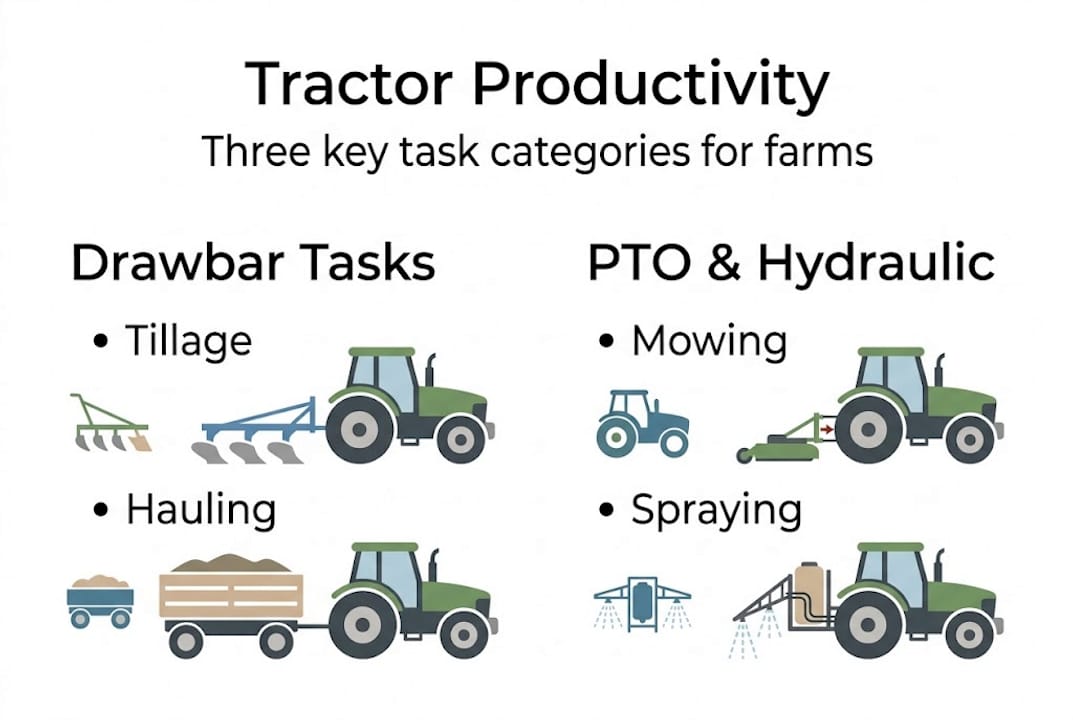
Most tractor operations fall into three broad categories, and understanding these categories changes how you think about equipment investment and daily scheduling. As expert sources note, the most useful way to organize tasks is to break tasks into drawbar power demand, PTO power demand, and hydraulic/3-point functions for optimal operation. Each category has different performance demands and requires different settings on your machine.
Drawbar tasks involve pulling a load behind the tractor. This includes tillage implements like disc harrows and cultivators, seed drills during planting season, and trailers during harvest and transport. The critical variable here is draft force, which is the pulling load measured in kilonewtons. Your tractor’s engine and transmission must be matched to that draft force, or you waste fuel and stress components.
PTO-driven functions use the tractor’s power take-off shaft to spin an implement directly. Mowers, balers, rotary tillers, water pumps, and grain augers all fall into this category. PTO speed (540 rpm or 1000 rpm) must match the implement specification, or you get poor performance and premature wear.
Hydraulic and 3-point hitch applications include front loaders, rear-mounted sprayers, soil graders, and precision seeders. These tasks rely on your tractor’s hydraulic flow rate and lift capacity, not just engine horsepower.
Here is a practical comparison of these three categories across common Greek farm operations:
| Task category | Example operations | Key tractor spec | Productivity impact |
|---|---|---|---|
| Drawbar | Tillage, seeding, transport | Draft force, gear ratio | High during planting season |
| PTO-driven | Mowing, baling, pumping | PTO rpm, shaft torque | High during harvest |
| Hydraulic/3-point | Loader, sprayer, grader | Hydraulic flow, lift capacity | Year-round |
Understanding the types of tractors for farming helps you identify which platform fits your primary task category. A compact orchard tractor suits PTO-driven vineyard work, while a high-clearance row crop tractor fits drawbar-heavy grain operations.
Key benefits of categorizing your tractor tasks properly:
- Better fuel planning per season
- Correct PTO speed setting reduces implement wear
- Hydraulic pressure matching prevents loader stress
- Faster implement switching when you plan by category
Pro Tip: Before each season, list every planned operation, then sort them into drawbar, PTO, and hydraulic categories. This simple exercise often reveals tasks that can be combined in a single field pass, cutting fuel costs without buying any new equipment.
Knowing which essential tractor types suit each category also prevents the common mistake of running an underpowered machine at maximum load continuously, which accelerates component wear and increases operating costs.
How tractors drive productivity: Data-backed performance insights
Once you understand their main functions, measuring how tractors perform on real tasks can inform smarter choices.
Generic horsepower numbers on a spec sheet tell you very little about what a tractor will actually do in your olive grove or wheat field. What matters is standardized, operation-specific performance data. Empirical benchmarking exists for tractor efficiency and productivity using standardized tests for fuel consumption and area output, and this data is publicly available for many popular models.
The DLG PowerMix test protocol, used across Europe including Greece, measures fuel consumption across a weighted cycle of typical farm activities. It gives you a reliable baseline for comparing tractor options before purchase. But real farm telemetry goes further.
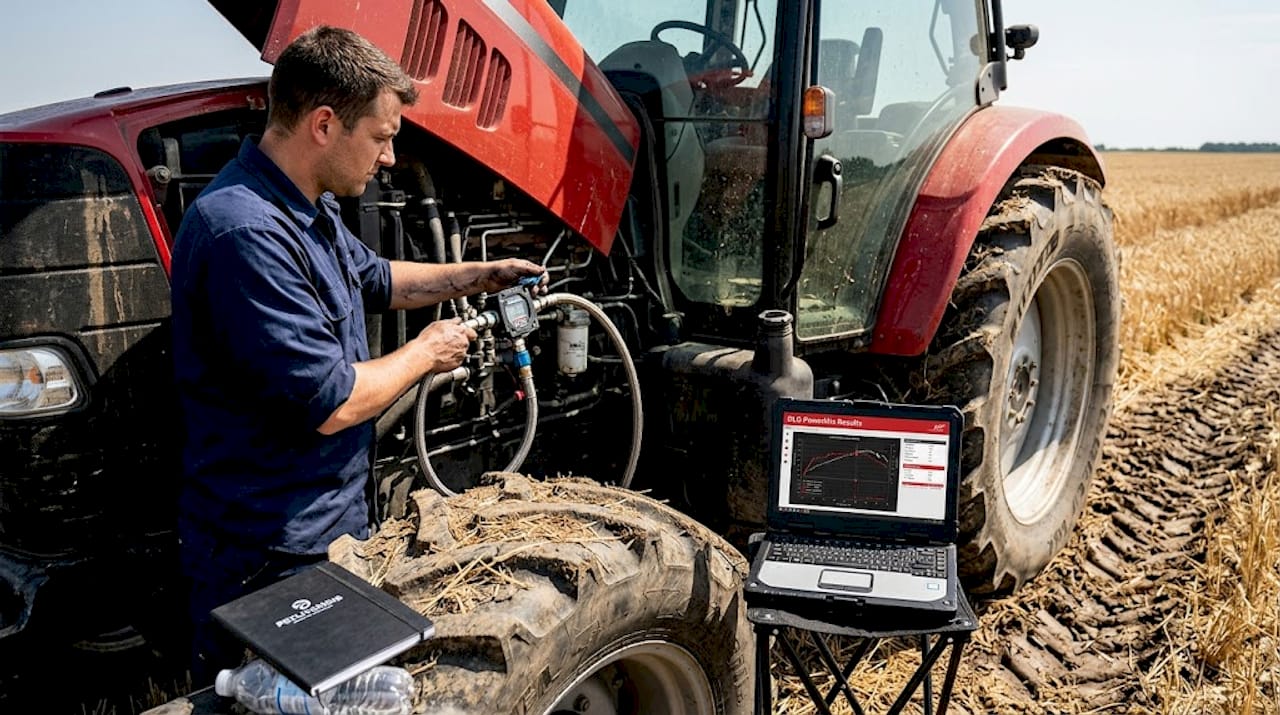
Field data collected using onboard sensors shows striking differences between activities. For example, fertilization uses 4.95±1.20 l/h while harvest in vineyards uses 14.70±3.39 l/h, meaning the same tractor can consume nearly three times more fuel per hour depending on the operation. If you budget fuel costs based on a single average figure, you will consistently underestimate harvest costs and overestimate how much fuel light operations actually need.
Here is how different vineyard activities compare across key performance metrics:
| Operation | Fuel use (l/h) | Field capacity variation | Optimization priority |
|---|---|---|---|
| Fertilization | 4.95 ± 1.20 | Low | Minimize passes |
| Spraying | ~6.5 | Medium | Speed and boom width |
| Pruning support | ~8.0 | High | Load cycle timing |
| Harvest | 14.70 ± 3.39 | Very high | Peak power readiness |
“Operation-specific benchmarking is not just for researchers. It is the most actionable data a working farmer can use to reduce operating costs and plan seasonal fuel budgets accurately.”
This matters especially in Greece, where farm plots are often fragmented and fuel costs represent a significant portion of variable operating expenses. If you want to optimize tractor performance across your whole operation, start by tracking fuel use per activity, not just per day or per tank.
One practical approach: keep a simple logbook or use your tractor’s digital display to record fuel use separately for each type of field operation for a full growing season. By the following year, you will have real benchmarks for your specific farm, soil type, and terrain, which are far more useful than generic averages.
Farmers focused on reducing tractor downtime also benefit from this data-driven approach. When you know which operations put the highest load on your machine, you can schedule preventive maintenance around those peaks rather than relying on calendar-based intervals that may not reflect actual wear.
Matching tractor, implement, and field conditions for best results
With performance data in hand, matching your tractor’s setup to your land’s specifics can make a striking difference.
A 150-horsepower tractor working in sandy, dry soil will perform very differently from the same machine working in clay-heavy, wet conditions on a hillside plot in northern Greece. The key insight from recent simulation research is that tractor performance relies not only on horsepower, but also on traction logistics and soil and terrain conditions, and combinations should be evaluated under relevant conditions. This confirms what experienced farmers already sense but rarely quantify.
Here is why this matters in practice. When soil moisture is high, rolling resistance increases and tractive efficiency drops. Your tractor burns more fuel to move the same implement at the same speed. On slopes above 10 degrees, which are common in Greek olive and vineyard country, the tractor’s stability and effective drawbar pull change significantly. An implement perfectly matched to flat conditions may be undersized or improperly configured for hilly terrain.
“The biggest hidden cost in Greek farm tractor use is not the machine itself. It is the mismatched implement running in soil conditions it was never calibrated for.”
Practical steps to improve matching:
- Assess soil texture and moisture before selecting gear ratio and engine load settings for tillage
- Check slope angle of your plots and verify tractor stability ratings for those grades
- Adjust tire pressure based on soil type: lower pressure in soft conditions increases contact area and reduces slippage
- Match implement width to tractor power class: wider implements in heavy soils increase draft beyond the tractor’s rated capacity
- Test implement depth settings on a small section before full-field operation to confirm power demand matches engine capacity
- Use ballast weights strategically on front axle or rear wheels to improve traction without overloading the drivetrain
For Greek farmers working on the different tractor types available for specific terrain, choosing between a four-wheel-drive articulated machine and a conventional two-wheel-drive model depends heavily on your slope and soil profile. Four-wheel drive adds meaningful traction in wet or steep conditions, but adds weight and fuel consumption on flat, firm ground.
Pro Tip: If you work multiple plot types, consider keeping a quick-reference card in the tractor cab with recommended tire pressures, implement settings, and gear selections for each plot category. This takes 30 minutes to create and saves time every time you move between fields.
Optimizing tractor use: Accessories and strategies for efficiency
To make all these gains tangible, let’s turn to accessories and smart practices that deliver daily results.
Accessories are where strategic investment has the highest short-term payoff. Selecting implements to minimize overlap passes and downtime during narrow planting and harvest windows boosts productivity in ways that upgrading to a bigger engine simply cannot. Greek agricultural calendars are tight. Olive harvest, grape picking, and winter cereal planting all create periods where losing a day to equipment problems or slow switching costs you more than the accessories themselves.
Here are the most impactful accessories and practices for the main Greek farming cycles, organized as practical steps:
- Install a front loader with quick-attach brackets. A versatile front loader turns your tractor into a handler for pallets, bins, and bulk materials. Quick-attach systems let you switch between buckets, forks, and bale spears in under five minutes, removing one of the biggest time drains in busy seasons.
- Add a rear hydraulic sprayer mount with a boom. For olive and vineyard operators, having a permanently mounted sprayer that connects via the 3-point hitch without tools eliminates the setup time that typically runs 30 to 60 minutes per session.
- Fit a GPS guidance system or lightbar. Even a basic lightbar system reduces overlap in seeding and spraying by an average of 5 to 10%, which directly cuts seed and chemical costs without any additional labor.
- Use ISO-BUS compatible implements where available. ISO-BUS systems allow implements to communicate with the tractor’s display, giving you real-time data on application rate, speed, and overlap without separate monitors cluttering the cab.
- Invest in a toolbox mounting system and onboard spare parts kit. Small hydraulic fittings, a spare PTO pin, and basic hand tools stored on the tractor prevent minor breakdowns from becoming half-day delays during harvest.
- Schedule implement switching in sequence. Plan your field operations so that tasks requiring the same hitch setup are done on the same day. Moving from 3-point sprayer to 3-point soil grader without dropping back to drawbar saves one full setup cycle per day.
Understanding the full range of options for explained tractor types also helps you decide whether a single multipurpose tractor or a second specialized unit makes more economic sense once your operation reaches a certain scale.
Pro Tip: Track implement switching time for one full week. Most farmers are surprised to find they spend 45 to 90 minutes per day on setup and teardown. Reducing that by half with quick-attach accessories often delivers more productive hours than buying a faster tractor.
The real key to tractor value: It’s what you measure and adjust
Here is a perspective that most equipment discussions miss entirely. The Greek agricultural sector has a tendency to frame tractor investment as a hardware problem: more horsepower, newer technology, bigger attachments. But the farmers getting the most consistent results are not always running the newest machines. They are running well-matched equipment that they measure and adjust constantly.
Generic “industry averages” for fuel consumption or field capacity are nearly useless for a farm in Halkidiki with thin rocky soil versus one in the Thessaly plains with deep clay. The data only helps when it reflects your actual conditions. That is why operation-specific tracking, the kind described above with fuel logs and activity benchmarks, converts raw machine capability into real farm income.
The shift in mindset from equipment acquisition to continuous optimization is harder than buying a new implement, but it pays off every season. Farmers who pursue tractor optimization lessons and apply them consistently tend to extend machine life, lower operating costs, and complete field operations closer to the optimal agronomic window. That last point matters more than most people admit. Getting the right field operation done at the right time, in good soil conditions, with a properly matched implement is worth more than an extra 20 horsepower applied two days late in the wrong gear.
The uncomfortable truth is that the bottleneck on most Greek farms is not the tractor. It is the system around it.
Upgrading your farm: Take the next step with expert guidance
If this article has shifted how you think about your tractor’s potential, the practical next step is straightforward. Start by reviewing the agricultural machinery parts available for your specific setup to identify gaps in your current configuration. When you are ready to add or swap implements, a clear tractor accessory installation guide walks you through best practices to avoid common fitting mistakes. For ongoing performance, following a proven machinery maintenance guide ensures your investment holds its value through every season. At pexlivanidis.com, we stock over 20,000 parts with free shipping across Greece on orders over 100 euros, serving farmers from Thessaloniki to Kavala and beyond.
Frequently asked questions
How can I measure my tractor’s fuel efficiency for different field operations?
Use onboard telemetry or CAN-bus tracking systems to monitor fuel use and calculate liters per hectare or per hour for each activity. Research using CAN-bus and telemetry shows these methods accurately quantify fuel consumption per hour and per hectare across different tractor activities.
Does tractor size or horsepower matter most for farm efficiency?
Both matter, but matching the implement and considering soil, traction, and field conditions usually has a bigger impact than raw horsepower. Performance goes beyond horsepower since traction logistics and terrain conditions are equally critical to real-world output.
What are the best tractor accessories for reducing downtime?
Quick-attach implements, GPS lightbar guidance systems, and multi-purpose front loaders with fork and bucket options reduce switch-over time and increase the number of productive field hours per day.
How do field conditions in Greece impact tractor use?
Soil texture, moisture, and hilly terrain all directly change draft force demand and fuel consumption, so equipment must be configured specifically for each plot type. Soil and terrain conditions alter tractive efficiency significantly, making generic settings unreliable across varied Greek landscapes.
How often should tractor implements be maintained for optimal results?
Check and service implements before each major seasonal operation and after any period of heavy use to catch worn components before they cause unexpected downtime in the field.