

TL;DR:
- Matching agricultural parts accurately requires verifying OEM part numbers against verified serial data to avoid costly mistakes and downtime. Using serial plates and detailed machine information ensures correct part selection, especially since visual similarities can be misleading across different machine generations. Relying on OEM, remanufactured, or reputable licensed parts for critical components guarantees better performance, warranty coverage, and reduced operational risks.
Comparing agricultural parts correctly means matching exact OEM part numbers to verified machine serial data, not eyeballing photos or trusting a brand name alone. Get this wrong and you face costly downtime that exceeds the part’s price before the repair is even finished. Farmers running John Deere tractors, CLAAS combines, or New Holland equipment all face the same trap: two parts look identical but serve different machine generations. This guide gives you a practical framework for agricultural equipment parts comparison, covering part categories, verification steps, and the quality criteria that separate a reliable repair from an expensive mistake.
How to compare agricultural parts without making costly mistakes
The single most common error in farm equipment parts comparison is ordering by model name alone. A John Deere 6130R and a 6130M share a model number prefix, but their hydraulic pump configurations differ by generation. Different production years of the same tractor model routinely require different versions of the same component. That means the part that fit your neighbor’s machine may not fit yours, even if the tractors look identical from twenty feet away.
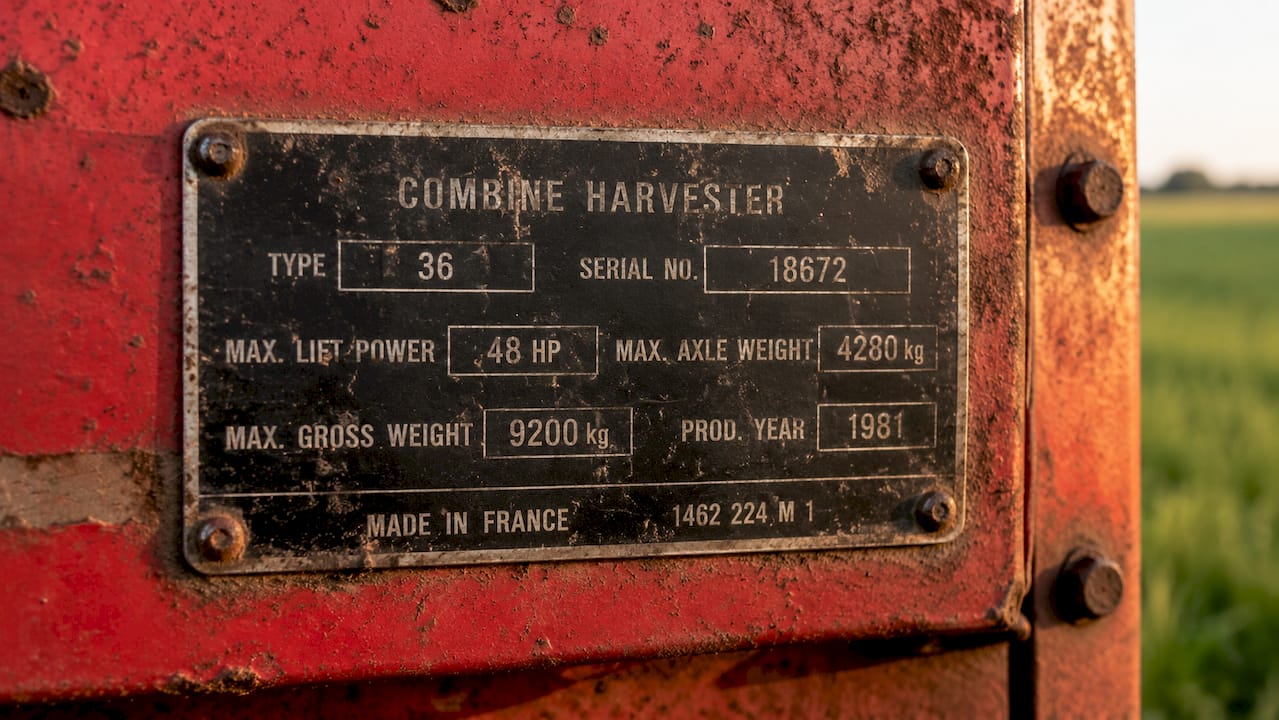
Visual similarity is the second trap. Two water pump housings can share the same bolt pattern and inlet diameter but differ in impeller depth or seal type. Installing the wrong one causes overheating within a season. The fix is straightforward: pull the serial plate from your machine before you search for anything. The plate gives you the exact model code, production year, and serial range, which are the three data points that lock in the correct part.
Pro Tip: Photograph your machine’s serial plate and store it in your phone’s notes app. When you call a supplier or search an online catalog, you have the exact data ready without walking back to the field.
Here is what you need from the machine before comparing any part:
- Exact model designation (not just “6130” but the full suffix)
- Serial number and production year
- Machine series or generation code (often found on the plate or in the owner’s manual)
- The OEM part number from the old part itself, if still legible
Ordering by model only without the serial plate and OEM number is the leading cause of wrong-part deliveries in agricultural supply chains. The time you spend pulling that plate saves days of waiting for a return shipment.
OEM, remanufactured, licensed, and aftermarket parts explained
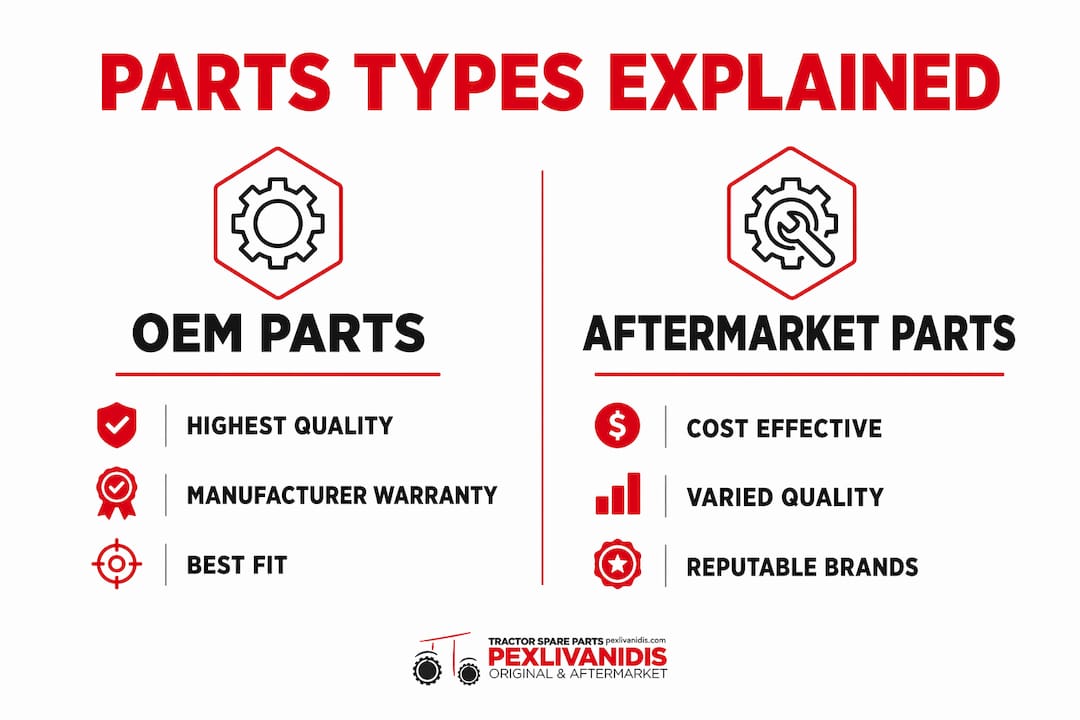
Understanding part categories is the foundation of any serious agriculture parts comparison guide. Each category carries different quality expectations, price points, and appropriate use cases. Matching the right category to the right component is as important as matching the part number itself.
| Part type | Quality level | Best use case | Typical cost vs. OEM |
|---|---|---|---|
| OEM (Original Equipment Manufacturer) | Highest, guaranteed fit | Safety systems, electronics, precision hydraulics | Baseline (100%) |
| Remanufactured | Near-OEM, tested | Turbochargers, hydraulic pumps, starters | 20–40% lower |
| Licensed | Engineered to spec, no brand logo | General mechanical components on limited budgets | 15–30% lower |
| Aftermarket (reputable brand) | High, brand-dependent | Belts, filters, blades, bearings | 10–30% lower |
| Unbranded aftermarket | Unpredictable | Not recommended for critical systems | Lowest |
OEM parts carry the manufacturer’s guarantee of fit and performance. For complex engine internals, hydraulics, and electronics, OEM is the standard recommendation. The cost premium is real, but so is the warranty coverage and the certainty of compatibility. You can read more about when OEM is the right call in Pexlivanidis’s guide to OEM tractor parts.
Remanufactured parts are disassembled, inspected, rebuilt to OEM tolerances, and tested before resale. Reman parts save 20–40% compared to new OEM and offer nearly equivalent quality. They are the smart choice for high-value components like turbochargers and hydraulic pumps where buying new OEM is expensive but quality cannot be compromised.
Licensed parts are produced to exact manufacturer specifications but sold without the brand logo. They reduce risk compared to random third-party parts and are a practical option when repair budgets are tight but reliability still matters. Think of them as the middle ground between OEM certainty and aftermarket savings.
Reputable aftermarket brands like Donaldson, Gates, and SKF produce high-quality components that often supply OEM manufacturers directly. Gates and Goodyear belts, for example, perform at OEM levels for drive systems. The key word is reputable. Unbranded parts from anonymous marketplace sellers vary wildly in quality and should be avoided for anything beyond the most basic consumables.
Pro Tip: For hydraulic and engine components, never go below remanufactured. For wear parts like blades, belts, and air filters, reputable aftermarket brands deliver solid value without the OEM price.
Step-by-step approach to evaluating parts for compatibility
A structured evaluation process removes guesswork from how to choose agricultural parts. Follow these six steps before committing to any purchase.
- Gather exact machine data. Pull the serial plate. Record the full model code, serial number, production year, and generation. Do not rely on memory or a previous invoice.
- Identify the OEM part number. Check the old part itself, the machine’s parts catalog (available from John Deere, CLAAS, Fendt, and most major brands as printed or digital catalogs), or a trusted supplier’s cross-reference database. The OEM number is your anchor for every comparison that follows.
- Cross-check dimensions and connection specs. For hydraulic fittings, verify thread type, port size, and pressure rating. For belts, confirm cross-section profile and length. For filters, check micron rating and bypass valve pressure. Catalogs from Donaldson and Mann+Hummel publish these specs openly.
- Validate supplier credibility. Confirm the supplier stocks parts with traceable origin documentation. A reputable supplier can tell you whether a part is OEM, licensed, or aftermarket and name the manufacturer. If they cannot, treat the part as unbranded. Pexlivanidis maintains a catalog of over 20,000 verified parts with documented sourcing, which removes much of this uncertainty.
- Evaluate warranty and expected lifespan. Remanufactured parts often come with warranties comparable to new OEM parts. Aftermarket parts from brands like SKF typically carry manufacturer warranties. No warranty documentation is a red flag regardless of price.
- Compare price against downtime risk. A cheaper part that fails during harvest costs far more than the price difference. Calculate the cost of one day of unplanned downtime for your operation, then weigh that against the savings from a lower-tier part. For critical systems, the math almost always favors OEM or reman.
| Verification step | Key data point | Tool or source |
|---|---|---|
| Machine identification | Serial number, model code | Machine serial plate |
| OEM part number | Exact part reference | Manufacturer parts catalog |
| Dimensional specs | Thread, size, pressure rating | Brand technical catalogs |
| Supplier verification | Origin documentation | Supplier inquiry |
| Warranty check | Coverage terms | Supplier documentation |
Common challenges and expert tips for parts comparison
Even experienced operators run into problems when comparing farm equipment parts. Knowing where the pitfalls are helps you avoid them before they cost you a season.
- Photos mislead. Use images only to confirm you are looking at the right general component. Never use a photo as the sole basis for ordering. Two parts can be photographically identical and mechanically incompatible.
- Cross-reference databases have gaps. Online cross-reference tools are useful starting points, but they are not infallible. Always verify the OEM number independently, especially for older machines or discontinued models.
- Emergency purchases cost more. Farmers who plan repairs in advance and maintain a parts inventory for high-wear components pay significantly less than those ordering under pressure during peak season. Suppliers charge more for urgent orders, and shipping timelines compress your options.
- Cheap marketplace parts carry hidden costs. Unbranded aftermarket parts vary drastically in quality and should be avoided. A bearing that fails in three months costs more in labor and downtime than the price difference ever justified.
- Licensed parts are underused. Many farmers default to either OEM or cheap aftermarket, skipping the licensed tier entirely. Licensed parts offer predictable compatibility and cost for operators on limited budgets, particularly for general mechanical components that do not require OEM branding.
Keep detailed records of every part number, supplier, and installation date for each machine in your fleet. This record becomes a reference library that cuts research time on future repairs and gives you a clear history if a warranty claim arises.
Pro Tip: Build a simple spreadsheet for each machine: one row per part, with columns for OEM number, part type, supplier, purchase date, and next expected replacement. Update it after every repair. This single habit reduces wrong-part orders more than any other practice.
For a deeper look at when to choose original versus aftermarket components across different farm equipment systems, Pexlivanidis covers the decision criteria in detail in their OEM in machinery guide.
Key takeaways
Correct agricultural parts comparison depends on OEM part numbers, verified machine serial data, and matching part quality to component criticality.
| Point | Details |
|---|---|
| Use OEM numbers, not photos | Serial plate data and OEM part numbers are the only reliable basis for parts comparison. |
| Match part type to component criticality | Use OEM or reman for hydraulics and engines; reputable aftermarket for wear parts and consumables. |
| Verify supplier documentation | Always confirm part origin and warranty terms before purchasing, regardless of price. |
| Plan purchases in advance | Pre-planned repairs reduce emergency costs and give you time to source the correct part tier. |
| Keep machine records | A parts log per machine cuts research time and prevents repeat ordering errors. |
What I’ve learned from years of watching wrong parts arrive
I have seen the same mistake play out dozens of times. A farmer orders a hydraulic pump by model name, the part arrives, and it does not fit because the machine was a mid-cycle revision with a different port configuration. The correct pump was available. The information to order it correctly was on the serial plate. Nobody looked.
The shift that changes everything is treating the serial plate as the starting point of every repair, not an afterthought. Once you build that habit, the entire comparison process gets faster and more reliable. You stop second-guessing whether a part will fit and start confirming it will.
Remanufactured parts have also changed how I think about repair budgets. For turbochargers and hydraulic pumps, reman units from documented suppliers perform at OEM levels and carry warranties. The 20–40% savings over new OEM is real money across a fleet of machines, and the quality difference is negligible when the reman unit comes from a credible rebuilder.
The operators who manage their equipment best are not the ones with the biggest budgets. They are the ones with the best records. A simple parts log per machine, updated after every repair, is worth more than any diagnostic tool when you are trying to order the right part under time pressure.
— George
Find the right parts with Pexlivanidis
Pexlivanidis stocks over 20,000 verified agricultural machinery parts, covering tractor accessories, spare parts, and components for major brands including John Deere, CLAAS, and New Holland. Every part in the catalog comes with documented sourcing so you know exactly what you are buying. Start with the 7 essential parts types guide to understand which part categories apply to your equipment and how to select them correctly. For operators focused on keeping machines running at peak condition, the machinery maintenance guide pairs directly with parts selection to give you a complete maintenance framework. Browse the full catalog at Pexlivanidis and order with confidence.
FAQ
What is the most reliable way to compare agricultural parts?
The most reliable method is to match the exact OEM part number from your machine’s serial plate or parts catalog, then verify dimensions and connection specs against the supplier’s documentation. Visual comparison alone causes frequent ordering errors.
When should I choose remanufactured over OEM parts?
Choose remanufactured parts for high-value components like turbochargers, hydraulic pumps, and starters when budget is a factor. Reman parts save 20–40% compared to new OEM and deliver near-equivalent quality with warranty coverage.
What are licensed agricultural parts?
Licensed parts are manufactured to the original equipment maker’s exact specifications but sold without the brand logo. They offer predictable compatibility at a lower price than OEM, making them a practical option for general mechanical repairs on limited budgets.
Are aftermarket parts safe for farm equipment?
Aftermarket parts from reputable engineering brands like Donaldson, Gates, and SKF are safe and perform at OEM levels for wear components such as belts, filters, and bearings. Unbranded aftermarket parts from unknown sources carry unpredictable quality and should be avoided for any critical system.
How do I avoid ordering the wrong agricultural part?
Pull the machine’s serial plate before searching for any part. Record the full model code, production year, serial number, and generation. Use the OEM part number as your primary search reference, and confirm origin documentation with your supplier before purchasing.