

Ordering the wrong tractor part costs Greek farmers days of downtime and hundreds of euros in wasted shipping and labor. Misidentification happens when you rely on appearance alone or skip verification steps, leading to incompatible parts arriving after critical repair windows close. This guide walks you through a proven five-step process to accurately identify spare parts using your tractor’s exact model data, OEM catalogs, and expert consultation. Following this method cuts ordering errors and gets your machinery back in the field faster.
Table of Contents
- Prerequisites: Tools And Information Needed
- Step 1: Confirm Tractor Model And Serial Number
- Step 2: Use Visual Inspection And Documentation
- Step 3: Consult Manufacturer Or Oem Parts Catalogs
- Step 4: Verify Part Compatibility And Specifications
- Step 5: Seek Expert Consultation
- Common Mistakes And Their Consequences
- Expected Results And Outcomes
- Reliable Tractor Spare Parts And Expert Support At Pexlivanidis
- Frequently Asked Questions
Key takeaways
| Point | Details |
|---|---|
| Gather model and serial number first | Exact tractor identity ensures catalog searches return compatible parts only. |
| Use OEM catalogs with diagrams | Manufacturer catalogs with exploded views reduce ordering mistakes by up to 50%. |
| Verify dimensions and specs | Cross-checking part numbers against manual specifications prevents mechanical failures. |
| Consult certified experts | Professional validation improves correct identification rates by up to 40%. |
| Avoid relying on visual similarity | Appearance-based guessing causes about 30% of all ordering errors. |
Prerequisites: tools and information needed
Before you begin identifying spare parts, gather the right documents and tools to streamline the process. Missing information at this stage leads to catalog searches that return dozens of irrelevant results, wasting hours and increasing error risk.
Start by locating your tractor’s model and serial number documents, typically found on a metal plate attached to the chassis or engine block. Have the specific service manual for your tractor model within reach, whether printed or digital. Access your manufacturer’s official parts catalog, which provides exploded diagrams and part numbers organized by system and assembly. If your brand offers a digital parts search tool or mobile app, download it to speed up catalog navigation and part matching. Keep a notebook or digital note-taking tool handy to record exact part numbers, compatibility notes, and dimensions as you work through identification.
Essential tools for identification include the service manual, OEM catalogs, and brand-specific digital search tools when available. Having these resources prepared before you start prevents mid-process delays and ensures you can verify every detail at each step. Check your tractor spare parts checklist to confirm you have all necessary documentation before moving forward.
Step 1: confirm tractor model and serial number
Your tractor’s model and serial number are the foundation of accurate part identification. These identifiers tell catalogs exactly which parts fit your machine, filtering out thousands of incompatible options instantly.
Locate the identification plate on your tractor, usually mounted near the front axle, engine block, or operator’s platform. The plate displays both the model designation and a unique serial number that tracks manufacturing date and configuration. Use your smartphone to photograph the plate clearly, capturing all numbers and letters without glare or shadow obscuring the text. Record these identifiers in your notes exactly as shown, including any dashes, letters, or spacing.
Cross-check the numbers against your service manual’s cover page or opening section to confirm they match the documentation you’re using. This verification step catches transcription errors and ensures the manual corresponds to your specific tractor variant. Some manufacturers produced multiple configurations under the same model name, so serial number ranges distinguish between them. Refer to your tractor spare parts installation guide for model-specific details on plate locations and numbering systems.
Pro Tip: If the identification plate is damaged or illegible, contact your dealer with your purchase records or registration documents to retrieve the original serial number from their database.
Step 2: use visual inspection and documentation
Once you’ve confirmed tractor identity, carefully inspect the actual part needing replacement to gather visual clues that narrow catalog searches. Direct observation reveals wear patterns, damage types, and manufacturer markings that photos and diagrams alone cannot show.

Examine the part on the tractor for stamped numbers, brand logos, or material specifications molded into the component itself. Many parts carry their own identification codes that you can cross-reference with catalog listings. Compare the part’s physical appearance to exploded diagrams in your service manual, noting how it connects to adjacent components and which assembly group it belongs to. Document the part’s dimensions using calipers or a measuring tape if exact sizing matters for compatibility.
Never order based solely on general appearance or shape similarity. Two parts may look identical but differ in thread pitch, bore diameter, or material grade, causing failure when installed. Record all observations including color, texture, mounting hole patterns, and any visible damage to support your catalog search. Reference your tractor parts replacement guide for visual identification tips organized by part category and common wear indicators.
Step 3: consult manufacturer or OEM parts catalogs
With visual data and model information in hand, you’re ready to search official parts catalogs for exact part numbers. These catalogs organize components by system and provide the numbers needed to order correct replacements.
Access the OEM or brand-specific parts catalog for your tractor model, available through manufacturer websites, authorized dealer portals, or printed manuals. Navigate to the relevant system section using your service manual’s assembly diagrams as a guide. OEM catalogs reduce incorrect orders by up to 50% by providing detailed exploded views that show how parts fit together. Locate your component in the diagram and note its assigned part number, typically a series of digits or alphanumeric characters.
Check compatibility notes and supersession information listed alongside each part number. Some parts have been updated or replaced with improved versions that serve the same function. Online digital catalogs often include search tools that filter by serial number, automatically showing only parts compatible with your specific tractor variant. Compare catalog photos and specifications against your visual inspection notes to confirm you’ve identified the correct component.
| Catalog Type | Advantages | Best For |
|---|---|---|
| Printed OEM manual | No internet required, detailed diagrams | Field reference, older models |
| Digital manufacturer portal | Real-time updates, supersession tracking | Current models, online ordering |
| Third-party databases | Cross-brand searching, pricing comparison | Multi-brand fleets, budget checks |
| Dealer assistance | Expert validation, custom configurations | Complex assemblies, rare parts |
Review buying tractor parts online tips for guidance on navigating digital catalogs and verifying part authenticity before placing orders.
Step 4: verify part compatibility and specifications
Finding a part number is only halfway to successful identification. You must verify that the part’s technical specifications match your tractor’s requirements before ordering.
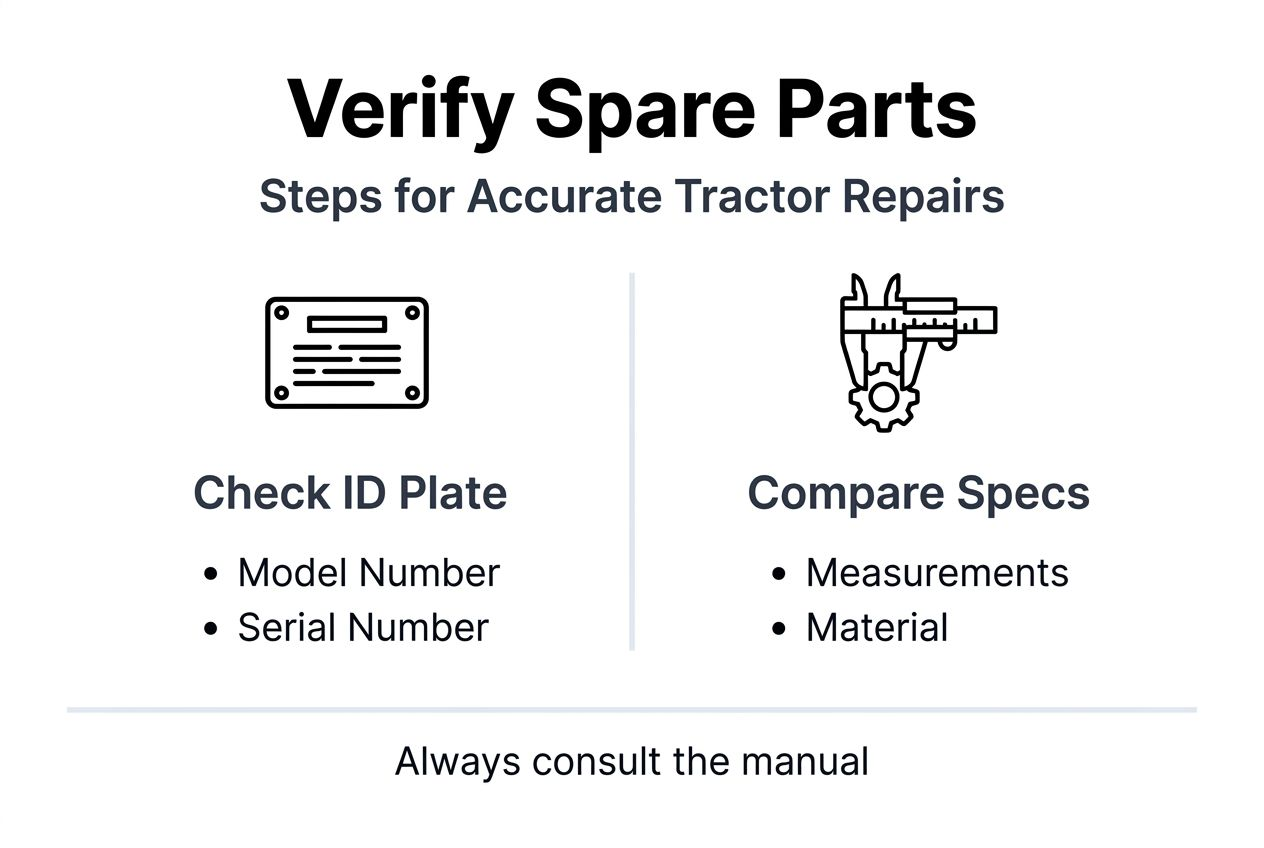
Cross-check the catalog part number against your service manual’s specifications section, which lists required dimensions, materials, and performance ratings for each component. Verify physical measurements including length, diameter, thread pitch, and mounting hole spacing. Confirm material compatibility, especially for hydraulic seals, gaskets, and fuel system components where chemical resistance matters. Review torque specifications and installation procedures to ensure the part installs safely without requiring modifications.
Safety warnings require verifying parts against manuals to avoid mechanical failures that can cause injury or machine damage. Never assume a part fits based on catalog listings alone. Some catalogs show universal parts that require adaptation or additional components for specific models. Check for notes indicating whether fasteners, gaskets, or seals are included with the part or must be ordered separately.
Use manufacturer notes and dealer expertise to validate compatibility when specifications seem unclear. Ordering a slightly wrong bearing size or seal material leads to premature failure and repeat repairs. Consult parts compatibility verification resources to understand common compatibility issues and how to prevent them.
Pro Tip: For critical components like bearings, seals, and hydraulic parts, order from authorized distributors who guarantee genuine OEM specifications rather than aftermarket alternatives that may not meet exact tolerances.
Step 5: seek expert consultation
Even with careful catalog work and specification checks, consulting a certified dealer or experienced mechanic adds a final layer of accuracy. Experts catch identification errors that cost you time and money.
Contact local certified dealers or authorized distributors like Pexlivanidis for consultation on complex or uncertain part selections. Use inquiry forms on supplier websites to submit your model number, serial number, and part details for expert review. Many dealers respond within hours with confirmation or alternative suggestions based on current part availability. Professional validators have deep experience with common misidentification patterns and can spot potential errors before you order.
Experts achieve up to 40% better correct identification rates than untrained buyers, particularly for hydraulic components, electrical parts, and transmission assemblies where variations are subtle. Keep records of expert recommendations including the advisor’s name, date, and specific part numbers confirmed for your order reference. Consultation becomes especially critical for expensive components where ordering mistakes cost hundreds of euros and weeks of delay.
Refer to the ordering tractor parts guide for step-by-step advice on working with dealers and submitting accurate part inquiries that get fast, helpful responses.
Common mistakes and their consequences
Understanding frequent identification errors helps you avoid costly pitfalls that delay repairs and waste resources. Awareness of these mistakes reinforces why each verification step matters.
Relying only on visual similarity causes about 30% of ordering errors, as parts with identical appearances often have different internal specifications or mounting dimensions. Failing to verify model and serial number leads to widespread incompatibility issues when parts arrive designed for different tractor variants. Skipping expert consultation commonly results in incorrect orders, especially for complex assemblies where catalog photos don’t reveal internal differences. Using outdated or unofficial catalogs increases the risk of ordering discontinued parts or wrong supersession replacements.
These errors typically cause two to three week delays while you return wrong parts, reorder correct ones, and wait for new delivery. For Greek farmers during planting or harvest seasons, such downtime directly impacts productivity and income. Additional consequences include paying return shipping, restocking fees, and repeat labor charges when mechanics must revisit the repair. Review buying tractor parts tips to learn how to avoid these common traps and order confidently the first time.
Expected results and outcomes
Following the systematic identification process described in this guide produces measurable improvements in ordering accuracy and repair timelines. Setting realistic expectations helps you plan maintenance schedules and budget appropriately.
Correct identification reduces delays from weeks to days, allowing you to complete repairs within narrow operational windows. Local Greek suppliers typically deliver parts within three to seven days when orders are accurate, compared to two to three weeks for wrong parts that require returns and reorders. Proper parts decrease mechanical failure risk by up to 70% by ensuring components meet exact manufacturer specifications and tolerances.
Efficient maintenance improves tractor uptime, directly boosting farm productivity during critical seasons. Over time, adopting a systematic identification approach saves thousands of euros in avoided shipping costs, restocking fees, and emergency repair surcharges. Your mechanics spend less time troubleshooting compatibility issues and more time completing quality repairs that last.
| Outcome | Without Process | With Process |
|---|---|---|
| Ordering accuracy | 70% first-time correct | 95%+ first-time correct |
| Average delivery time | 14-21 days (including returns) | 3-7 days |
| Mechanical failure rate | 30% within 6 months | Under 10% within 6 months |
| Time spent per identification | 3-5 hours (trial and error) | 1-2 hours (systematic) |
Check expected outcomes of compatibility for detailed case studies showing how correct identification impacts long-term maintenance costs and equipment reliability.
Reliable tractor spare parts and expert support at Pexlivanidis
Pexlivanidis offers a comprehensive selection of genuine tractor spare parts backed by knowledgeable staff who understand Greek farmers’ operational needs. Their expert team assists with part identification, verifies compatibility, and provides fast local delivery to minimize machinery downtime. With over 20,000 items in stock and free shipping within Greece for orders exceeding 100€, you get the parts you need quickly and affordably. Explore detailed guides on agricultural machinery parts explained and the agricultural machinery maintenance guide to optimize your maintenance practices. Partner with Pexlivanidis for reliable support and access their maintenance tips guide to keep your equipment running efficiently throughout the season.
Frequently asked questions
How can I quickly find the tractor model and serial number?
Check the chassis or engine plate, usually located near the front axle or operator’s platform. Look for a stamped metal plate or sticker displaying both model designation and serial number. If the plate is illegible, consult your service manual’s opening pages or contact your dealer with purchase records.
What if I can’t find a parts catalog for my tractor model?
Contact the tractor manufacturer or an authorized dealer directly for catalog access, as they maintain archives for older models. Check online forums or specialized digital databases that aggregate parts information across brands. Use expert consultation services at suppliers like Pexlivanidis to help identify and source parts without needing a catalog.
Are all tractor spare parts universal?
No, most spare parts are brand and model specific with variations even within the same model family. Always match parts using your tractor’s exact model and serial number to ensure compatibility. Universal parts exist for some commodities like fasteners, but critical components require precise specification matching.
How long does it take to receive spare parts after ordering?
Local Greek suppliers typically deliver within three to seven days for in-stock items when orders are accurate. Timelines depend on part availability, order accuracy, and your location relative to the supplier’s distribution center. Expedited shipping options may be available for urgent repairs during peak seasons.