

TL;DR:
- Most farmers mistakenly believe Perkins 2-cylinder diesel engines are rare or obsolete units.
- In reality, these engines serve a specific niche in small agricultural and industrial machinery where precise knowledge of their specs and maintenance is crucial for minimizing downtime.
Most farmers who search for a Perkins 2 cylinder diesel engine assume they are looking for a rare or obsolete unit. The reality is more specific: these engines occupy a precise niche in small agricultural and industrial machinery, and understanding that niche is what separates a fast repair from a weeks-long parts hunt. The Perkins 402D-05 is the primary model you will encounter, and knowing its exact specs, serial number structure, and correct maintenance intervals will directly affect how long your machine stays in the field instead of sitting idle in a workshop.
Table of Contents
- Understanding Perkins 2 cylinder diesel engines
- Key maintenance practices for Perkins 2 cylinder engines
- Diagnosing and troubleshooting common Perkins 2 cylinder engine issues
- How Perkins 2 cylinder engines compare to other Perkins engine types for farm use
- Practical tips for sourcing parts and documentation for Perkins 2 cylinder engines
- Why relying solely on model names risks costly maintenance errors
- Find quality agricultural machinery parts and maintenance tips at Pexlivanidis
- Frequently asked questions
Key Takeaways
| Point | Details |
|---|---|
| Know your engine | Understanding the Perkins 2-cylinder engine specifications is essential for proper use and maintenance. |
| Use serial numbers | Always rely on engine serial numbers to identify parts and service requirements accurately. |
| Regular maintenance matters | Scheduled checks and timely servicing prevent common issues and extend engine life. |
| Verify parts compatibility | Avoid costly downtime by confirming parts match the exact engine model and configuration. |
| Trusted resources help | Use recognized platforms and suppliers like Pexlivanidis for genuine parts and expert advice. |
Understanding Perkins 2 cylinder diesel engines
To make effective use of these engines, farmers must first understand their key specifications and unique characteristics. The Perkins 2 cylinder diesel engine is not a stripped-down compromise. It is a purpose-built unit for compact, low-power applications where a larger 4-cylinder engine would be physically and economically impractical.
The Perkins 402D-05 is a 2-cylinder direct-injection diesel engine producing 13.7 bhp at a displacement of 507cc. That places it firmly in the light-duty category, but do not let the numbers mislead you. For small tillers, compact utility machines, and light transport equipment common in Greek agriculture, this output range is exactly right.
Key Perkins diesel engine specs for the 402D-05 include:
- Cylinders: 2, inline configuration
- Displacement: 507cc (0.507 liters)
- Power output: 13.7 bhp
- Injection type: Direct injection
- Cooling: Liquid cooled
- Bore and stroke: Designed for high torque relative to displacement
- Emissions compliance: Tier 4 Final / Stage IIIA certified for the D-series
What makes this engine distinct from the more common Perkins 4-cylinder units found in larger tractors is its physical footprint. The 402D-05 weighs significantly less and takes up far less space under a hood, making it ideal for compact diesel engines used in orchard equipment and small cultivators in areas like the Peloponnese or Central Macedonia where row spacing is tight.
Key maintenance practices for Perkins 2 cylinder engines
Understanding your engine lets you apply the right maintenance routines to keep it running reliably. Perkins engine maintenance tips for 2-cylinder models follow the same logic as larger units, but the smaller displacement means there is less room for tolerance. One neglected oil change or a partially blocked fuel filter has a more immediate impact on a 507cc engine than on a 2-liter unit.
Follow these numbered steps as your baseline maintenance program:
- Check engine oil level before every use. The 402D-05 holds a small oil volume, so contamination or low level affects lubrication faster than in larger engines.
- Replace the oil and filter every 250 hours or annually, whichever comes first. In hot Greek summers, err toward the shorter interval.
- Inspect the air filter every 50 hours. Dusty harvesting conditions accelerate filter clogging dramatically.
- Clean or replace fuel filters at 500-hour intervals, or sooner if you notice power loss or rough idle.
- Check coolant concentration twice yearly before summer heat and before winter cold. A 50/50 mix of antifreeze and water is standard.
- Inspect injectors annually. Dirty or worn injectors are the single most common cause of hard starts and black smoke on these engines.
- Verify belt tension and condition every 250 hours. A snapped fan belt on a compact engine can cause overheating within minutes.
One of the most underrated steps in Perkins engine maintenance is matching parts to the exact engine build. Maintenance success depends heavily on matching the exact build and configuration by engine serial number, not just model name. Two 402D-05 units built for different OEM customers can have different injector specifications, air cleaner configurations, or governor settings.
Building routine checks for farm machinery into your seasonal schedule protects you from the compounding failures that happen when small issues go unnoticed. A well-maintained agricultural machinery program includes pre-season inspection, mid-season checks, and a full post-season review before storage.
Pro Tip: Before ordering any part for your Perkins 2-cylinder engine, locate the engine nameplate and write down the full model designation AND the serial number. The serial number encodes the build date, assembly plant, and configuration variant. Without it, even experienced parts suppliers can send you a component that fits physically but performs incorrectly.
Diagnosing and troubleshooting common Perkins 2 cylinder engine issues
Armed with maintenance knowledge, you can now detect and fix issues before they escalate into field stoppages. Compact diesel engines like the 402D-05 give clear warning signs if you know what to look for.
Watch for these common symptoms:
- Hard starting in cold conditions: Usually points to low compression, worn glow plugs, or degraded fuel quality. Greek winter temperatures in northern regions like Florina or Kastoria can drop enough to cause genuine cold-start issues on poorly maintained units.
- Loss of power under load: Most often caused by a partially blocked fuel filter, air filter restriction, or worn injector tip. This is the most frequent complaint on high-hour engines used in continuous tillage work.
- Excessive black smoke: Signals over-fueling, typically from a stuck injector or incorrect injection timing.
- White smoke on startup that clears quickly: Normal in cold weather. White smoke that persists suggests a coolant leak into the combustion chamber, which on a 2-cylinder engine is a serious issue requiring immediate attention.
- Unusual knocking noises: In a 2-cylinder, any knock is amplified relative to a 4-cylinder. Low oil pressure, worn rod bearings, or injector rattle all produce distinct sounds. Learning the difference saves diagnostic time.
A critical but often ignored step is confirming your cylinder count and engine designation before ordering any components. Cylinder count assumptions based on marketing text are unreliable; always verify the engine designation or physical configuration before ordering parts. A machine sold as a “two-cylinder unit” may have been upgraded or replaced with a different engine at some point in its working life.
Use the troubleshooting agricultural equipment process as a framework: start with fuel delivery, move to air supply, then compression, then injection timing. This sequence eliminates the most common problems first.
Pro Tip: Take a photo of the engine nameplate the moment you purchase a machine. Store it in your phone. When something breaks at 7am during harvest, you will not need to crawl under the hood to find a serial number before calling your parts supplier.
How Perkins 2 cylinder engines compare to other Perkins engine types for farm use
Comparing engine types clarifies where the Perkins 2-cylinder stands out and where alternatives may suit better. Perkins offers engines ranging from inline-2 to V8 configurations, each targeting different power bands and machine types.
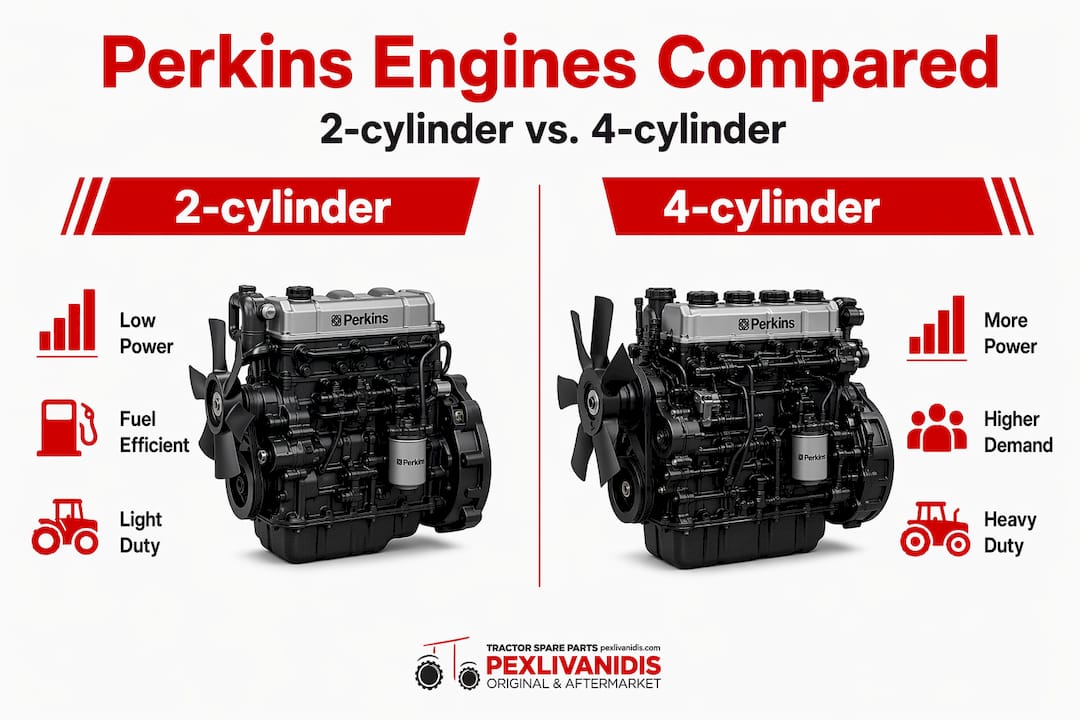
| Feature | 2-cylinder (402D-05) | 4-cylinder (e.g. 404D-22) | 6-cylinder (e.g. 1106D) |
|---|---|---|---|
| Power output | ~13.7 bhp | ~35 to 75 bhp | ~130 to 250+ bhp |
| Displacement | 507cc | ~2.2 liters | ~6.6 liters |
| Typical application | Small tillers, compact utility | Medium tractors, loaders | Large tractors, combines |
| Weight | Very light | Moderate | Heavy |
| Fuel consumption | Very low | Moderate | High |
| Parts availability | Specialized | Wide | Wide |
| Best for Greek farms | Orchards, small plots | General field work | Large-scale cereal farming |
The Perkins engine fuel efficiency advantage on the 2-cylinder is real and measurable. Running costs for small orchard machines powered by a 402D-05 are substantially lower than running a 4-cylinder unit at partial load all day. The smaller engine operates closer to its optimal load range, which improves combustion efficiency.
Where the 2-cylinder falls short is in raw pulling power. If you are plowing clay soil in Thessaly or running a large rotary cultivator, a 2-cylinder will struggle. The engine is not designed for sustained heavy draft work. The right choice depends on matching the engine to the task, not chasing horsepower.
For anyone making a purchase decision or planning a replacement engine, reviewing tractor maintenance tips specific to your machine type will clarify operating limits and service intervals based on engine category.
Practical tips for sourcing parts and documentation for Perkins 2 cylinder engines
Knowing how to navigate parts sourcing efficiently lets you maintain your engine with minimal downtime. The Perkins 2-cylinder is not stocked as widely as 4-cylinder units, which makes getting your identification right the first time even more important.
Here is what every farmer should know before contacting a supplier:
- Read the nameplate first. The engine plate shows the model designation (e.g. 402D-05), the serial number, and sometimes the build specification code. Each piece of information unlocks a different layer of parts data.
- Never rely on the machine model alone. A manufacturer may have used different engine configurations across production years of the same machine. Your neighbor’s identical-looking tiller may have a different engine variant inside.
- Use Perkins SPI2 as the authoritative reference. Perkins SPI2 is the official service and parts information platform. It organizes all parts data by serial number and model, making it the most accurate starting point for any order.
- Be cautious with unofficial SPI2 database copies. Third-party tools exist that claim to replicate SPI2 data, but they can be outdated or incomplete. For a less common unit like the 402D-05, outdated data leads to wrong part numbers.
- Confirm part compatibility before payment. Any reputable supplier will cross-reference your serial number against their inventory. If they skip this step, consider it a red flag.
Fastest parts sourcing uses the exact model and serial number because engine variants and build differences make generic searches unreliable. This is especially true for Perkins 2-cylinder units, where production volumes are lower and component variation between builds is proportionally higher.
Bookmark the Perkins engine parts list tips guide as a reference when preparing any order. It walks through the identification process in detail and reduces the back-and-forth that adds days to a repair.
Why relying solely on model names risks costly maintenance errors
Here is an uncomfortable truth that most parts catalogs and even many technicians will not tell you directly: the model name on the side of your engine is not enough information to get the right part. It never was.
This is not a Perkins-specific problem. It is a systemic issue across all engine manufacturers. But it hits harder with low-volume units like the Perkins 2-cylinder because there is less margin for error in the supply chain. When a 4-cylinder Perkins gets the wrong injector, a supplier can often overnight the correct one from regional stock. When a 402D-05 gets the wrong part, the correct item may need to come from a specialized importer with a multi-day lead time.
Farmers in Greece who operate on seasonal schedules feel this acutely. A three-day wait for a replacement part during olive harvest or grape pressing season is not an inconvenience. It is a financial loss with a real number attached to it.
The solution is simple but requires discipline: treat the serial number as the primary identifier, not a backup. Matching exact build configuration by serial number is the single habit that most reliably separates fast repairs from extended downtime. Print the serial number. Photograph it. Keep it with your machine logbook.
The farmers we see resolving issues fastest are not necessarily the ones with the most technical knowledge. They are the ones who arrive at a conversation with a supplier already holding complete, accurate engine identification. That one habit shortens every repair cycle. Use the Perkins engine parts guide as your template for building that documentation habit before something breaks.
Find quality agricultural machinery parts and maintenance tips at Pexlivanidis
At Pexlivanidis, we stock a wide selection of Perkins-compatible parts and maintain detailed resources built specifically for farmers and operators across Greece. Whether you are sourcing a replacement injector for a 402D-05 or looking for guidance on agricultural machinery parts, our catalog covers the components you actually need, not just the popular models. With over 20,000 items available and free shipping within Greece on orders above 100€, you get the right part without the wait. Our agricultural machinery maintenance guide and maintenance tips resource go deeper than basic service schedules, giving you practical procedures tailored to the machinery and conditions common in Greek agriculture.
Frequently asked questions
What is the Perkins 402D-05 engine?
The Perkins 402D-05 is a 2-cylinder direct-injection diesel engine producing 13.7 bhp, designed for compact industrial and agricultural machinery where low weight and fuel efficiency are priorities.
How important is the engine serial number for maintenance?
Extremely important. Matching exact build configuration by serial number ensures you receive the correct parts and avoids costly delays caused by variant differences between production builds.
Can I use parts from different Perkins engine models on a 2-cylinder engine?
No. Parts vary between builds even within the same model family, so verifying compatibility using the exact engine designation and serial number is essential before placing any order.
Where can I find reliable maintenance guides for Perkins 2-cylinder engines?
Reliable guidance is available through the official Perkins SPI2 platform and through specialized agricultural machinery resources like those published by Pexlivanidis, which are tailored to the needs of Greek operators.