

TL;DR:
- A gearbox failure during harvest can incur significant delays and costly repairs, making prompt troubleshooting essential. Understanding common symptoms, preparing proper tools, and following a systematic diagnostic process help identify issues quickly and accurately. Regular maintenance, including timely oil changes and correct lubricant use, is vital to prevent costly breakdowns and ensure optimal tractor performance.
A gearbox failure in the middle of harvest season is not just inconvenient — it can cost you days of work and thousands of euros in emergency repairs. Tractor gearbox troubleshooting is a skill every serious farmer in Greece should have, whether you run a small family operation in Kavala or manage a large-scale farm in Thessaly. The difference between a minor fix and a full rebuild often comes down to how quickly and accurately you identify the problem. This guide walks you through everything from reading the early warning signs to executing a complete diagnostic process.
Table of Contents
- Understanding tractor gearbox basics and common problems
- Preparing to troubleshoot: tools, safety, and preliminary checks
- Step-by-step gearbox troubleshooting process
- Common gearbox issues and how to fix them
- Preventative maintenance to keep your tractor gearbox running smoothly
- The maintenance trap most farmers fall into
- Get the right parts for your tractor gearbox repair
- Frequently asked questions
Key Takeaways
| Point | Details |
|---|---|
| Gearbox function clarity | Understanding how a tractor gearbox works helps diagnose and fix problems correctly. |
| Preparation is key | Proper tools, safety, and checks save time and prevent accidents during troubleshooting. |
| Systematic troubleshooting | Following a step-by-step approach separates mechanical failures from control issues for accurate repair. |
| Fix common issues quickly | Addressing leaks, gear damage, and shifting problems early prevents costly damage. |
| Regular maintenance | Consistent oil changes and inspections extend gearbox life and maintain tractor performance. |
Understanding tractor gearbox basics and common problems
Before you can troubleshoot anything, you need to know what the gearbox actually does. The gearbox transmits engine power to the rear wheels and the PTO (power take-off) shaft, which drives attached implements like tillers, balers, and sprayers. Think of it as the translator between your engine’s high-speed rotation and the slower, higher-torque movement your wheels and tools actually need. Without it working correctly, your engine’s power is essentially useless.
Understanding gearbox function in tractors helps you recognize when something is off before it becomes catastrophic. The most dangerous gearbox problems are the ones that start small and quiet. A slight whine at a specific speed, a momentary hesitation when shifting into third gear — these are the gearbox sending you a message.
Symptoms like hard shifting, strange noises, and leaks often indicate developing gearbox issues well before any complete failure. Here are the most common signs to watch for:
- Unusual noises: Whining, grinding, or clunking sounds at specific speeds or during gear changes
- Hard or stuck shifting: Difficulty moving the gear lever, or gears that pop out under load
- Oil leaks: Puddles or seepage around the gearbox housing, rear axle area, or PTO cover
- Power loss: The tractor pulls weakly, especially under load, even though the engine sounds fine
- Vibration: Noticeable shaking through the drivetrain during operation, not present at idle
- Burning smell: Overheated gear oil from low fluid levels or contaminated lubrication
Accurate identification of which symptom you are dealing with avoids the expensive trap of replacing parts that are not actually broken. A grinding noise during gear changes, for example, points to a very different cause than a whine that only appears under full load.
Preparing to troubleshoot: tools, safety, and preliminary checks
Jumping straight into a gearbox inspection without preparation is how small problems get made larger. Before any hands-on work, gather what you actually need.
Essential tools and equipment:
- Combination wrenches and socket sets (metric and imperial)
- Flathead and Phillips screwdrivers
- Torque wrench for reseating fasteners to spec
- Drain pan and funnel for oil checks
- Flashlight or inspection lamp
- Disposable gloves and safety glasses
- Service manual for your specific tractor model
| Preliminary check | What to look for | Action if abnormal |
|---|---|---|
| Oil level | Low or overfilled dipstick reading | Top up or drain to correct level |
| Oil condition | Dark, milky, or metallic particles | Full oil change, investigate contamination |
| Visible leaks | Seepage at housing, seals, or drain plug | Mark and document source for further inspection |
| Gear lever movement | Stiffness, wobble, or loose play | Check linkage adjustment before opening gearbox |
| PTO engagement | Slipping, jerking, or failure to engage | Note behavior pattern for diagnostic phase |
Safety is not optional. Park the tractor on flat, solid ground, engage the parking brake, and remove the key before touching anything underneath or around the drivetrain. Never crawl under a tractor supported only by a floor jack.
Pro Tip: Before changing any fluids or opening any covers, take a photo of the current oil color on a white rag. That simple visual reference can tell you a lot about contamination history, and it gives your mechanic crucial context if you end up needing outside help.
Good maintenance practices for tractors include keeping a simple logbook with oil check dates and condition notes. Over time, that log becomes your best diagnostic tool.
Step-by-step gearbox troubleshooting process
Once you are prepared and your initial checks are done, work through the diagnostic process in order. Skipping steps wastes time and leads to misdiagnosis.
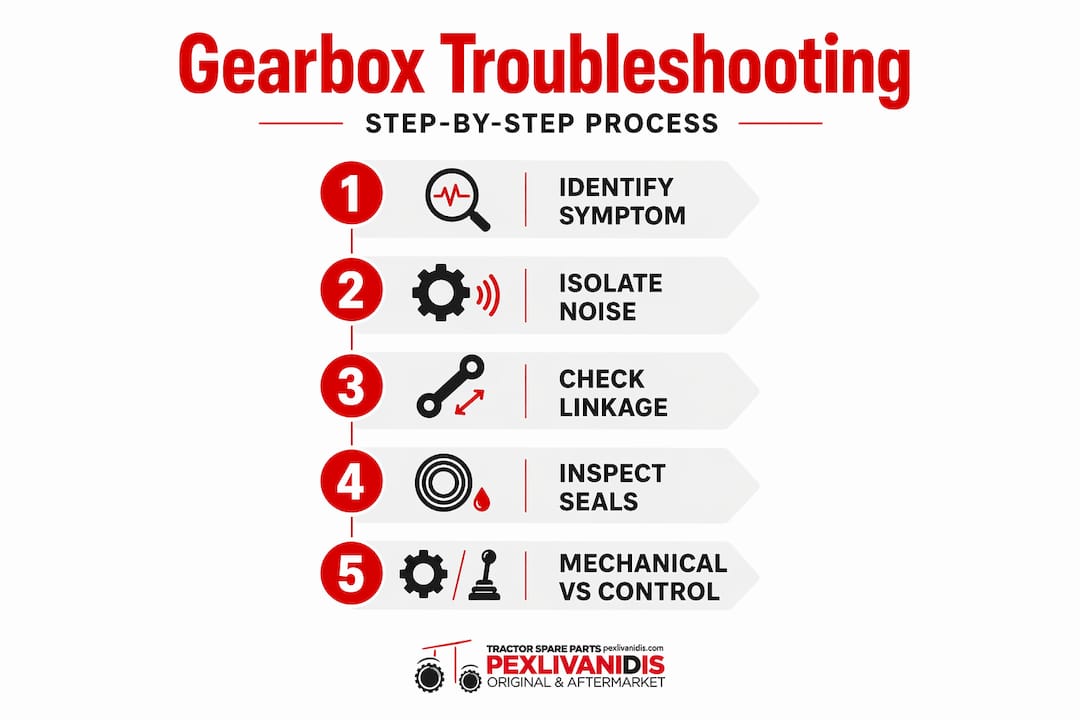
Step 1: Reproduce the symptom under controlled conditions
Start the tractor and move through the full gear range in a safe open area. Note exactly which gear, speed, or load condition triggers the problem. “It makes noise” is not a diagnosis. “It grinds going into 4th gear under load on a slope” is.
Step 2: Isolate noise origin
With the tractor idling and stationary, engage and disengage the clutch slowly. If noise appears during clutch engagement before the gearbox is under load, the clutch or input shaft bearing is the more likely culprit, not the gears themselves.
Step 3: Inspect the shift linkage
Before assuming internal gear damage, check the external shifting linkage. Worn bushings, bent rods, or loose pivot points cause hard shifting and gear slippage without any internal damage at all. This is one of the most commonly overlooked steps in tractor transmission troubleshooting.
Step 4: Check seals and inspect for leaks under load
Some seals only leak when the oil is warm and under pressure. Run the tractor for 15 minutes, then inspect the gearbox area carefully. Fresh wet spots you did not see in the cold inspection confirm a heat-activated seal failure.
Step 5: Distinguish mechanical damage from control issues
This is critical. Separating driveline mechanical problems from engagement/control problems prevents unnecessary part replacements that cost money without solving the actual fault.
Pro Tip: A cheap stethoscope tool (available at any auto parts supplier) pressed against the gearbox casing at different points lets you pinpoint whether bearing noise is coming from the input shaft, layshaft, or output shaft area — without removing a single cover.
Comparison of symptom causes by type:
| Symptom | Likely mechanical cause | Likely control/adjustment cause |
|---|---|---|
| Grinding on engagement | Worn synchronizers or gears | Clutch not fully disengaging |
| Gear jumping out | Broken detent spring or worn dogs | Misadjusted shift linkage |
| PTO not engaging | Damaged PTO shaft or gear | Faulty engagement lever or cable |
| Whine under load | Worn bearings or gear mesh | Incorrect oil viscosity |
| Oil leak at PTO | Worn PTO seal | Overtightened or loose housing bolts |
Knowing how to keep your tractor in perfect condition long-term starts with developing this kind of systematic diagnostic thinking, not just reacting to whatever fails next.
Common gearbox issues and how to fix them
Most gearbox issues in tractors fall into three categories: leaks, gear or bearing damage, and shifting problems. Each has a specific resolution path.
Fixing leaks:
Leaks often come from improper torque, gasket installation, or worn seals, and shock loads can cause cracked cases and gear damage that makes leaks worse over time. Start by re-torquing all housing bolts to the manufacturer’s specification before assuming you need a new gasket. If re-torquing stops the leak, you saved yourself a full disassembly. If the leak persists, replace the specific seal or gasket at the leak source. Applying sealant as a substitute for a proper gasket is a short-term fix that almost always fails again within one season.
Addressing gear and bearing damage:
Worn or chipped gears need prompt replacement. Leaving damaged gears in service spreads metal particles through the oil, which then accelerates wear on every other moving surface inside the gearbox. This is the chain reaction that turns a 200-euro gear replacement into a full rebuild costing 10 times more.
Correcting shifting problems:
Before concluding you have internal damage, adjust the shift linkage. Most tractors have adjustment points on the gear selector rod where you can correct play and misalignment without opening the gearbox at all. If internal damage is confirmed, replace synchronizer rings and worn shift forks as a set, not individually.
- Replace seals in pairs or full sets for that gearbox area, not just the one that is visibly leaking
- Always flush the gearbox with clean oil after any internal repair before filling with fresh fluid
- Use only the oil grade and viscosity specified in your service manual
Pro Tip: When replacing a gearbox seal on an older tractor, measure the shaft diameter for wear before installing the new seal. A worn shaft running against a new seal will simply tear through it again within weeks. A repair sleeve (speedi-sleeve) solves this without shaft replacement.
Regular attention to tractor maintenance practices prevents most of these failures from developing in the first place.
Preventative maintenance to keep your tractor gearbox running smoothly
The best version of tractor gearbox troubleshooting is the kind you never have to do because you prevented the problem. Most Greek farmers run their tractors hard through spring plowing and fall harvest, then let them sit. That seasonal pattern is actually harder on gearboxes than year-round moderate use.
Core maintenance routine:
- Check gearbox oil level every 50 hours of operation or at the start of each major work season
- Change gearbox oil every 250 to 500 hours, following your manufacturer’s specification
- Use the correct API GL-4 or GL-5 lubricants for your gearbox type — GL-5 is not always a better choice and can actually damage bronze synchronizers found in older European tractors
- Inspect all external seals and breather vents every season for cracking, swelling, or blockage
- Check and lubricate PTO engagement forks and linkage pivots annually
- Inspect gearbox mounting bolts and housing for cracks, especially after any heavy impact or over-the-ditch work
Signs that your maintenance interval needs shortening:
- Oil turns dark or shows particles before the scheduled change interval
- You work in particularly dusty or wet conditions, which accelerates seal wear
- The tractor is over 15 years old — older seals harden faster and need more frequent checks
- You recently repaired an implement collision or sudden PTO engagement under load
Following a solid preventative maintenance plan for your tractor is what separates farmers who occasionally deal with a seal replacement from those who face full gearbox rebuilds mid-season. If you want to go further, there are also specific practices that help maximize tractor performance across all drivetrain components, not just the gearbox.
The maintenance trap most farmers fall into
Here is something worth saying plainly, because most articles in this space gloss over it: most gearbox repairs in Greece are not caused by bad luck or worn-out machines. They are caused by ignoring the oil. Specifically, by running gearbox oil well past its service life because the tractor “seems fine.”
Gear oil degrades in ways you cannot see until the damage is done. The additives that protect metal surfaces break down with heat cycling. Water contamination from condensation in seasonal machines is almost invisible until the oil turns milky. Farmers who work hard-use tractors without tracking oil hours are not being careless — they are just busy. But that habit accounts for the majority of preventable gearbox failures we see in agricultural machinery.
The uncomfortable truth about common gearbox problems is that they are mostly a maintenance debt that gets collected at the worst possible moment. The gearbox does not break during the slow season when repairs are cheap and convenient. It breaks during plowing or harvest, when every day off the field costs real money.
There is also a false economy at play with gearbox oils. Farmers sometimes substitute transmission fluid or automotive gear oil because it is cheaper or more available locally. This is a mistake that can destroy bronze synchronizers within a season. The correct oil for your specific gearbox costs a fraction of what a single repair costs.
Get the right parts for your tractor gearbox repair
When your diagnosis is done and you know exactly what needs replacing, finding the right parts quickly matters. At Pexlivanidis, we stock over 20,000 agricultural machinery parts, including gearbox seals, bearings, shift forks, PTO components, and lubricants for a wide range of tractor makes and models common across Greece. We offer free shipping throughout Greece for orders over 100€, and our team in Thessaloniki is available to help you confirm the right part for your specific machine before you order. Whether you need a single seal or a full set of gearbox internals, you will find it here without the wait.
Frequently asked questions
What are the first signs that my tractor gearbox needs troubleshooting?
Common early signs include unusual noises, difficulty shifting, oil leaks around the housing, and noticeable loss of pulling power under load. Catching these symptoms early almost always means a cheaper and faster repair.
Can a PTO problem be mistaken for a gearbox issue?
Yes. Since the PTO and gearbox share driveline components, separating mechanical driveline faults from control/engagement issues is the key first step to avoid replacing the wrong parts and spending money unnecessarily.
How often should I change my tractor gearbox oil?
Follow your manufacturer’s guidelines, but as a general rule, change gear oil every 250 to 500 hours using the correct API-rated lubricant specified for your gearbox — GL-4 or GL-5 depending on your model.
What are common causes of PTO system leaks affecting the gearbox?
PTO leakage most commonly comes from improper fastener torque, incorrectly installed gaskets, and worn or hardened seals, all of which allow oil to escape under operating pressure.
Can incorrect installation cause repeated tractor gearbox failures?
Absolutely. Repeated premature PTO or gearbox failure is a strong indicator of misapplication or improper installation, usually identifiable through abnormal noise patterns and accelerated wear in specific components.